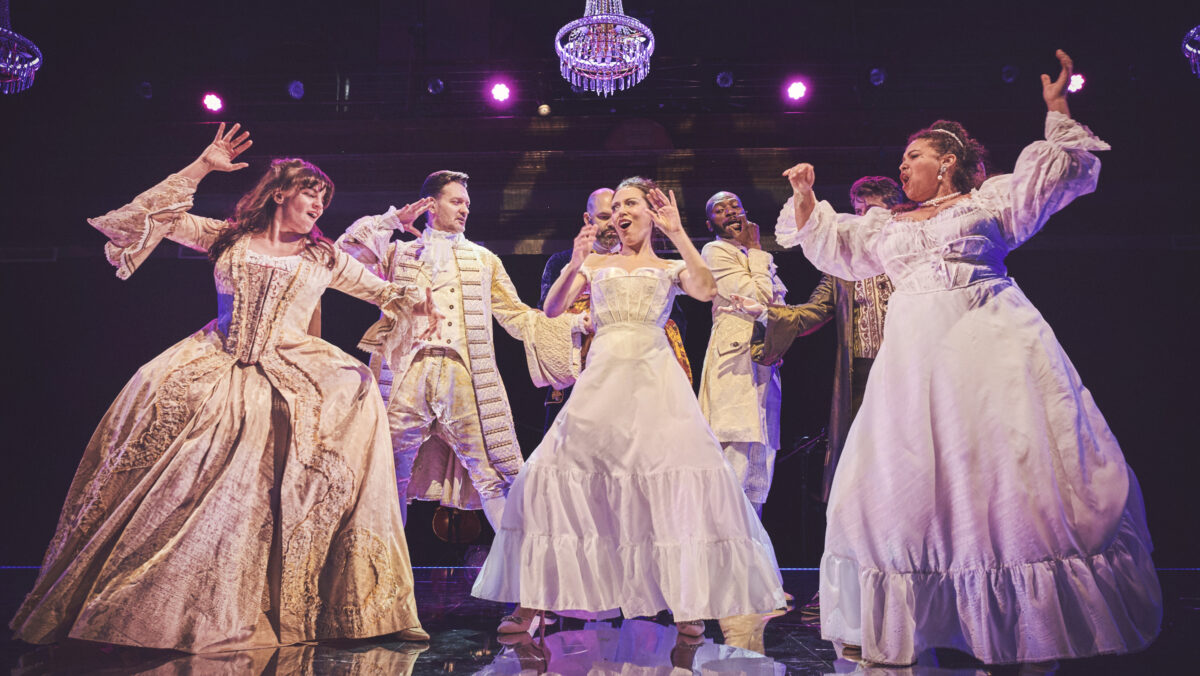
The company of Heartbeat Opera’s Manon! (Photo by Andrew Boyle).
New York City has lacked anything resembling a Volksoper since the shuttering of New York City Opera. Many European cities have a company that performs in the native language of the audience – English National Opera is one prominent example. Though I am not in general a proponent of performing opera in translation, done well it can bring the opera closer to the audience and remove comprehension and engagement barriers. As we know, there are many people who do not like reading subtitles for films (or surtitles in the opera) and don’t mind if they are dubbed. Cinephiles (and operaphiles) may demur, but that’s the facts, folks.
Heartbeat Opera’s chamber version of Massenet’s Manon, performed in English as MANON!, revealed a best-case scenario. The English translation by artistic director Jacob Ashworth and stage director Rory Pelsue was loose and colloquial, sometimes rhyming, sometimes not, and sat well enough on the vocal line with few glaring clunkers. The orchestral reduction for eight players, arranged and led by music director Dan Schlosberg from the piano, kept all the musical layers and did not overwhelm the singers or the room. The only flaw was some feedback from one of the mikes late in act one that disappeared by the middle of act two.
Manon is described as an opéra-comique which is a more intimate work with musical set pieces interspersed with spoken dialogue rather than recitatives. Comic opera and serious opera elements are combined. (Massenet did create an international version with orchestrally accompanied sung recitatives, but that only premiered in Saint-Etienne in 2009.) In large international theaters, spoken dialogue in French is a problem – with exceptions of the occasional francophone specialist with dramatic talent like Natalie Dessay or Benjamin Bernheim, most international opera singers butcher the language and the line readings. The Paris Opéra Comique was full of specialized singers who were native speakers trained in the skill of speaking and singing convincingly like American musical theater performers. Working in English, the Heartbeat Opera ensemble of seven singer-actors had no problem switching back and forth (many have bounced back and forth between opera and musical theater).
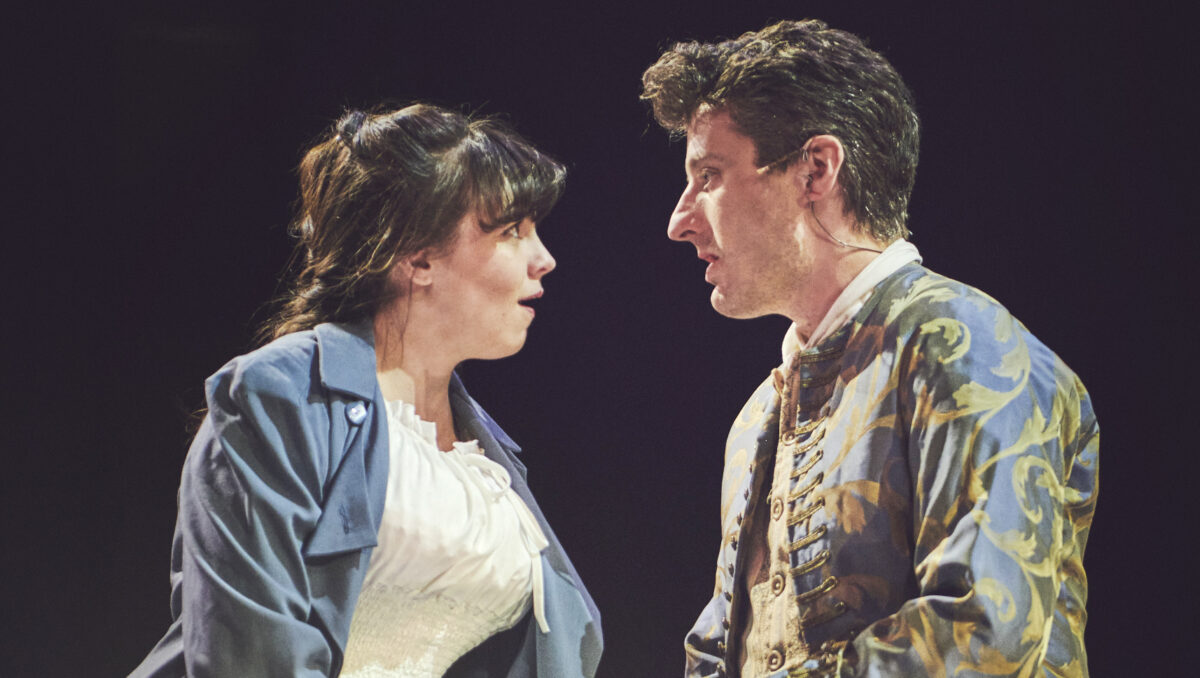
Emma Grimsley and Matt Dengler in Heartbeat Opera’s Manon! (Photo by Andrew Boyle).
Though the full version of Manon has large ensemble scenes with chorus and a ballet, the heart of the opera lies in the fraught emotional confrontations between the feckless Manon and her Chevalier des Grieux. At Heartbeat, the chorus and ballet were not missed as we concentrated on the central pair watching the rise and fall of their affair in 100 minutes with no intermission. Everything essential was there.
Here the roles of Manon’s protectors Guillot de Morfontaine and Monsieur de Brétigny were combined into one character of Guillot, an aging playboy type afraid of losing his edge, well performed by lyric tenor Glenn Seven Allen, a City Opera regular in a prior decade. Katie McCreary and Natalie Walker as Poussette and Javotte acted and sang with vivacity and sharp wit. Baritone Jamari Darling as Lescaut (who has done Broadway in Ain’t Too Proud: The Life and Times of the Temptations) has a dazzling smile and sparkling eyes, embodying a born hustler like his pretty cousin. Bass-baritone Justin Lee Miller sang the Comte des Grieux and various other supporting functionaries, officers and authority figures. He has a strong stage presence and resonant voice.
As the ill-fated central lovers, soprano Emma Grimsley and tenor Matt Dengler were convincingly very young, totally impressionable, deeply vulnerable and fatally lacking in self-awareness. In the intimate space of the Space at Irondale in Brooklyn, you felt like you were in the room with them, sharing their experiences in the moment and seeing the look in their eyes before they made one bad decision after another. Dengler totally projected love (or fatal obsession) at first sight when Des Grieux encounters the convent-bound Manon in act one.
Most of the singers were lightening their middle voices to gain clarity of diction and quicker speaking tone removing “operatic” resonance and vibrato overlay. Grimsley’s pointed soprano seemed slender but would surprise with dazzling brilliant and accurate coloratura, showing a complete operatic technique at her command. Dengler, when not under pressure, had a fluent tenor with an easy, almost crooned top. The big aria and duet in Saint-Sulpice in Act 3, scene 2 revealed limits to his stamina and vocal security with the tone breaking at exposed high passages. Like the entire cast, his emotional transparency and total engagement saved the day.
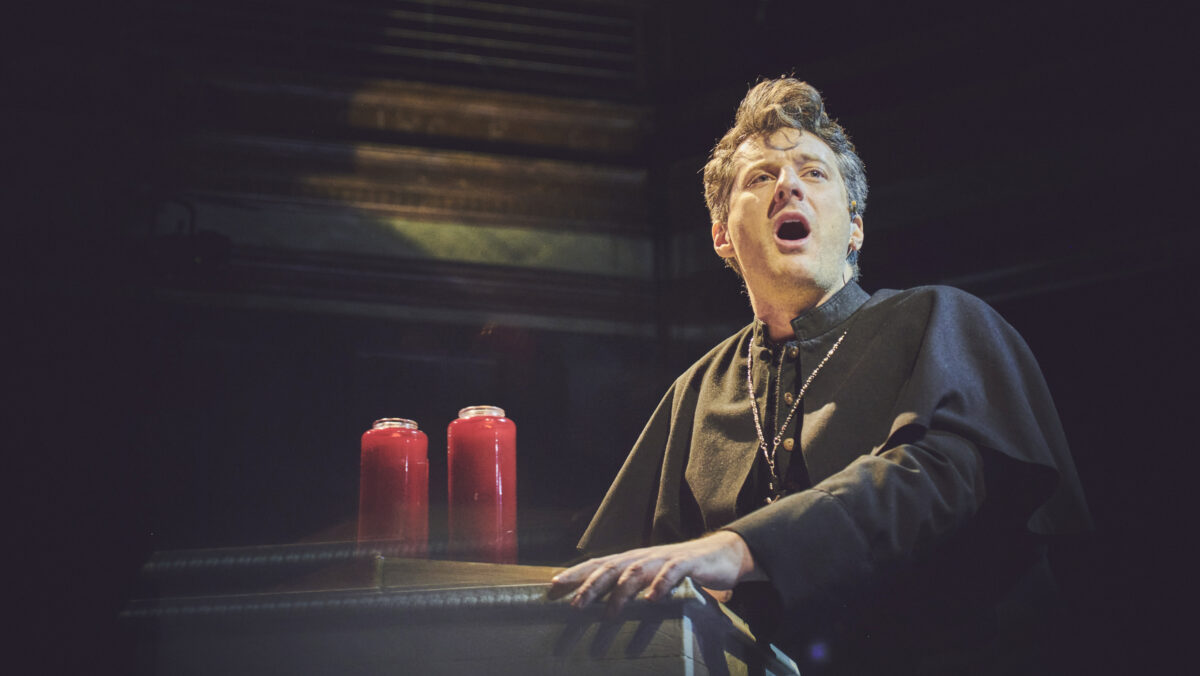
Matt Dengler in Heartbeat Opera’s Manon! (Photo by Andrew Boyle).
Grimsley was a free-spirited and liberated woman of a Manon, one who didn’t wish to be confined to marriage or conventional morality. She was not just motivated by pleasure or a desire for wealth and easy living. This was clearly Pelsue’s concept of the Abbé Prévost character as reflected in his adaptation of Gille and Meilhac’s original French libretto.
In Act Two, Manon playfully casts aside Des Grieux’s mention of impending marriage with the comment that their tiny flat has no room for a trousseau. In full courtesan mode at the Cours-la-Reine (here a private demimonde party), Manon states in the translation of “Je marche sur tous les chemins”:
“My friends, I am glad to be here. You gave me my perfect career: I am loved and I love my life. I have all of this and I am no one’s wife!”
The new lyrics to the Gavotte emphasize the ephemeral qualities of youth and pleasure with the constant presence of death foreshadowing her tragic fate:
“Let me sparkle brightly while I may. Youth will end before I catch my breath. Let me live life only for today for we know youth is not so far from death.”
Grimsley maintained a certain wide-eyed ingenue Sally Field honesty and a sense of wonder in the role – the simple country girl was always there and never hardened into a femme-fatale.
Pelsue’s direction used minimalism to increase emotional connection and dramatic propulsion aided by the reduced playing time with no intermission, the spare scenery and very intimate acting. The action all took place on one runway like platform. The stage was mostly bare except for the occasional chest (doubling as a table or bed) and crystal chandeliers above (designed by Alexander Woodward). The period was the 18th century but stripped down – the costumes (by David Mitsch) were mostly simple waistcoats for the men with the women in revealing shifts and corsets. Manon’s change from white dress to lacy corset showed the evolution of her character. The dominant color was white.
The success of this production has caused Heatbeat Opera to extend the run an extra week with performances going from February 3rd to February 8th and additional performances February 10th through February 15th. Tickets are available here but are selling out. If you can, go!


