
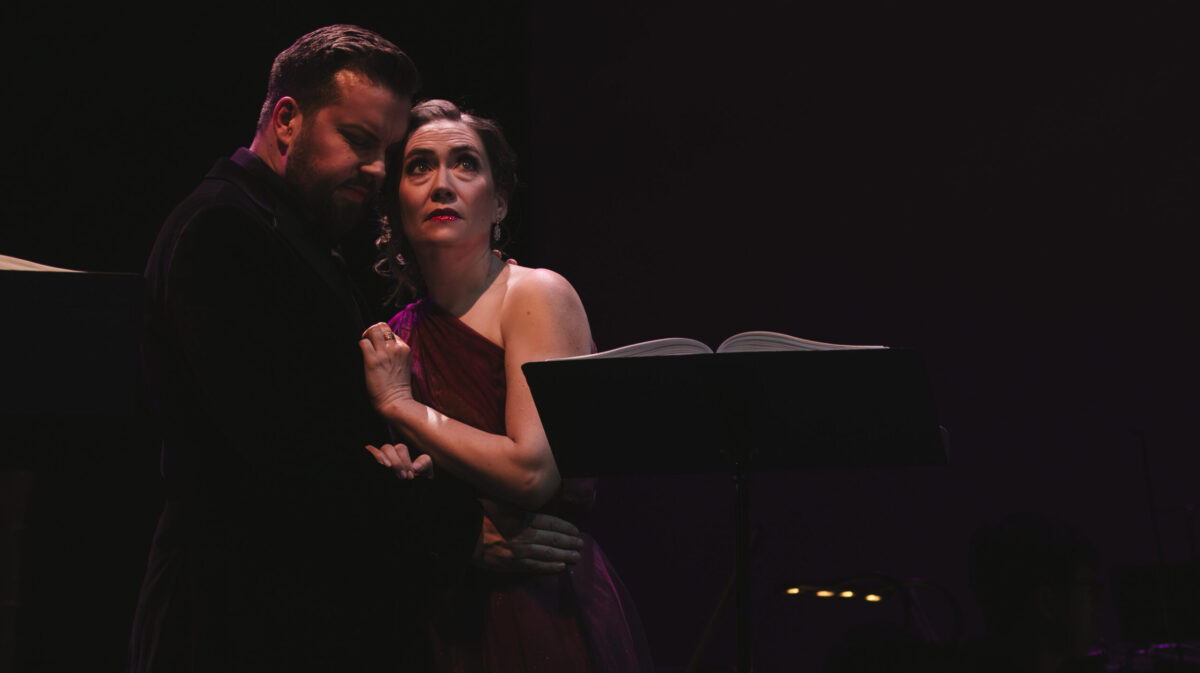
David Butt Philip (Apollo) and Heidi Stober (Daphne) in “Daphne in Concert” at Seattle Opera. Photo: Sunny Martini.
Richard Strauss’s Daphne, which premiered in 1938, doesn’t get performed much in the United States. It had to wait until 1960 for its US premiere, in concert performances in New York City. Its first staged performances were in Santa Fe, in 1964.
Why is this? The score is gorgeous –– hey, it’s Strauss, what do you expect? –– but the libretto by Joseph Gregor is somewhat clunky. Daphne’s transformation into a laurel tree is difficult to stage. And because it’s Strauss, it features not only one impossible tenor role but two. The title role is also nothing to sneeze at, calling for sustained upper-register brilliance.
Seattle Opera, which is struggling financially, has cut back its season significantly in the last few years and, sadly, has completely given up on Wagner performances, once a specialty of the company. To fill some of the gap, the company has now presented concert versions of two rarities: 2025’s Carthage-acts-only Les Troyens, which was well sung and conducted but marred by some odd cuts, and this year’s Daphne, which was nothing short of sensational.
Daphne is subtitled “A Bucolic Tragedy,” and that it is. The opera takes place during the feast of Dionysus, and there are numerous references in it to rutting animals (and men). The score is bucolic; even with no scenery, it evokes the natural world so strongly that you can see trees and fields before you.
Daphne (soprano Heidi Stober) likely in her late teens, is more comfortable with nature than with people. She is clearly discomfited by men and by anything to do with sex. Her childhood friend and playmate, Leukippos (tenor Miles Mykkanen), is in love with her in every sense, erotically and emotionally. She feels that he is like a sister to her; a beloved friend, but not a lover. (Leukippos plays the flute, and Strauss provides numerous pastoral solos for that instrument, all played with sinuous, gleaming beauty by principal flutist Demarre McGill.)
Daphne’s parents, the fisherman Peneios (bass Matthew Rose), and his wife Gaea (mezzo-soprano Melody Wilson), are leaders of the feast. Gaea wishes that Daphne were open to love and Leukippos, but, alas, it’s not to be.
Along comes Apollo (tenor David Butt Philip), the sun god, disguised as a cattle herder (everyone else herds sheep). Still, he can’t completely hide his godhood, and there’s wonder when he appears. He woos Daphne, who is attracted but also frightened.
Leukippos challenges Apollo to reveal his true identity –– challenging a god is never a good idea –– and shortly finds himself dead, struck down by the god. Daphne is stricken with grief. Apollo arranges to have his father Zeus turn Daphne into a laurel tree.
Except for Butt Philip, singing his third Apollo, all of the singers in these performances were making their role debuts. The opera’s success truly hinges on the three principal roles, Daphne and her tenor suitors, Leukippos and the god Apollo.The singers in these roles were all superb.
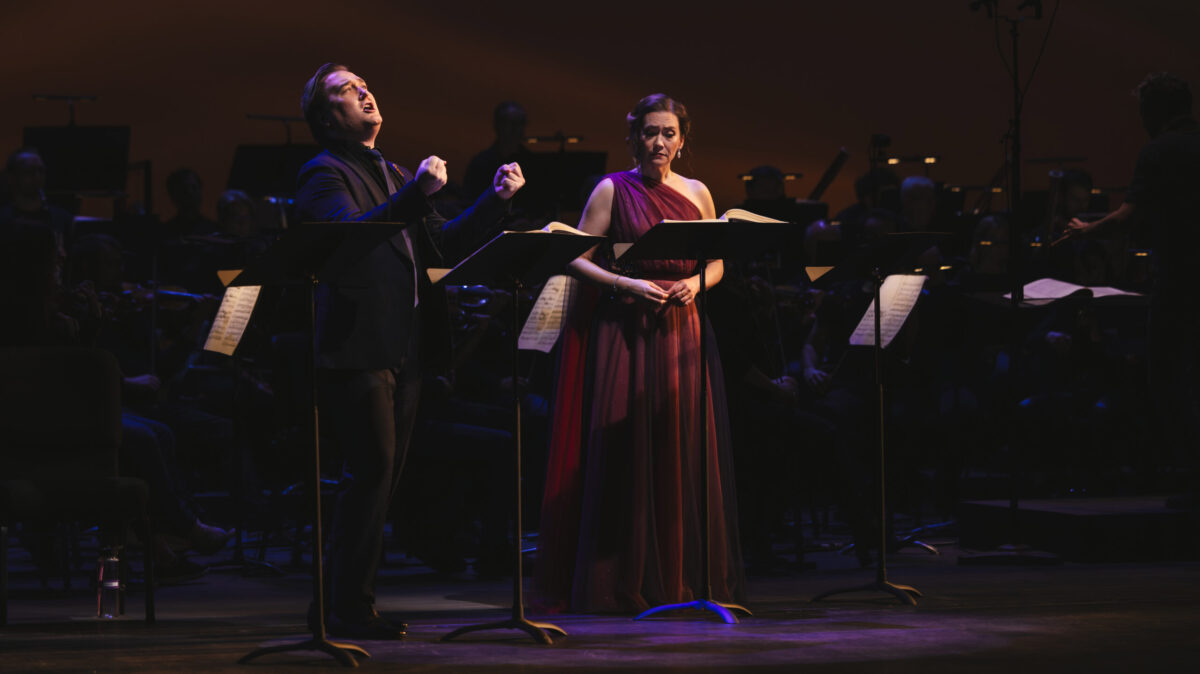
Miles Mykkanen (Leukippos) and Heidi Stober (Daphne) in “Daphne in Concert” at Seattle Opera. Photo: Sunny Martini.
As Daphne, girl-turned-laurel tree, Stober sang magnificently and with majestic poise, her shimmering voice and luminous high register ideal for the part and other Strauss roles too. You could see her Daphne recoil from the earthiness of physical love and her love for the natural world, even with no sets and minimal direction. Daphne is a long and difficult role, yet Stober was as fresh at the close as in the opening.
The less impossible tenor role is that of Leukippos, taken by Mykkanen, a young American who has had recent starring roles in Kaija Saariaho’s Innocence at SFO and Mason Bates’s The Amazing Adventures of Kavalier & Clay at the Met. His bright voice and yearning interpretation suited the part well.
Butt Philip sang Apollo with magisterial power and dark beauty, his dramatic tenor ringing throughout his range. His bearing, too, was regal. You could believe that he might strike you dead in a moment of fury.
Rose brought a beautiful and resounding bass to the role of Peneios. As Gaea, Wilson sang with warm smoothness but with less volume and vocal presence than the rest of the cast; props to her thematically appropriate green gown embroidered with gold laurel leaves!
Ilya Silchukou, Martin Bakari, Micah Parker, and Michael J. Hawk were four shepherds. Meryl Dominguez and Sarah Coit were two maids. These six roles provide color and interjections without playing big parts in the larger drama, but all these singers performed well.
David Afkham has experience in Strauss. Conducting Daphne for the first time, he led a gorgeously transparent and sweeping performance. With the orchestra on stage, behind the principals and chorus, he kept every moment in perfect balance, supporting the singers and never swamping them, even in the biggest orchestral outbursts.
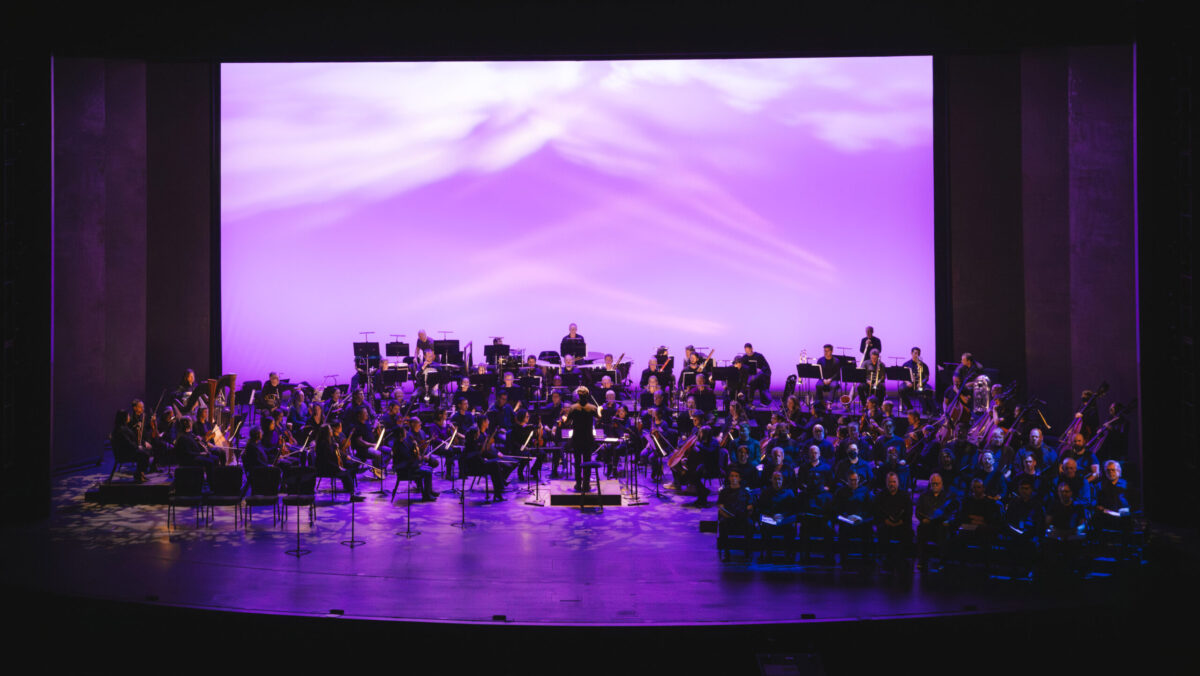
Members of the Seattle Symphony and Seattle Opera Chorus, led by conductor David Afkham, in “Daphne in Concert” at Seattle Opera. Photo: Sunny Martini.
Members of the Seattle Symphony provide the orchestra of the Seattle Opera, and they played marvelously. Mark Robbins, Associate Principal Horn of the Symphony, took on the alphorn part, prominent in the opera’s opening, then not heard again. Concertmaster Emerson Millar provided a number of beautiful violin solos. Ben Hausmann on oboe and Benjamin Lulich on clarinet played wonderfully, their lines intertwining with those of McGill’s flute throughout.
There was not much in the way of staging, though David Gately’s direction brought out each character’s personality even without a lot of action and interaction. Changing Stober’s outfit from a mauve gown to a billowing green pantsuit for Daphne’s transformation was a nice, thematically appropriate touch. Ranleigh Starling’s beautiful lighting enhanced and supported the drama. The projected laurel silhouettes were lovely.


