Tristan Cook / Chamber Music Society of Lincoln Center.
The abridged family-friendly version of Mozart’s Die Zauberflöte, performed in Julie Taymor’s 2004 production, returned once again to the Met last month for another extended run. As it turned out, both of this season’s Paminas—Erin Morley and Joélle Harvey—also appeared locally in concert, Harvey before the Magic Flute run and Morley last week.
In November, Harvey, whom I’d only previously heard in concert, proved to be an absolutely top-notch Susanna in the Washington National Opera’s Le Nozze di Figaro. I caught the run’s last performance which might turn out to be the company’s final show—at least for the time being—at the performing arts complex formerly known as the Kennedy Center.
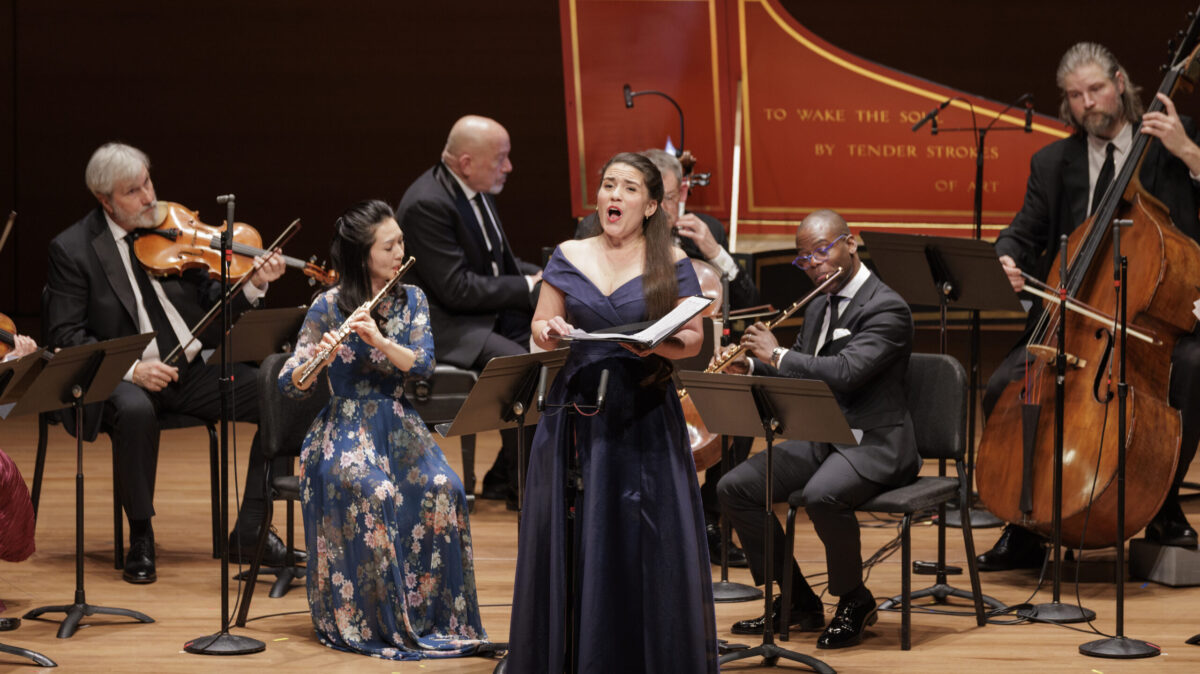
After Figaro and before Flute, Harvey took part in an all-Bach concert at Alice Tully Hall on December 9th, part of the Chamber Music Society of Lincoln Center’s annual holiday baroque series, which always features the group’s highly popular traversal of the Brandenburg Concerti. Joined by nine instrumentalists, tenor Paul Appleby and baritone John Moore, Harvey performed a program of secular cantatas by J.S. Bach concluded with the well-known “Coffee Cantata.”
Harvey opened the evening’s first half with Non sa che sia dolore, a rare work in Italian. The enchanting soprano who had been so vivid and lively as Susanna brought a more staid concert manner to a lovely, if rather bland performance of the solo cantata, followed by the even less-familiar birthday “serenata” Durchlauchtster Leopold in which she alternated arias with Moore. The soprano employed far less vibrato than she had in the DC Mozart, an HIP style familiar from her lovely Rinaldo Almirena heard at Carnegie Hall almost eight years ago.
After intermission, Moore offered what turned out to be the evening’s highlight, a fiery rendition of another Italian work, Amore traditore, accompanied only by Timothy Eddy on cello and Kenneth Weiss at the harpsichord. Moore’s intense approach brought the cantata’s aggrieved narrator vividly to life, particularly in the second aria which featured an extended, fiendishly challenging keyboard introduction, handily dispatched by Weiss, a noted Bach specialist.
Moore’s performance brought to mind an issue always puzzles me when I listen to Bach’s vocal music. Arias included in the composer’s many, many cantatas are usually in the A-B-A da capo form, but I don’t ever recall hearing—either live or on recordings—the singer ornamenting the repeat of the initial A section, a stylistic omission unthinkable in arias by other baroque composers. Especially confounding during the CMSLC performance was that nearly every da capo repeat was completely omitted.
Not having recently listened to Non sa che sia dolore, I was quite surprised when Harvey performed only A-B (followed by a repeat of the instrumental introduction to the A section) in her pair of arias. During intermission, I scrolled through the IMSLP score on my phone and wasn’t surprised to discover that each aria indeed included a da capo marking. Moore, on the other hand, sang a complete A-B-A for his two Amore traditore arias, albeit un-ornamented, of course. Omitting A section repeats also marred the “Coffee Cantata,” except for the work’s jaunty brief concluding trio chorus, handled with sly aplomb by Harvey, Moore and the under-employed Appleby.
Stephanie Berger Photography, Inc.
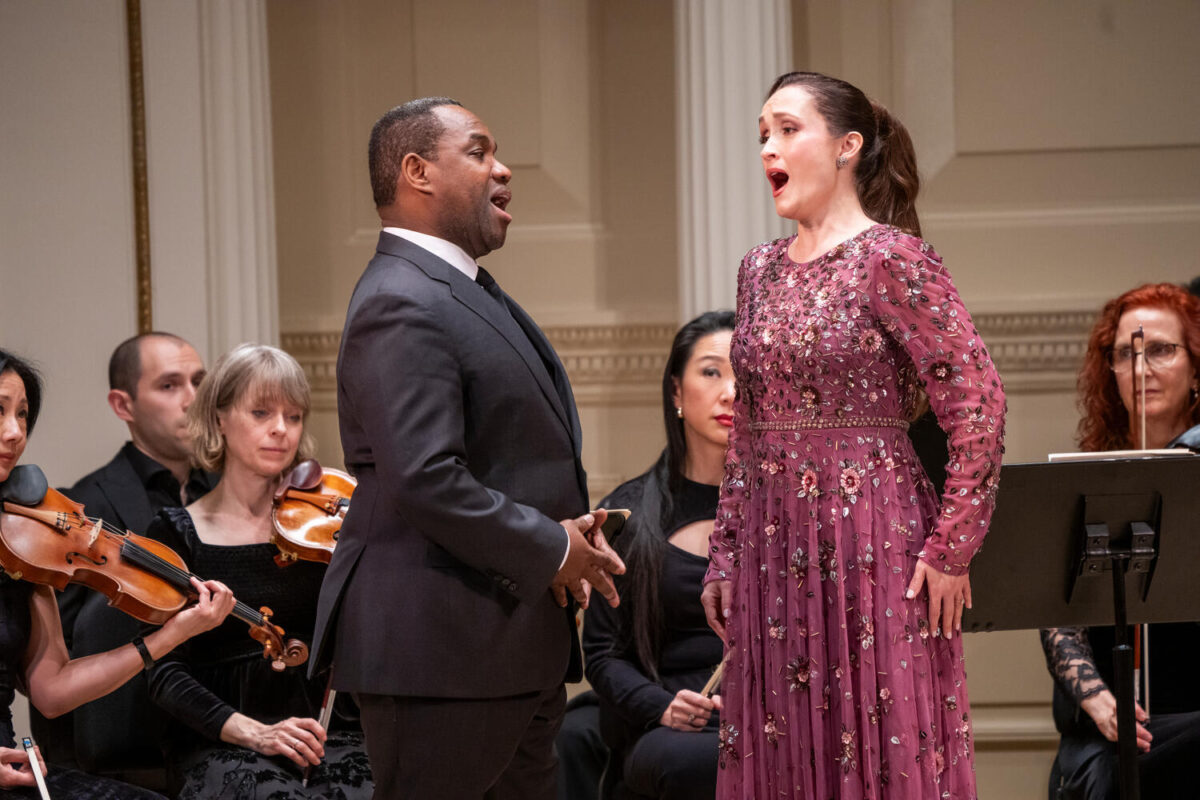
On January 12th at warmly intimate Weill Recital Hall, I attended, for the first time, a performance by the Met Orchestra Chamber Ensemble. When it was initially announced, Morley was the sole soloist. However, at some point, Lawrence Brownlee joined the program, a change presumably prompted by their engaging partnership last fall in the Met’s revival of La Fille du Régiment.
A primary attraction of the program for was an opportunity to hear Schubert’s entrancing Der Hirt auf dem Felsen live for the first time. Accompanied by Israel Gursky on piano, Morley’s pearly soprano was joined by Silvio Guitian’s ravishing clarinet in a joyful, spring-like performance, much more beguiling than Brownlee’s sturdy Auf dem Strom which followed, a quite attenuated scene for tenor and horn, performed that evening by Hugo A. Valverde.
Although there are more than eleven months remaining in 2026, I’ll surely remember Morley’s Vorrei spiegarvi, oh Dio as one of the year’s most sublime moments. Buoyed by conductor Patrick Furrer and a small band of fourteen players from the Met Orchestra, the soprano raptly negotiated Mozart’s dizzyingly high lines with polished finesse. If the aria’s occasional exceptionally low notes failed to pack a punch, her spectacular leap from a low E to a high D brought the striking concert aria, originally written for sister-in-law Aloysia Weber, to a thrilling conclusion. It brought back the exceptional version I heard Morley sing at the Mostly Mozart Festival a decade ago.
On his day off from the Met, Brownlee added to his recent bel canto triple-crown of Fille, La Sonnambula and I Puritani by duetting with Morley in a lovely “Tornami a dir” from Donizetti’s Don Pasquale, which can also be heard on their thoroughly captivating CD “Golden Age,” released this fall on Pentatone. As on the CD, they beautifully spun out Norina and Ernesto’s exquisite intertwining lines–though if I had had a handy-dandy on-site equalizer, I might have turned down Brownlee’s volume a notch and raised Morley’s.
The pair will return to New York in May for a “Golden Age” concert at the 92nd Street Y accompanied by Malcolm Martineau which will include their smashing Le Comte Ory duet.
Post scriptum on the penultimate Puritani:
I finally made it to the Met’s new (godawful) production of Bellini’s final opera. Its fifth performance found Artur Ruciński back in great form as Riccardo, whose downright ridiculous (albeit show-stopping) “Suoni la tromba” scene with Christian van Horn demonstrated that director Charles Edwards had unwisely and too well absorbed the worst excesses of Sir David McVicar, his frequent collaborator. Joining the recent Sonnambula, the second installment of “unhappy-ending Bellini” once again demonstrated to me that one must hear Lisette Oropesa live. I had been disappointed by her Elvira in the two broadcasts I listened to, but the voice in the house Thursday rang out with a vibrantly expressive throb with just a few pinched extreme high notes marring her increasingly bizarre “Portrait of the Young Madwoman as an Artist.” High-note obsessives were surely disappointed that this time Brownlee declined to tackle Arturo’s high F, an omission, like Javier Camarena’s, that was just fine with me.