Photo: Bernd Uhlig
It is a Wagner-heavy season at the Deutscher Oper Berlin. This comes as no surprise, as 2026 marks the 150th anniversary of the Ring Cycle’s world premiere at the Bayreuth Festspielhaus. In celebration, the Deutscher Oper is performing the entirety of Der Ring des Nibelungen along with other Wagnerite favorites; Lohengrin, Parsifal, Tannhäuser, and Tristan und Isolde.
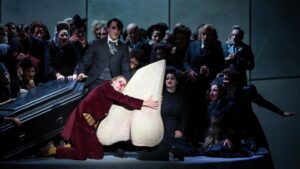
Michael Thalheimer’s production of Tristan und Isolde premiered at Deutscher Oper on 1 November 2025, after being performed at the Geneva Opera last season — it was obvious that the Deutscher Oper team ignored the mixed reviews coming out of Geneva. One reviewer, Ossama el Naggar, went so far as to write that Thalheimer’s production ‘failed’ Wagner. While I believe, for all intents and purposes, that Wagner failed himself, Thalheimer’s production left much to be desired.
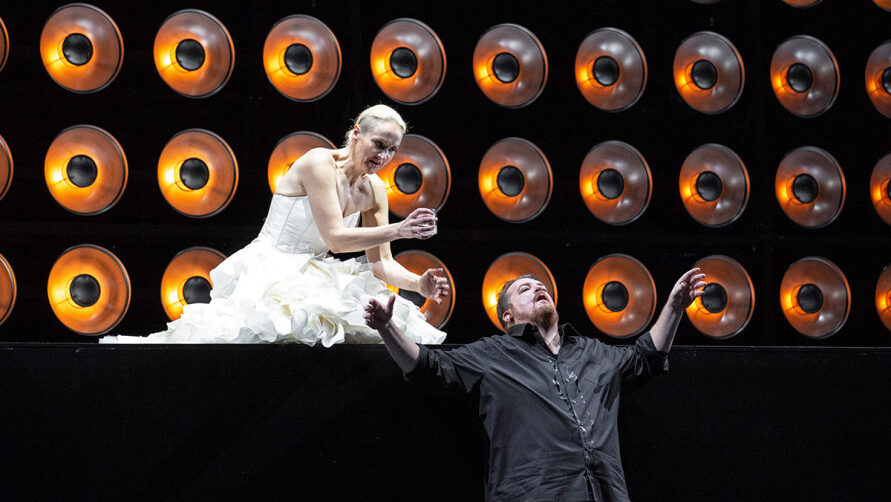
The problem, or rather, the question surrounding Thalheimer’s production is how much minimalism is too much minimalism? With stage design by Henrik Ahr, the set consisted of a wall of 260 mirrored lightbulbs, resembling a police investigation room. Other than the wall of lights, Ahr included a square black box, meant to represent the ship in Act I, a rope, and a Liebestrank-filled chalice. Despite having a German opera house’s budget, Ahr’s design was akin to that of my high school’s drama program: black stage cube and all.
While I am not against minimalist stagings of Wagner operas—I grew up with Lepage’s Ring, after all—I felt that Thalheimer’s concept was misguided. Michael Thalheimer defines his version of minimalism more as concentration, a reduction, a simplification; “I simply want to avoid everything unnecessary,” he shares in the program, “if you look back to antiquity, perhaps to the very origins of theater, great emphasis was placed on reduction, on omitting the superfluous, the distracting.”
I’d argue, however, that there is a difference between ‘distracting’ the audience and elaborating specific narratives and themes. When sitting through five-plus hours of music, the audience may need a guiding hand, or rather, a reminder to engage with the work. Thalheimer’s lack of direction left the singers to carry the work, responsible for creating the world of Tristan und Isolde all on their own. The performance felt like a recital, and perhaps they should have marketed it as such: “park and bark (with the occasional facial expression).”
Due to the stripped-down nature of the production, I found myself perhaps unfairly picking apart the vocal performances. The singers were fighting for their lives and the audience’s attention, causing me to overanalyze their every note only to stay entertained. American tenor Clay Hilley’s bright Tristan did not quite balance Norwegian soprano Elisabeth Teige’s melodramatic Isolde, her warm voice often soured by his Heldentenor point.
Teige’s vocal warmth was matched by the full, round timbre of Californian mezzo Irene Roberts singing Brangäne. While Roberts’s vocal performance declared a strong presence, her costume and demeanor presented a shy Cherubino, rather than a fate-altering confidante. Bass Georg Zeppenfeld singing King Marke, Isolde’s betrothed, was perfectly cast, his stoic King fitting right into Thalheimer’s park and bark vision.
The true highlight of the production was the orchestra’s clarity and precision. Under the baton of Sir Donald Runnicles, the orchestra was perfectly balanced, leaving ample space for emotive interpretation. Never have I heard such a focused rendition of the prelude, perhaps due to the German audience’s holding in their coughs out of respect for the almighty Tristan Chord.