© Vincent Pontet
Silvia Costa has been around long enough, assisting Romeo Castellucci and directing films, plays, and operas herself, to have won an artistic knighthood in France as a ‘Chevalier des Arts et des Lettres.’ But this La Damnation de Faust, for which she designed the sets and costumes as well as directing, was my first experience of her work and it proved baffling. As with Shirin Neshat’s recent Aïda, I’ll start by outlining the production, as its weaknesses in turn impacted the musical side of the evening. This bald outline should also give those not present an insight into why, without preparation, I found the staging baffling. But of course, if you aren’t interested in productions or are just pressed for time, you can skip it.
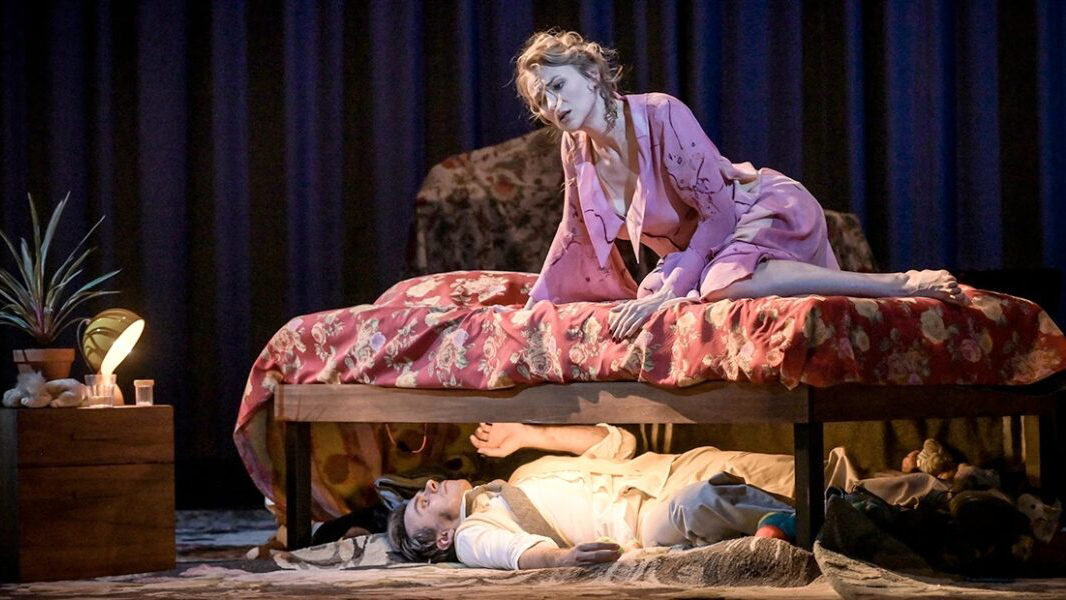
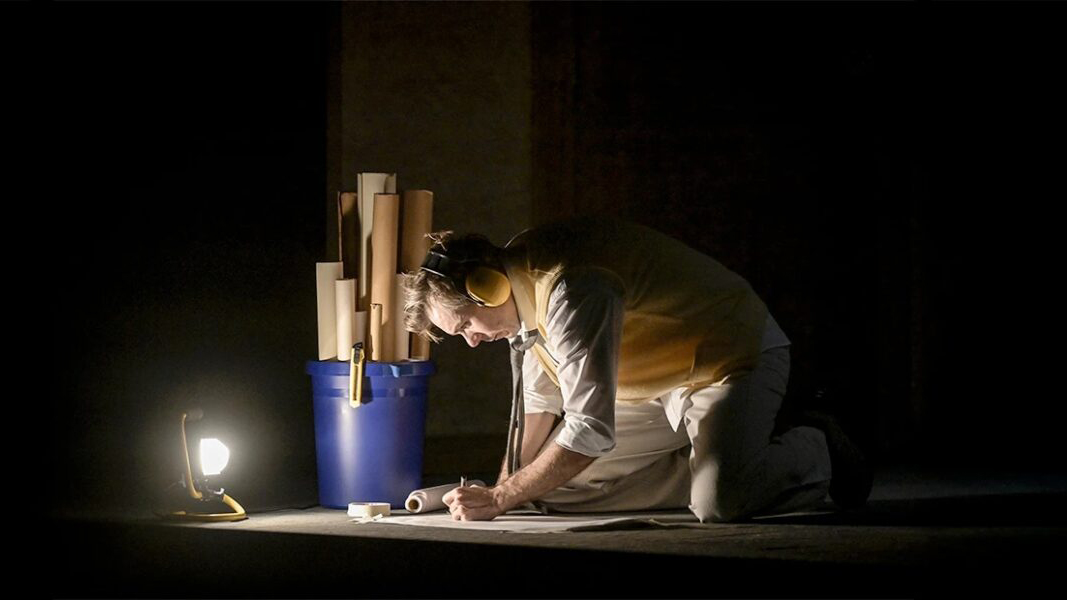
As the curtain – and the sun – rises, we find Faust in bed, in a shabby studio flat with raw plywood walls, under a mountain of plush toys that cascade to the floor as he emerges, bare-chested and with dishevelled hair, in his boxers. Without even a splash of water, he pulls on clothes from a crumpled heap nearby. These include a half-knotted tie, a detail that struck me as particularly unlikely – until the end: see below. He nibbles at some leftovers, waters a house plant, and on the floor, scribbles on large sheets of paper before crumpling and trashing them. So perhaps he’s an artist, I thought – but Le Figaro‘s critic supposed he was a composer, which may make more sense.
He dons jumbo headphones as the peasants sing and dance offstage, and is driven to distraction, holding his tousled head, by the Hungarian March on a crackling, vintage radio. As the music plays, he toys with the light switch – off, on, off and on again; and as his frenzy mounts, he hurls his clothes against and over the walls. For the Easter hymn, calming down, he wheels out a projector on a stand to watch a slide-show of family snapshots from his childhood (‘Ô souvenirs!’). As Méphistophélès strolls in with a wry grin wearing a royal blue boiler suit with peaked shoulders and a black beret (I couldn’t work out what this outfit signified), the plywood walls collapse with a bang.
For the tavern scene, children in grey suits and ‘bald wigs’ ringed with grey hair emerge – like the monsters and spirits in Sellars’s Castor et Pollux last year – from various openings, including the oven as well as traps in the floor, to mime to the offstage chorus. As Brander, in an identical suit and wig, sings, the kids toy with what appears, worryingly, to be a live mouse or rat in a glass box. Marguerite is puzzlingly absent and zombie-like, in disturbingly grubby-looking pink. She stirs a pan of soup or whatever listlessly with a wooden spoon (the cooker is still there), and for some reason briefly puts her head in the oven.
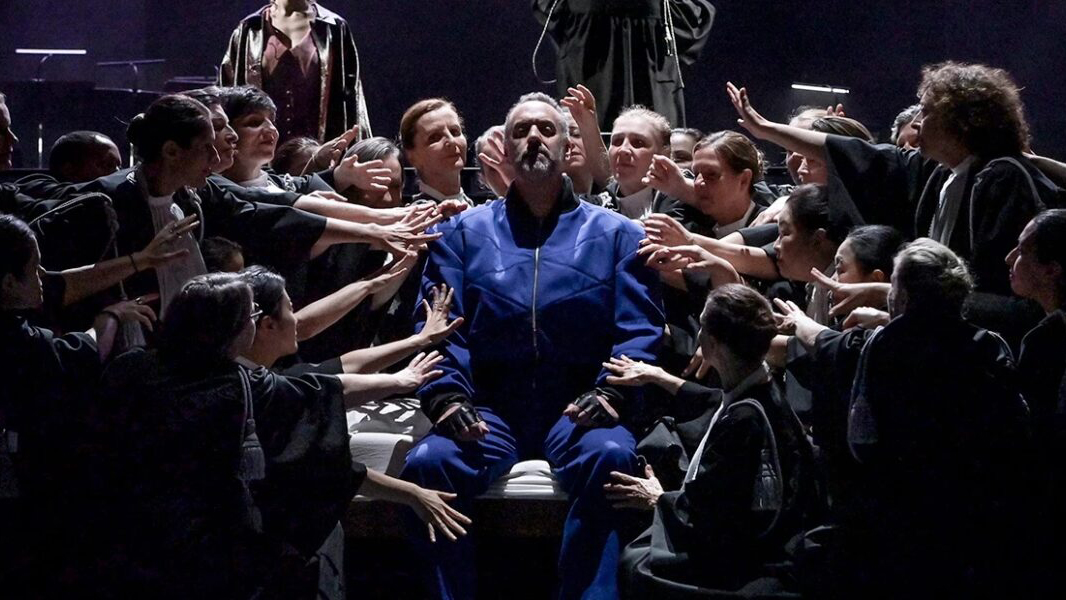
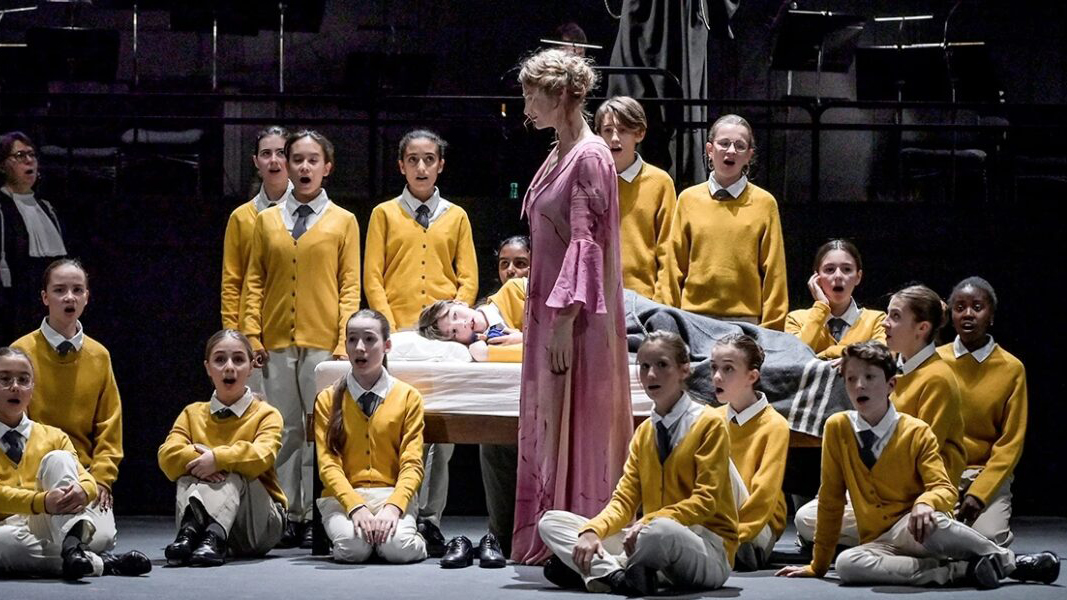
After the interval, the orchestra, all dressed – conductor too – in judges’ robes, is high up on a platform at the rear, with the chorus, similarly costumed, lined up higher behind. Faust’s ever-present bed is now at the fore, and the pit is empty. ‘D’amour l’ardente flamme’ and ‘Nature immense’ are sung in this courtroom setting. To descend into hell, Faust descends into the pit, capering wildly (so I read afterwards; as I was in the stalls, I couldn’t see), wielding music stands (which I did see) as weapons. And finally, a child, wearing the same yellow cardigan as Faust – and a tie – walks in stiffly, and shakes Mephistopheles’ hand. Surrounded by the other children, all neatly dressed in yellow jumpers, all with ties (school uniforms), he is tucked into bed peacefully by the no-longer-zombie-like Marguerite.
As I mentioned above, I went to this Faust without preparation. I prefer to confront new productions without prior study, and do my reading, if need be, afterwards. In this case, the TCE informs us that Silvia Costa’s production is ‘more abstract than narrative,’ and invites us ‘to follow Faust’s dreamlike journey in search of the source of life.’ It is, then (yet again, you might say, as the approach has long helped directors explain away the inexplicable) all a dream or nightmare, hence the ever-present bed. But whose dream or nightmare? The implication, at the end, seems to be that it was the child Faust’s. But if Marguerite, tucking him in, is actually his mother, that raises other, more troubling implications…
© Vincent Pontet
I could quote Silvia Costa from an interview in Opéra Magazine, hoping to offer clues, but she herself admits her thoughts are fragmented and that she has a tendency to contradict herself. I could barely make head or tail of the article and remain baffled. But even if her ideas were good and I alone am too thick to penetrate them, my impression was that her directing wasn’t strong enough to sustain them comprehensibly, consistently and convincingly over the duration of the evening.
The characters were only partially formed, vague and woolly and lacking evident purpose. And Damnation, a ‘Légende Dramatique,’ not an opera as such, includes longish instrumental and choral passages which are a real test for directors staging it as they strive to concoct convincing, apparently meaningful things for the soloists to do. A Bieito on a good day might pull it off. You can have Mephisto pretend to conduct for a while, but not too long and often. In the end I felt sorry for Benjamin Bernheim, putting such visible effort into acting the tortured artist, throwing tantrums, emoting into the house, and leaping around the pit with his music stands for long stretches at a time.
Finally, the production never delivers any of the sense of wonder, majesty, evil, awe or diabolical magic you anticipate from such a Romantic work as Damnation: a few puffs of stage smoke and some red lighting don’t do it. And the orchestra, a key player in Berlioz, offered no support at all.
Over twenty years ago, in an article headed ‘Everything you ever wanted to know about Sax…’, I explained how ‘bright, brilliant, radiant, colourful’ the sound of the Orchestre Révolutionnaire et Romantique was in Les Troyens under John Eliot Gardiner. That performance convinced me I would never need to hear Berlioz on modern instruments again. Les Siècles, a similar such ensemble, used to be a respected period band, but since it lost its founder (to accusations of sexual abuse) has apparently lost its mojo. Perhaps, as well as its conductor, it has lost some… key players. The performance was, in a word, dismal. The orchestra started out a mess, improving slightly for the Hungarian March, but ultimately never delivered the bite and crunch, the thrills you hope old instruments will provide. Nor did they play with accuracy, let alone vigour, or even, under Jakob Lehmann, discernible phrasing, a semblance of style. Rarely, after an opera in Paris, are a conductor and orchestra booed, but menacing rumblings could be heard from the upper floors on Thursday night.
© Vincent Pontet
In these shaky circumstances, it was up to the poor singers alone to carry the evening, and obviously, with only half a production (though not, I thought, deserving the furious booing that greeted it at the premiere) and an absent orchestra (in Berlioz of all things!) this was a tough call.
The Radio France Chorus, usually first-rate though not always at ease on stage, were at their best when actually visible and standing still. When they were in the wings, coordination was problematic, and when milling around on stage you could see them snatching at any opportunity to glance at the conductor to keep in time.
The cast was, as you might expect, dominated by Benjamin Bernheim. To his usual honeyed timbre, accuracy at whatever pitch, well-turned phrasing, and perfect diction, he’s now bringing a good deal of vocal power. (Until now, it had continued to surprise me that I’d first heard him as Rodolfo.) However, Faust’s perpetually tortured characterization and the weakness of the orchestra depriving us of his usual charm and sapping his big numbers, he had to work hard to keep that characterization afloat. The magnificent orchestral introduction to ‘Nature immense,’ for example, with its usually majestic rumblings and shifting and surging, just wasn’t there, tragically diminishing what should be an awe-inspiring overall effect.
Christian Van Horn is becoming a familiar face in Paris – he was Philippe II in this year’s revival of Don Carlos at the Bastille – a welcome one as far as I’m concerned. As you might expect, he made a fit, jovial Méphistophélès, more wryly teasing than diabolically devious, more like a ribbing bro than the devil incarnate, with a brighter, less cavernous sound than some, though a dark, resounding core.
© Vincent Pontet
Marguerite must be a daunting role to take on when so many illustrious singers have sung the ‘Roi de Thulé’ song (to my ear, Berlioz at his weirdest), or the (contrastingly) marvellous ‘D’amour l’ardente flamme.’ Victoria Karkacheva, new to me, is a welcome discovery. Her voice is reassuringly secure, with a brighter timbre than some of those famous forebears (as I guess will also be true of her Carmen next year at the Bastille), even a touch steely at the top. It’s a real shame that the production, with its withdrawn characterization of the role, again undermined the impact of her arias. Finally Thomas Dolié brought his customary distinction, even surrounded by a rowdy troupe of kids, to the rumbustious role of Brander.
In sum, Silvia Costa may have worked with Romeo Castellucci, but she is no Castellucci or Bieito herself, Les Siècles is not the Orchestre Révolutionnaire et Romantique, and Jakob Lehmann is not Sir John Eliot Gardiner. By a long shot. For the singers only, this one.