To our glorious dead
The St. Louis Symphony Orchestra offered a rending reading of Britten‘s massive War Requiem with an eclectic trio of soloists.
 By
Elaine Yao
By
Elaine Yao
Virginia Harold
The St. Louis Symphony Orchestra, embarking upon its first season in its newly-refurbished home, has not shied away from ambitious programming and big swings. Its opening concert involved three fanfares and Joyce DiDonato in a Kevin Puts world premiere, capped off by Strauss’s Ein Heldenleben; successive outings have included concerto performances by Emmanuel Ax, Augustin Hadelich, and Nikolaj Szeps-Znaider, in addition to a slew of SLSO and U.S. premieres. Powell Hall, gleaming in freshly repainted rococo glory, has certainly been busy.
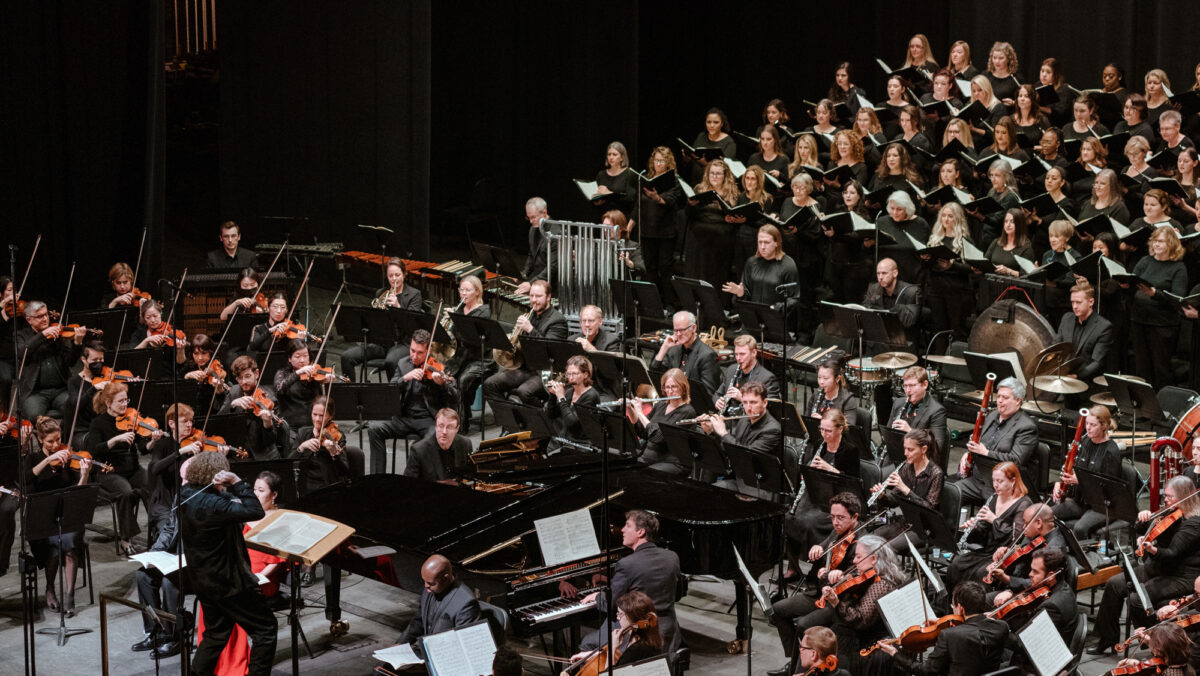
If the last two months have been any indication, the SLSO seems to thrive in larger formats—its Heldenleben, for instance, was infinitely more convincing than the fanfares that previewed it on opening night. In larger works, the symphony seems to breathe and to carry longer lines of thought, whereas its work with soloists and guest conductors has felt relatively deferential and short on personality. And of all its recent big swings, Benjamin Britten’s War Requiem might be, by sheer numbers alone, the biggest yet. Involving the symphony, additional instrumentation, a full chorus, three soloists, and an off-stage children’s chorus, the War Requiem at the very least presents an intriguing game of Tetris: how to fit all those on-stage forces on the stage? In St. Louis, the solution seemed to involve the harpist where the sixth-stand cellists might usually be, a percussionist in the basses’ corner, and a separate chamber orchestra tucked into an enclave of the main band — making for an intriguing acoustical and visual effect.
At the focal point of the monumental War Requiem forces is a triangle of soloists, sung by Roderick Williams, Ian Bostridge, and Felicia Moore. Each was making their SLSO debut and together constituted somewhat strange stage-fellows: Two Lieder singers of distinctly different temperaments and a budding Wagnerian soprano. As the leading voices of Britten’s War Requiem, their casting seemed, intentionally or not, to mirror the work’s internal contradictions and competing voices. War Requiem is held together by conflict, not coherence: Not only in the tense juxtaposition of Owen’s embittered war poetry and the Latin text of the Requiem Mass, but also the score’s writhing, tritone-heavy, Straussian palette, and its capacity for nihilism, cruelty, even sadism. To sell it simply as a pacifist work undersells its uneasy self-contradictions, which were amplified effectively by the leading men.
As the tenor and baritone soloists, Bostridge and Williams were a study in contrasts. Over his long career, Ian Bostridge has evolved from Dorian Gray boy chorister – youthful in looks and voice well into middle age – to something like the Erlkönig by way of Eddie Redmayne: skeletal, tall, twitchy, and mercurial. His fidgeting on-stage felt almost intentional, in spirit with his reading of Owen’s text: louche, ironic, quick to sarcasm, shaded with disgust.
Long associated with this role, Bostridge has now sung it nearly over a hundred times; it is perhaps unsurprising then that his interpretation remains largely consistent with his 2012 LSO recording. What he has perhaps lost in sheer beauty of tone, he has gained in a willingness to take musical and gestural risks. There is an almost jazzy, parlando edge to his phrasing — he seems to punctuate the text in real time, adding commas and em-dashes, letting consonants land slightly late, like parting jabs.
As tenor soloist, he is the first to break the chimes and bells-studded opening enchantment with a scathing retort: “What passing-bells for these who die as cattle?” In Bostridge’s delivery, the /k/ of “cattle” was all but spat. He is unafraid to wail, sliding up to a pitch and holding it straight and bright in the air before letting vibrato bloom. Effective as this could be, it increasingly felt like camouflage for a hoarse grain, substituting an unwillingness or inability to simply spin a seamless line. And in the brief moment in the Agnus Dei when the tenor finally acknowledges the Latin text, setting aside fury to simply echo the chorus’s Dona nobis pacem, Bostridge seemed ill at ease, reluctant to let go of his mannerisms and simply deliver the line with either resignation or relief.
Roderick Williams, for his part, was sturdy and genteel – his phrasing tasteful, his bearing noble, and his sound classically beautiful. Bearing more than a passing resemblance to Dominic West, he seemed to channel something of that actor’s portrayal of then-Prince Charles on The Crown: a figure caught between duty and sorrow, representing a fading order. His lyrical, almost Shakespearean delivery let the rhythm of the poetry and musical line lead, restrained at a certain level of emotional remove. Where Bostridge raged and spat, Williams seemed to reflect and mourn, embodying the pre-war gentleman – a lingering representative of a kinder world rent asunder. He was most effective, I thought, in the Dies Irae, where Britten sets Owen’s “On Seeing a Heavy Piece of Artillery Brought into Action.” There, his understated poise conveyed both the grim determination and seething self-loathing of impending violence – the moral stakes made quietly, insistently clear.
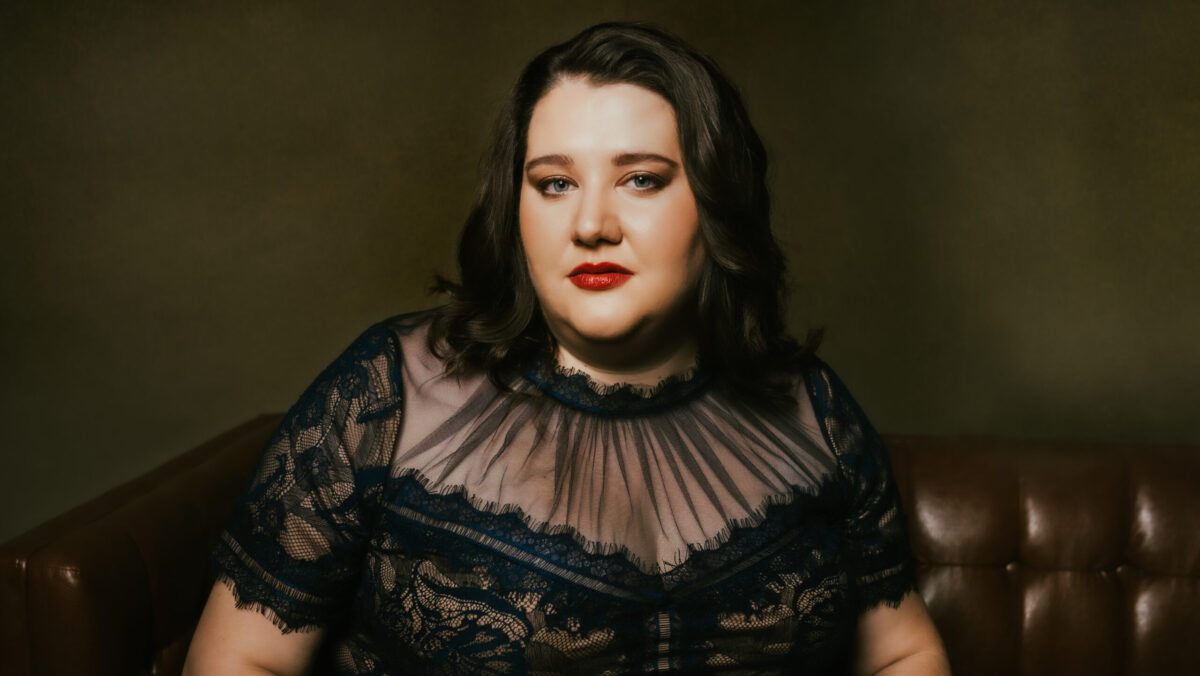
Felicia Moore, Photo: Gillian Riesen
Their contrasting personas and interpretations were particularly affecting in the final dialectical confrontation, in which a soldier (Bostridge) descends into the underworld and encounters a soldier he has just killed (Williams). In response to Bostridge’s tortured narration of his Orphic crawl came Williams, singing with unaffected humanity: “I am the enemy you killed, my friend.” As their voices descended together into murmuring echoes – “Let us sleep now…” – the orchestra seemed to ebb and flow in response, an ocean whose menace is but temporarily muted.
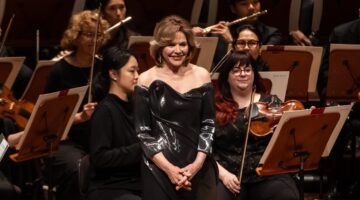
The triangle’s third point is the soprano who steers the chorus through the Mass. Felicia Moore, stepping in for Christine Goerke, sang with a cool, Wagnerian gleam. In contrast to the lieder-inflected approach of both men, Moore stayed in full operatic sail, riding above chorus and orchestra with steely, avenging-angel conviction even from her place behind the orchestra. Britten takes an ambivalent attitude towards the Latin Mass text – a relic of a Christendom twice-destroyed. Rather than allow the listener to take refuge in those familiar words, Britten sets them at a distance: impersonal, ritualistic, unable to speak directly to the modern horrors Owen describes.
Moore embodied this remove well, her tone and bearing suggesting a Valkyrie from another world entirely, one with no understanding of or mercy for the men below. Her severe dignity kept the Mass text magnificent but unreachable, never offering false comfort. Moore is young, but her biography already includes Die Kaiserin in Die Frau ohne Schatten. Her ability to carry above a massive, Eastern-inflected, percussion-heavy orchestral texture speaks well of her promise in Strauss. If one wished for a slightly more secure reading here, it could easily be attributed to her late addition to the cast.
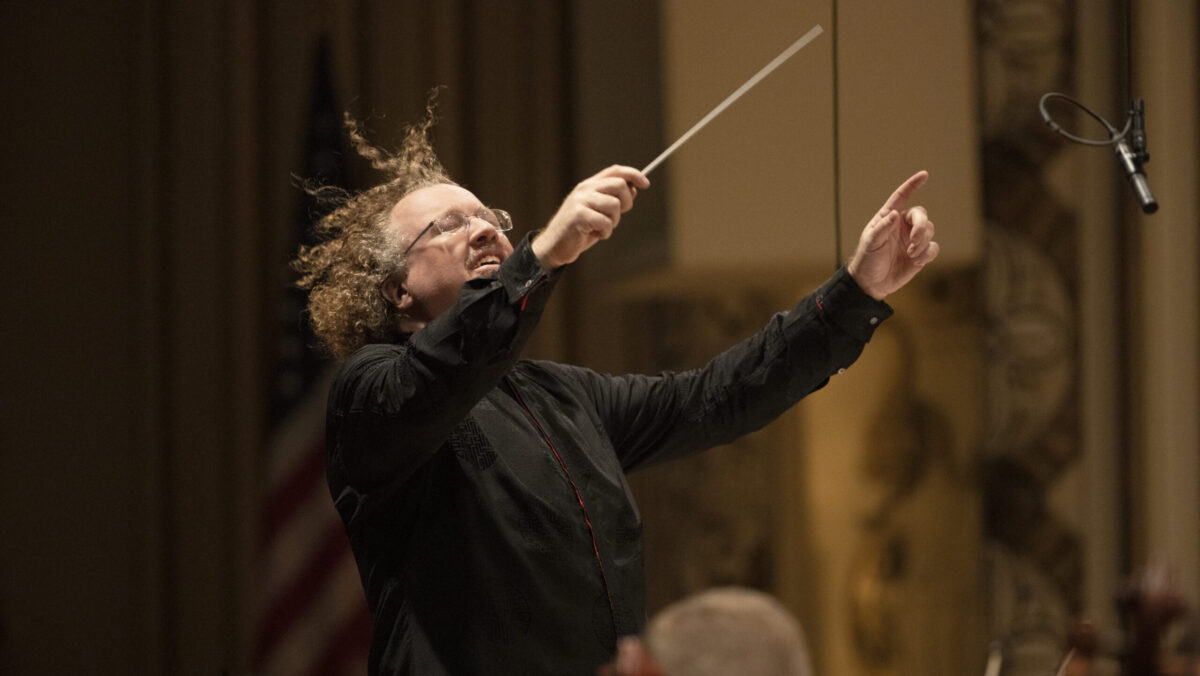
Stéphane Denève, Photo: Dilip Vishwanat
In the War Requiem, triumphs ring hollow, while defeats seethe with meaning. Under the baton of Stéphane Denève – who must be commended for marshalling such extensive forces with musical coherence – the SLSO did not shy away from lashing the audience with the sharpest dissonances, both musically and thematically.
One of the score’s cruelest juxtapositions comes in the Offertorium: while the children’s chorus repeats the serene promise –“quam olim Abrahae promisisti et semini eius” – Bostridge and Williams cheerily narrate Owen’s retelling of the Abraham story. As they anticipate the expected rescue (“When lo! and angel called him out of heaven / Saying, Lay not thy hand upon the lad / Neither do anything to him”) Britten brings the male voices into blissful harmony, the violins singing cinematically and the tempo relaxing into a sigh of comfort. For a moment, we are allowed to believe in salvation.
Then Britten twists the knife. With a sudden, discordant lurch, we learn that this Abraham does not accept God’s substitute sacrifice. Instead: “He slew his son / and half the seed of Europe, one by one.” Denève and the soloists seized the brittle, carnivalistic cheer with which Owen’s rhyming line lands, its false triumphal finality mocking the war’s own hollow victory celebrations. But even then there is no easy escape for the listener. As the soloists repeat Owen’s final words with manic brightness, the music turns into a buoyant, glitchy nightmare – a grin that just won’t fade. The children, unseen and far away, go on promising; the men, up close, go on dying. The grin becomes a rictus as the children’s chorus continues to repeat its consolations, the words unchanged but the harmonic texture increasingly eerie. Ritual is intact – but evacuated of comfort.
Lord, in praise we offer to Thee
sacrifices and prayers, do Thou receive them
for the souls of those whom we remember
this day: Lord, make them pass
from death to life.
As Thou didst promise Abraham
and his seed.
Elaine Yao
Elaine Yao is Assistant Professor of Political Science at Washington University in St. Louis. Formerly a PhD student permanently marooned on NJ Transit en route to the Met, she spent years playing Baroque violin badly enough to love it and well enough to know better. Her musical interests remain divided between the 17th century and the paroxysms of modernity.
-
Topics: Review, St. Louis Symphony Orchestra
-
People: Augustin Hadelich, Benjamin Britten, Christine Goerke, Felicia Moore, Ian Bostridge, Joyce DiDonato, Kevin Puts, Roderick Williams, Stéphane Denève, Wilfred Owen
-
Places & Organizations: London Symphony Orchestra, Powell Hall, St. Louis Symphony Orchestra