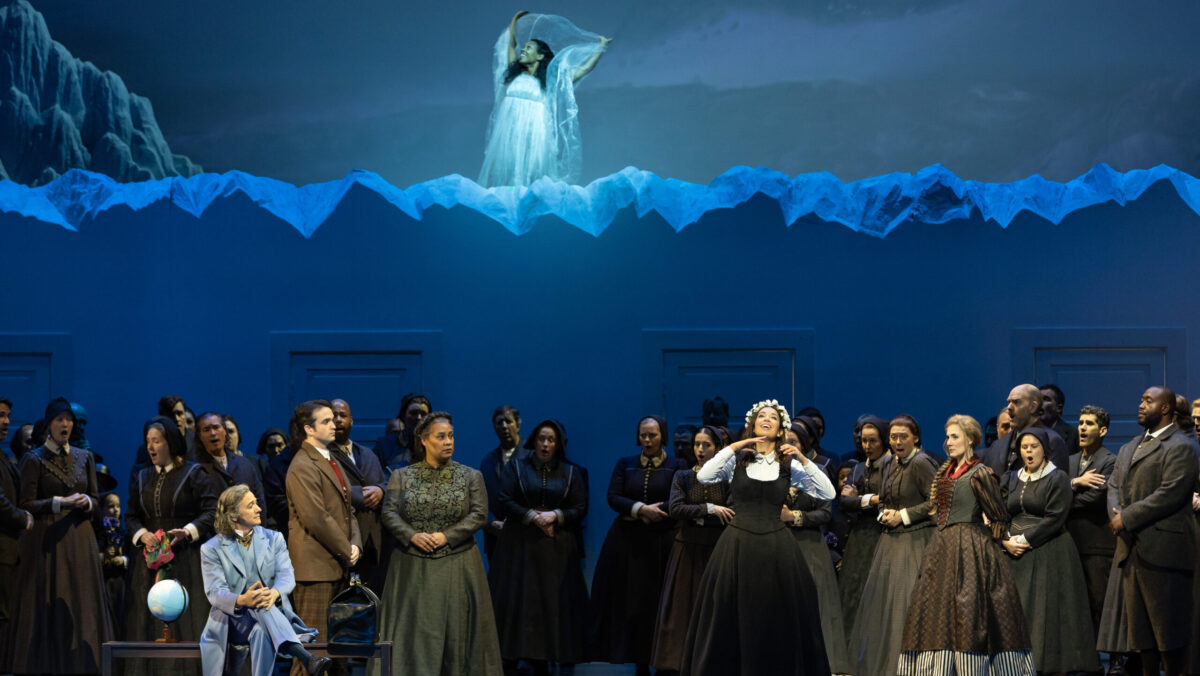
Alexander Vinogradov as Count Rodolfo, Xabier Anduaga as Elvino, Deborah Nansteel as Teresa, Nadine Sierra as Amina, Sydney Mancasola as Lisa, Nicholas Newton as Alessio, and solo dancer Niara Hardister (above) in Bellini’s “La Sonnambula.” Photo: Marty Sohl / Met Opera
Bellini’s La sonnambula seems quaint yet it’s full of inner complexities – it belongs to the aesthetic tastes of an earlier era that don’t jibe with contemporary sensibilities and it is easy to be condescending about the work’s deliberate naïveté, a mistake made by the previous 2009 Metropolitan Opera production staged by Mary Zimmerman set in a modern day rehearsal studio.
As I have written before, it is of of the opera semiseria genre – a sentimental melodrama with a put-upon damsel in distress heroine who is wronged and suffers… and suffers… and is eventually saved and restored to love and honor. Pathos is the dominant emotional affect which turns into joy at our heroine’s final redemption and good fortune.
The genesis of the genre goes back at least to Nicolas Dalayrac’s Nina ou la Folle par l’amour from 1786. That story reached its fullest realization with the superior music of Giovanni Paisiello as Nina, o sia la pazza per amore in 1790. Each of the great trio of bel canto composers created one work in the semiseria genre – Rossini with La gazza ladra and Donizetti with Linda di Chamounix. All these works derive from French sources.
Vincenzo Bellini’s La sonnambula (1831) is his contribution to the genre and it is a thing of beauty. The libretto by Felice Romani, based on the ballet-pantomime La Somnambule, ou l’Arrivée d’un Nouveau Seigneur by Eugène Scribe and Jean-Pierre Aumer about a young woman who sleepwalks her way into (and out of) romantic tribulations, is deeply poetic with beautiful verses that radiate innocence and love of nature. Bellini’s score is one meltingly melodic gem after another. It is deserving of love and respect but even as far back as a 1905 revival with Marcella Sembrich and Enrico Caruso, critics heaped scorn on its faded charms and antique dramaturgy – it would only return as a vanity vehicle for the current coloratura superstar of the moment i.e. Lily Pons, Joan Sutherland, Natalie Dessay, etc.
Rolando Villazón was to have brought his staging of La sonnambula to the Metropolitan Opera during the canceled 2020-2021 season but the COVID-19 pandemic delayed it to this season where it opened on Monday night to rapturous audience response. Villazón as an operatic interpreter is an artist who is undeniably sincere and who believes deeply in his characters but whose intensity could push him into a vocal and dramatic overdrive that would devolve into manic hyperactivity, overwrought acting, distracting busyness, and occasional goofiness onstage. As a director, Villazón falls into similar traps.
The production is set in a typical modern opera nowhereland – there is a cyclorama of wintery Alps covered in snow and ice. (Set design by Johannes Leiacker.) The unit set downstage consists of two bare white walls with rows of doors. Occasionally, set pieces fly in and out, benches are carried on and off and there is a ladder where outsider characters can climb down into the space. Oddly, Count Rodolfo’s room at the inn is bare of any furnishings including a bed or chaise for Amina to lie down upon in a compromising manner. (She uses the floor.) Amina enters in the final scene of Act II on an errant Alp, not on a rickety bridge over the water wheel and the mill race. It is a place that is situated uneasily between dull reality and surreal dreamscape and our heroine Amina is trapped in it.
Several writers have observed that the chorus of Swiss villagers is a major protagonist in the story. Their emotional attachment to Amina, turning from adoration to scorn, is a central force in the dramaturgy. Here it seems that Amina has been adopted into a regimented community of puritanical religious fanatics – they dress entirely in long black dresses and coats, wear black bonnets (costumes are by Brigitte Reiffenstuel) and are choreographed to move as a unit repeating the same gestures. Within this community, Amina is an outsider: never at ease, constantly watched and corrected, and in conflict for her rebellious urges.
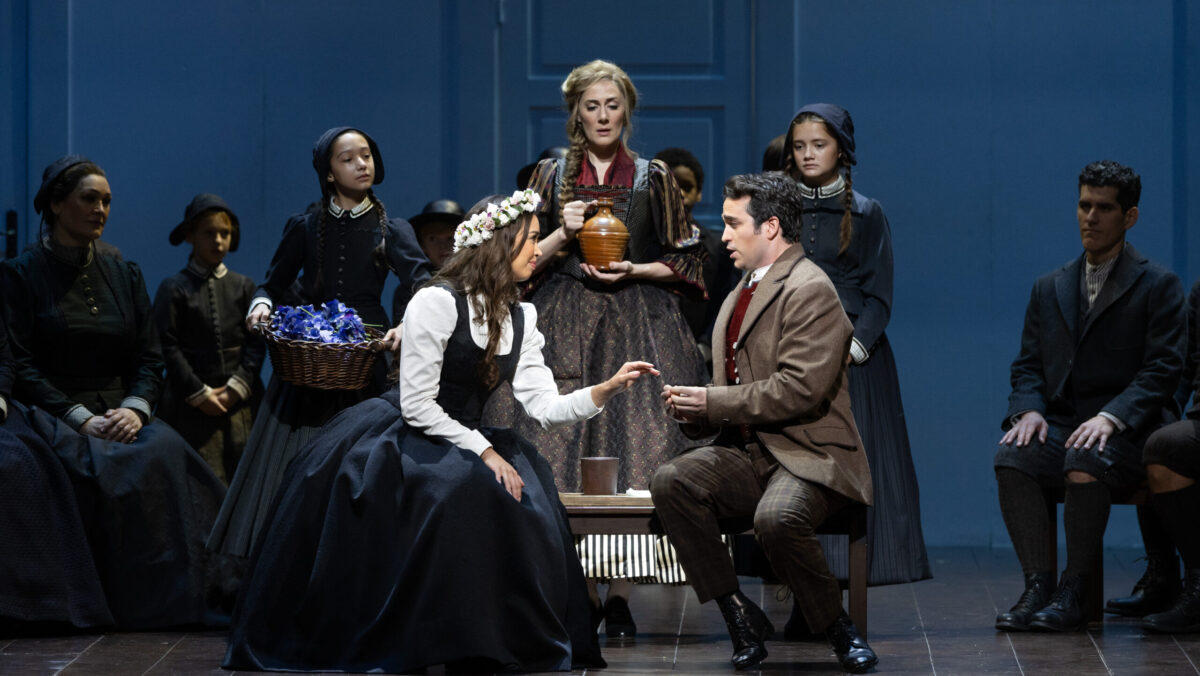
Nadine Sierra as Amina, Sydney Mancasola as Lisa, and Xabier Anduaga as Elvino in Bellini’s “La Sonnambula.” Photo: Marty Sohl / Met Opera
Here Villazón starts to overplay his hand with nonstop movement and redundant business. The chorus is constantly forcing Amina to fold her hands in her lap and not gesture. Twice Amina dons a pink embroidered scarf over her plain dark dress and twice she is forced to remove it – once would have sufficed to make the point. Amina herself has an element of Carol Burnett goofiness with ditsy schtick and silly smiles; Villazón the clown intrudes into the story.
Elvino is played as stiff, humorless, and jealous, both an oppressor and oppressed; he wants to kiss Amina during their duet but fights it. There are some other non-conformists here – Lisa, owner of the inn and Amina’s would-be rival, is not merely spiteful but also an independent and proud spirit with secret pain. Count Rodolfo is a suave cosmopolitan eager to share not just a gallant flirtation but his knowledge of the wider world with Amina. (He gives her a globe.) Amina’s foster mother Teresa turns into a tiger mom when the town turns against Amina, spitting at her, and when Elvino attempts to wed Lisa on the rebound. The lovelorn peasant Alessio is played as a severe assistant deacon and choir master apt to rap children and young women on the knuckles. Lisa really doesn’t want him and doesn’t acquiesce to him at the end.
Another directorial cliché is the dancer doppelganger (Niara Hardister) for the lead soprano. “Dream Amina” is seen at the very beginning dressed in a wispy white negligée twirling on the upstage raised area above the set of white doors. (Choreography by Leah Hausman.) This twirling wraith is an embodiment of Amina’s rebellious subconscious, chafing at repression and curious about all the things she has not been told about or experienced – including sex. She wanders in and out of the action beckoning to Amina. These repressed urges and feelings emerge in Amina’s sleepwalking – when she wanders through the window into Count Rodolfo’s room at the inn in Act I, Amina is dreaming about her wedding night to Elvino. She is finally going to experience sex and the conflicting fear and desire unsettle her psyche causing her to wander in the night.
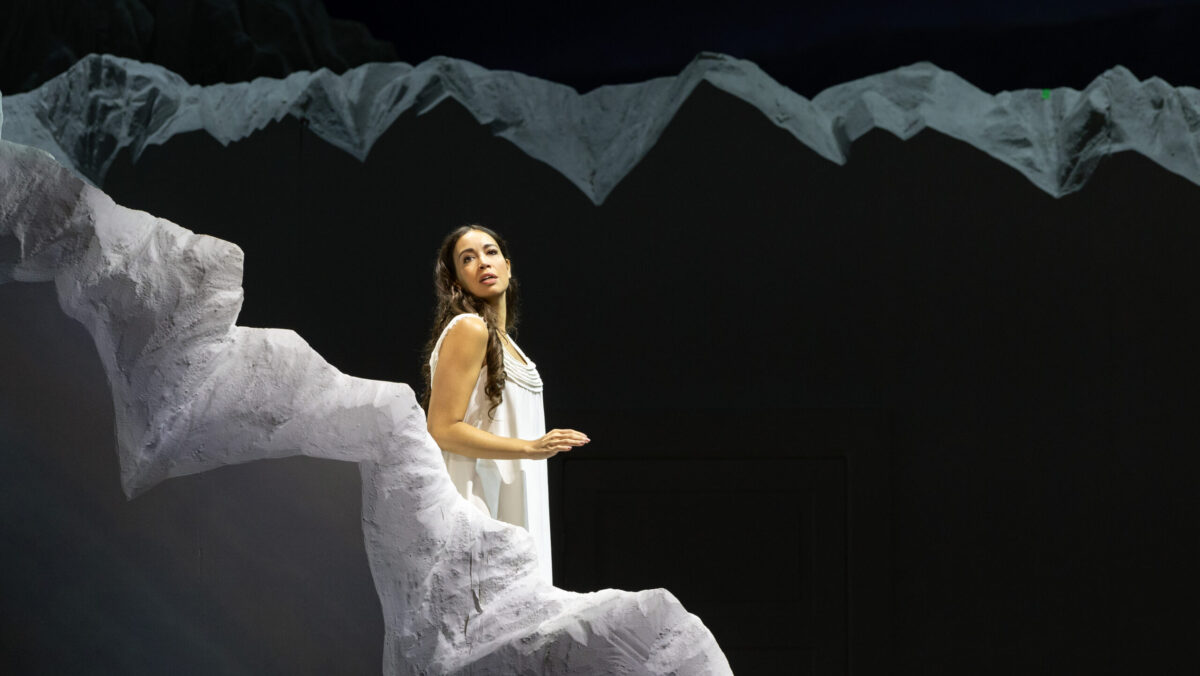
Nadine Sierra as Amina in Bellini’s “La Sonnambula.” Photo: Marty Sohl / Met Opera
In this bleak landscape the barriers between the world of reality and world of dreams are thin and tenuous – some scenes such as the chorus of villagers at the beginning of Act II are staged as Amina’s dreams. During the final double aria, Elvino, Teresa and the villagers are offstage voices as Amina sleepwalks in her own world. Upon being awakened, this Amina sings exultantly but her joy is not from regaining love but from realizing herself. In a revisionist ending that will either delight or mystify the viewer, this community and even her fiancé Elvino prove oppressive to Amina and she makes one final escape.
Villazón’s basic ideas are sound but the execution is often overwrought. The music suggests a sunny Tyrolean landscape but the sets and costumes are wintry and bleak. (A friend described the concept as ‘The Sound of Music meets the Amish’ and more suitable to I Puritani than Sonnambula.) At the final bows, the Mexican tenor-turned-auteur was greeted with marked enthusiasm punctuated with a firm undercurrent of booing. The cheers outnumbered the boos but the boos were insistent and present.
As a diva (and divo) showpiece, this La sonnambula is on firmer ground. As first presented at the Teatro Carcano in 1831, soprano sfogato tragedienne Giuditta Pasta showed her more delicate side partnered by the superstar divo Giovanni Battista Rubini, both of whom “sang like angels” according to Bellini, driving the audience to rapturous applause. So it was Monday night, as Nadine Sierra poured out reams of velvety, radiant cantilena capped with cascades of accurate and brilliant coloratura while displaying a convincingly girlish, charming, and winsome personality. It was a lovefest with the audience.
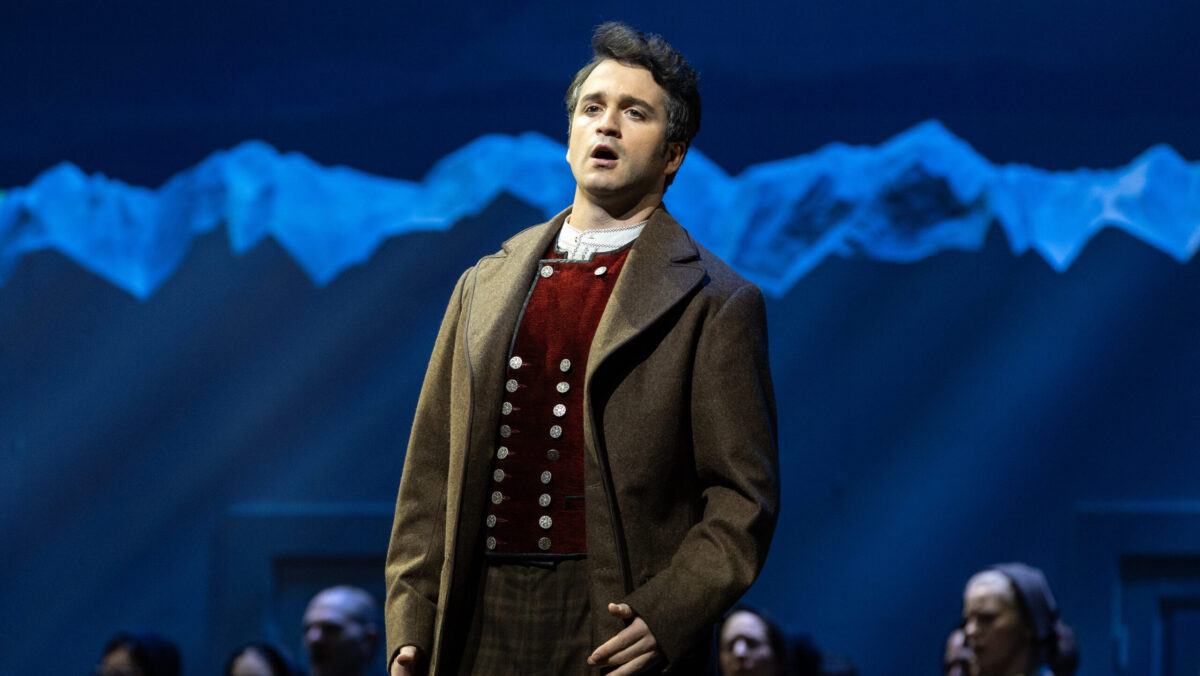
Xabier Anduaga as Elvino in Bellini’s “La Sonnambula.” Photo: Marty Sohl / Met Opera
The adorably boyish Basque tenor Xabier Anduaga conquered the impossibly high tessitura of Elvino, albeit in the usual lowered keys of the Ricordi score, replete with high C’s and D-flats, with a surprisingly rich, mellow, and sweet lyric tenor which bears a resemblance to the young José Carreras (before Karajan, leukemia and the wobble) but with an irresistible tonal brilliance all its own. His characterization of Elvino was a little stolid and inflexible but that, I think, is Villazón’s conception of the male protagonist. Both soprano and tenor phrased with musicality and grace – their duets were unalloyed pleasure. The audience could not get enough of them and were vociferous in their approval throughout.
The supporting players were uniformly apt. Count Rodolfo proved a congenial assignment for the Muscovite bass Alexander Vinogradov who is better suited to the basso cantante repertory, despite somewhat woolly Italian, than the more imposing profondo repertoire he has faced in the past. As the minx Lisa, Sydney Mancasola was tonally bright but not as precise in her ornaments as Nadine. Her acting had moments of sympathy, her pained expression as she witnessed Amina and Elvino plight their troth in “Prendi l’anel ti dono” was trenchant. Mezzo-soprano Deborah Nansteel brought plenty of warmth and feisty backbone to her portrayal of Teresa, the foster mother. Bass-baritone Nicholas Newton as Alessio, in his Met debut, brought a richly supported tone of some force making the character more imposing than the usual mopey loser on the sidelines.
Conductor Riccardo Frizza, a specialist in this repertory, kept the ensemble moving with no nonsense brisk tempos. I think he missed some of the internal contrasts and rhythmic counterpoint in Bellini’s score but the level of orchestral playing and choral ensemble was impressively tight and polished.
In the end, bel canto opera comes down to music and voices, and that was where this production earned very high marks with stellar voices and sincere emotional expression. My feelings about the Villazón concept were initially positive and then became more mixed as the evening went on. But Bellini’s music conquers all and the enthusiastic audience was certainly conquered by the musical magic on display.