Cory Weaver
After planning for over a decade, the company’s premiere of West Side Story at the Los Angeles Opera (LAO) finally took place at the Dorothy Chandler Pavilion on Saturday, September 20; the stunning spectacle marked the start of LAO’s 40th Anniversary Season and also Music Director James Conlon’s 20th and final season.
West Side Story, arguably one of the most iconic American musicals, was created by four Broadway legends: composer Leonard Bernstein, lyricist Stephen Sondheim, book writer Arthur Laurents, and Jerome Robbins, who came up with the idea, directed, and choreographed the 1957 debut. Inspired by Romeo and Juliet, the story takes place in the multicultural, working-class neighborhood of the Upper West Side in Manhattan, where the rivalry between two street gangs (the white Jets and the recently immigrated Puerto Rican Sharks) replaces the two warring families in Shakespeare’s play. The story explores social themes such as racism, immigration, self-identity, bullying, and violence, making it more relevant than ever to today’s world.
Francesca Zambello’s production—a co-production with Lyric Opera of Chicago, Houston Grand Opera (HGO), and the Glimmerglass Festival—originally premiered at HGO in 2018. For this staging, Zambello updated the setting to 2018, the year of the premiere, which is most notably reflected in Jessica Jahn’s hip-hop-inspired costumes (red and black for the Sharks, blue jeans and white for the Jets) and a poster of Bad Bunny in Maria’s room.
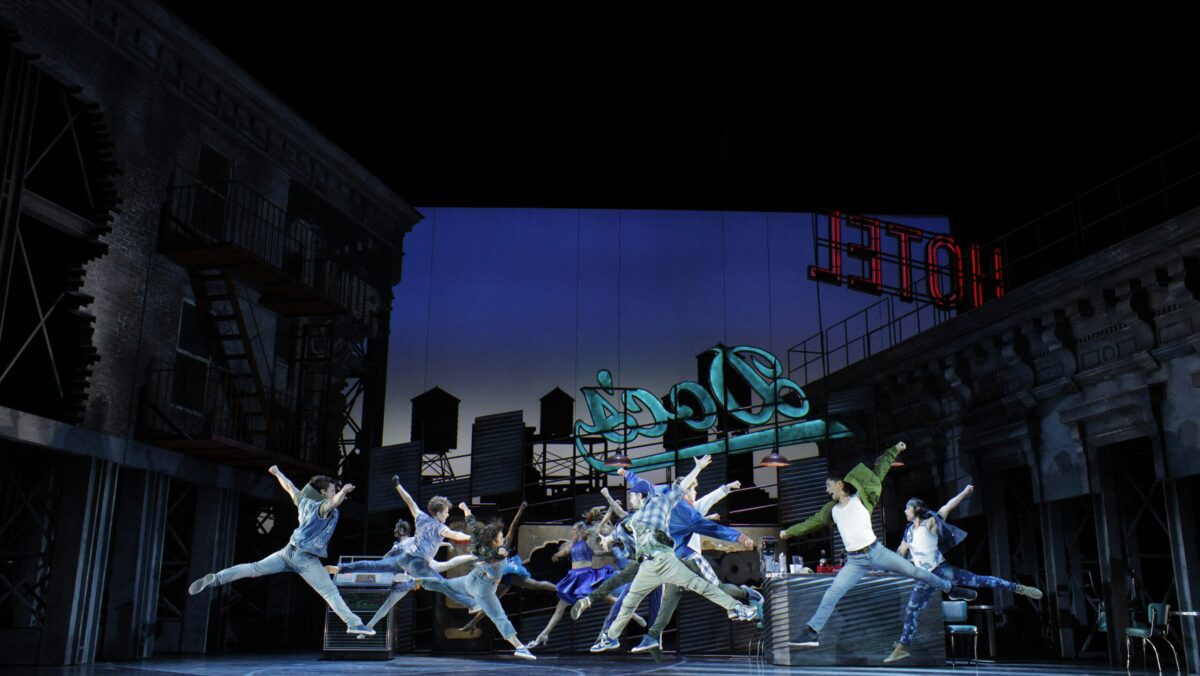
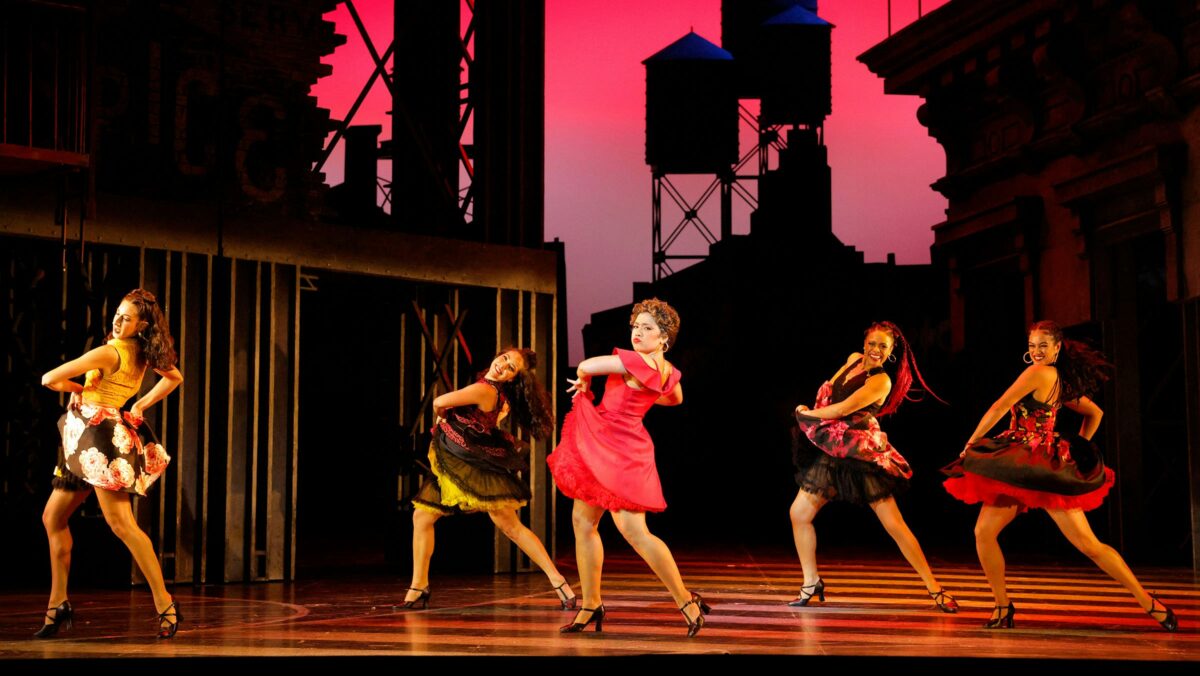
Zambello aimed for a production that was “suggestive of a historic time, but with a contemporary, cinematic feel,” and set designer Peter J. Davison realized that vision grandly with his towering sets that immediately evoked a borough in Manhattan with its scenic skyline in the background. He positioned the action at a junction, with a graffiti-covered brick building on stage right serving as the Sharks’ home, and a columned classical structure on the opposite side for the Jets. The mid-section of the brick building swung open to reveal Maria’s room, and the transition between the façade and the room via a window was hilariously used back and forth during “I Feel Pretty.” Additional walls (such as the one with hundreds of silver balloons and a backboard to denote the gym scene) were flown in and out smoothly from the ceiling, giving the entire show a sleek, polished look.
Another remarkable aspect of the show was the dancing throughout, Robbins’s original choreography meticulously reproduced by choreographer Joshua Bergasse. Bergasse, whose mentor learned the dance directly from Robbins himself, considers Robbins’s choreography “on an equal footing with Bernstein’s music and Sondheim’s lyrics,” and his reproduction was precise, sharply executed, and exuberantly danced, making it such a joy to watch. “The Rumble” scene was particularly jaw-dropping in its intensity.
The updated setting highlighted the relevance of the piece, but here in 2025, it also revealed a danger: several scenes on stage felt too close for comfort. Whether intentional or not, when Chino shot Tony from the top of the Jets’ building, it clearly echoed current events. So, attend this show with caution if such things bother you.
Cory Weaver
From the beginning, LAO planned to present West Side Story with a mix of opera singers and musical theater performers. For this production, the two main lovers were sung by opera stars, while the rest were filled with musical theater performers, many of whom had appeared in previous West Side Story shows (including earlier versions of this one), likely because of the extensive choreography. Everyone on stage was clearly mic’d. While that made the spoken words audible, on Saturday, there were a few moments in Act I where the miking overwhelmed the balance with the orchestra.
Amanda Castro truly made her presence felt as Anita, infusing her bright voice with sensitive phrasing of the lyrics and a range of genuine expressions, from the sarcastic tone of “America” to the hurtful howl in Act II. In a role that features strong personas (both Rita Moreno and Ariana DeBose won Oscars for this role), Castro’s fierce, no-holds-barred character showed a lot of determination, clearly marking her as the leader of the Shark Girls. Likewise, this sharp resolve was also reflected in the clear lines of her dancing, especially in “America.”
Performing in the musical for the ninth time, Yurel Echezarreta, too, displayed familiarity and experience in his portrayal of Bernardo with ease. There was a slick quality to Echezarreta’s delivery, especially in “The Rumble,” where he performed one portion of the “knife dance.” His counterpart, P. Tucker Worley (substituting for an absent Taylor Harley on opening night), brought a dignified presence to Riff, the leader of the Jets. Another Jets member who made a strong impression was David Prottas, whose brazen, impetuous Action evoked a dangerous, almost hateful, persona. LAO assembled a strong ensemble for the comprimario roles, both in singing (under Chorus Director Jeremy Frank) and dancing, as both the Jets and the Sharks.
Cory Weaver
The miking proved to be somewhat problematic for the opera singers in the central roles, particularly for Gabriella Reyes’s Maria, as it amplified her slight vibrato to the point of obscuring her beautiful voice, especially in the Act I climaxes. She fared much better in the more introspective aspects of the score, such as in the duet “One Hand, One Heart.” Fortunately, sound designer Andrew Harper seemed to address the matter in the next Act. Reyes’s tender “Somewhere,” in this production assigned to Maria, was both heartbreaking and hopeful, and it definitely stood out as a highlight.
Reyes’s characterization of Maria was an interesting case study. Gone was the usual doe-eyed naivety the role portrayed, replaced by a steely determination to live, and eventually, to love. It was definitely reflective of her own experience, being the daughter of immigrants. The duet with Anita, “A Boy Like That/I Have a Love,” for example, memorably turned into a sort of “battle of wits” between two strong women asserting their loves. Such a genuine and authentic portrayal made the ending even more shattering – Do you choose to hate, or to love?
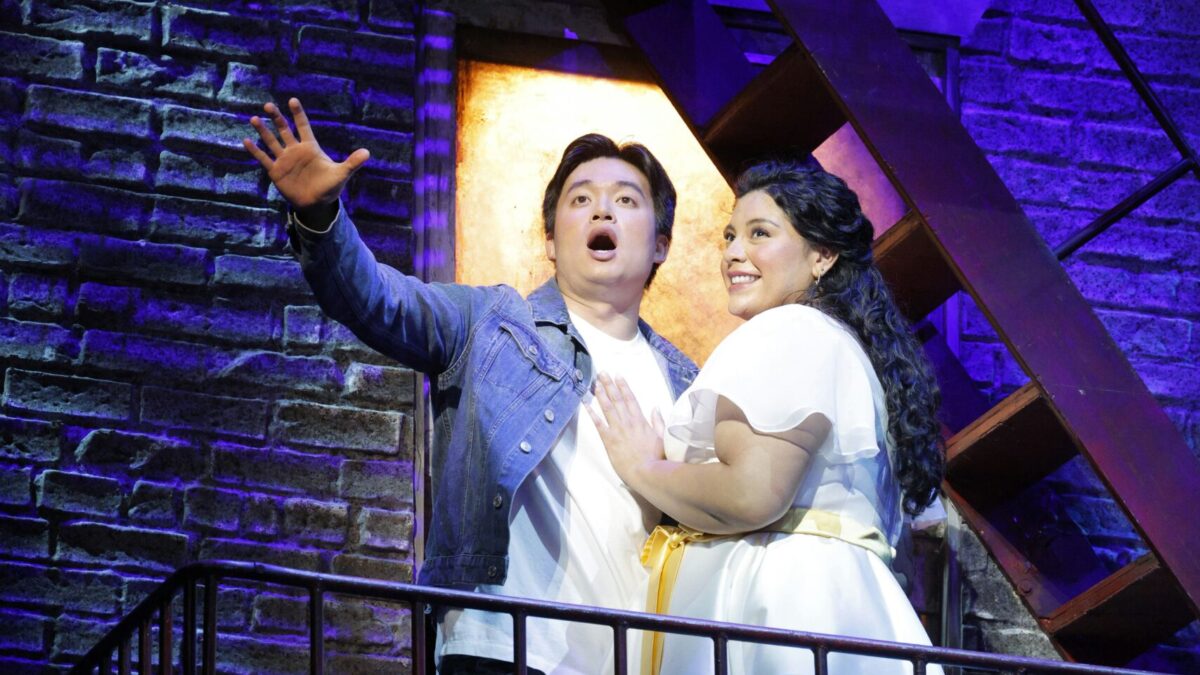
Personally, the choice to cast Duke Kim as Tony was a curious one, especially in a production where racial identities played a defining factor, and considering the controversy surrounding the 2020 Broadway revival mentioned above. Zambello herself emphasized that it was important that “everyone who’s a Shark is Latino.” Unfortunately, such a casting ended up making Tony seem like an outsider within the Jets himself, in my humble opinion.
Nevertheless, Kim sang the hell out of Tony, bringing a youthful, innocent quality to the role with his bright, sonorous tone, culminating in a jaw-dropping “Maria” that brought the house down. His Tony was almost too naïve for his own good. He demonstrated considerable acting chops, especially in the final scene, where he transitioned from naivety to anger and rage, which ultimately led to the tragedy.
The highlight of the event for me was unquestionably Conlon’s conducting, a sentiment that seemed to resonate with the audience that night. Conlon, who grew up in New York City, demonstrated a strong connection with the city as shown in his illuminating talk above. He showed great respect for the score, guiding the LA Opera Orchestra with a steady hand, clear precision, and energetic vigor, along with meticulous attention to detail. Under his direction, Bernstein’s intricate melodies and percussive rhythms came to life, with every syncopation skillfully executed and every dance beautifully performed. As the icing on the cake, the orchestra for opening night was enhanced with seven additional violinists and one bassist, adding extra grandeur to the whole event. To my ears, it was undoubtedly one of the best occasions I’ve ever heard him conduct!
This was truly an auspicious occasion for LAO, marking a great start to its 40th Anniversary Season. I am pleased to report that tickets are selling quickly, to the point that two additional shows (October 11 and 12) have been added. Don’t miss the chance to experience this extraordinary production live if you can!