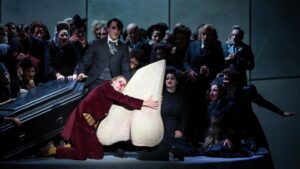
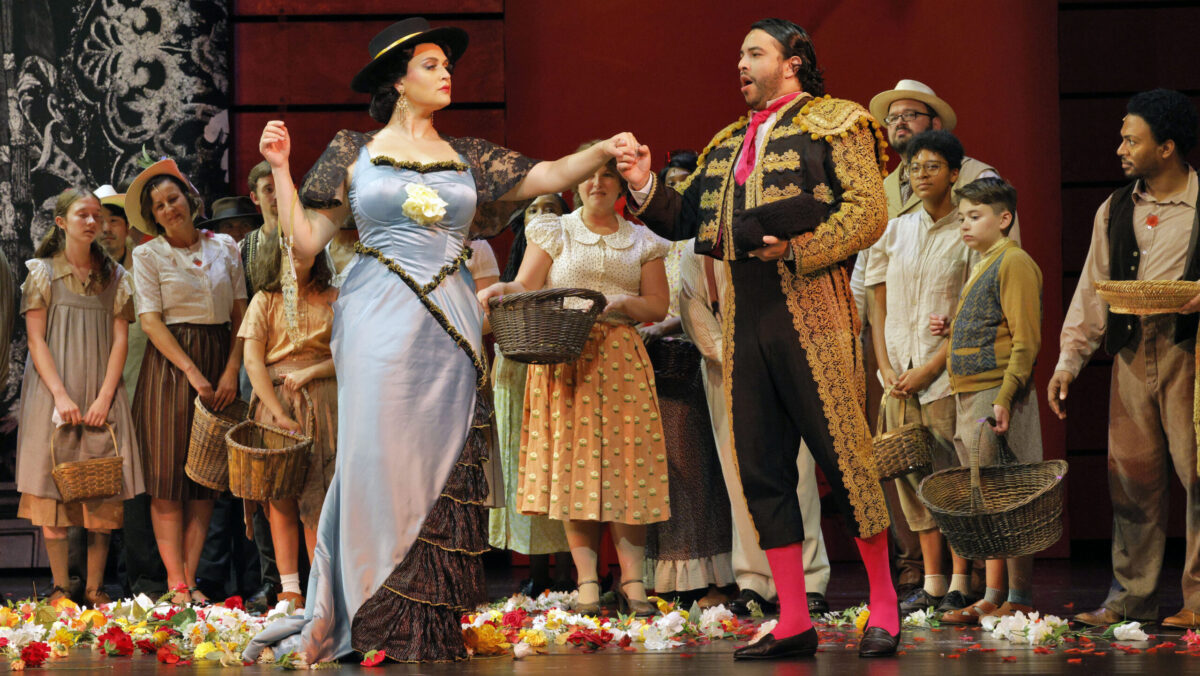
Courtesy of Wolf Trap
The nation’s capital is looking ahead to the US semiquincentennial — alternatively, the sestercentennial or bisesquicentennial, if you prefer —the 250th anniversary of US independence. (The Washington National Opera and National Symphony Orchestra’s 2025-26 seasons are replete with American composers.) But this year marks another anniversary with an unwieldy Latin-derived name: the sesquicentennial (150 years) of one of the most beloved operas in the standard repertory, Georges Bizet’s Carmen, which debuted at the Opéra-Comique in 1875. Wolf Trap Opera offered a timely celebration of this milestone with a performance of Carmen to a packed house as the finale of its summer 2025 season. For one night only, Wolf Trap’s Filene Center took the Met’s crown as the largest opera house in the country; the outdoor amphitheater boasts a maximum capacity of 7,028 between a covered pavilion and lawn seating.
Mezzo-soprano Elissa Pfaender, returning to the Wolf Trap stage after a scene-stealing turn as Marcellina in Le nozze di Figaro in June, was vocally an excellent fit for the role of Carmen. Her dark, smoky mezzo underlined the rebellious and mercurial nature of the character and Pfaender sounded particularly fine in the rich depth of her lower range. Tenor Daniel O’Hearn gave an even, sweet-toned rendition of Carmen’s lover turned jealous ex, Don José, and his melancholic delivery of his Act II aria “La fleur que tu m’avais jetée” was a highlight of his performance.
Soprano Amanda Batista sang Micaëla with earnest girl-next-door charm and enjoyed some of the biggest audience applause of the evening, including for her showpiece Act III aria “Je dis que rien ne m’épouvante,” an effective vehicle for Batista’s expressive tone and strong upper register. Baritone Laureano Quant was a smooth-talking, delightfully swaggering Escamillo with plenty of bluster, particularly in his Act III confrontation with his rival, Don José. Soprano Midori Marsh, mezzo-soprano Erin Wagner, baritone Charles H. Eaton, and tenor Travon D. Walker sang the roles of Carmen’s four smuggler associates with gusto and delivered a spirited, nimble rendition of Act II’s quintet at Lillas Pastia’s tavern. As Don José’s commanding officer Zuniga, Sam Dhobhany’s assertive bass and authoritative stage presence elevated a smaller role. William Woodard led a rousing chorus that brought character to the streets of Seville.
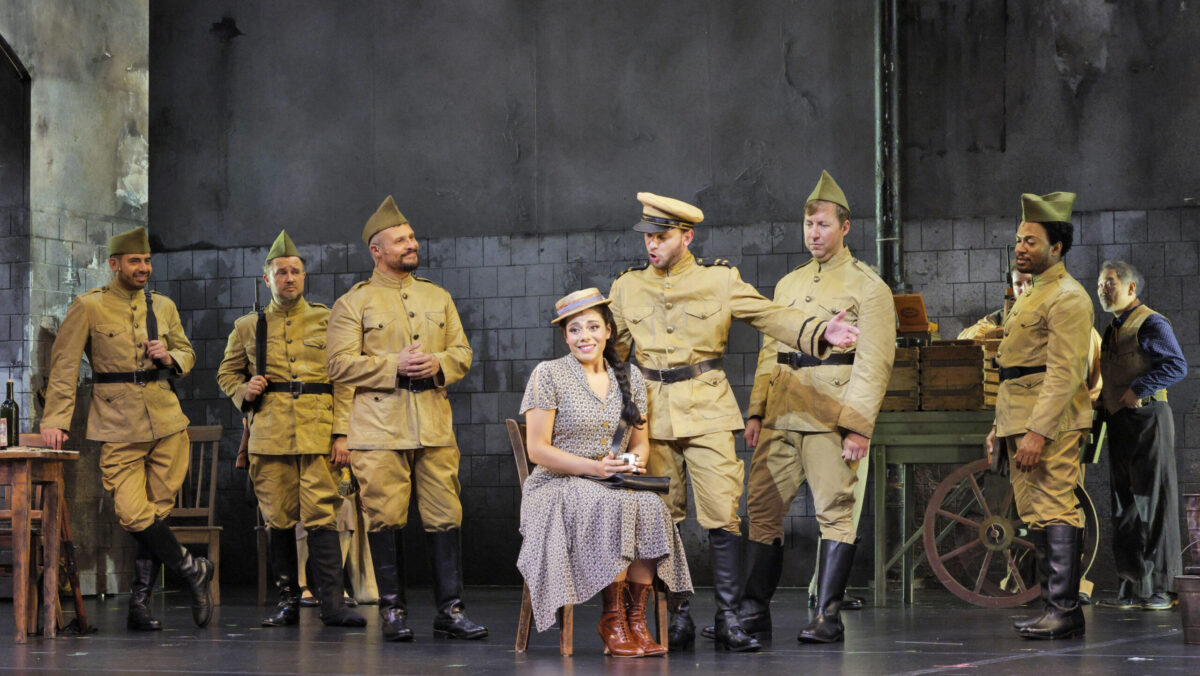
Courtesy of Wolf Trap
Seeing opera in the great outdoors can be magical — my personal favorite Wolf Trap memory is the outbreak of a thunderstorm aligned with the conclusion of Verdi’s Rigoletto; you can’t ask for more effective staging than that — but summer open-air opera in Virginia has its perils. Wolf Trap’s artists took the stage on an evening that can be only described as soupy; local humidity levels during the three hours of the performance peaked at 91 percent. The cast’s acting, particularly the dynamic between Pfaender’s Carmen and O’Hearn’s Don José, was not as steamy as the weather—but singing opera at all under such conditions cannot be easy. I hope to see this cast’s singers again, particularly Pfaender, in a more temperate setting.
Conductor José Luis Gómez presided over the Wolf Trap Opera Orchestra in an effective performance of Bizet’s timeless score, the second time that Wolf Trap audiences heard it this summer (the National Symphony Orchestra played selections from Bizet’s Carmen Suites in July), but the first in context. Gómez’s conducting particularly shone in the orchestra’s dreamy accompaniment of Batista in Act III. The cast sounded crisp in its pronunciation during the libretto’s spoken components, a credit to the work of French diction coach Jocelyn Dueck.
Co-owned by the Glimmerglass Festival and Minnesota Opera, this production of Carmen set Bizet’s opera in approximately 1930s Spain, adding a greater poignancy to Carmen’s famous declaration that that she was born free and will die free. Director John de los Santos’s efforts to update the 150-year-old opera bore some fruit but fell short in certain ways. (The program notes that the production was originally directed by Anne Bogart.) The director’s decision to have Carmen mastermind her own escape plan (even as she still manipulated Don José into letting her go) with a signal to sidekicks Mercédès and Frasquita to put a scheme into motion deepened the character with greater strategic focus. His change to the opera’s finale, which left Carmen limping off stage, wounded but alive, and Don José seemingly oblivious to the unsuccessful outcome of his attempted homicide, felt inconsistent with Bizet’s music, however. The composer’s memorable fate motif drives towards a tragic end that this production ultimately did not deliver.
The introduction of a prominent supernumerary, an older woman who popped in periodically throughout the opera to give Carmen pointed looks, raised more questions than it answered and it wasn’t clear what this device was meant to represent. De los Santos successfully gave audiences a vibrant taste of Seville, thanks to excellent blocking of a large roster of choristers that conveyed a bustling city and the captivating inclusion of a pair of flamenco dancers during the Act IV entr’acte. Scenery originally designed by Riccardo Hernández for Glimmerglass evoked a Seville with a dark, seedy edge. Act IV’s set design featured artful projections, including one of a 17th-century statue of the Virgin Mary from a Seville basilica as it appeared prior to a recent botched restoration.