Lawrence Sumulong
Listen, we all have our regrets. Sometimes, out of nowhere, I’ll remember that talented violinist I was way too mean about in a series of reviews a decade or two ago, or that opera I was way, way too nice about, and I’ll feel a sharp pang in my gut, and my heart will beat a little faster. In 2021, at the New York premiere run of Eurydice, I pasted a new regret into this mental scrapbook of shame: how incredibly hard I had slept on the music of composer/conductor Matthew Aucoin, whose breathless press and 24-karat résumé (summa cum laude at Harvard, graduate studies at Juilliard, assistant conductor at the Met) had me groaning and rolling my eyes the other way until I finally sat my ass down and listened to one of the most perfectly conceived English-language operas from the past quarter century.
Why oh WHY must the hype swirling around the accomplishments of brilliant young people with their whole lives ahead of them always turn me into one of those bitter, resentful critics from some fucking Ayn Rand novel? Well, okay, I guess I know why, but whatever, the point is: believe the hype. Matthew Aucoin really is everything he’s made out to be. Earlier this month, he and his American Modern Opera Company (AMOC*, with an asterisk, like Marvel’s Thunderbolts*) closed out their Running AMOC* festival at Lincoln Center with the New York premiere of Music for New Bodies, an opera/oratorio/song cycle on texts by Jorie Graham, and Aucoin proved again the depth, richness, and flexibility of his resources as a composer of vocal music.
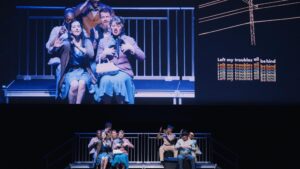
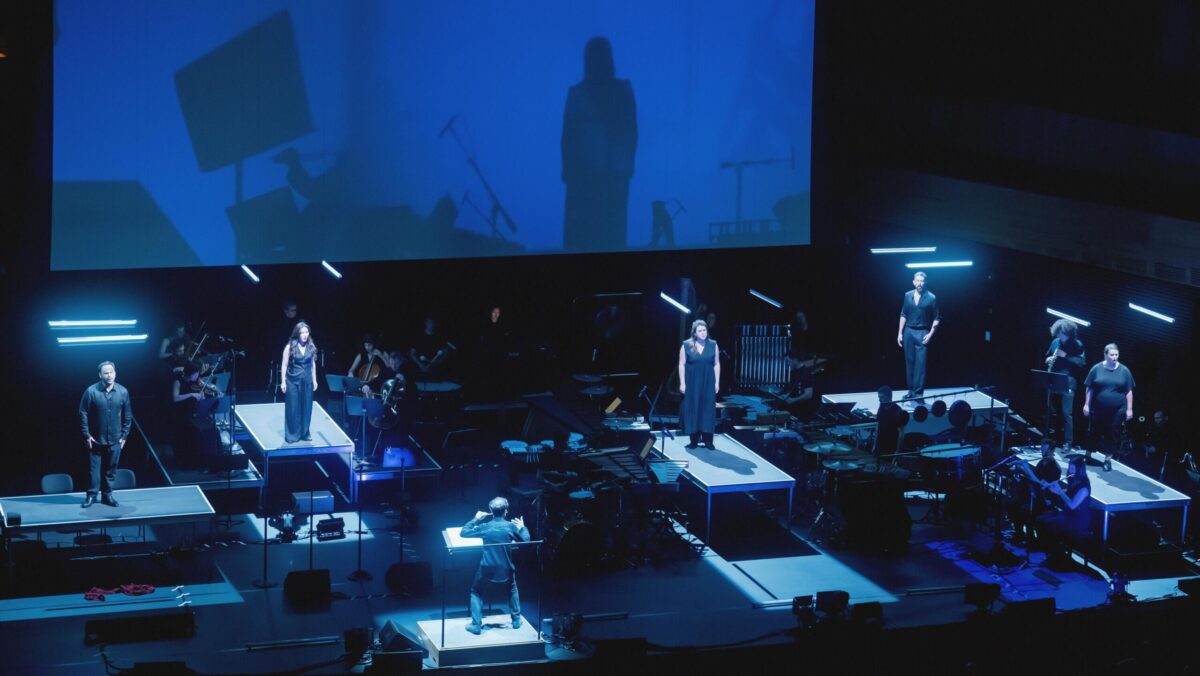
New Bodies sets five poems by Jorie Graham, one of our most celebrated living poets and (of course!) Aucoin’s mentor at school, and each dark, occasionally cryptic lyric settles heavily on the one before to create the cumulative sense of a vast, apocalyptic collapse: of the body, of the self, of the sea, of the Earth. Director Peter Sellars, who—much as he did with John Adams’s pre-Antony & Cleopatra operas—helped conceive the piece in addition to creating the staging, lent the piece a suitably grim, alienating, sub-aquatic vibe with color-changing LED bars hanging just over the heads of the performers (part of designer Ben Zamora’s lighting scheme) and stark, table-like metal risers as the only set. The performers were outfitted in basic black—presumably their own clothes. (Victoria Bek was credited as “costume stylist” rather than as designer.)
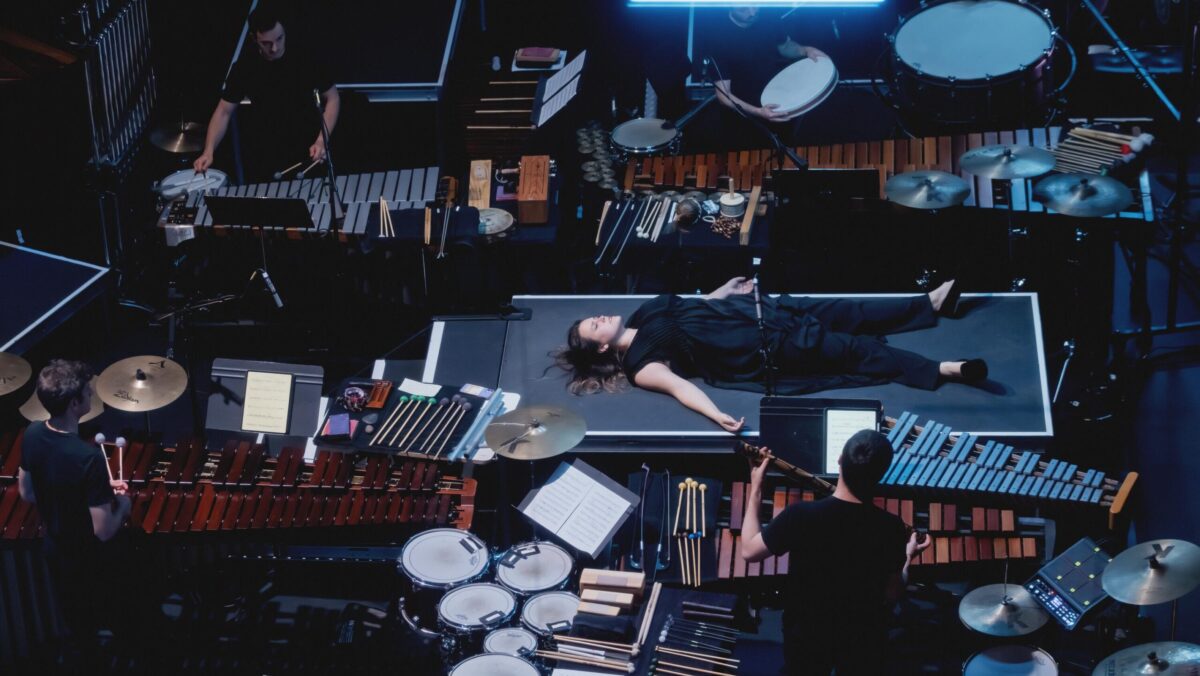
Somehow, even in this minimally-staged production, Sellars’ direction managed to showcase, as usual, both his genius for stagecraft as well as just a dash of unintentional silliness. Why did the cast use standup mics for spoken passages, when I was fairly certain they were wearing discreet stage mics for the sung passages? I can’t be sure, but it worked! (And Mark Grey’s sound design—there’s a name I’ve been typing a lot this year—was solid and discreet, except where required to be otherwise.) I loved seeing the singers and musicians stand together, physically, when their voices and instruments were paired in the score, and it made musical and visual sense to have the two male voices in the quintet seated at a desk for much of the show, while each of the three women was placed at the head of a different little choir of instruments: the string section, the woodwinds, and the percussion. (This last was played by the wonderful Sandbox Percussion quartet.)
Aucoin describes his piece as an “opera,” in the larger sense of that word, and I won’t argue, though to me the piece felt more like a book of dark madrigals, with each of the singers representing an internal dialogue rather than different characters. The effect in this staged performance was something like a late Samuel Beckett drama, or Sarah Kane’s 4.48 Psychosis, where the multiplicity of voices suggests the shards of a shattered psyche.
Lawrence Sumulong
But once in a while, the characters would be unified by some kind of stage business, to varying degrees of success. Did we need everybody to whip out their phones, early in the piece, like those scientists in the Adams/Sellars Doctor Atomic dutifully trooping onstage with the sandwiches and coffee mentioned in the libretto? Did we need everybody to flop around on the floor like fish out of water during the third movement, “Deep Water Trawling?” It seemed a little… Mickey-Mouse. I thought of an article I read years ago where a musicologist scoffed at the notion that there was something “queer” about female voices singing about beautiful women in Renaissance madrigals, since after all, we didn’t imagine that Monteverdi’s five-part settings of Petrarch meant Laura was being wooed by a would-be polycule. These little, too-specific moments broke the spell, and put me in mind of poor Laura and that amorous quintet.
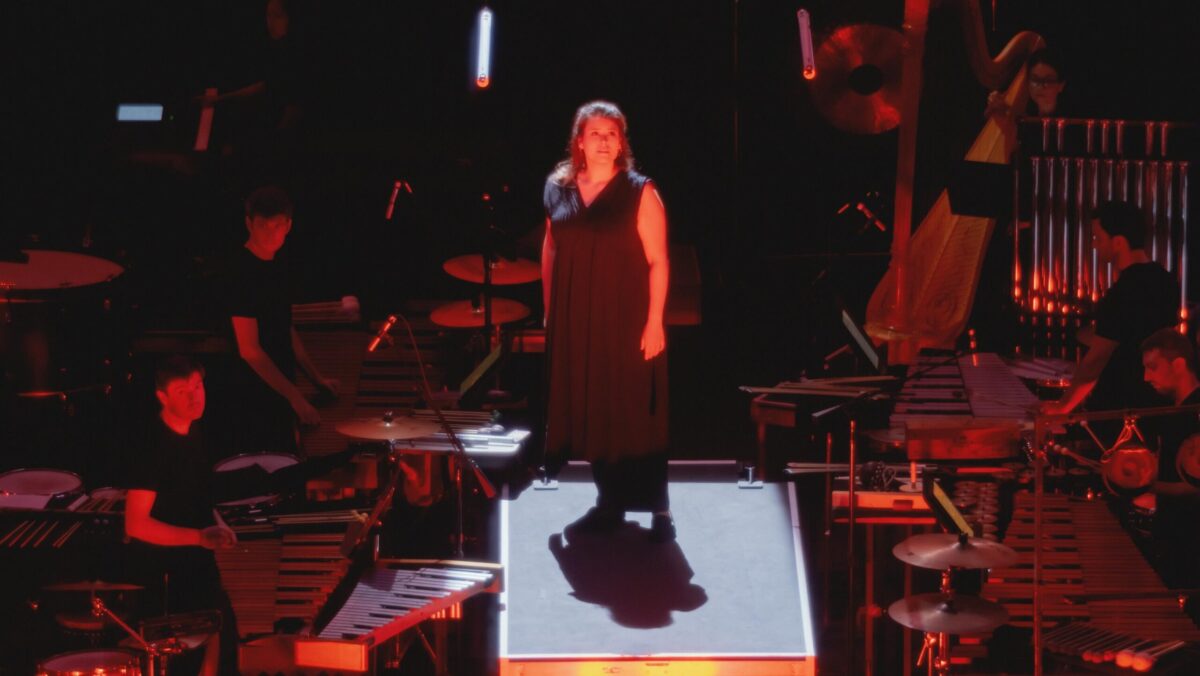
But the singers committed fully to the business and, even more importantly, to the music. The vocal texture was dominated by delicious ensemble writing, but a few voices did catch the ear more than others—the brilliant color of Aucoin’s music comes from the thick, dissonant close harmonies in the highest registers, and so Song Hee Lee’s spectacular coloratura soprano singing was a special treat, particularly juxtaposed against the high woodwinds, where Aucoin’s clusters generated Ligeti-like psychoacoustic effects. Megan Moore’s earthy mezzo lent a human warmth and pathos to her solos, and I find myself falling more in love with Paul Appleby’s bright, high tenor instrument every time I hear it — which, to his credit, seems to be more and more these days. The authoritative bass-baritone of Evan Hughes and the sweet soprano of Meryl Dominguez rounded out the ensemble.
The real star, though, was the composer, whose command of vocal and instrumental writing gave every moment a pyrotechnic sparkle. Graham’s often complex and fragmented verse sings naturally in his settings, and all of her most moving (or upsetting) lines flew unerringly home. This, from “Prying,” a poem in which the speaker prepares to be anesthetized before surgery for cancer, hit me right in the soul: “They will / learn everything about me while I sleep.” It’s all there, the alienation of illness, of modern medicine, of the very mind, lurking with a dreadful irony in an almost childishly simple turn of face.
Lawrence Sumulong
And Aucoin’s bag of tricks is absolutely bottomless. I namechecked Ligeti’s woodwinds a minute ago; the writing for metal percussion reminded me of Boulez and his high modernist compatriots. But the music is always grounded, with roots in tonal harmony and in pulsing rhythms that become less and more apparent as required but constantly offer the requisite emotional push and pull. There was a moment where I thought he’d strayed into cringe, with a percussionist suddenly playing a slightly hokey pop beat, the singers doing jazz chords, and the lights flashing different colors like a disco—and then, as if reading my mind, he immediately struck back with a harsh sample of electronic noise.
The piece moved with remarkable swiftness for 70 uninterrupted minutes with no plot and no characters, but then, it was created by a composer and a director who have each demonstrated a deep understanding of how to shape and stage musical material for maximum dramatic impact. And the end, when it came, turned to a musical language of genuine warmth and reassurance, offering some hope, some consolation, after all the darkness and doom.
The hybrid form of Music for New Bodies, says Aucoin, is something of a departure for him. I’ll admit that after his masterful comedy and pathos in Eurydice, I can’t wait for him to return to “real” opera (you know what I mean), but this cycle demonstrates that whatever form his next theater piece takes, it will be sure to enthrall.