Changing habits
A new production of Dialogues des Carmélites featuring Anna Caterina Antonacci proves that it’s hard to be an iconoclast in Venice.
Michele Crosera
Everyone in Venice appears to be obsessed with space right now. Not the outer kind, but rather the theoretical concept “Bodies and spaces,” as the trope is occasionally derided. From the 2025 Biennale Architecture exhibitions that were uniformly animated by the idea of an installation-as-space to the Peggy Guggenheim Collection’s temporary exhibit of Maria Helena Vieira da Silva entitled “Anatomy of a Space,” Venice’s mythical dual-nature as a monument to ancient history that is nevertheless perpetually brimming with life from all over the world can be felt everywhere. But at a first glance, the former tendency seems to override the latter. This, after all, is a city where any new construction is inevitably an endeavor of restoration rather than creation; the overarching attitude seems to be that the book is closed on Venice – rather than be additive or subtractive, moving forward means preservation and maintenance.
Within this singular context, Emma Dante’s new staging of Francis Poulenc’s Dialogues des Carmélites at Teatro La Fenice is moderately ambitious and mostly successful, due in no small part to the fastidious conducting of Frederic Chaslin and committed performances from a cast featuring both emerging international artists and a particularly engaged and possessed Anna Caterina Antonacci, now in her 42nd year as a professional soloist.
Dante’s staging of Carmélites (a co-production with the Teatro dell’opera di Roma) is the first ever to reach the Venetian lagoon. This may be somewhat surprising to those who are familiar with the opera’s performance history, which saw its world premiere at Teatro alla Scala in 1957 – in Italian. (Leyla Gencer AND Virginia Zeani? At the same time?)
To perform Carmélites in French at an Italian house like this production did is, of course, contrary to Poulenc’s oft-cited wish that his recitatif-driven opera be presented in the vernacular of whichever locale it appears. Yet it may be that the musical benefits of performing in French outweigh potential dramatic inadequacies; Poulenc’s inspirations for the work were diverse, with the score’s cover page citing Debussy, Verdi, Mussorgsky and Monteverdi as “models.” One might argue that the most palpably felt of the four is Monteverdi, evidenced by the way recitative is used as a vehicle of expression rather than a tool for exposition. Yet Poulenc maintains a characteristically “French” approach to recitative, capturing natural linguistic rhythms and stresses no matter how many irregular metrical changes and subdivisions are required. In this vein Poulenc more closely channels Lully, but you find evidence of similar text setting from as early as the 14th century.
The cast dispatching this recitatif was aided in no small part by Chaslin’s skillful and well-calibrated direction of the orchestra. Poulenc’s score is (relatively) harmonically conventional but formally dense, with complex tableaux that require coordination between the stage and pit as well as expansiveness with its long, irregular melodic ideas. Invariably, vocalists of all different scope have to be assembled to fit the kaleidoscope of characters presented, which puts a significant amount of pressure on the conductor to secure balance across the many recit-heavy scenes.
For his part, Chaslin rose to that challenge, which was particularly apparent in the earlier scenes where Blanche’s father and brother — a booming duo of Armando Noguera and Juan Francisco Gatell — were provided with a slightly higher degree of timbral edge from the strings than in the later scenes. Minus an apparent false-start at the beginning (a minute in the action stopped and the curtain fell and the show restarted with no explanation), this was the right person for the job.
Michele Crosera
It’s important to have that level of comfort managing verbose, expository vocal writing when the opera in question is as emotionally textured as Carmélites. As far as operatic plots go, the surface details – a Carmelite monastery caught in the crosshairs of a raging French revolution, a willful aristocratic young woman who abandons her birthright for a life of perpetual devotion, a shockingly expressionistic mass execution sequence – are sufficiently compelling on their own. But the subtleties between varied prisms of fear through which the characters perceive their circumstances are unusual for the medium.
Have you ever thought about joining a convent? I confess to never experiencing the kind of religious convictions that would draw one to such a life, but on a purely affective level, there’s always been something so wistful and melancholy yet hopeful and peaceful about that kind of decision. Whether you go through with it or not is another matter, but the decision process certainly would make for some compelling scenes – it’s not that I actually want to be Maria von Trapp but imagine the catharsis of saying “I don’t know… I don’t know!” in the Reverend Mother’s study. Much in the way I don’t think I’d like to be Princess Margaret but I could definitely see myself curating a few interpersonal breakdowns against the glittering backdrop of the Caribbean sea. I’m getting off topic.
To be fair, the well-heeled Blanches de la Force of the 21st century are afforded a slightly larger array of escape routes from the indignities of the modern, should they feel so compelled. They can teach aerial fabric at Club Med or sell hemp jewelry in Vermont (or in cases of severe emotional damage, start a PhD in the humanities). But The Convent, as a looming “other way,” is still very much there. Catholicism is, at least reportedly, also on something of a rise within the younger generations, so who knows?
Michele Crosera
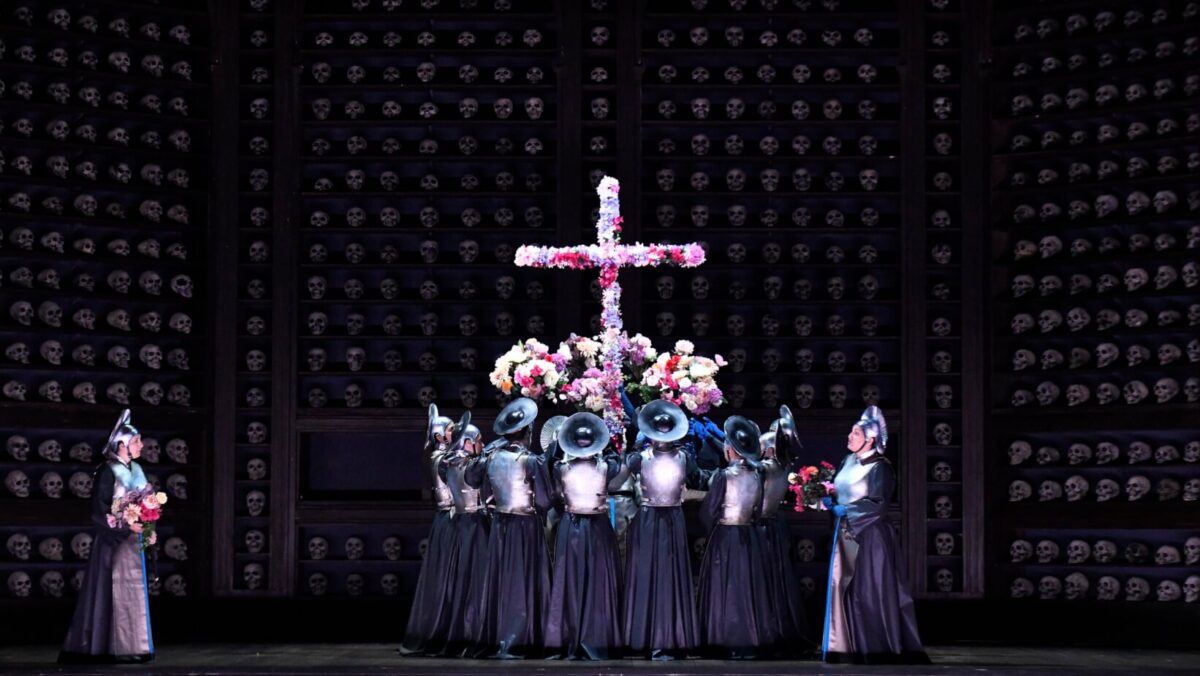
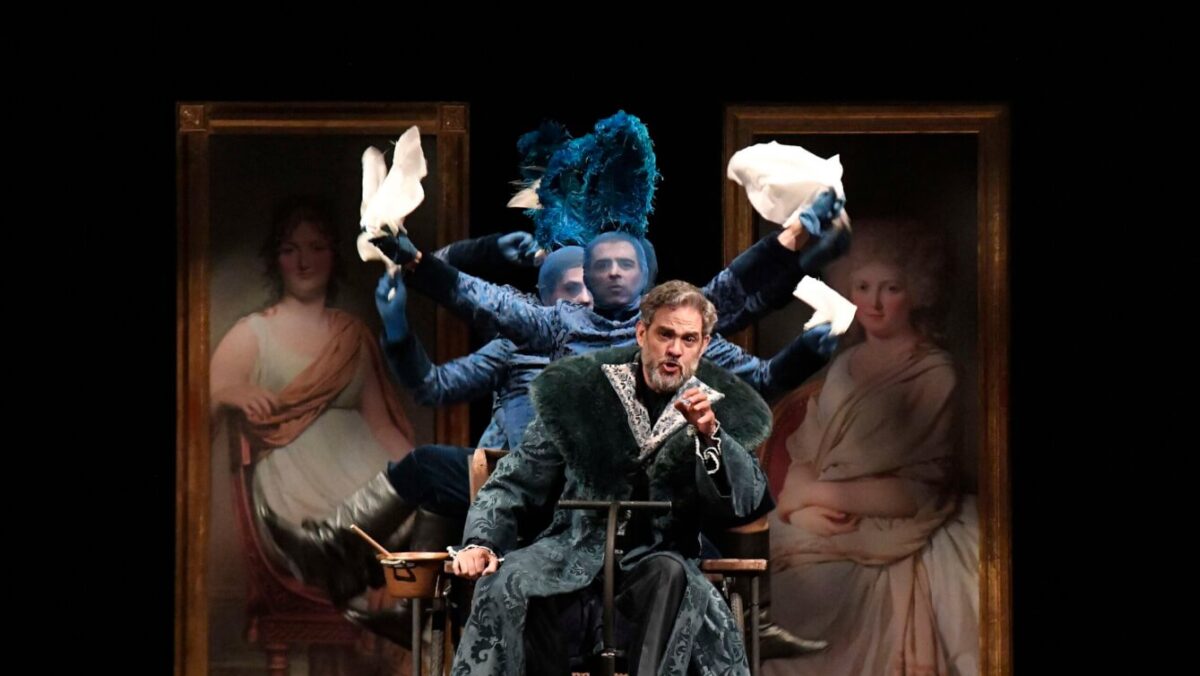
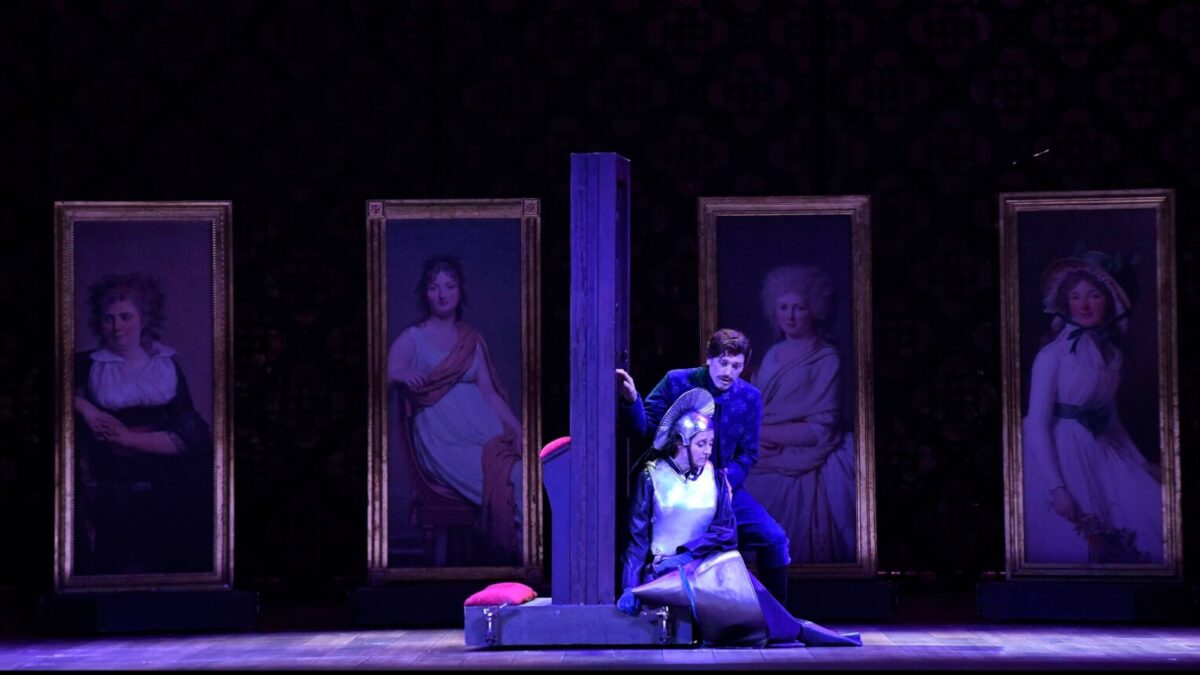
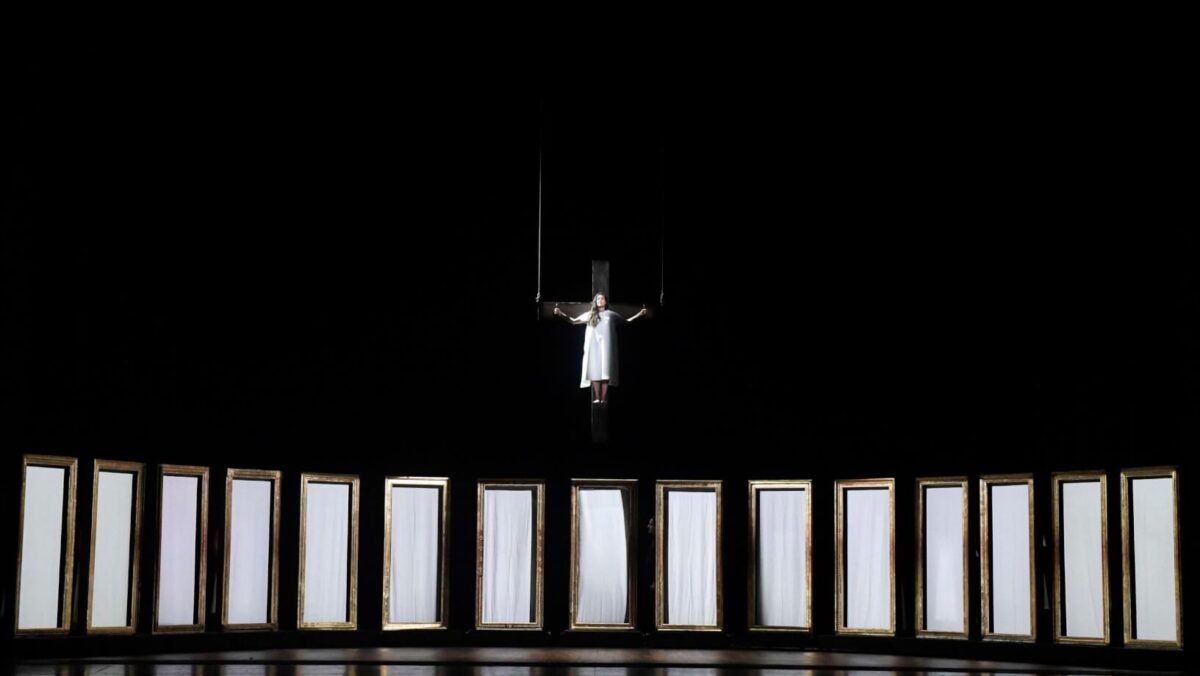
All this to say, Carmélites is an opera that is amenable to updated stagings. Historical context aside, a story about a young woman seeking respite from imminent political and social collapse requires little effort to be transposed into the 1830s, or the 1940s, or 2025 etc. so I was intrigued to see what Emma Dante would bring to this historic Venetian premiere. Many elements were familiar: a collection of life-sized framed portraits of women were later fitted with spring-powered white curtains that fell one-by-one during the execution sequence. Early convent scenes featured the nuns in plain off-grey habits. If there were any blatant anachronisms, I did not notice them.
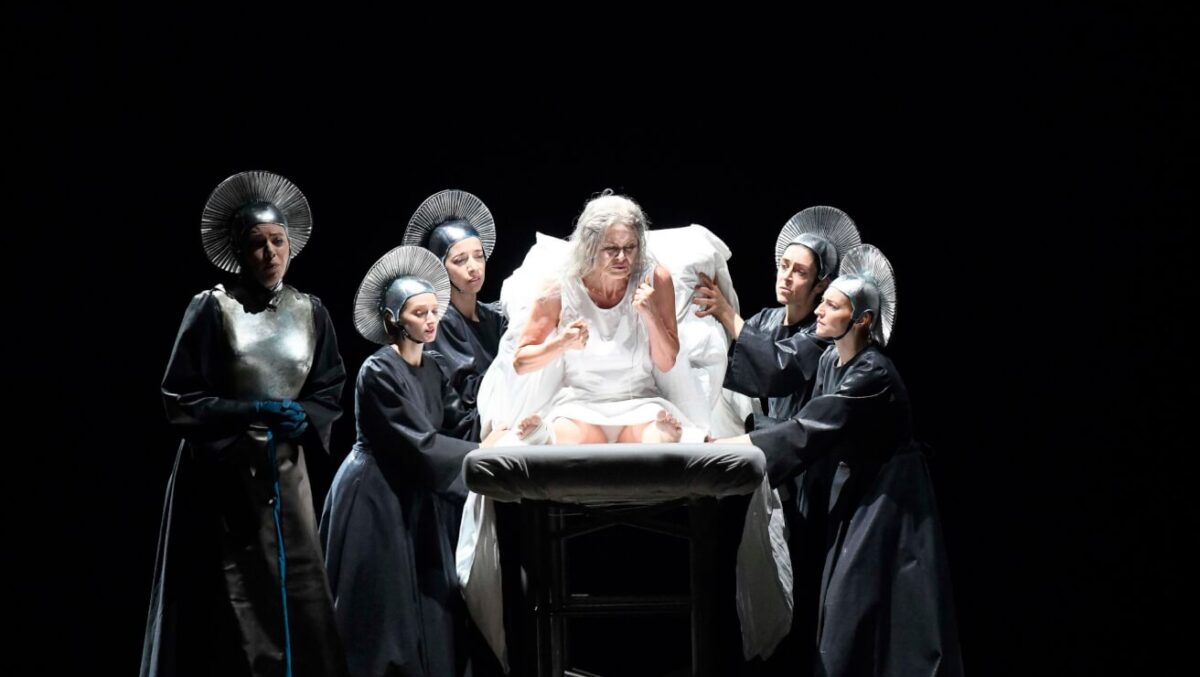
Yet that isn’t to say Dante’s approach was conservative. There were certainly some provocative elements – an androgynous Christ-like mannequin swung from a crucifix and was later taken down by the nuns. (Blanche would later make her final ‘surprise’ appearance on this same cross.) Convent attire was far from static – though a nominally Carmelite order, subsequent scenes where the nuns either wore gilded Nimbus crowns or let their hair flow freely evoked something closer to Hildegard’s Rupertsberg. But more broadly, Dante seemed to be trying to heighten the otherwise predictable elements of her stagecraft. A mammoth oversized ironing board transformed into de Croissy’s deathbed. Blanche’s initiation into the order unfolded like an interrogation, the sleeves of her habit overlong and stretched across opposite sides of her body like a straightjacket. The Marquis de la Force was followed around his mansion by a coterie of male dancers wearing turquoise feathers on their heads.
As is often the case with productions that seek to thread the needle of both tradition and innovation, I was subsequently not left with an overly strong impression of Dante’s read on the story. But that is only one facet of a staging – what also matters is the degree to which the characters are able to express the uncharacteristically layered emotions underlying their motivations. Carmélites is distinguished for having some of the most interesting female characters in the repertory, with the central role of Blanche de la Force being especially complex.
Michele Crosera
I love Blanche because unlike many operatic characters I do genuinely relate to her — and not in a “we all feel like Maria Ewing from time to time” way (as a side note, I literally am Rosanna Carteri) — but more because the borders of her existential dilemma feel much closer to home. As a character with a foot both in and out of the door, Blanche can embody our own ambivalence towards our (real and imagined) circumstances. The crises unfolding around Blanche are historically remote but her fear of fearfulness is wholly modern.
When I saw Julie Cherrier Hoffman listed as the Blanche for this production I was excited to hear the role undertaken by an apparent specialist in this repertory. (La voix humaine, one of her most frequent bookings, is perhaps the example par-excellence of Poulenc’s recitatif style.) Simply put, Blanche is an unconventional leading soprano role in both tessitura (it’s mostly low but frustratingly exposed whenever high) and form (she is nearly always in dialogue with another character and rarely expresses herself at length). But irrespective of where a Blanche sits in the current fach-astrology, she needs to express a lot using a comparatively modest array of vocal “looks.”
Unfortunately this would not come to pass. While Hoffmann’s Blanche was lovely to behold, her large eyes and waist-length brown hair brought to mind a young Rose Byrne, her singing was poorly projected in the middle and lower ranges and stiffly deployed above the stave. Rather than shape Blanche’s irregular paragraphs of music within and through Poulenc’s verse, accuracies of pitch and word were at the mercy of Hoffman’s relative ability to produce them. More unfortunately, this imprecision affected her dramatic comportment, which often failed to articulate Blanche’s character beyond the very surface.
Michele Crosera
Soeur Constance (a sweet-toned and ardent Veronica Marini) often appeared to be arguing with a phantom, expressing genuine pain and humiliation from the utterances of an indifferent, eye-rolling Blanche who seemed more annoyed than disturbed by her sister’s placidity towards death. A similar dynamic unfolded later on when the gradual mental break of the stoic and forceful Mère Marie de l’Incarnation (a timbrally complex but occasionally hard-on-top Deniz Uzun) appeared to take place in a vacuum. In effect, the story seemed to turn in spite, rather than because of, any action or decision taken by Blanche.
Vanessa Goikoetxea’s Madame Lidoine arrived not a moment too soon. Immediately, her assured command of Poulenc’s angular vocal lines allowed her to succeed in that indispensable element of operatic singing, to explain a character’s motivation through the particular musical demands assigned to them.
And as Madame de Croissy, whose protracted death is so disturbing to Blanche, Antonacci’s tone has an attractively dark hue that retained clarity. Moreover, four decades of professional singing has paid dividends for her ability to marshal her physical resources towards optimal musical ends. Which is to say that there were technical compromises made, but they served a larger dramatic purpose. This was doubly impressive given the physicality that Dante demanded from her character; despite being on her deathbed, this was a frantic and vivacious de Croissy, precariously standing on her hospital gurney and terrifying the attending nuns who tried to coax her down.
Antonacci’s performance was, in a way, explanatory of what I referenced at the start of this review. It’s hard to be an iconoclast in Venice – but you can work within the space made available to you and use the medium to generate a platform of expression for your artists. In this way, most of the performances demonstrated Dante’s success in finding optimal individual performances from her cast. Perhaps with a more secure and confident Blanche, Dante’s staging will find appreciative audiences beyond these first two iterations in Rome and Venice.

Miles Greenberg
Miles Greenberg is a PhD candidate in Historical Musicology at the University of Rochester - Eastman School of Music, where his research focuses on 17th-century Italian Vocal Music.
-
Topics: Review, teatro la fenice
-
People: Anna Caterina Antonacci, Armando Noguera, Claude Debussy, Claudio Monteverdi, Deniz Uzun, Emma Dante, Francis Poulenc, Frederic Chaslin, Giuseppe Verdi, Jean-Baptiste Lully, Juan Francisco Gatell, Julie Cherrier Hoffman, Leyla Gencer, Modest Mussorgsky, Vanessa Goikoetxea, Virginia Zeani
-
Places & Organizations: Teatro alla Scala, Teatro dell'Opera di Roma, Teatro la Fenice