

Headshot of La Cieca

Cher Public

  • armerjacquino: Missed this in all the Scala excitement- ta, Nerva. 5:37 AM
  • CruzSF: No need to be sorry, Marcello. I just didn’t want you to miss out. 4:54 AM
  • shoegirl: 418 comments! Good Lord!! 4:29 AM
  • Marcello: Sorry about that. 4:29 AM
  • shoegirl: I did, of course! And was very pleased. I thought Miss Bardon actually sounded far better in that lovely... 4:26 AM
  • CruzSF: That discussion has already started. You can join the others here, part way down the page: http://parter... 3:06 AM
  • m. croche: I’m so glad to hear that you enjoyed yourself, Buster. It sounds as though you really caught the... 3:02 AM
  • Marcello: The schedule of La Scala for 2013/14 is now online. Guess who will be singing Annina in the new Traviata... 2:47 AM

Katharina’s church

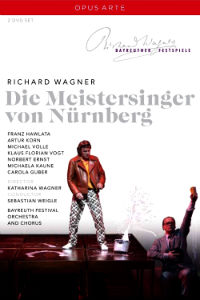
meistersinger_amazonIn the summer of 2007, at the height of the heated speculation and public debates over who would succeed Wolfgang Wagner as the head of the Bayreuth Festival, his daughter, Katharina Wagner presented a new production of Die Meistersinger von Nürnberg at the festival, replacing the mind-numbingly boring one by her father (his third at Bayreuth).

It’s hard not to see this production as an audition for the job of General Manager; in fact, Katharina and her half sister Eva Wagner-Pasquier were named as co-managers of the festival the following year. 

At the time, the 29-year-old director had only directed four other operas including an intermittently bewildering modern-dress Lohengrin in Budapest.  There are extended excerpts of that production available on YouTube that are worth watching for the fire-breathing Ortud of Eva Marton.

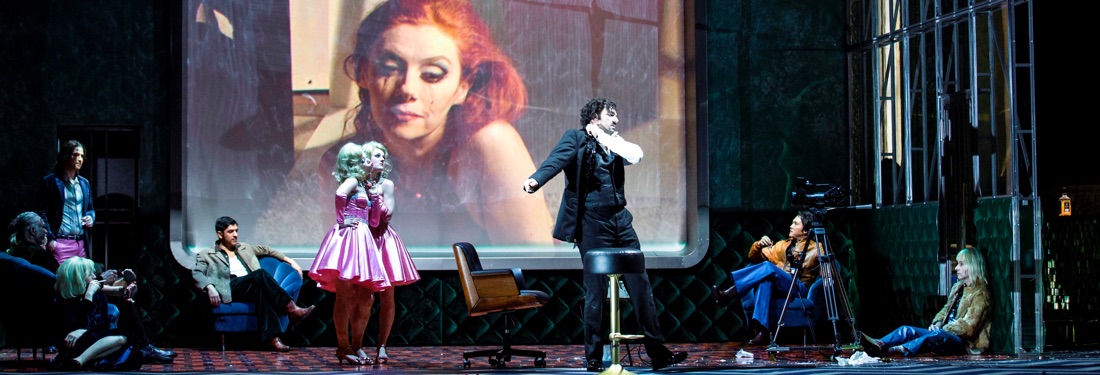
This new DVD presents a performance from the second run of performances. Her production is unapologetic full-bore Regietheater, determined to compel the viewer to think about the work and the role it has come to play both at Bayreuth and in German culture.

Its central thesis is a powerful one:  Die Meistersinger has come to be viewed in a way that is the reverse of what Wagner intended.  His tale of the outside innovator who triumphs over cultural conservatives to invigorate a stagnating art has ironically been appropriated by cultural and political conservatives who use the work to defend both traditionalism and purity in art.

To convey this paradox, she turns the work on its head.  Nuremberg is a suffocating, militaristic arts academy where the automaton-like students are taught only to reproduce the works of the past.   David’s apprenticeship consists of xeroxing pages from the bottomless supply of yellow Reclam paperback editions of standard classics.  Sachs is the token iconoclast; he doesn’t wear a tie, smokes, slouches, and walks around barefoot like any reputable cobbler.  Walther is a performance artist, graffiti painter and all-purpose bad boy who crashes into Nuremberg when he climbs out of a Bosendorfer piano, slamming the lid behind him.  For his audition, he paints the town white and Nuremberg quickly finds itself in a collective tizzy.

At the end of Act II, the riot of the libretto becomes art happening with the residents joyously splashing each other with paint from giant Warholesque soup cans, tossing off their wigs and congaing like is 1965 all over again. Even the statues of the great German artists of the past that line the walls of the academy come to life as Bobbleheads Behaving Badly.  By the end of the riot, Sachs and Walther rue the artistic high spirits they have unleashed and frantically try to clean things up while Beckmesser revels in his newfound joy of personal expression.

In Act III, this reversal continues.  During the “Wahn” monologue Sachs is tormented by visions of the Great Artist Bobbleheads acting up: Wagner himself boinks a dead swan; while another takes a dump while reading the newspaper (SCANDALOUS!)  Sachs and Walther, suitably chastised, then dress in proper suits and ties and plot a properly inoffensive entry for the prize competition. The Quintet becomes their saccharine vision of the future for Walther and David’s families.  During the orchestral interlude and entry of the Meistersingers, the Bobbleheads revolt once more, tie Sachs to a chair and force him to watch their debauchery.

As they finish, a production team comes out and takes a bow.  This is too much for poor Sachs, who frees himself and clears the stage, forcing the renegade production team into a dumpster.  He then sets them on fire as the still invisible chorus sings the “Wach auf” chorale.  He pulls a statue of a golden stag from this human crucible. A scrim rises to reveal the formally dressed chorus set in bleachers, clutching Bayreuth Festspiel programs.

Beckmesser arrives, in his Bohemian best, eager to demonstrate his creativity.  He performs a performance art piece in which he creates a naked Adam out of clay, as one would make a golem.  The golem them summons a naked Eve and the two of them pelt the scandalized audience with fruit.

Walther then sings the prize song as a kitschy tableau vivant of knight and damsel is created.  The crowd loves it.  Walther is crowned the winner and given the golden stag while Beckmesser watches in disbelief.

The stage goes nearly black except for an ominous spotlight on Sachs.  He sings his final monologue as statues of Goethe and Schiller rise from the floor to create a Leni Riefenstahl-esque final tableau, demonstrating the regie equivalent of Godwin’s Law which states that any production of a German opera ends up being about Hitler.

While this may seem compelling and thought provoking in outline, the production suffers from the fact that the director didn’t know when to stop filling her cart at the Regie superstore.  There are too many other aspects to the staging that distract from her central argument.  Why, for example, does Sachs make “shoes” at a typewriter and why do sneakers fall from the sky when Sachs critiques Beckmesser’s song in Act II?

Furthermore,  the production robs most of the characters of their interest and motivation.  It’s never clear why Walther would ever want to be a Meistersinger and why he would be attracted to the frumpy Eva.  Sachs as a kind of monster is an interesting idea, but Katharina doesn’t make him a very compelling villain.  Only Beckmesser holds our interest, which is part of the director’s point.  In the end the production ends up feeling like an overzealous college application essay, crammed with too many ideas and references, and stymied by its overeager determination to establish prove the writer’s intellectual bona fides.

Musically, the performance is a rather stolid one.  Maestro Sebastian Weigle finds neither the poetry nor the conversational quality that others have brought to this score.  Furthermore, he is sabotaged by the recording engineers who have created a balance between stage and orchestra that sounds nothing like it would in the Festspielhaus because the orchestra is way too blatty and prominent.

Klaus Florian Vogt as Walther is the biggest star in the cast.  He sings with an enviable combination of sweetness and stamina that results in a truly melting Prize Song.  One only misses a touch of metal and bite for the character’s angrier outbursts.

The Sachs, Franz Hawlata, barks his way through too much of the part and displays little romantic soul in his more introspective moments.  To be fair, the production demands a gruff belligerent Sachs and the perpetual smoking on stage, even with fake cigarettes can’t be easy for a singer.

Eva (Michaela Kaune) and Magdalene (Carola Gruber) were both rather matronly and shrill.  Their voices grated rather harshly, but they demonstrated a thorough commitment to the director’s concept. 

Michael Volle was mesmerizing as Beckmesser, clearly relishing the opportunity to portray a different take on this character.  I would be reluctant to assess his vocal capabilities based on this interpretation, but I would be happy to encounter him again in an opera.  The others in the lengthy cast didn’t leave strong vocal impressions.

For this DVD, the producers included closeups and other camerawork that was filmed during rehearsals.  This makes for some great images including a shot of burning flames reflected in Sachs’ glasses, but also serves to emphasize that the production placed some critical action at the extremes of the enormous set where it could not have been easy to see.  The vigorous booing at the final curtain is preserved as well.

Is this worth buying?  I found the performance riveting even if the production was sometimes confounding and overthought.  It inspired a great deal of thought and discussion in the days after I watched it and for that I am grateful that I saw this.

7 comments

  • OpinionatedNeophyte says:

    All that’s missing is Zombie Varnay and Zombie Melchior. Brilliant review, I particularly appreciated this sock to the gut:

    Its central thesis is a powerful one: Die Meistersinger has come to be viewed in a way that is the reverse of what Wagner intended. His tale of the outside innovator who triumphs over cultural conservatives to invigorate a stagnating art has ironically been appropriated by cultural and political conservatives who use the work to defend both traditionalism and purity in art.

    But also appreciated your point that difference, for difference sake isn’t any better than traditionalism for traditionalism sake.

  • papopera says:

    Disgraceful Scheisse !

  • CruzSF says:

    The outline does indeed sound promising. But after the strong reservations you express in the second part of your review, I think this one is strictly a rental for me. Thank you for a well-written and comprehensive review.

    • mrsjohnclaggart says:

      Dawn is my sole remaining fave on Parterre (not entirely true, I like Nerva Nelli and Bill when they show up) and I was happy to see his review. I almost went to see this myself but plans went a-bust as surely I must and soon.

      I will purchase this, for I have never seen (and rarely heard live) a Meistersinger that was interesting and full of ideas (that Schenk horror at the Met was surely a joke, with no less than poor Araiza in its first cast conducted by Willie with the beat of a Whale — the owner of this site has gone over to the dark side in his regular endorsements lately of the mediocre — Pop Tart — and now and then just rotten — e.g. the routinier with the luck of Stalin, Levine — or worse, for the good for and at nothing “Zinka”. That one could get close to Handelman given his oder is maybe an olfactory triumph but to celebrate such a vicious grotesque is really a bit much, and if La Cieca’s olfactory nerve has collapsed perhaps his nerve has collapsed period?)

      I don’t exactly know what one could do with Meistersinger in the theater; it is so long and the characters need charismatics to make one care in a ‘traditional’ production (it’s also vocally a killer, not that that matters any more here), while Regie, though a way out for certain, may just be TOO way out to work if one embraces it whole hog in this particular piece where our Richard (the worthwhile one, not the handelmanesque moron, “a study in the hideous, worthless and preposterously banal” — Stephen Jay Taylor, “reporting” on the great Brittanica site. Oh wait, was our Jay talking about Art in general? Sorry that was it. Our Jay, the pissoir of Earl’s Court, adores our local Richard who posts with such self importance and abundant help from Wikipedia, usually misread, on this site) but THE RICHARD in Meistersinger keeps stubbornly and at length insisting on his hobby horses (with reason; he was desperate when he wrote it, it must have seemed that any career was gone and as a hedge against despair Meistersinger is a marvel).

      There remains the artifact absent the autobiography and what to do, what to do? I’m sure the above is awful and aside from Vogt and Volle (fabulous in a range of roles)pretty dismal musically and vocally but at least Katharina has thought about it and I LOVE some of the images.)

      • grimoaldo says:

        This post is an entertaining read, but it takes a little decoding and knowledge of other online opera forums to understand it.
        I guess “Willy the whale” is a reference to Levine?
        “plans went a-bust as surely I must and soon.”
        I do hope not! Thrive and continue long, please, mrsjohnclaggart!

  • La Cieca says:

    [La Cieca commented a few days ago on this production over at opera-l, and she hopes her comments may be of some interest here as well:]

    To begin with, this DVD is the very first instance of an actual performance being recorded in the Festspielhaus in real time, in the manner of a Met “Live in HD” showing. Presumably the finished DVD includes a few patches from a filmed dress rehearsal, and there are a few shots from angles apparently onstage that seem unlikely to have been taken during a live performance with audience. But, in general, this is “Die Meistersinger” as it happened August 7, 2008.

    Katharina Wagner’s concept for the production is reasonably straightforward for the first two acts. She sets “Meistersinger” in a post-Wagnerian society, or rather in a society that is a product of Wagnerian and other 19th-century German ideas. Her particular focus in this production is the nature of society’s relationship to art. This approach is particularly valid, I think, in that Wagner put into Sachs’ mouth text that essentially defines society as a function of art:

    …zerfällt erst deutsches Volk und Reich,
    in falscher wälscher Majestät
    kein Fürst bald mehr sein Volk versteht,
    und wälschen Dunst mit wälschem Tand
    sie pflanzen uns in deutsches Land;
    was deutsch und echt, wüsst’ keiner mehr,
    lebt’s nicht in deutscher Meister Ehr’.
    Drum sag’ ich euch:
    ehrt eure deutschen Meister!
    Dann bannt ihr gute Geister;
    und gebt ihr ihrem Wirken Gunst,
    zerging’ in Dunst
    das heil’ge röm’sche Reich,
    uns bliebe gleich
    die heil’ge deutsche Kunst!

    (More about Sachs’ peroration later.)

    So: Nürnberg is an arts academy, the apprentices in school uniforms and the Masters the faculty. In one corner of the stage, technicians are carefully restoring a mural, and throughout the first act, David and others carefully arrange stacks of paperback editions of standard classic literature. Part of his job is also photocopying these books, indicating that the goal of the academy is the preservation of art without any regard to innovation. The walls of the academy are lined with life-size busts of great German thinkers and artists, including Wagner himself.

    Walther, as outsider, is a sort of celebrity graffiti artist, and at least at first his preferred medium is whitewash on musical instruments, a broad parody of Wagner’s notions about “synthesis of the arts” perhaps. Sachs attends the Masters’ “faculty meeting” affecting the attitude of a 1950s bohemian, shabbily dressed and barefoot, chainsmoking. The first act ends in the usual rejection of Walther by the Marker and the masters when he gets carried away in his “Fanget an!” song and ends up slinging paint all over the board table.

    The second act is set in a sort of commons area on the campus and involves first, Walther painting almost literally everything in sight, including Eva; then a rather surrealistic interpretation of the “shoe-making” scene. Sachs does not hammer at his last but rather pecks at a manual typewriter, and for each musical mistake Beckmesser makes, a sneaker plummets from above the stage. It’s a very funny effect but I’m not sure of a precise meaning.

    The riot is a pivotal point in this production, because as it turns out it’s not exactly a riot, but rather a 1960s style happening. The “great thinkers” busts, still onstage from the first act, come to life and flail across the stage like zombies, and the apprentices carry in giant Warholesque soup cans and pour gallons of paint all over the crowd; meanwhile the throng are dancing joyously and holding aloft copies of revolutionary 20th century art, e.g., a Picasso sculpture and a Jackson Pollock painting. As the Night Watchman’s song sends everyone home, we see the beginnings of a transformation in the three leading male characters. Sachs and Walther are disturbed by the excesses of what they just witnessed and begin to clean up the mess, including wiping up Walther’s graffiti. Beckmesser, meanwhile, has a sort of far-off look as he tentatively daubs paint on his shirt.

    The third act is where Katharina really turns the story upside down with her most extreme innovations. Sachs’s workshop turns out to be a quite chic bachelor flat with modern furniture (so much for his pose of bohemianism!) and as the act progresses both he and Walther discard their “arty” garb for well-cut, expensive suits. Meanwhile, Beckmesser, far from being bitter about the previous night’s drubbing, seems to have become radicalized into an avant-garde artist. (Michael Volle in the part sports a t-shirt that reads “BECK IN TOWN.”) The scene of the creation of the Dream Melody is interpreted pessimistically, i.e., Sachs and eventually Walther realize that for art to be successful, it must be dumbed down into forms that can be easily understood by a mass audience.

    Katharina deliberately creates a visual dissonance with the exquisite music of the Quintet by staging it as kitsch, the two couples grouped with children as if for a Christmas card photo. Then the really radical stuff begins.

    Lurking in the background of this act have been grotesque figures, oversized caricatured masks of the “great thinkers” on dancers, sort of like performers in a Mardi Gras parade. During the transition to the Festival Meadow, they break into Sachs’s studio, tie him to a chair, and force him to observe a bizarre bawdy pantomime that includes a good deal of nudity. This sequence continues into the Waltz, finally ending when a “production team” of conductor, stage director and designer enter to take a bow for the show that has just been put on. Sachs and his fellow Mastersingers tear apart the grotesque costumes and put them (and the production team) into a dumpster and set the whole thing on fire. (This is during the “Wach auf” chorale.) When the fire goes out, Sachs retrieves from the ashes a statue of a golden calf that will serve as the prize in the upcoming song competition.

    And that competition turns out to be a “Pop Idol” TV show, complete with glitzy lighting effects and the Volk ranged in theater seats at the rear of the stage.

    Beckmesser’s song turns out to be not a farrago at all, but a piece of very esoteric performance art that involves a sort of Frankenstein-like [note how "La Shiksa" interprets the Golem motif!] creation of a nude man, a woman who is chosen from the audience and also stripped, and then all three hurl fruit into the crowd. It is fair to say that the Volk don’t get it, and they mock Beckmesser mercilessly. He, however, does not get particularly angry, just (as I read it) disappointed and a bit philosophical that his art went so far over their heads.

    Then Walther arrives, looking very sleek and handsome in his suit, and he performs the Prize Song spotlit downstage, singing directly to the audience in the auditorium as if in a pop concert; meanwhile a pair of plump actors in sequinned “Holbein” costumes strike kitsch poses “acting out” the lyrics. The Volk, following the libretto, just eat all this up, and Walther is declared victor. The ceremony includes showgirls carrying out an oversized check from “Bank Nürnberg” for 10,000 Thaler and Sachs holding out to Walther the “Veau d’or.”

    When Walther rejects the prize, Sachs launches into his big speech as Beckmesser observes with increasing disbelief. The lighting turns ominous as Sachs seems to be transformed into a political speaker at a rally, and Arno Breker-style golden statues of Wagner [correction: I later found out these are of Schiller and Goethe - LC] rise from the stage to flank him. The big C-major chorus at the end of the show is sung in near-darknessm, the Volk glimpsed as an anonymous crowd in an dark auditorium in unanimous approval of Sachs’s reactionary spiel about the necessity of protecting “Holy German art” from foreign contamination. Beckmesser finally flees the stage, leaving visible only Sachs, and, spotlight center stage, the Golden Calf.

    It seems to me that Katharina’s jumping-off point here is the huge irony that a work about an artist’s successful rebellion against hidebound rules should become the touchstone of artistic conservatism, the only work in the Bayreuth canon that has never until now been reinterpreted or deconstructed, but only “preserved.” (The program notes to the DVD refer specifically to the strongly negative reaction to Wieland’s 1956 “Meistersinger Ohne Nürnberg.) The production also addresses Wagner’s own complicated politics, evolving from radical to arch-conservative, as well as the shifting place of Wagner’s canon in relationship to the rest of Western art, from avatar of the avant-garde to mainstream to “establishment.”

    The DVD presents a quite messy production, with many details hard to see or, if seen, to grasp, and in general it feels like an early draft still in need of very stern editing. But the ideas are surprisingly mature, particularly the notion of re-examining the dramatic action surrounding Beckmesser, which by extension leads the audience to question their unthinking trust in how the composer and librettist interpret a story.

    Sorry for the very long post, but maybe this will give some of you an idea whether this “Meistersinger” might be your cup of tea.

    • lorenzo.venezia says:

      “The production also addresses Wagner’s own complicated politics, evolving from radical to arch-conservative…”
      Dunno about this.
      It is my understanding that Wagner’s youthful anarchism (hanging out with Bakunin, etc.) — and which gave rise to the Ring libretti — was replaced not with political conservatism or “arch-conservatism”, but with Schopenhauer, who he first read in 1854 and read and studied almost every day for the rest of his life. Tristan and Parsifal and Meistersinger (and to a certain limited extent, given the libretto and leitmotifs were already written, Gotterdammerung) were are fruits of his Schopenhauerianism, and he made clear that — had he lived — Parsifal would have been his last opera and he would have devoted himself to symphonic works (Magee goes on at length about this aspect), turning away from the necessities of theater to embrace the music solely. That is, he turned away from the concept of the stage representation and the words as having equal necessity along with the music and came to feel that the music alone was the expression of the numinous, the — dare I say it — “thing in itself.” He turned away from revolutionary politics much earlier, and the final expression of his Schopenhauerianism was not political, it was metaphysical, philosophical. On and off he had considered writing an opera about Buddha, but finally decided that Parsifal said it all and he need write no further operas. But Schopenhauer’s “pessimism” isn’t a “glass half empty” kind of thing, it’s based in the view that the world as we know it represents nothing but illusion, delusion, maya; the pessimisim of the buddhist regarding the value of the phenomenal world. Schopenhauer was amazed, when he first read the vedas and buddist texts, that they were grounded in the same idea as his philosophy, and turned Wagner on to all of it. I think it’s more accurate to say that Wagner turned from his early radical politics to a philosophical outlook that placed the value not on the phenomena of the world but on noumena, a deeply felt mysticism. One listen to Tristan or Parsifal certain indicates that. The same also goes to explain the difference in the Ring from the time he laid down his pen to the time he later picked it up for Siegfried Act III and Gotterdammerung.
      How this fits into Katerina’s Meistersinger I don’t know because I haven’t seen it. I’m stuck in the middle of Schopenhauer and Kant get out…..