Headshot of La Cieca

Cher Public

  • MontyNostry: Like some kind of soul-diva boa constrictor, is La Holliday about the swallow that girl whole? 3:45 AM
  • Nerva Nelli: Aren’t you forgetting Jochen Kowalski as Nireno? http://s3.static69 .com/m/image-of... 3:34 AM
  • Nerva Nelli: Have not read an obit. No activity listed lately here http://www.filmref erence.com/film... 3:26 AM
  • bobsnsane: This B a uncommon crotch rocket, out among-st us men folk… 3:26 AM
  • bobsnsane: …we must call Doctor Hugh Jorgan immediately!” I’ll let u fine fellows finish the other... 3:20 AM
  • bobsnsane: B sure 2 note the Helmet polishers… 3:08 AM
  • bobsnsane: What other bons mots shall yet spew 4th? Shucks, I better bone up on this opera. 3:01 AM
  • bobsnsane: with ribbing? 2:59 AM

What lies underneath

salome_konwitschny

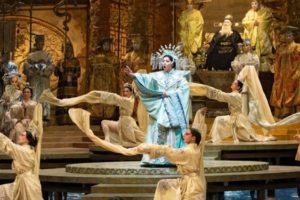
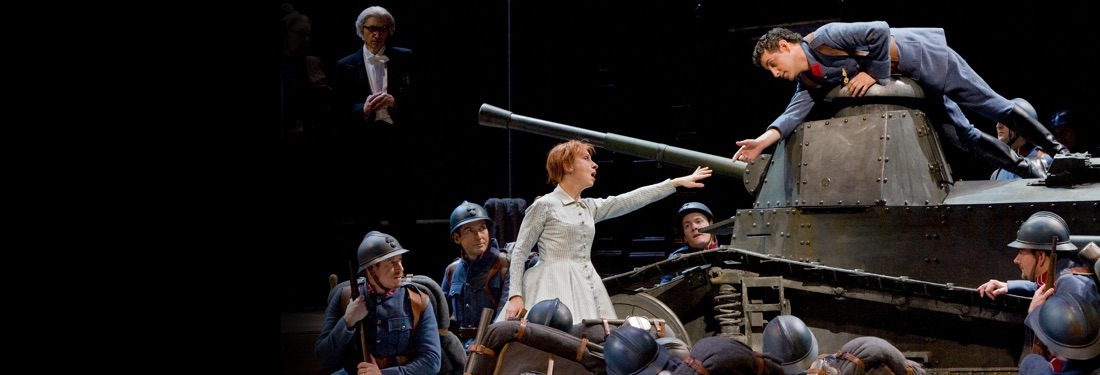
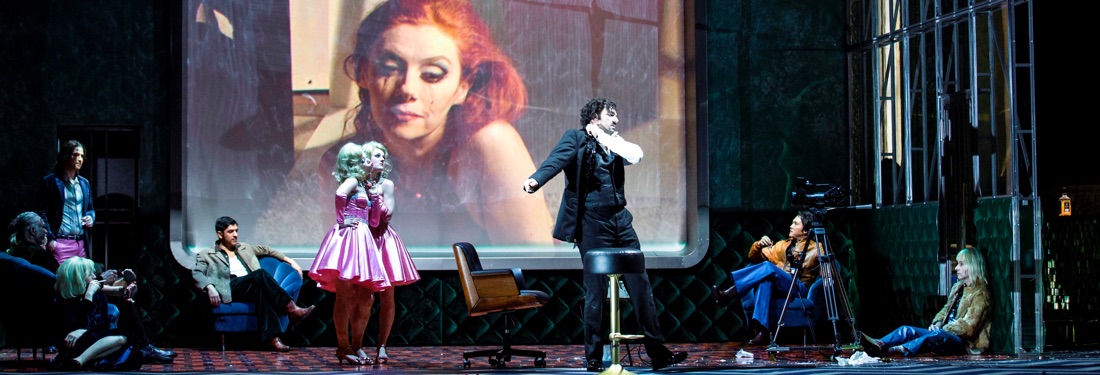
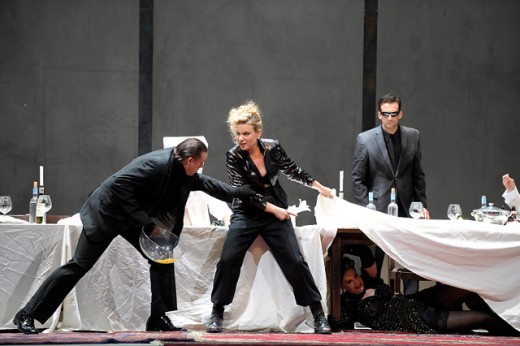
parterre fave Peter Konwitschny has returned to his métier, directing a new production of Salome — with a happy ending!

Following the jump are excerpts from an interview with the director in Volksrant, translated by Our Own Freniac.

“What caused my crisis?” One of Europe’s most notorious opera directors laughs shyly, the air coming out of his nose with short thrusts.

“Very simple. I fell in love with a young Russian girl. And I killed that love with rational arguments. She was too young, we came from a different social background, we didn’t even speak the same language. I followed my head instead of my heart. And the I fell into a depression. For four years I lacked the courage to direct a new production.”

For Peter Konwitschny (65), talking also means sighing a bit at the same time. It’s also possible that he has to recuperate a bit in the small office of the Amsterdam Muziektheater from the rehearsals in which he persuades people to drink, shoot up, perform blowjobs, fuck, cannibalize and perform necrophilia.

Richard Strauss’ Salome, one-act opera after the play by Oscar Wilde. About a princess who’ll only dance if she’s presented with the head of John the Baptist on a silver platter. Premieres this Tuesday. It will be the first new Konwitschny since his crisis and the entire European music press is gathering for the occasion.

“Gut, serh gut!” the director had called, moments earlier, to the crowd of singers treating tenor Marce Reijans to a post-mortem rape. Now he stirs his latte macchiato calmly. Balding, grey pony tail.

He analyses: “Salome grows up in a perverse environment. But if you look carefully, you see that she has a quality others are missing: she sincerely want to know what love is. That’s crucial. To show this, I first have to go through all the dredge.”

[kml_flashembed movie="http://www.youtube.com/v/9YVk4uwgZEQ" width="425" height="350" wmode="transparent" /]

The director who grew up in former East-Germany is now known as an uncompromising thinker…. His primal theme: the unmasking of patriarchal society, the male-dominated world which is always accompanied by suppression, lack of freedom and terror. Humour and paradox are his main weapons.

He wrote down his first thoughts on Salome three years ago. Jochanaan is not beheaded. Salome eludes her execution. And as a romantic couple the princess and prophet exit the stage.

“Regard it as utopia”, Konwitschny explains. “I did not feel like doing an opera presents women as the Evil in the world. That’s a typically male ideology: first you use her, then you call her perverse.”

Sentence by sentence, bar by bar, he examined the piece. When the idea would misfire, he would give back the direction assignment. He knocks on the score and murmurs a motive from Salome’s final scene: four notes in a gently sliding ascent. “That does not sound perverse, does it? If it did not fit the music, I could never have staged it.”

. . . .

Salome’s ‘Dance of the Seven Veils’ will not end in a striptease at De Nederlandse Opera. It will not be necessary to retch when the princess kisses Jochanaan’s dead lips.

Konwitschny: “I let Salome speak to a living man. He bursts into tears. A woman you can talk to – this does not have a place in his ideology.”

But she certainly tastes his lips. “ Hat es nach Blut geschmeckt?” Salome wonders, textually accurate. “Nein? Doch es schmeckte vielleicht nach Liebe. Ich habe deinen Mund geküsst, Jochanaan. Ich habe ihn geküsst, deinen Mund.“

After this they toast with a brandy and the stage curtain closes behind them.

Konwitschny cites Jean Genet, the French playwright who thought that above all else, theatre should raise the desire for a better world.

“Philosophically, politically, socially: opera teaches us what we should and shouldn’t do. I realize that only a fraction of the entire population ever visits a performance. But still: opera can save us, it’s an important societal corrective.”

More love, that’s what it boils down to according to the director. “Only through love you become completely human. That’s why children always want their parents to love each other. When that’s not the case, they feel existentially threatened.”

He was 13 when his parents’ marriage hit the rocks. Franz, the conductor, was buried at Leizpig’s Südfriedhof in 1962. His ex-wife passed away in January 2009. Peter Konwitschny arranged a spot for his mother overlooking the monument of the Gewandhauskapellmeister.

Chuckling: “A reconciliation of sorts, which I’ve managed to bring about.”

30 comments

  • kashania says:

    Sounds like Konwitschny needs a different opera to direct.

    • CruzSF says:

      This Salome goes far beyond the placement (or not) of two candlesticks and a crucifix. It should go straight to video!

      Unless, Salome imagines riding off into the sunset with Jochanaan as she lies dying.

      How does Konwitschny reconcile his concept with the opera’s last line?

  • kashania says:

    But the problem is that she doesn’t lie there, dying; She dies very suddenly. I can see some projections during her final lines, showing her and Jokonaan together, but only if it’s clear that it’s all in her head.

    • CruzSF says:

      I agree with you.

      • kashania says:

        I have to say, abstractly speaking, the idea of Jokanaan breaking down into tears and being “won over” is an interesting one. I’m actually moved by the notion itself. But, it would go completley against the music, the text, and the character of Jokanaan himself.

  • Regina delle fate says:

    Graciella

    I heard her sing Senta rather horribly – squally and shrieky – with Welsh National Opera (opposite Wales’s own Bryn T) so I wasn’t in a hurry to hear her Isolde. My mistake apparently as she got very good reviews and I heard nothing but excellent reports. Since then, she’s sung Isolde in Cologne.

  • quattrofontane says:

    True,kashania, but that calls for a completely different opera, n’est-ce pas?

  • Harry says:

    This Konwitschny creep needs a regie sojourn in one of those ‘rest establishments’ to sort out what is reality. What piffle these confused traffic directors spout. to hide the fact they are ‘away with their own self absorbed pixies’.
    Unless Salome is set and seen in some historical context, the plot is laughable. It just becomes a bad staged version of a cheap horror flick.

    Johanann , along with all the rest of Herods’ court is unfeeling, to what Salome ‘the child’ wants. Worse, she experiences his total rejection on more levels than just sexual desire. She mocks and tries to tease him yet at the same time : incapable of comprehending what he represents, says, or stands for. Narraboth desired her, yet we see her nonchalant response when he kills himself.
    Salome is the ‘black widow’ spider in training – spawn of her mother, ready to show off to ‘mother’. Herod , even hints at that style of metaphor: about ‘indeed’- being the daughter of Heriodias . Men are to be ensnared in a web, and then devoured. The fearful Herod The ‘web’ dungeon floor grille is symbolic, in regard to Johanann.It is the only way such women can feel empowered in such a corrupt environment. Some productions ( I.E. the Mc Vicar one) even hint that Herod has previously possibly had ‘ a crack’ at his step-daughter. That is valid and can help explain her unflinching vengeful total humiliation of Herod … ‘at all costs’. Since Salome , to ‘satisfy’ the dismemberment of her prized toy (only has a head left!) she abuses it ‘every which way’, talks to it, cuddles it. She is now just a mad babbling homicidal child with her wished -for but destroyed object.

  • Freniac says:

    Konwitschny’s ‘solution’ for the “Mann töte dieses Weib”? Simple: he just leaves it out…

    A friend of mine who attended the dress rehearsal told me that Herod does not get his last line, and only AFTER the last bars of music have ended (so after the moment Herod would have spoken/sung them), someone from the auditorium/audience calls out (in Dutch): “kill her, kill that woman!”

    The sheer elegance and humble simplicity of this solution is mind-blowing, isn’t it?

    • CruzSF says:

      The person in the auditorium who shouts “kill that woman!” is a member of the production? Or was s/he a paying member of the audience?

      • Freniac says:

        As far as my friend coudl tell, he was was a member of the production.

        Of course, this particular feature of the production can be explained in different ways:

        - someone ‘in the story’, perhaps an example of the traditional patriarchal society who isn’t convinced by her words as Jochanaan is and actually wants Salome dead.

        - a stereotypical audience member, digruntled by the happy end, who wants his traditional ending. In this option, Konwitschny would seem to be cleverly anticipating reactions by traditionalist.

      • No Expert says:

        I don’t know….giving audience members the notion that it’s ok to start demanding executions might be a bad idea.

  • Buster says:

    The person who catches the head has to stand up and say that line.

  • Buster says:

    The real event, by the way, is not this Salome, but Serge Baudo conducting Pelléas et Mélisande at the Concertgebouw.

  • Harry says:

    Buster: This could b the start of ‘inventive TRUE regie’…not this fraudulent imitation most mod directors presently try.

    Why it is ‘Sing -0 – Long Opera !
    With ‘audience participation’ at appropriate moments.They can even have a bouncing ball, dobbing along the projected surtitles. I’m ready listen…………………” Keill vartt Voman”. It is so easy.