


Headshot of La Cieca

Cher Public

  • zinka: httpv://www.youtube.com/watch?v=KqjKOalcI10For all of ...
  • Feldmarschallin: Has anyone heard someone by the name of Serena Farnocchia? S...
  • zinka: httpv://www.youtube.com/watch?v=GCI0MR9nPYsIf I named ...
  • louannd: Eileen Farrell and Beverly Sills - Maria Stuardahttpv://...
  • zinka: LOVED Meier...One of the greats..Today would be even greater...
  • Gualtier M: I read Riccardo Massi's online bio and he has an interesting...
  • Feldmarschallin: Inge Borkh is quite stunning in that aria as well.
  • DurfortDM: Insane. That is all.
  • Clita del Toro: I saw Gauvin a few years ago here in Chicago--a wonderful si...
  • figaroindy: Thanks, Windy for the reminder of Miss Farrell's birthday......

blog advertising is good for you

E poi morir, e poi morir!

sunsetblvdIn the year and half that New York City Opera has been absent from the musical milieu of our metropolis, Tony Tommasini has been sadly deprived of one of his favorite topics of conversation. 

No, cher public, you’re wrong, because I’m not talking about barihunks; NYCO hasn’t a monopoly on those, and the Times scribe in fact has of late moderate his wonted zeal for the strapping earthy darlings of the lyric stage. No, no: it’s something else. 

For the longest time, Tony’s tip-top topic, amounting almost to an obsession one might say, was the subject of the sound enhancement system installed in the New York State Theater a decade ago.

Over the past ten years, TT has returned to his subject, uh, occasionally.
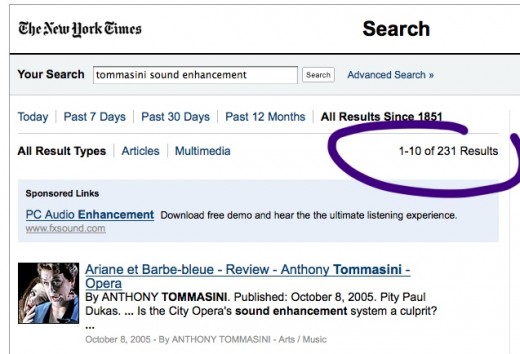
231_results

If La Cieca were feeling less charitable, she might call the Tommasini v. Microphone feud an idée fixe, but La Cieca is feeling charitable, so she’ll just say, well, at last Tony has got his wish.

Though, as TT himself notes, an acoustic theater does not necessarily mean a voice-friendly theater; so we’ll have to wait and see, won’t we?

25 comments

  • Alto says:

    “While I agree that Tommasini needn’t have harped on about it ad nauseam after his initial comments after it was firt installed …”

    Even more nauseating is his colleague Kozinn’s constant vilification of the acoustics of the new Tully, which to my ears are far more lively than before. He bases review after review on his vendetta against the renovation. Enough already.

    And he’s wrong, anyway.

  • Alto says:

    “What worries me about the State Theatre renovations is that, despite the price tag, not all that much has been done for the acoustics of the place (from what I’ve ready anyway).”

    You’re absolutely right, and I’m puzzled that the TIMES — presumably with the collusion of NYCO — pretends that the work is done. I have a good friend who is involved in the renovations, and I’ve been having to “talk him down” for months because of his distress that the renovations are being portrayed as substantially finished, when the firm in charge of acoustics was engaged only in April, after the firing of the German firm whose object up to then was to DEADEN the acoustics completely and project all the music via amplification. (They even had put sound-absorbing material under each of the new seats, which had to be reversed at great cost by their successors. What were Mortier et Cie. thinking?)

    This is nowhere acknowledged in the journalism I’ve seen. Ripping out the carpets — commendable as that may be — will not revolutionize the acoustics when much more projected work is undone. This inactivity is being blamed on the Board by my informant.

  • Fritz says:

    Here’s a link to a documentary about Fritz Wunderlich. At about the 8:00 mark, Fischer-Dieskau appears and casually mentions that the then new Met (1965) was using amplification. He adds that he hopes he’s not letting any secrets out of the bag. What do you think? Is he just repeating a 40-year old rumor, or is there any truth in what he says?

    http://www.youtube.com/watch?v=nYN-EMFoX6o

  • operaguy says:

    Re: 23 – How would DFD know – he never sang there! And his wife didn’t sing there until 1978. An undetectable amplification system in 1966 is a laughable notion. Someone probably told him about microphones on the stage (that were there for broadcasts) and he made an assumption.

  • Harry says:

    All this talk about amplification I find laughable. If a theater is acoustically dead, what is the moral difference for ‘altering the existing sound’?…….Amplification correction or in some cases massive expensive architectural re-fit in other cases. Amplification DOES NOT necessarily mean ‘blowing up voices to be more powerful’ than they naturally are. The end result of greater clarity is what’s being desired! Frankly correction has been going on for years in opera houses. Most discreetly, is the term used I am told, when and if they are pressed. For special sound effects during certain operas is another shy excuse, offered! When venues are multi purpose, notice the plainly displayed sound panels ‘for the other events’ still in place. Non active loudspeakers in a confined space when subjected to sound forces present: turn into passive moving radiators of sound! Just close your eyes during a performance, whilst noting the ‘positioning of everybody’ representing singers and orchestral members. Imagine it is really a recording you are listening to. It is then if they discreetly amplifying’ the shit can hit the reality fan. When one is asking one’s ears why is the singer or instrument sounding ‘in the wrong channel’? A simple case of a particular direction sound force, being caught by the ‘wrong microphone’- A.K.A ‘in the wrong place, at the wrong time’. Then there is the ‘metallic ring’ when sounds reach fortissimo levels can be another tell tale sign ‘everything is not quite kosher’ live – for the purists.

    If one has regularly experimented with even smallest degrees of delay systems with added amplification & speakers in a listening room: equipment that studios in those times,would not have even dreamed of or thought possible. Using even vintage 40′s or 50′s’s mono recordings, the results although seemingly still mono, can be remarkable. Wire -like strings tamed, voices brought forward, shallow narrow -slit like sound being transformed into an acceptable wider but firm solid presentation. At the same time, mindful of not pulling and stretching such performance, beyond believability. Should one listen purist-like and suffer…..because that’s the way the music was offered up (with the then limitations)? I say NO!

    At least, we are not discussing the real horror ‘auto -tune’ a device used in pop studios to automatically correct performers when they stray off pitch.
    Jeepers, if THAT was used in opera houses, all mention of singers having an off night or not hitting a top note would stop. Though it is a pity, one has to say that some singers should be carrying a small personal portable model of it, if it was feasible/possible!