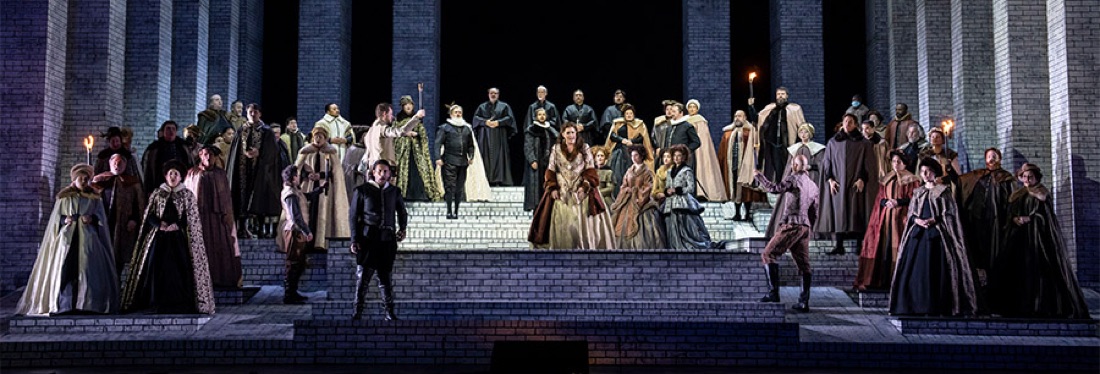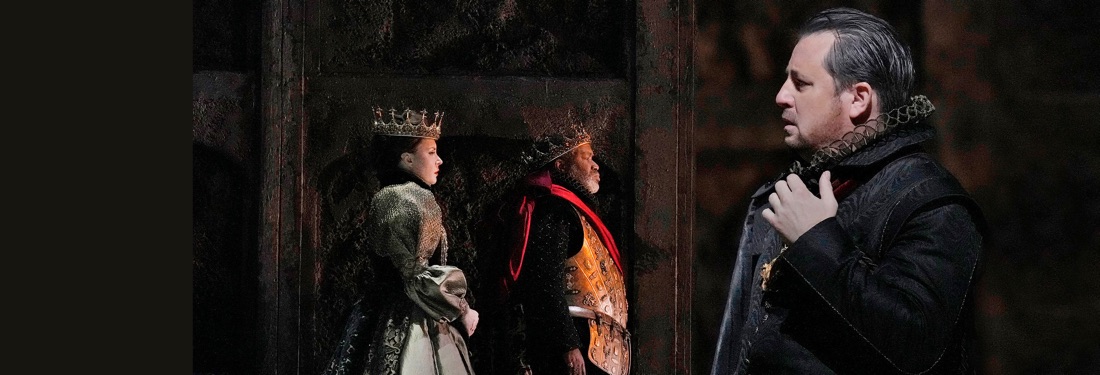
The revival of Don Carlo(s) which opened on November 3 restored the translated Italian text and the cut 1882 four-act revision not seen at the Met since Rudolf Bing’s last season in 1972.
With the phenomenal cast that stacked Paris Opera’s production of I Capuleti e i Montecchi , it was easy to overlook the quirks of Bellini’s opera and get lost in the pleasures of glorious bel canto singing.
This sterling revival shows the Metropolitan to be surviving well and in good shape.
The Met’s new Don Carlos has prompted a lot of discussion lately about opera-in-translation, so Trove Thursday this week offers two works unexpectedly performed in French: Rimsky-Korsakov’s Snegourotchka and Weber’s Euryanthe.
When was the last time the Metropolitan Opera mounted a new production that was musically outstanding yet the direction and/or design mostly sucked?
In any case, we are now in the Queen’s garden of the Palace in Madrid. It is the day before the coronation of King Philip. Coronation? What coronation?
The only correct version of Don Carlos must be in French. That is the language that Verdi composed it in and he made all his revisions in that language.
In online discussion on “Favorite Opera” and cuts in opera in general, it seems Don Carlos (in its original French title) or Don Carlo (as it is better known in Italian) – with or without the “s” – generally get the most votes both as favorite and as an opera from which deplorable cuts are made.
Lyric Opera of Chicago scored a smashing success on Sunday with its “Verdi Voices” concert, featuring soprano Tamara Wilson, tenor Russell Thomas, and Lyric Music Director Enrique Mazzola conducting Members of the Lyric Opera Orchestra in what might be termed a program of Verdi’s Greatest Hits.
Don Carlos is my favorite Verdi opera, and I’m always in favor of including the most music. But it can be a dizzying task to keep track of all the options.
In the last weeks of January, as the Metropolitan Opera season wound to a close (prior to the winter hiatus) two striking sopranos were thrust into the limelight.
Trove Thursday offers a nearly forgotten 19th century opera with a most marvelous name: Le Roi d’Ys by Éduoard Lalo featuring a superb French cast led by Alain Vanzo, Andrea Guiot, Jane Rhodes and Robert Massard.
In the month and a half leading to Bernard Haitink’s passing on October 21, my AirPods constantly channeled a musical festival of sorts centered on the Dutch giant’s expansive discography.
In an era when the Metropolitan Opera cannot cast an Aida, Trovatore or Forza consistently, New Amsterdam Opera managed to cast large, attractive and fully technically capable voices in all the cruelly demanding principal roles in I Vespri Siciliani!
Maria Callas and Montserrat Caballé are two of the most highly-regarded and esteemed exponents of the great soprano roles in both bel canto and in the operas of Verdi, and their recordings are held as artistic triumphs of the highest order.
Trove Thursday begins February with two striking versions of Rossini’s Tancredi.
Mr. Wilson’s production concept, according to his liner notes, has more to do with Paris at the time of the premiere and a “world of memory” than it does with the storytelling of civil war in medieval Spain.
An acclaimed revival earlier this season of Sebastián Durón’s Coronis (that name, yikes!) reminded me that Trove Thursday has been ignoring baroque zarzuelas.
Joseph Bologne, Chevalier de Saint George is frequently referred to as “le Mozart noir.” While surely intended as a favorable comparison to Mozart, the sobriquet is diminishing, implying that Bologne’s music was somehow derivative of Mozart’s.
Trove Thursday goes mini-epic with Gustave Charpentier’s naturalistic slice-of-life of fin-de-siêcle Paris in a rare 1999 Renée Fleming performance of Louise co-starring Jerry Hadley, Samuel Ramey and Felicity Palmer.
While last year’s finals were dominated by early nineteenth-century bel canto arias, this year’s finalists took on a remarkably broad range of music from a variety of repertoires.
Elina Garanca’s glorious Marguerite transformed La Damnation de Faust into the Met’s first essential must-see of the year.
Sunday’s Richard Tucker Gala at Carnegie Hall was unusually satisfying despite a less than usually superstarry line-up.
The musical director of the Opera Royal de Wallonie at Liege is currently experiencing the early phase of a promising international career in music.
Tell us: Filth or dementia?
Hasten thee to feed another quarter of conversation for The Talk of the Town!
Sign up for our free Newsletter.
Support Parterre Box
Donate to keep opera's liveliest publication free and independent. No paywalls, no institutional backing, no bootlicking.
Get our free newsletter
Opera's top reads delivered to your email weekly…ish.
Join over 100k readers.
The best opera magazine on the web.
Reviews, breaking news, critical essays, and brainrot commentary on opera from those demented enough to love it.
Essentials
Copyright © 2026 Parterre Box.
All rights reserved.
Registration or use of this site constitutes acceptance of our Terms & Conditions and our Privacy Policy. Do Not Sell or Share My Personal Information.
Sign up for Parterre’s free newsletter.
Exclusive opera reviews, commentary, and top reads
delivered to your email weekly…ish.