
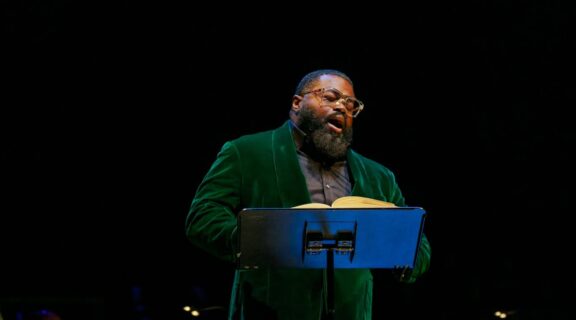
An extraordinarily rich variety of opera happens locally, under the umbrella of New York Opera Fest.
“Trove Thursday” steps in with one of René Jacobs’s favorite and rarest rediscoveries, Francesco Conti’s marvelous Don Chisciotte in Sierra Morena from 1719.
As portrayed by Vittorio Grigolo, Nemorino was a manic self-absorbed, probably bipolar, stalker who—against all odds and good sense—gets the poor girl.
The wonderful Spanish mezzo Teresa Berganza celebrates her 81st birthday next week and “Trove Thursday” gets the party started.
Bartlett Sher’s “new to Chicago” production of Romeo et Juliette came to the Lyric Opera at Monday’s opening after appearances at Salzburg and Milan.
When Maestro Carlo Rizzi lifted his baton and began leading the Lyric Opera Orchestra in a stirring, detailed account of the overture to Nabucco, the electrified audience knew we were in for an exciting evening of music making.
Fidelio but with an unhappy ending, Bedrich Smetana’s stirring Dalibor opens 2016’s “Trove Thursday” in a 1968 German-language broadcast from Bavarian Radio.
As a whole, the evening seemed forced and a bit dispiriting.
On Thursday evening Jennifer Wilson “finally” made a belated, disappointing Met debut as Turandot.
This “new-to-Chicago” production is a sheer pleasure from beginning to end.
Although the season is less than three weeks old, Metropolitan Opera audiences may hear nothing else this season as beautiful as Peter Mattei’s “Song to the Evening Star.”
You might be surprised, though, when that title turns out to be Show Boat.
The legendary Canadian heldentenor died on Friday. He was 88.
This past Tuesday, Cincinnati Opera presented its first world premiere in over 50 years with Morning Star by Ricky Ian Gordon and William Hoffman.
Fifteen years after his first parterre box interview, that criterion of countertenors David Daniels speaks of Oscar Wilde, Marilyn Horne, marriage and political art.
Worried about the future of opera in America? Don’t be!
Is Der Ring des Nibelungen responsible for the transformation of Seattle from a gray, damp, low-rise Boeing company town where half the jokes had punchlines in Norwegian (and were about lutefisk in any case) into today's booming cultural metropolis? I like to think so.
American mezzo Jamie Barton, who has steadily been winning fans in the US over the past few years for her rich and nuanced singing, took the international opera world by storm last weekend by winning both the Song Prize as well as the overall prize in the BBC Cardiff Singer of the World competition.
“Is a work an opera simply because its creators choose to call it one?”
Rule Britannia? Often during the Olympics that famous number from Thomas Arne’s 1740 Alfred echoed in my ears.
Richard Strauss’s “last romantic opera,” as he called Die Frau Ohne Schatten, is and has always been a problem child.
If it wasn’t anything special as art or even entertainment, Lyric Opera of Chicago’s recent production of Rinaldo (March 24) does offer an excellent peg on which to hang an argument about the future of opera in America.
“Hey the line forms, on the right dear / Now that Macheath’s back in town / You’d better lock your doors, and call the law / Because Macheath’s back in town.” So concludes Marc Blitzstein’s famous English translation of the song that opens Die Dreigroschenoper.
Despite baby-steps over the years, America’s musical scene, especially opera, remains decidedly un-HIP. (HIP: “historically-informed performance,” also called “period performance.”) While European opera houses turn increasingly to “original instrument” orchestras and specialist singers for seventeenth and eighteenth century works, this rarely occurs in the US.
Tell us: Filth or dementia?
Hasten thee to feed another quarter of conversation for The Talk of the Town!
Sign up for our free Newsletter.
Support Parterre Box
Donate to keep opera's liveliest publication free and independent. No paywalls, no institutional backing, no bootlicking.
Get our free newsletter
Opera's top reads delivered to your email weekly…ish.
Join over 100k readers.
The best opera magazine on the web.
Reviews, breaking news, critical essays, and brainrot commentary on opera from those demented enough to love it.
Essentials
Copyright © 2026 Parterre Box.
All rights reserved.
Registration or use of this site constitutes acceptance of our Terms & Conditions and our Privacy Policy. Do Not Sell or Share My Personal Information.
Sign up for Parterre’s free newsletter.
Exclusive opera reviews, commentary, and top reads
delivered to your email weekly…ish.