
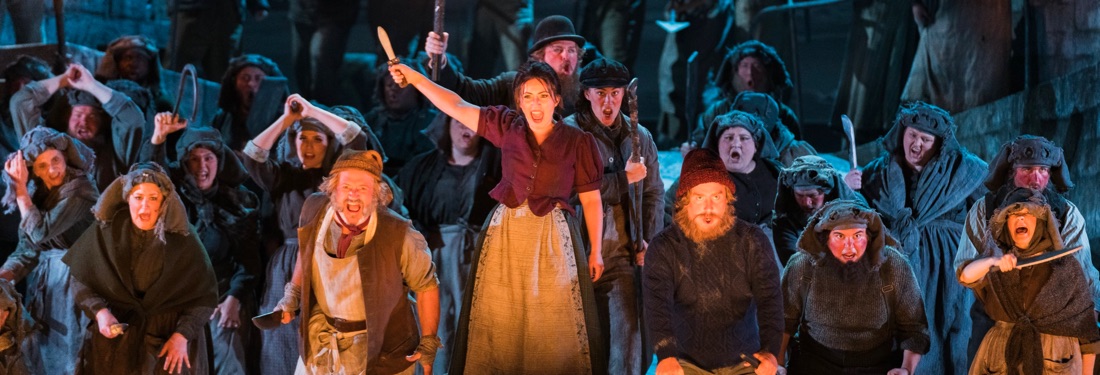
C-major has made available the first DVD/Blu-ray of Franco Faccio’s Amleto.
Ali Baba ou Les Quarantes Voleurs continues straight-tone September with Teresa Stich-Randall as its heroine while Alfredo Kraus scales the heights with another Nadir.
“Trove Thursday” pays tribute to the great German bass Kurt Moll
We leave behind the Vienna of the 1740s, the time of breeches, fans and white wigs.
Director Barrie Kosky’s Glyndebourne 2015 production of Handel’s 1739 oratorio Saul (released on Opus Arte DVD) shows imagination as well as a strong cast and design team.
Just when you thought it was safe to return to Rossini and Verdi—blam!
The Hänsel und Gretel discussions over the holidays plunged me down a YouTube rabbit hole.
Contemporary stagings of Parsifal tend to be spare, abstract affairs scrubbed of religious associations, knights in armor and, sometimes, a grail.
Manon Lescaut was Giacomo Puccini’s first big international success. His publisher, Giulio Ricordi, tried to put him off the project by citing Jules Massenet’s very successful adaptation just nine years previously. Puccini was intent on making the story his own, insisting, “A woman like Manon can have more than one lover… I shall feel it…
Almost exactly twenty years after her auspicious Metropolitan Opera debut as the Fiakermilli in Arabella and a year following what she has claims was her final appearance on the operatic stage, Natalie Dessay returned Sunday afternoon to Lincoln Center—to sing opera.
Passion propels more operas than almost any other human emotion; however, many musical dramas have a very different sort of passion—the final days of Jesus—as their subject.
After viewing Stefan Herheim’s production of Rusalka, I’ve got a new category: “regie slick.”
The appeal of Ariadne auf Naxos (for me anyway) is the acknowledgment that underneath it all, opera (and all other forms of “high art”) is really show business.
It appears that Mariame Clément’s conception of Don Pasquale is that the opera should be retitled Malatesta.
Beneath the pageantry, the paeans to German art and the self-referential allusions to the creative process, Die Meistersinger is a story about a community and human qualities like love, friendship, envy and hatred.
I think we’re all aware by now of the wicked libel that the French dramatist Victor Hugo concocted about the fair Lucrezia Borgia with his depiction of her as a murderous virago.
I suspect most New York City opera-lovers had long since given up hope that the fascinating soprano Anna Caterina Antonacci would ever return to their city.
It may have taken most of Verdi’s canon to do it, but the “Tutto Verdi” collection finally manages to do justice to Verdi in his last two operas.
For decades thousands and thousands have attended Handel’s Messiah (usually around Christmas or more appropriately near Easter) making it easily one of the most widely known works of classical music.
“I’ve lived with mendacity!—Why can’t you live with it? Hell, you got to live with it, there’s nothing else to live with except mendacity, is there?”
Opera’s Scottish enfant terrible David McVicar has applied his considerable skills in this 2011 Glyndebourne production of Die Meistersinger, the result being a refreshing new take on a familiar warhorse.
Handel’s 1711 opera Rinaldo was the first Italian opera ever written specifically for the London stage.
We approach, beloveds, as unto a shrine, for these are no ordinary performances.
Richard Strauss’s “last romantic opera,” as he called Die Frau Ohne Schatten, is and has always been a problem child.
Tell us: Filth or dementia?
Hasten thee to feed another quarter of conversation for The Talk of the Town!
Sign up for our free Newsletter.
Support Parterre Box
Donate to keep opera's liveliest publication free and independent. No paywalls, no institutional backing, no bootlicking.
Get our free newsletter
Opera's top reads delivered to your email weekly…ish.
Join over 100k readers.
The best opera magazine on the web.
Reviews, breaking news, critical essays, and brainrot commentary on opera from those demented enough to love it.
Essentials
Copyright © 2026 Parterre Box.
All rights reserved.
Registration or use of this site constitutes acceptance of our Terms & Conditions and our Privacy Policy.
Sign up for Parterre’s free newsletter.
Exclusive opera reviews, commentary, and top reads
delivered to your email weekly…ish.