Let it begin here
San Francisco Opera’s revolution-set The Marriage of Figaro may not always strike the right balance, but it certainly speaks to the moment.
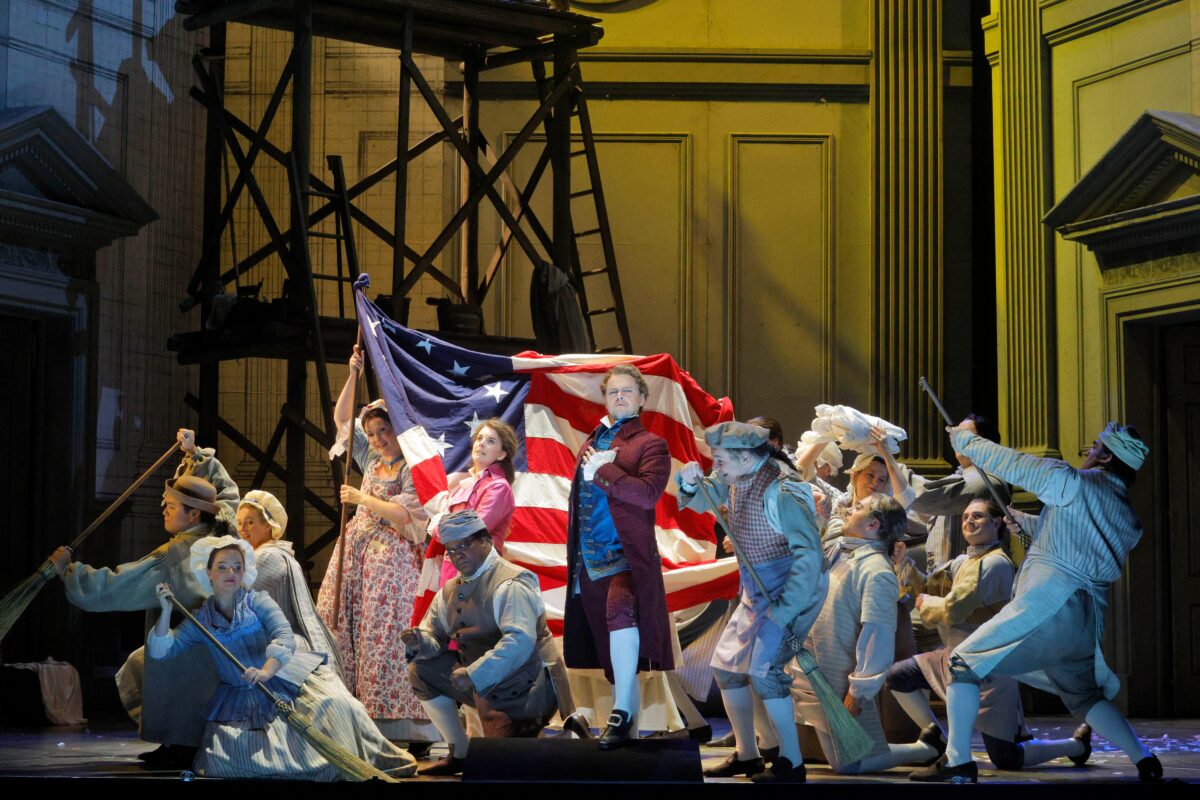
Photo: Cory Weaver / San Francisco Opera
Nobility, fortune, rank, position! How proud they make a man feel! What have you done to deserve such advantages? Put yourself to the trouble of being born—nothing more!
Figaro does not say this in W.A. Mozart’s opera that bears his name. Figaro was not allowed to say this in Mozart’s opera that bears his name. This incendiary statement is made by the Figaro created by Pierre-Augustin Caron de Beaumarchais, the French playwright and polymath whose play Mozart and his librettist Lorenzo da Ponte were so keen to adapt for the court opera in Vienna. It’s a wonder they ever got the idea to do it in the first place. Beaumarchais’ play was summarily banned in France and Austria by “enlightened” despots terrified of the message it would send: that aristocracy is merely an accident of birth. To Figaro, there is nothing inherently noble about the nobility.
I took my seat in the War Memorial Opera House for the opening performance of San Francisco Opera’s production of The Marriage of Figaro, unable to keep the midterm elections from my mind. As poll after poll shows the American electorate frustrated by the cost of living (and as cities across France are riven by fury over the same), I could not help but applaud the timing of this Figaro. Though Mozart and da Ponte got away with their Figaro (and their Figaro) by bleeding the politics out of Beaumarchais, the opera is still a surprisingly acidic take on privilege run amok. Sure, it’s farce. But the argument is that it’s all a farce, isn’t it?
Politics today is no less a farce, but there’s also a danger in just dismissing it as such. While noblemen may no longer exercise droit de seigneur, other exploitations have taken its place, both literal and figurative. Mozart and da Ponte allow us to confront these anxieties while also reminding us that there is still beauty in life, there is still nobility. You just can’t inherit it.
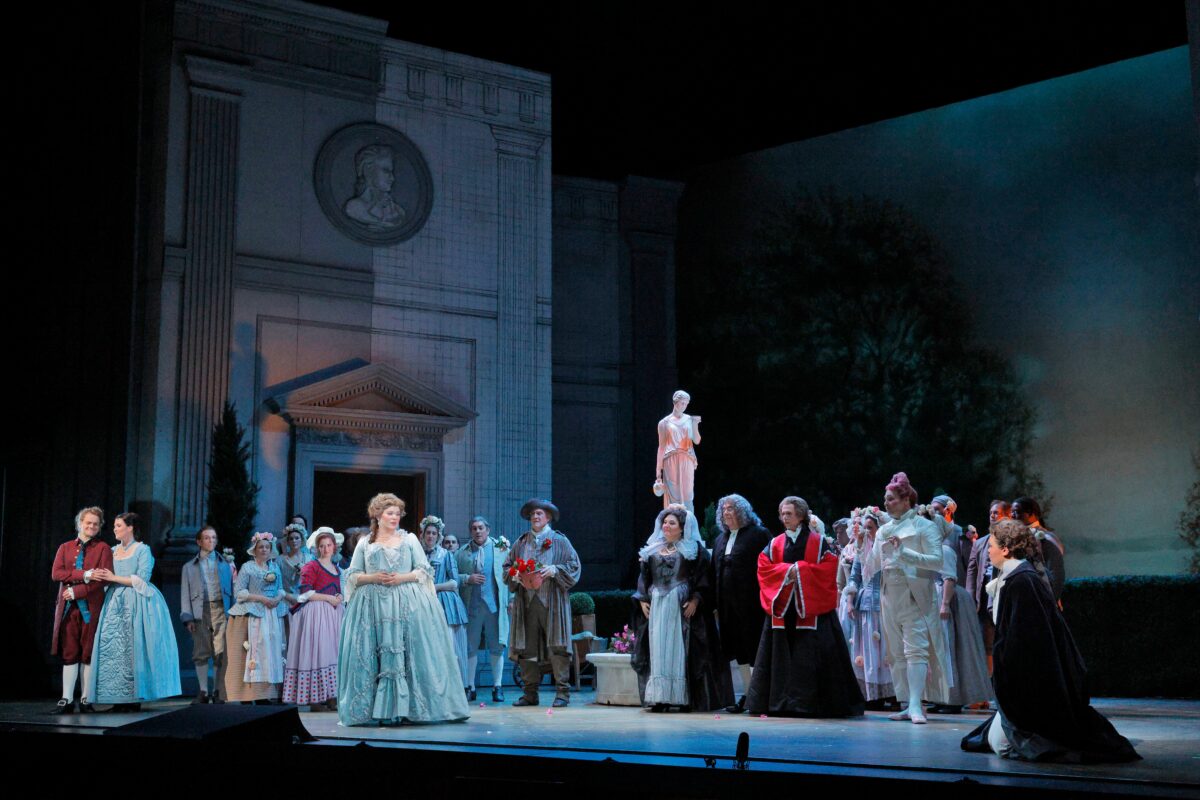
Photo: Cory Weaver / San Francisco Opera
San Francisco Opera has revived its production created by the late Michael Cavanagh in 2019. With set designer Erhard Rom and costume designer Constance Hoffman, Cavanagh reimagined all three Mozart/da Ponte operas as an American story. He set his Figaro just after the American Revolution (so contemporary with both Beaumarchais and Mozart). He would later set Cosi fan tutte among the smart set of the 1930s and Don Giovanni in a post-apocalyptic future.
As has been a theme with each production of San Francisco Opera’s fall season, changing the setting doesn’t harm the opera. It also doesn’t really help it. An American audience is arguably more apt to understand some of the underlying social critique by witnessing it as a function of American history. But the Americanness is put on like the hats the opera’s characters wear to disguise themselves as each other.
Rom’s set is a federal style neoclassical estate in an unnamed mid-Atlantic state. The house is unfinished, half of it still made up of drawings, renderings of architecture yet to come. It’s a metaphor for a nascent republic based on the Greek model. But there is no democracy to speak of: The estate’s patriarch, Count Almaviva, hangs onto the old ways—the ways of a decadent Europe that a war was supposed to banish to the past. In Cavanagh’s production, revolution hasn’t changed much of anything. The colonies are now the states, but the ruling class is still firmly in place.
The conceit of something new being built is an intriguing one. If only the idea had been carried through to the rest of the opera. As I did seven years ago, I wondered when we’d see Count Almaviva poring over the plans for his new estate or a more direct reference to Susanna or the Countess being the architect of the Count’s humbling. Cavanagh’s production consistently sets up good ideas, but doesn’t really see them through.
The production design is handsome and tasteful, an Ethan Allen catalogue brought to life in cool grays and blues. Walls are configurable to create different spaces without overwhelming the singers. For the bigness of their ideas and the bigness of their emotions, Mozart operas are small. With Cavanagh and Rom pushing things as far downstage as possible, they made the War Memorial Opera House feel like a smaller house than it really is.
Constance Hoffman’s costumes cleverly incorporated red, white, and blue across characters without making it all look like the Miss Firecracker contest. As with the set, the overall tonal coolness of the costumes matched a certain nouveau riche aesthetic that has always permeated the American upper classes.
Shawna Lucey, the artistic director of nearby Opera San José, was the revival director. As is her tendency, she largely played it right down the middle but added some bits and bobs that weren’t particularly necessary. I got the feeling that she thought she was directing Rossini’s La cenerentola rather than Mozart’s The Marriage of Figaro. A lot of the action was played out to the audience rather than between the characters. In opera built on a series of intimacies between the characters (some sought, some compelled), I found it unconvincing. Comic moments were underlined, italicized, and highlighted. At one point late in the opera as the plot starts to unspool and the subterfuges crash into each other, there was a good amount of jazz hands.
Mozart comedies are like meringues. Yes, they are light and airy—but they’re also solid. Mozart does not need a directorial heavy hand. Inadvertently, perhaps, Lucey’s approach made me realize how the comedies of Mozart and Rossini are so different from each other, despite trading in a lot of the same musical and dramaturgical tropes. If Rossini is the music hall, Mozart is the playhouse.
The most successful scenes were the ones between the women, who are the opera’s the moral and intellectual center. For all of Figaro’s manic scheming, it’s Susanna and the Countess that know exactly what to do and when to do it, even if they’re making it up as they go along. Lucey backed away from the vaudeville when those two were onstage alone (or with Cherubino), and the result was a heartfelt wryness that seems much in keeping with the tenor of the piece.
The evening’s standout performance was soprano Slávka Zámečníková as Susanna. Her approach to the character was at odds with Lucey’s comic overripeness—and she stood out for it (and for all the right reasons). Her Susanna was a performer when needed and disarmingly authentic when it counted. Zámečníková raised an eyebrow or offered a half-smile when her Susanna watched someone make an ass of themselves. Not in condescension, but in honest wonderment. I never realized until seeing this singer in the role how much of the opera Susanna watches. How much of the farce she observes, mentally banking all of it to use later. I will never claim that Mozart was a feminist by any means. But because of Zámečníková’s performance, I realized that the opera’s center is Susanna.
Zámečníková’s vocal technique is a textbook approach to Mozart: clean attack, exquisite bel canto phrasings, no pushing of the voice. The top is neat as a pin, the middle voice warm and grounded. Her Act IV aria “Deh vieni, non tardar” was gorgeous. But it also revealed a smart singer: At the lowest note (and Susanna sits low for a lyric soprano), Zámečníková gently tapped the note for a moment then climbed back up the staff to where her voice blooms. She honored the composer but also made his music hers. It’s perhaps the best Mozart performance I’ve ever heard at San Francisco Opera.
Her real-life husband, baritone Peter Kellner, was her Figaro. To say that Kellner was committed to the role is an embarrassing understatement. He threw himself head-first into the part. Strange as it may be to say this, I think he was too committed. His Figaro was so volatile, so voluble, so risible as to be downright unpleasant. Figaro is a happy warrior. Outraged at the Count’s antics, yes. But Figaro enjoys the game. In his Act II aria “Se vuol ballare” he sings:
If you want to dance, my little count,
I’ll play the little guitar for you…
If you want to come to my school
I’ll teach you the capriole,
He will teach the count to dance, to perform like a dressage horse (a capriole is such a maneuver). It’s not revenge, it’s one-upmanship. Kellner sang this toss-away aria like he was Frollo imagining burning Esmeralda at the stake. His Figaro leaped and lurched around the stage, Iago combined with Puck. It was too much. If Kellner and director Lucey had decided to make Figaro more of a revolutionary, then they could have pulled it off.
Vocally, Kellner seemed to struggle. The middle voice was well-supported and robust, but the top notes went flat and the bottom notes went sharp from so much pushing. Less dashing about and more creating the character through music would probably even out those extremes.
Olivia Smith was the Countess Almaviva in her largest role with the company so far for this young artist on the rise. Mozart gives the Countess a gorgeous soliloquy (“Porgi amor”) the first time we see and hear her in Act II. It’s so very exposed, giving the singer nowhere to hide, demanding such control and support. Smith acquitted herself gracefully. Her voice is plush and the casting director was smart to pair it with Zámečníková’s more streamlined sound. I actually felt Smith sounded better in her first aria than she did at any other point that evening. As the top of the voice opened up in “Porgi Amor,” it heralded a Strauss singer in the making (in 7-10 years I hope she is singing Arabella or the Marschallin). Her voice expanded like a bubble but never burst, the vibrato slower but steady, sounding as rich as befits a Countess. As the comedy took hold, Smith’s voice shrank a bit, the placement more in the face almost matching Susanna. I wanted her not to try so hard. She has the goods. Her take on the Countess was sweet and earnest, if a bit one-dimensional. The more she sings the role, I think she’ll find the underlying sadness, the sense that maybe she’s stuck.
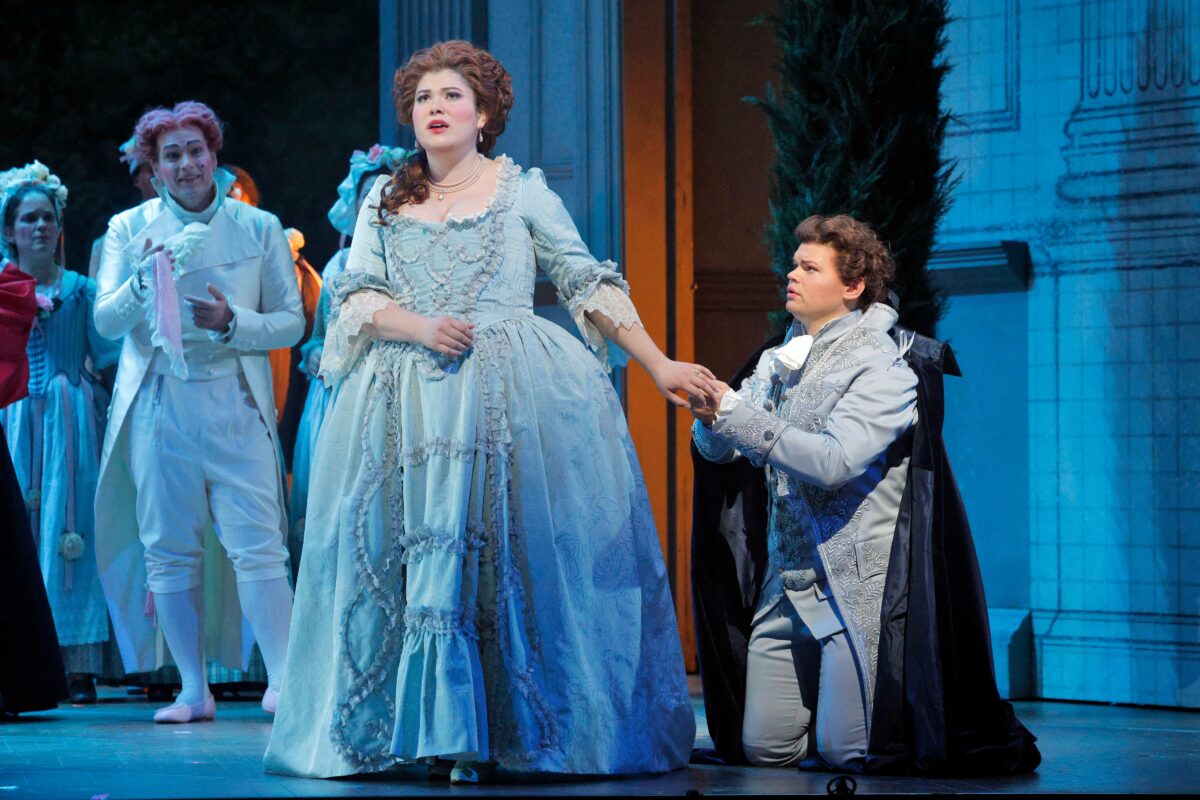
Photo: Cory Weaver / San Francisco Opera
Another young singer took on Count Almaviva. The baritone Thomas Mole, who earlier this year made a thunderous and charismatic house debut in Mary, Queen of Scots, seemed less at ease with the Count. The Count is tricky. He’s gross. There’s no question. But he’s also a buffoon. I wish Kellner’s Figaro and Mole’s Almaviva had traded approaches to character. Mole needed Kellner’s sheer chthonic aggression, and Kellner needed Mole’s embrace of the buffoon. Mole embraced the villain in Mary, Queen of Scots so I can’t square his apparent apprehension to play a villain. For all that, Mole sounded solid. He has an elegant and sizable baritone that will serve him well in a variety of operas as time goes by.
Mezzo-soprano Simone McIntosh’s Cherubino found the sweet spot between honoring the physical comedy, but not compromising the voice. Her Cherubino was definitely hormone-driven, but she cut it with an endearing Romeo-in-love-with-Rosaline way of idolizing the countess. McIntosh’s voice is also robust, perfectly comfortable at the top and more than audible at the bottom in the chest notes.
Alex Shrader was a dandyish (and uncommonly well-sung) Don Basilio, mincing about the stage like a fencing master who has never picked up a foil. San Francisco stalwarts Catherine Cook (Marcellina) and Philip Skinner (Antonio) are always welcome sights on the War Memorial stage. Italian buffo bass Maurizio Muraro is an old hat when it comes to Dr. Bartolo and he delivered. Sophia Gotch made a strong impression as Barbarina (for once I found the Pin Aria something other than filler for a set change). She’s a singer to watch.
In the pit, conductor Sebastian Weigle made his house debut on the podium. No moss grew on his score. Somehow the running time was three hours and forty-five minutes even as Weigle was on the express train. On the one hand, comedy thrives on speed. And some scenes were helpfully zippy. On the other hand, it was a reading that didn’t really offer any much in the way of sheer beauty, a shame with an orchestra as good as the San Francisco Opera Orchestra and chorus as good as the San Francisco Opera Chorus. It felt like Weigle took his cue from Peter Kellner’s brusque Figaro. Most disappointing was Weigle’s rushing of the Countess’ Act III aria “Dove sono”, one of the most arresting moments in all opera. It was so fast as to be bled of any pathos whatsoever. Fortunately, he didn’t rush the opera’s sublime payoff when Count Almaviva is brought low and begs his wife’s pardon (“Contessa perdono”). I wish this restraint had happened earlier.
The assembled cast at the end of Figaro sings:
Lovers and friends, let’s round things off
In dancing and pleasure,
And to the sound of a gay march
Let’s hasten to the revelry.
This is miles away from the opera’s incendiary beginnings as a banned play and a political polemic. In some ways, the most American thing about this opera has nothing to do with the Americanness of the production. Though we threw off a monarchy, the stories we tell ourselves in this country often focus on the elites and their shenanigans. Mozart softened Figaro’s edge to avoid censorship. But I also think he was being honest by showing us a story in which everyone forgives the elite and in which the working class accepts its place. Mozart isn’t suggesting this is the way it should be, but the way that we expect it will be. Mozart could not have predicted the national and global reckoning we are having about privilege. Then again, maybe he did.
Matthew Travisano
Matthew is a San Francisco-based educator and actor. He has taught and lectured on the performing arts for more than two decades. He has trained a generation of actors in the greater Bay Area at both Oakland School for the Arts and Ruth Asawa School of the Arts, where he has also taught literature, composition, literary theory, and aesthetics. He holds a BA in English from UC Berkeley and a Master's in Teaching (MAT) from San Diego State University.
-
People: Alex Shrader, Catherine Cook, Constance Hoffman, Erhard Rom, Maurizio Muraro, Michael Cavanagh, Olivia Smith, Peter Kellner, Philip Skinner, Sebastian Weigle, Shawna Lucey, Simone McIntosh, Slávka Záme?níková, Sophia Gotch, Thomas Mole
-
Works: Le nozze di Figaro
-
Places & Organizations: San Francisco Opera