Lipsync for your life
Heartbeat Opera’s Queeney Todd draws together New York’s queer theater multiverse in a stunning drag production that breathes new life into the opera and leaves the audience in stitches.
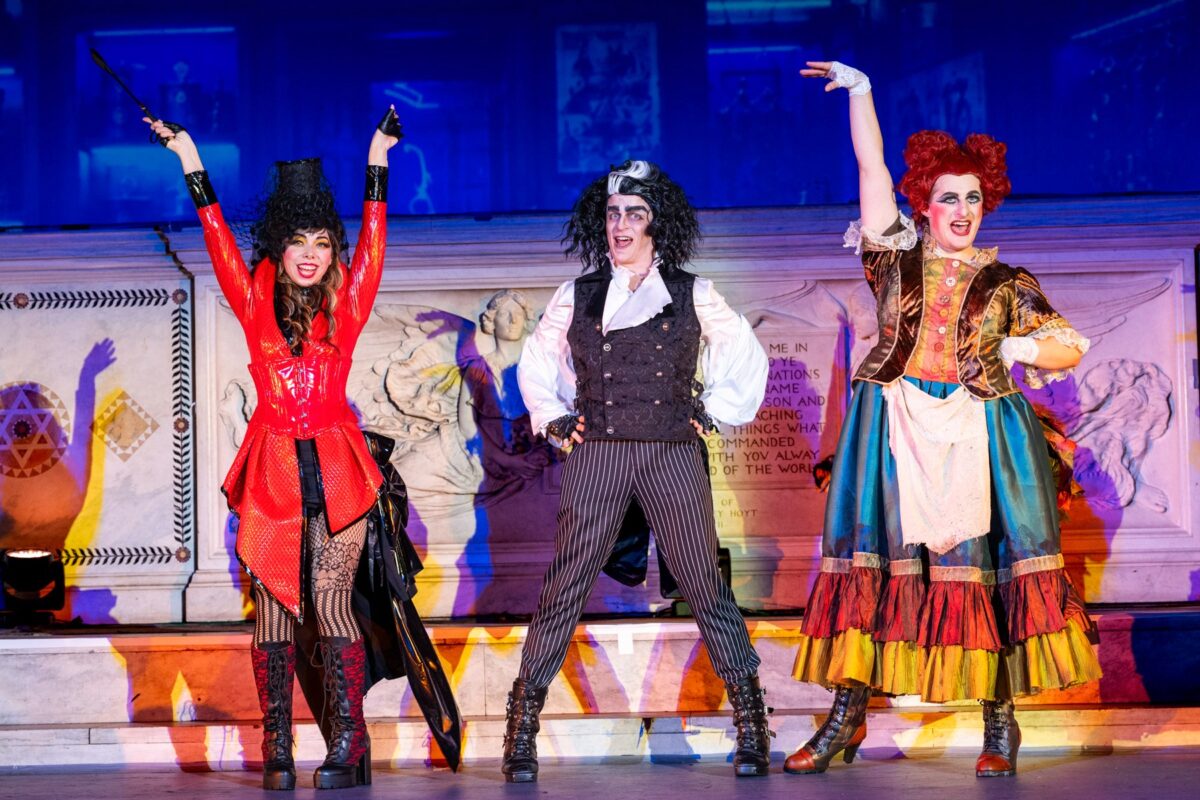
Photo: Russ Rowland
Theater in New York, even off-Broadway, is now so expensive, and the cultural and economic chasm between old and young so vast, audiences frequently present as an ocean of gray heads. Walking into Judson Memorial Church for Heartbeat Opera‘s Queeney Todd, therefore, was like walking into another world. House music played, the sanctuary of the famous activist church was lit up like gay Christmas in Hades, and the audience was diverse in every way that matters. This mélange is a product of the artistic brilliance of the company, particularly show creator Kemar Jewel and artistic director Jacob Ashworth, but also the community that a show like Queeney Todd draws out. The New York City queer multiverse sometimes draws back the curtain to reveal what is still possible in contemporary theater. It turns out that a better, gayer, world is still possible.
Queeney Tdod opens up a window of possibilities. There is a vibe you get in the theater when everyone, from the orchestra musicians to the stagehands, is in on the joke. Yes, there were big gasping belly laughs, but these achieved through direction and choreography that was artful and beautifully crafted. The jokes, the choreography, the costumes, the effects, and the timing were all so spot on and simultaneously intimate and tactile. Queeney Todd didn’t have the distant polish of a screen or a huge stage production. There were no supertitles and there were plenty of lines that got lost in the cavernous sanctuary. This low-tech quality ensured that the audience leaned in and was actively listening. Heartbeat’s experiments in theatrical scale are impressive, and Queeney Todd in particular takes the concept of the chamber opera to new places.
The individual performances blend outrageous drag personas with comedic stock characters. “Demon bottom” Queeney Todd, performed by baritone Nathaniel Sullivan, was lithe as a cartoon, and jaunts about the stage with matador-like plasticity. His voice is rich and heroic, presenting a hilarious contrast with the obscene and ridiculous lyrics. The teasing snippets of traditional opera drizzled throughout the show, were, without exception, performed with sizzle. They were serious enough for the huge number of opera veterans in the audience while never feeling out of place in the absurd plotline. Eliza Bonet, with her lush, quivering mezzo, performs the role of Rosina, and begins the show with a teasing snippet of “Habanera” from Bizet’s Carmen. She gives by far the most extraordinary technical performance in the show. She gave me the unique experience of being bent over in belly laughs while hearing a voice so beautiful I had goose-pimples on my arms. It was a full body experience.
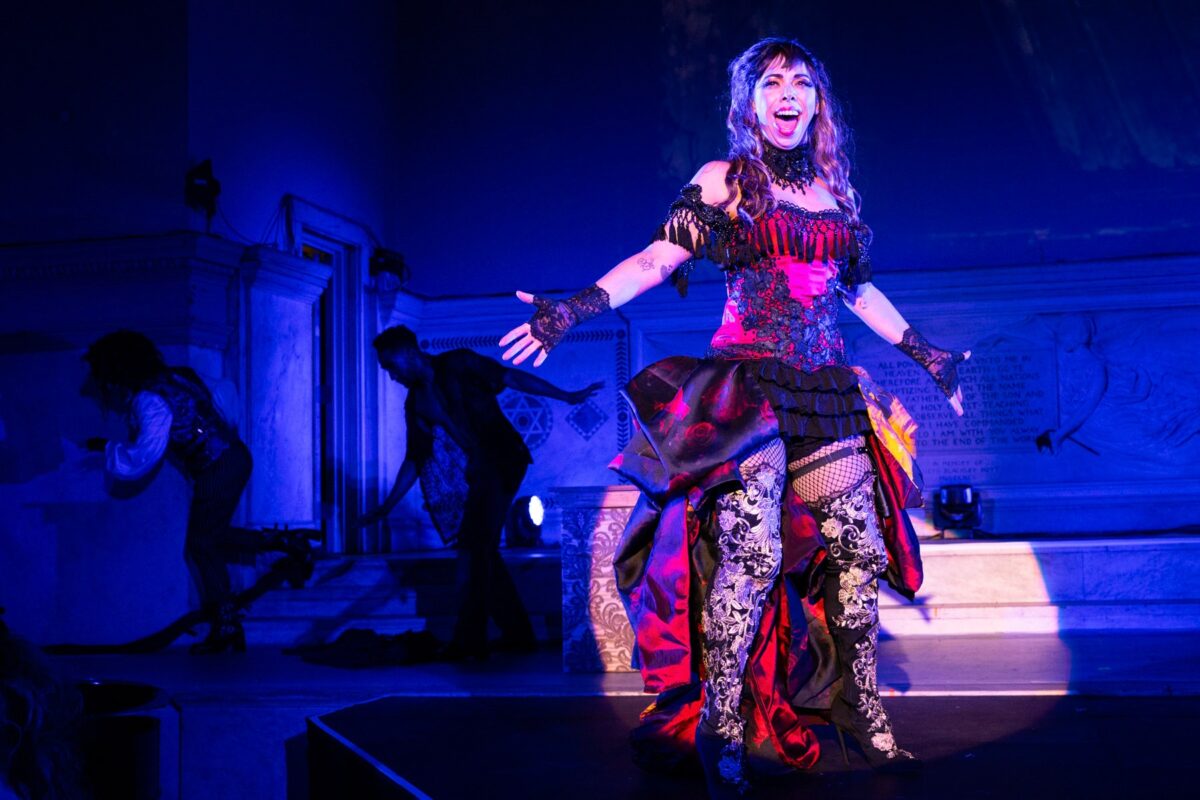
Photo: Russ Rowland
Imara Miles, performing as “the top,” the many faces of Queeney’s ill-fated grindr hookups, brought warmth and intimacy to her drag king performance. She presented a happy contrast with the stridency and bravado of the other singers. She performed with perfect comic timing, her huge, elastic expressions and supple movements repeatedly bringing the house down in laughter. Her aria montage, taking us through the openings of “Addio fiorito asil” from Puccini’s Madama Butterfly, “La Fleur” from Bizet’s Carmen, and “La Donna e Mobile” from Verdi’s Rigoletto, in a marathon of singing, clowning, and choreography, was a feat of brilliance.
Jonathan Burke, who played Mungojerrie in Cats: The Jellicle Ball, brought Broadway glamor and some seriously sexy moves to Queeney Todd. His lipsync and voguing to “Largo al factotum” (with Imara Miles singing backstage) was like the theatrical equivalent of ice cream for dinner. It was so delightful it felt clandestine. It made me think about how much drag, opera, and ballroom have in common—the way they can sample from many cultures and traditions to create total works of art. This group marriage of artforms seems entirely natural since they all draw from the extreme edge of artifice, dispensing with realism and focusing on the serious work of make believe.
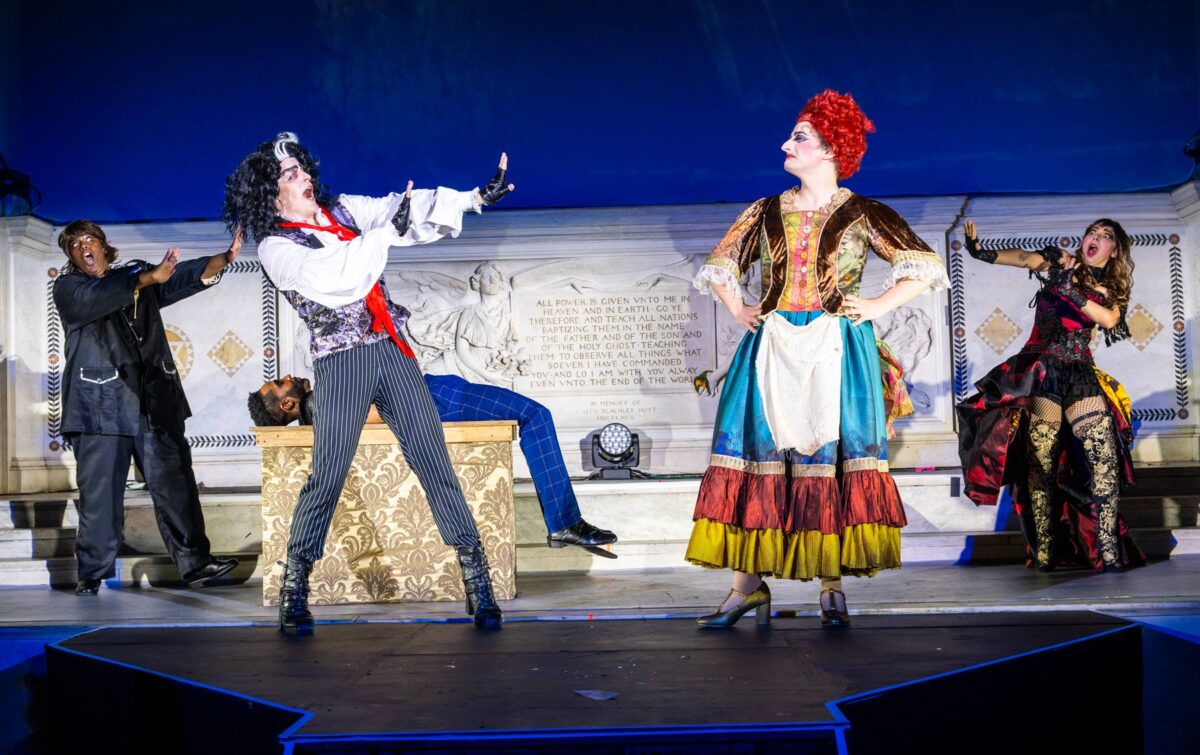
Photo: Russ Rowland
If Burke’s voguing was ice cream for dinner, then Matt Dengler’s performance as Mrs. Lovedick was MDMA for dessert. Performing as the bawdy harridan innkeeper and accessory to murder, Dengler stole the show, bringing virtuoso comedic range to the role and embodying the spirit of a production that took from ballroom, opera, Broadway, and drag. His comic phrasing had a crisp sensitivity that connected with the audience, as in a cabaret performance, teasing and flirting like he was performing just for you. His surprise concluding montage had me gasping with laughter.
The chamber orchestra, also in drag, was sensitive to the performers and flexible through a dizzying variety of musical styles, from high baroque to Broadway. Music director Daniel Schlossberg was particularly impressive, spinning back and forth from keyboard to piano, in drag, while the performers chased each other through the orchestra and humped his instruments. The Stonewall Chorale, an LGBTQIA+ community choir, brought in exactly the right dash of seriousness to the show’s cavalcade of tomfoolery.
Heartbeat turned Judson Memorial into a loud, boisterous, democratic space, where the bar was open during the show and hooting and hollering was encouraged. As contemporary as the show is, it held hands with the past, presenting opera as it was before Wagner turned the theater into a dour and sacred space. “Why can’t every opera be like this?” my husband whispered to me as a spectator across the aisle received a lap dance from Jonathan Burke. It got me wondering how many great traditional operas have got a drag opera waiting inside it, boiling beneath the surface. Rather than leaning towards the tastes of the aging elite in opera’s donor base, Queeney Todd reaches out to the much bigger and brighter queer community. It feels like the future.
-
People: Daniel Schlossberg, Eliza Bonet, Imara Miles, Jacob Ashworth, Jonathan Burke, Kemar Jewel, Matt Dengler, Nathaniel Sullivan
-
Works: Queeney Todd
-
Places & Organizations: Heartbeat