Voices of the past
Rhiannon Giddens and Michael Abels’s Omar fascinates and frustrates in equal measure in Chicago.
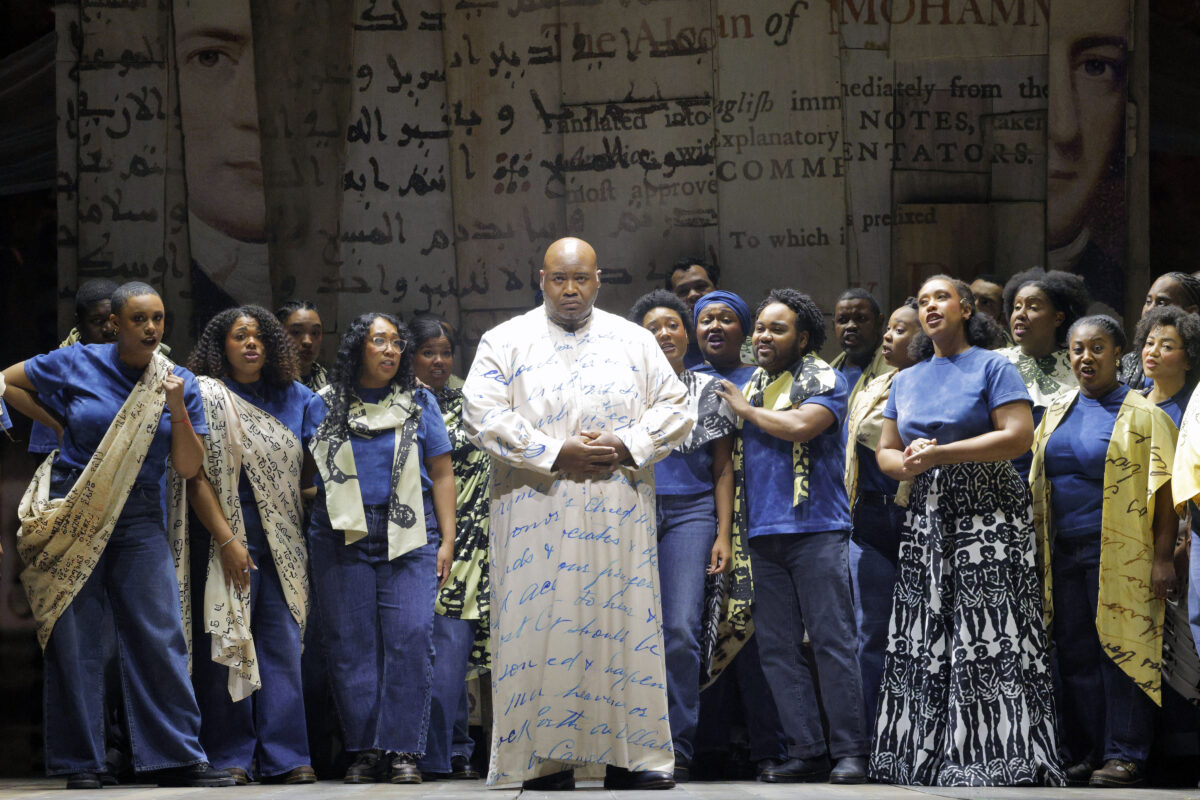
Issachah Savage as Omar and the Company of Omar. Photo: Cory Weaver
W. E. B. Du Bois’s The Souls of Black Folk opens its final chapter with one of American literature’s most remarkable revelations:
They that walked in darkness sang songs in the olden days—Sorrow Songs—for they were weary at heart. And so before each thought that I have written in this book I have set a phrase, a haunting echo of these weird old songs in which the soul of the black slave spoke to men.
Drawing out the musical phrases that preside over its chapters, Du Bois’s genre-defying masterpiece reverse-engineers itself as a libretto, a book-length elaboration of these “bursts of wonderful melody, full of the voices of my brothers and sisters, full of the voices of the past.”
It was not, of course, only in song that the enslaved spoke, and indeed wrote. The archive of American slavery is filled with extraordinary, ingenious documents, and deeply sorrowful ones, narratives that invent or indulge or shrewdly repurpose cliché—often all of these. Reading, and hearing, what Du Bois called “the articulate message of the slave to the world” is a task both eternally urgent and, as many scholars have explored, profoundly challenging.
Rhiannon Giddens and Michael Abels’s 2022 opera Omar, which opened Friday evening for a three-performance run at the Lyric Opera of Chicago, takes as its source one of this archive’s characteristically profound and challenging texts. To its credit, the opera fits its narrative to an accessible, even beautiful score, composed with clear reverence for the vernacular musical traditions Du Bois heard and which Giddens has spent her multifaceted career exploring.
Yet that narrative, as told by Giddens’s libretto, levels the literary difficulties of its source text into something disappointingly rote. Omar’s source is the autobiographical narrative written in Arabic in 1831 by Omar ibn Said, a Muslim scholar from present-day Senegal who was enslaved in the Carolinas for nearly sixty years until his death in 1864. (His image survives in an extraordinary ambrotype, alongside other manuscripts and documents of his life.)
Ibn Said’s fifteen-page narrative, published in a facsimile of his learned script with a facing-page translation by Ala Alryyes, strikes a contemporary reader as strange: roughly one-third written prayer, one-third praise for the Owen family—his longtime enslavers—and only a curious, condensed description of his capture, transport, and sale:
[Then there] came to our country a big army. It killed many people. It took me, and walked me to the big Sea, and sold me into the hand of a Christian man who bought me and walked me to the big Ship in the big Sea.
We sailed in the big Sea for a month and a half until we came to a place called Charleston. And in a Christian language, they sold me. A weak, small, evil man called Johnson, an infidel who did not fear Allah at all, bought me.
With these brief sentences, ibn Said sketches his experience of the Middle Passage—the defining narrative of transatlantic modernity. For him, its key motif is walking: “It took me, and walked me”; “who bought me and walked me.” After escaping Johnson, he “walked” again. Ibn Said understands, and narratively dispatches, what must have been the most traumatic years of his life through constant movement, whether forced or free. Omar’s libretto stretches these two short paragraphs into the opera’s first act, drawing out scenes—principally, a lengthy slave auction—on which ibn Said declines to dwell.
What the opera gains in legibility it loses in particularity. Omar’s story blurs into one that is straightforward to imagine because we have heard its awful contours before: the dehumanizing interior of the slave ship (here including excellent capsule biographies delivered by Cameo T. Humes and Nicholas LaGesse); a family separated at auction; an abusive master (Kyle Ketelsen, singing the roles of Omar’s two masters with, by turns, terrible rage and chilling kindness). These things happened, many times and to many people. But this is precisely the libretto’s difficulty: Omar’s narrative turns out not to be ibn Said’s.
By generalizing his narrative, Omar makes Omar difficult to understand. What moves him? How does he feel, think, or change? With a luminous, sensitive tenor capable of both vulnerability and self-assurance, Issachah Savage made the absolute most of an underdeveloped role that gives just an outline of Omar’s life before enslavement and only the most straightforward explanation of his need, amid the turns of a difficult life, to stop and pray. In the libretto, Omar is devoted to Allah and to the spirit of his mother, Fatima (Zoie Reams, leading the company in prayer in a vivid, composed mezzo-soprano), but we have only a schematic sense of why. Where ibn Said’s own narrative of these years keeps him in motion, Omar’s libretto makes Omar and his devotion static.
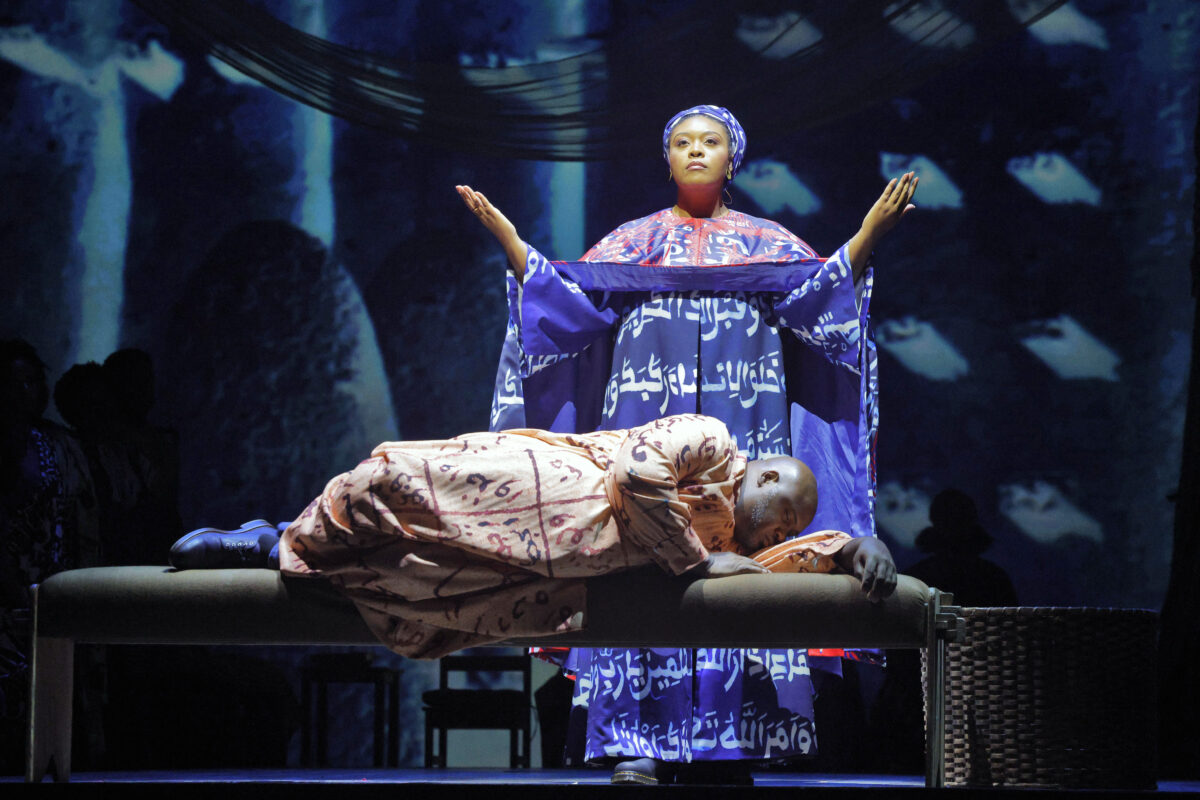
Issachah Savage as Omar and Zoie Reams as Fatima. Photo: Cory Weaver
What this opera would benefit from—might still, despite a Pulitzer Prize and successful runs across the country—is a more robust dramatic shape. It doesn’t help that the libretto typically rejects ibn Said’s movingly spare style—“And in a Christian language, they sold me”—for clunky, rhymed couplets: “You sent me a sign: the girl. / Send me another as this unfurls.” The finale, featuring the chorus in indigo-dyed tees and Levi’s (costumes, otherwise excellent, by Micheline Russell-Brown, April M. Hickman, and Charlese Antoinette Jones) spread across the stage to implore Omar, and us, to “tell your story,” cross-pollinates the sentimentality of “We Are the World” with the closing number of Hamilton.
There is a better and more challenging story to be found in ibn Said’s narrative, and Giddens and Abels’s intelligently woven score, conducted capably on Friday by Kazem Abdullah, would be capable of telling it. Owen, the kind but unsettling second master, quotes Christian parables to a cannily Wagnerian setting. A striking, unaccompanied moment in Omar’s second-act monologue nods to Benjamin Britten’s Peter Grimes—another tenor who doesn’t quite fit in, though in extremely different circumstances. In these moments, Omar finds resonances among the multiple musical domains it aims to inhabit. (The operatic texture occasionally collapses into a broader, Broadway lexicon, especially in the ensemble writing; Friday’s singers wore microphones.)
The evening also brought excellent performances from Daniel Luis Espinal, tonally confident in the difficult role of a light-hearted slave auctioneer, and Camille Robles, who delivered a lovely account of a perhaps misconceived light-opera aria in which Owen’s daughter convinces her father to buy Omar from jail. The evening’s weak vocal link was Kearstin Piper Brown, dramatically effective as Omar’s confidante Julie but suffering from a faint lower register and an imperfectly controlled “My daddy wore a cap like yours.”
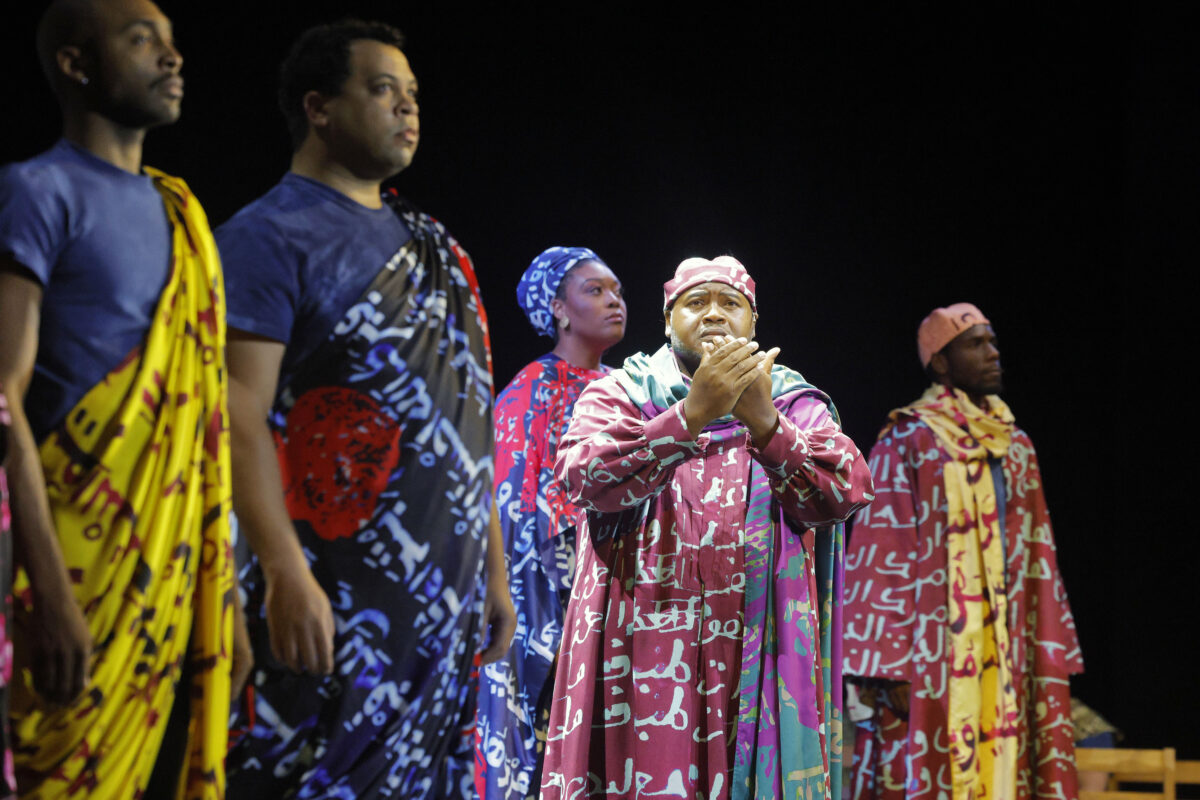
Issachah Savage as Omar and the Company of Omar. Photo: Cory Weaver
Kaneza Schaal’s original production, centered on a tree in the sculptural language of Barbara Chase-Riboud, continues to be smartly designed, with sets (by Amy Rubin) and overgarments emblazoned with the scripts of African languages lost amid American slavery and with images of the new print cultures it produced. Ibn Said’s narrative, which declares its own textual impossibility—“I cannot write my life, I have forgotten much of my talk”—embodies both sides of this story of linguistic destruction and cultural transformation.
In the opera’s most dramatically and musically powerful moment, Joshua Higgason’s outstanding projections supertitle Johnson’s threatening drawl phonetically, representing the way an uncomprehending Omar hears his purported, secular master while he overlays Arabic prayers to the divine. This is the kernel of a dramaturgy that would sustain the complex meditation on writing, devotion, and cultural tradition to which Omar’s music and its production aspire. Omar made me wish for a more dramatically assured and textually sensitive opera—one that, were its real-life subject to see it, might find him saying, as Du Bois wrote: “Ever since I was a child these songs have stirred me strangely. They came out of the South unknown to me, one by one, and yet at once I knew them as of me and of mine.”

Bradford Case
Bradford Case is a PhD student in English at the University of Chicago. A bassoonist and former music director of Yale's Berkeley College Orchestra, he is currently the Editor of Chicago Review.
-
Topics: Review
-
People: Cameo T. Humes, Camille Robles, Daniel Luis Espinal, Issachah Savage, Kaneza Schaal, Kazem Abdullah, Kearstin Piper Brown, Kyle Ketelsen, Nicholas LaGesse, Zoie Reams
-
Works: Omar
-
Places & Organizations: Lyric Opera of Chicago