The pleasure principle
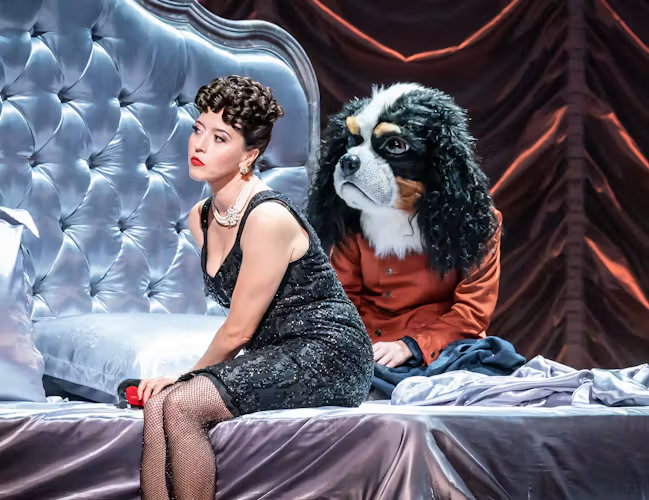
Photo: Marc Brenner
Love, duty, courtesy, mercy — The only path”, a banner projected onto the curtain proclaims early on in Richard Jones’s Alcina. The only path it extols is that of an Amish-like community, all broad-brimmed hats and bonnets and a very rigid sense of a proper way of life — and one that the glamorous temptress Alcina will fatefully shake.
If it sounds over-the-top, that’s because it largely is: Jones’s exuberant staging recasts Handel’s adaptation of Ariosto’s free-wheeling chivalric epic into a struggle between two extreme forms of existence, total puritanism and self-centered pleasure. Their opposition is set up early on during the overture, as Alcina sneaks into Bradamante and Ruggiero’s marriage ceremony, nonchalantly snatches their scriptures to deposit them in a garbage can, and transforms the smitten congregation into beasts, a retinue to serve at her pleasure. The dashing Ruggiero gets to retain his human form, promptly being dragged offstage by Alcina, while the stunned Bradamante and Melisso are left to embark on a rescue mission.
The ensuing clash of the two worlds is put to work primarily for amusement — lighthearted and always angling for a laugh, the production works with a decidedly comic approach. Exaggeration reigns supreme. Alcina’s urn, the font of her power, is shown here as a giant perfume bottle, while her lovers-turned-beasts sport huge, hyperrealistic animal heads, following Alcina around with servile adoration, tending to her garden, and snatching up her various items of clothing with fetishistic joy, later taunting the jealous Ruggiero with their spoils.
The comic bent is matched with vivid, colorful visuals, and, much like its fellow prospective Met co-production, Guth’s Semele, the occasional dance routines (excellently staged by movement and revival director Sarah Fahie, and delightfully executed by her crew). Antony McDonald’s stage design fittingly riffs on the combination of artificiality and glamour: the hallway of Alcina’s palace is decorated with giant photos of herself, her boudoir is walled off by gleaming silver curtains, the trees of her impossibly verdant gardens are pushed around on trolleys.
Yet, to Jones’s credit, the production offers more than a sex comedy wrapped in glittering garb. There is no mere subversion of the work’s moral order, nor a simple sense of right and wrong. The puritan concepts of love and happiness may hold little appeal, and the escape from the stifling quasi-Amish world allows its inhabitants to experience a different way of life, but there is always a stark reminder that Alcina’s realm is as much one of sexual liberation as it is of subjugation. Jones emphasizes the dark undercurrent of the enchantress’s world, dominated by narcissism and ruthless exploitation: once the members of Alcina’s enthralled retinue regain their consciousness through Melisso’s ceaseless proselytizing, they are terrified and furious at their state, ultimately only kept back by Bradamante from violently seeking revenge.
But Alcina gets the last laugh. The congregation that tasted the forbidden fruit is no longer content to follow “the only path”: the wedding ceremony from the overture is repeated to the misery of all involved (you just can’t beat the image of the dejectedly step-dancing Amish). The eternal temptress triumphantly returns, the congregation overthrows Melisso and submits to Alcina’s enchantment willingly, exchanging their scripture and banner for Alcina’s rulebook: The Joy of Sex.
Compared to its 2022 premiere run, the production, already well-paced and tightly run, felt even more well-rounded in its revival. Some previous blind spots — the fairly cliched, superficial portrayal of Alcina’s anguish in her Act II and III arias — have been smoothed out, while other aspects continue to captivate. Bradamante is laudably complex: initially a straight-laced avenger, she grows movingly empathetic towards Alcina, willing to forgive where Melisso would punish. She is also as irrevocably changed by Alcina’s island as Ruggiero, enjoying an episode of brief, ambiguous intimacy with Morgana after being briefly bewitched during “Ama, sospira”; and ultimately ending up just as dissatisfied with Melisso’s “path” as the rest. One major issue remains, however, in Ruggiero’s portrayal. Rendered here as an aimless, oversexed young man, Ruggiero is largely relegated, at times, to running around the stage and delivering his arias in a functionally park-and-bark manner, in a careless misuse of Emily D’Angelo’s superior acting chops and a shoddy take on one of the work’s central figures.
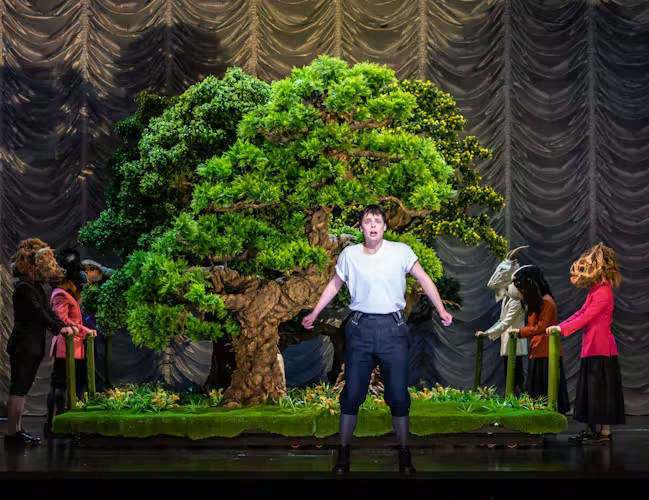
Photo: Marc Brenner
Musically, the evening offered both enchantment and disillusionment. Most of the premiere run’s main cast returned, led by the inimitable Lisette Oropesa. Hers was a fully realized portrayal even on the occasion of her role debut, and she continues to rock the part, visibly delighting in playing the strutting, capricious sorceress. Vocally, Handel’s writing fits her like a glove, too: the raging runs of “Ma quando tornerai” were, expectably, tossed off with fiery ease, the sharply punctuated, tortured phrases of “Ah, mio cor” sung with heartrending emotion, the act-closing, devastating “Ah! Ruggiero crudel … Ombre pallide” rendered with a suitably lachrymose tone and grave, sharply dramatic sense of phrasing. (”Di, cor mio” could have used a touch more creamy tone and a less fluttery vibrato, but who am I to nitpick?)
At her side, Emily D’Angelo’s sheer technical prowess — the formidable breath control, endless, seamless phrases (making time stand still in an aria like “Verdi prati”), and impeccable coloratura — is awing as ever, and the darkness of her timbre and clarion high notes are more than fitting for portraying the young, impetuous warrior. There was, however, a frustratingly superficial relationship with the text in her delivery, and a nonchalance towards expressive phrasing that considerably marred what would be an otherwise hugely impressive performance.
The sole major cast change from 2022 was in the role of Bradamante, welcoming the meteorically rising mezzo Beth Taylor. Taylor had awed me as Cornelia in Il pomo d’oro’s Cesare tour with a combination of sheer torrent of sound and generous richness and warmth of tone. Bringing the same outstanding instrument and an engaging stage presence to Alcina, her Bradamante was a delight to see and hear, a mix of youthful impetuousness, righteous anger, and bewilderment. A vehement, despairing “È gelosia” showed off the sonority of her mezzo-soprano, while a fire-spitting bravura performance of “Vorrei vendicarmi” displayed agility and burning emotional intensity. (There was, however, a touch of unevenness across the registers, her top notes paling in volume and tone.)
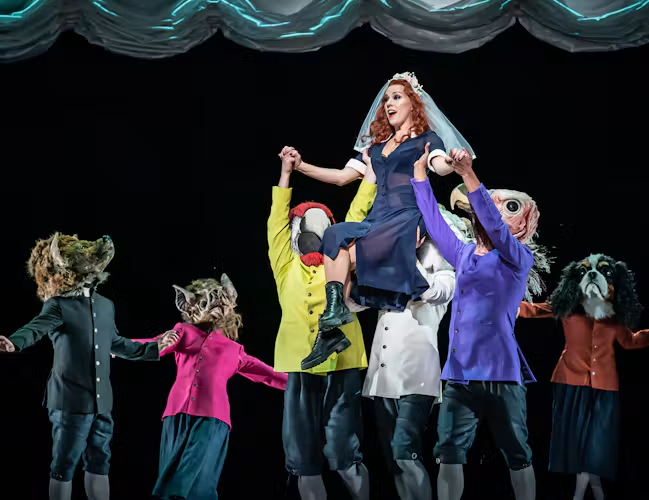
Photo: Marc Brenner
As Morgana, Mary Bevan remains charmingly rogue and coquettish, ceaseless in her pursuit of the cross-dressed Bradamante, shifting between touching earnestness and delightful condescension along the way. Musically, though, what should be a delectable soubrette role sounded wiry and hard-set instead, with a sourness to her timbre and a considerable constraint in her top notes that served a showpiece aria like “Tornami a vagheggiar” all too little. (One can only wonder what a singer like Giulia Semenzato, contemporaneously engaged for the RBO’s Don Giovanni as Zerlina, could have made of the role instead.)
Ru Charlesworth’s bullish Oronte was similarly laudably well-acted, but not quite so sung – the timbre is not particularly pleasing, and the voice, if suitably flexible, delivering a biting “È un folle”, tends to turn nasal under pressure. Edward Grint’s Melisso was as smarmy and repulsive in his righteousness as possible, and offered a reliable performance. With no ill feelings toward the boy soprano valiantly taking on Oberto, I remain little convinced that the role is not better served by an adult singer, especially if “Barbara!” is going to be included.
In 2022, Christian Curnyn charmed only moderately in the orchestra pit, and I can’t say that David Bates’s thoroughly correct, workmanlike approach made a much more favorable impression. (Raphaël Pichon and his Ensemble Pygmalion in Ariodante have, perhaps, spoiled me for good when it comes to repertory performances of Handel at major houses.) Brief flashes of energy and bite through Act I made me yearn for a more boldly phrased and dynamic reading, one that would come only with Act II, where the icy pangs of the strings in Ah, mio cor and the hypnotically reeling “Ombre pallide” both captivated. The strings offered warm, lyrical beauty in the slow arias (particularly arresting in “Verdi prati”), as did the woodwinds, with marvelous support from the recorders in “Mio bel tesoro.” Not one for the ages, perhaps, but all in good fun.
Orsolya Gyárfás
Based in Budapest, Orsolya Gyárfás has been publishing opera reviews in English and Hungarian since 2016. Currently wrapping up a PhD focusing on Metastasian opera seria; general interests and obsessions include all things Baroque, queer, Regietheater, and any given combination of the above.
-
People: Beth Taylor, David Bates, Edward Grint, Emily D'Angelo, Lisette Oropesa, Mary Bevan, Richard Jones, Ru Charlesworth
-
Works: Alcina
-
Places & Organizations: Royal Ballet and Opera