Smooth operators
A husband-wife duo add star power to San Francisco Opera‘s stylish revival of Manon.
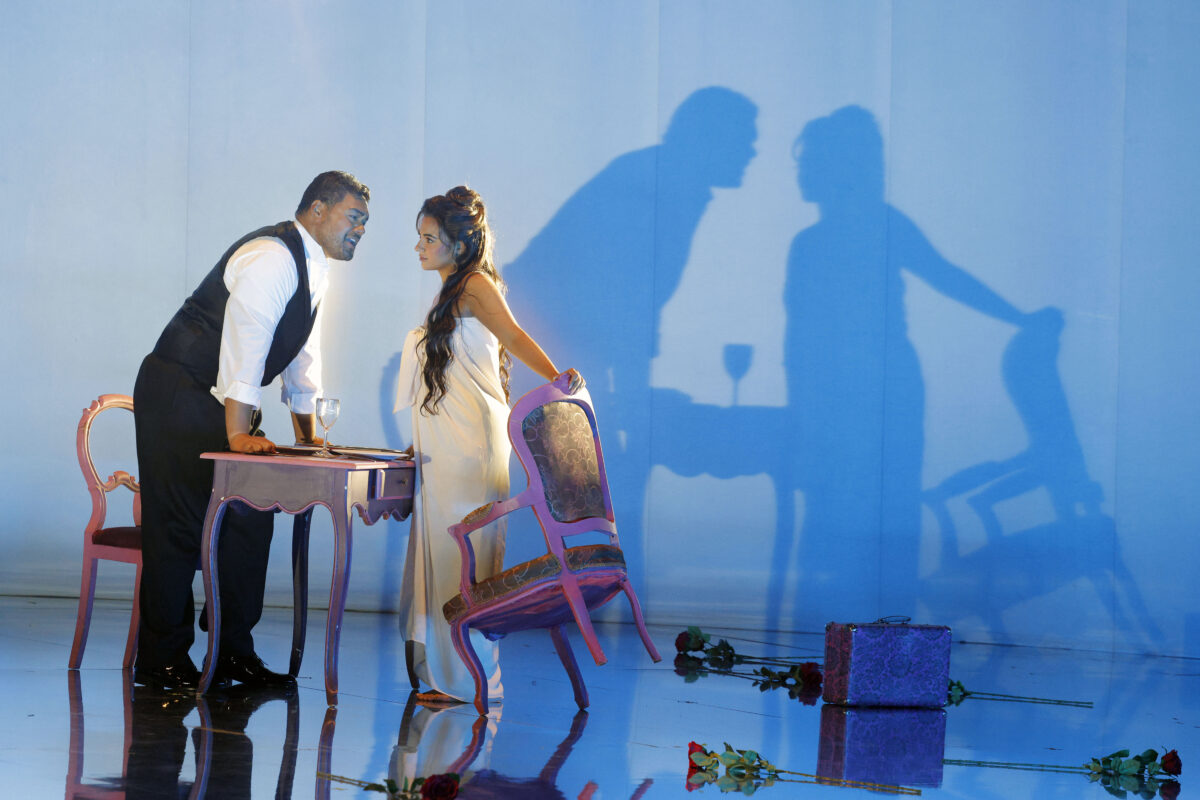
Photo: Cory Weaver/San Francisco Opera
Sparks flew when the San Francisco Opera (SFO) revived Vincent Boussard’s nearly decade-old production of Jules Massenet’s Manon. In a full display of its commitment to the Merola and Adler Fellow training programs, the show was headlined by program alumni and real-life husband-and-wife Bay Area favorite tenor Pene Pati and soprano Amina Edris. The operatic power couple was understandably the main selling point of this run, and they made a welcome return together to the War Memorial stage, their first since Gounod’s Roméo et Juliette in October 2019.
The celebrated Samoan lyric tenor Pati, who now lives in Paris with Edris, has been in the news lately for receiving the Chevalier de l’ordre des Arts et des Lettres from the French government earlier this year and for the release of his documentary, Tenor: My Name is Pati, which showcases his rise to opera stardom from his humble beginnings in Samoa. On Thursday, he delighted the audience with his suave, gentle reading of des Grieux. His voice has definitely matured since I last heard him as Romeo; the youthful abandon has largely given way to intelligent phrasing and nuance, revealing a multitude of colors. His “En fermant les yeux” was the perfect example of this, as he dreamily imagined a simple married life while throwing gorgeous pianissimi, making it one of the highlights of the night. While his St. Sulpice scene might be a bit lacking in the red-hot display of passion, his gentle portrayal rendered the final scene completely heartbreaking. Here was a man who stayed true to his love despite the volatile nature of his lover!
Edris’ return to War Memorial after originating the role of Cleopatra in John Adams’ Antony and Cleopatra during the Centennial Season was equally glamorous. Manon has become one of Edris’ calling cards; she made her European debut in that opera in 2019 (fresh from the Adler Fellowship) and performed the role in two runs at the Paris Opera. Her familiarity paid off on Thursday as she embodied Manon with chameleon-like intensity, delivering a well-rounded portrayal of the notoriously difficult role. Edris saw Manon in herself, and as a result, her acting clearly reflected drive, ambition, and passion. Vocally, she handled the demands of the role well, though her bright soprano sounded much darker than as Cleopatra, with considerable grit at the top when she pushed hard (which she tended to do at the beginning). The gavotte “Obéissons quand leur voix appelle” in Act III’s Cours-la-Reine scene was particularly thin and brittle, although she recovered nicely in time for the famous duet “N’est-ce plus ma main?” that closed that act. Nevertheless, it was a wholesome performance that stood only to improve with subsequent performances.
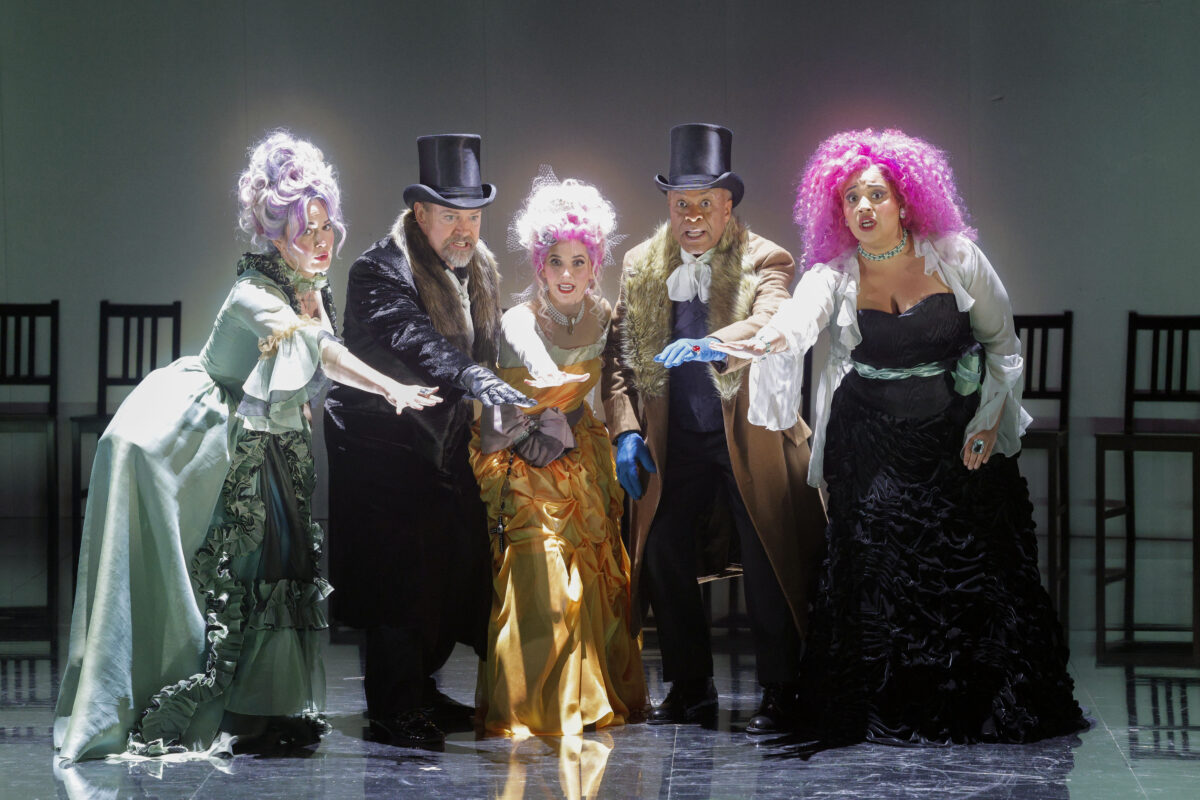
Photo: Cory Weaver/San Francisco Opera
SFO assembled a handsome cast of principals for this show, and they rose to the occasion as a tight ensemble, even though most of them were making role debuts. Brazilian baritone Vitor Bispo made his presence known in his US debut as Lescaut, though it took him a while to warm up on Thursday. Even better was bass James Creswell, who returned from the production’s premiere. His deep, booming voice as des Grieux’s father gave the role a dignified gravitas, making it one of the best-sung of the night. Steven Cole and the debuting Stephen Gaertner took on Guillot de Morfontaine and de Brétigny with great panache, giving the roles nuanced substance rather than mere comic relief. Laura Krumm also returned as Javotte, working harmoniously with Taylor Raven’s Rosette and current Adler Fellow Sofia Gotch’s Poussette, both in their role debuts. It was heartening to see many small roles assigned to members of the San Francisco Opera, who blended smoothly with the chorus on stage, as prepared by John Keene.
Music Director Eun Sun Kim took a different approach in her second French repertoire at the War Memorial stage, following Poulenc’s Dialogues des Carmélites, also during the Centennial Season. This time, Kim decidedly downplayed the score’s Frenchiness and put greater focus on the drama. This approach paid dividends in the second half as the story moved toward its tragic ending, but at times it made her conducting a bit heavy-handed, particularly in the first act and in the Cours-la-Reine scene, where I missed the bubbly, Champagne-filled feeling. After all, Manon was an Opéra-Comique’s creation, and Massenet himself gave five of the principals comic scenes!
I found it puzzling when SFO announced it was bringing back Boussard’s production, since I recalled that his non-time-specific staging was sparse, heavy on style yet light on substance, and relied heavily on the singers to carry the story. Seeing it fresh last Thursday, I gained more insight, as the mounting felt more relevant than in 2017, particularly in the era of social media and influencers – a point SFO emphasized by placing decorations, booths, models, and even corset “tasting” throughout the halls. Vincent Lemaire’s static, curved silver wall and silver floor, coupled with Gary Marder’s spotlight and Boussard’s outrageously colorful costumes, seemed to warn the audience that Manon’s story could easily be theirs too if they weren’t careful. Filled with singers who could act, this revival seemed much more alive than I remembered. Nevertheless, there was one moment when I felt Boussard went too far; with the ballet music cut in the Cours-la-Reine scene, the giant chandelier felt superfluous and indulgent (I kept expecting dancers to show up underneath), and the scene fell flat.
It was nice to revisit this jewel of an opera with this power couple, and I bet the show will gain strength in upcoming performances. Five more performances remain, and the broadcast is scheduled for the October 21.
-
People: Amina Edris, Eun Sun Kim, Gary Marder, James Creswell, John Keene, Laura Krumm, Pene Pati, Sofia Gotch, Stephen Gaertner, Steven Cole, Taylor Raven, Vincent Boussard, Vincent Lemaire, Vitor Bispo
-
Works: Manon (Massenet)
-
Places & Organizations: San Francisco Opera