We’re not in Kansas anymore
Our critics assess Kansas’s own Ben Bliss in a (nearly) all-American program performed at the Park Avenue Armory and Vocal Arts DC.
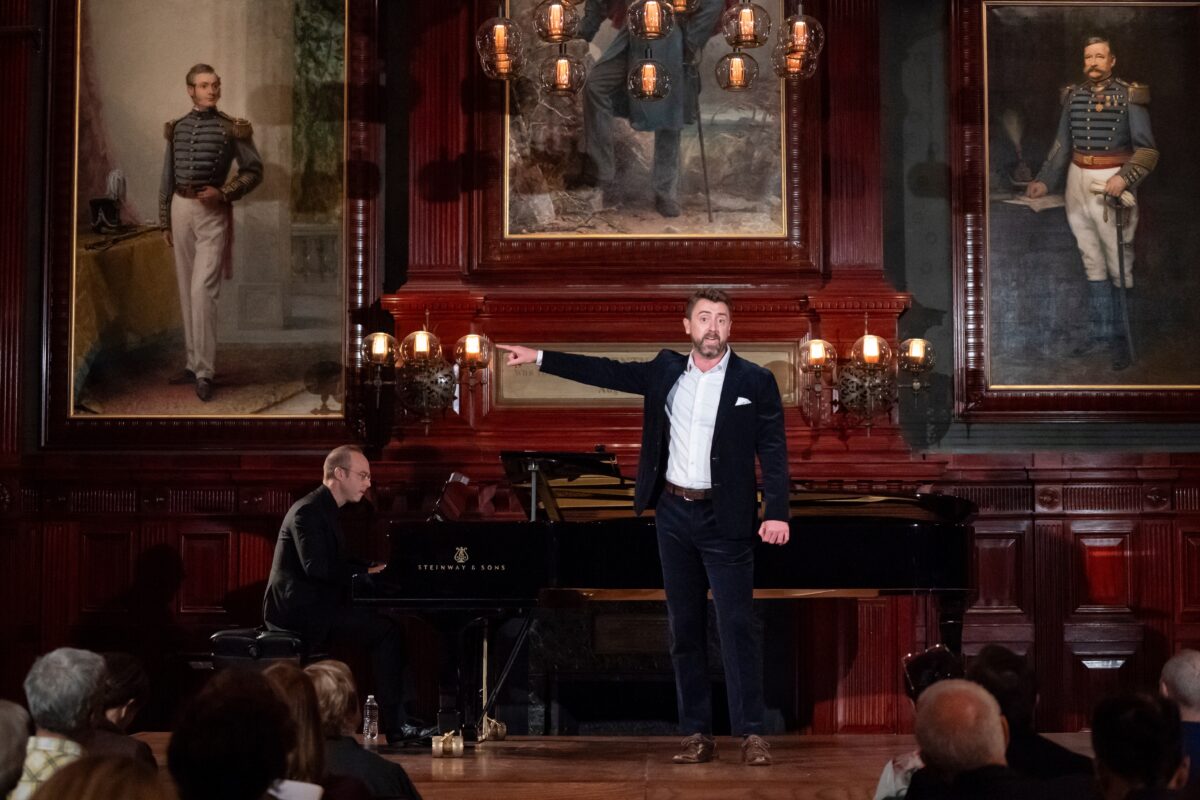
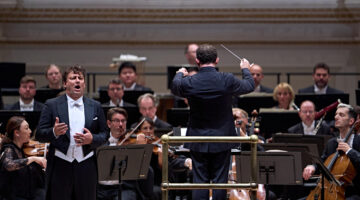
Photo: Stephanie Berger Photography, courtesy of Park Avenue Armory
Richard Lynn, from New York
Walking into the Park Avenue Armory on Sunday, October 11, I had no idea what tenor Ben Bliss and pianist Christopher Allen had selected for their recital. Imagine my surprise and delight to see that they had chosen an all-American, English-language program to mark America’s 250th birthday. The program included a tantalizing mix of art songs, musical theater selections, and popular numbers. Technically, one number by Sir Noël Coward did make it into the show, but the appropriation of British popular culture should be commemorated as part of a show devoted to the American experience.
The program is available here. The duo blissfully (I had to do it once) ignored so many recital conventions in its construction. A more standard program would have had a few American art songs in the second half with perhaps a popular song or two saved for the encores. Here, the genres were all woven together. This made for a much more interesting and thematically coherent program. We somehow even managed to avoid “Over the Rainbow” altogether, even though Bliss is from Kansas.
Many classically trained singers come to grief in non-classical repertoire, even if it’s rarely as egregiously bad as it is here. Happily, Mr. Bliss avoided the typical pitfalls. His delivery of the material was free of the weird overemphasis of the text and the cringey attempts to avoid sounding operatic. He employed his full tenor sound when required and integrated it into the overall line and interpretation. He moved and gestured naturally, which helped the material ring true emotionally. At times, he did some high-falsetto singing, but it was what would be expected in the material. Not everyone in the audience enjoyed his approach or the material. At intermission, one person announced, “I hate crooning,” and made a dramatic exit, never to return. I wouldn’t have labeled his approach “crooning.” Next time I’m in the shop, I’ll get my Croon-o-meterTM checked.
Several selections really stood out for me, including “Lonely House” from Street Scene, two unpublished settings of e.e. cummings’ poems by John Gruen, Barber’s Nocturne, and “Being Alive” from Company. He really knows how to convey a wistful sadness without ever crossing the line into maudlin sentimentality. Not that I want Mr. Bliss to defect to Broadway, but I’d love to see him do a run of Company somewhere. Who should sing “Ladies Who Lunch”?
The highlight was his final selection: Philip Glass’s spoken-word setting of the Allen Ginsberg poem “Wichita Vortex Sutra.” This was written for Ginsberg and Glass to perform together; Bliss’s barnstorming rendition (from memory!) surpasses even their version. He really had you believing a poem could alter history and heal the world. It was a truly mystical experience and a stunning end to the recital. I did not expect an encore, but they chose a corker in “Pace non trovo,” the first of the three songs in Liszt’s punishing “Tre Sonetti di Petrarca.” Bliss barely displayed any tiredness or strain in this punishing music.
Allen was an ideal partner throughout, finding the right style and coloring for each piece.There were microphones on the stage and one can only hope this was recorded for eventual publication. Apparently, this program began as a suggestion from opera impresario / singer whisperer Matthew Epstein, who was at the recital to hear what he hath wrought. He seemed pleased. Hopefully, he can help get the recording released.
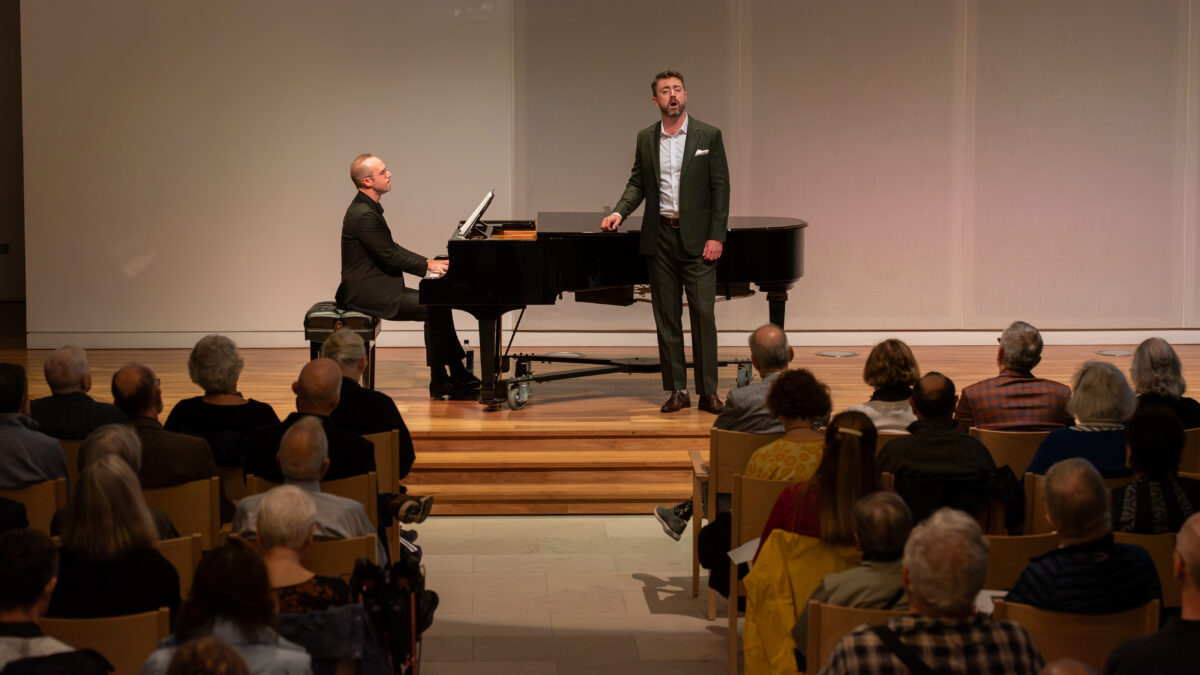
Photo: Caitlin Oldham Photography
Andrew Lokay, from Washington DC
Tenor Ben Bliss’s eclectic recital with Vocal Arts DC, which spanned from an observance of America 250 to his roots in Kansas City, had some hits and misses.
Vocal Arts DC plays an invaluable role in the cultural ecosystem of the nation’s capital by giving Washingtonians the chance to hear big-name talent who may not otherwise come to town in intimate performances. Bliss’s recital this month was only his second performance in DC; Vocal Arts DC was also responsible for his local debut, a recital 10 years ago. (Bliss was originally cast in the titular role of Washington Concert Opera’s performance of Wolfgang Amadeus Mozart’s Idomeneo earlier this year but withdrew.)
Bliss and pianist Christopher Allen offered an unexpected take on the recital format. Except for one song by Noël Coward, the program consisted exclusively of works by American composers — art songs, showtunes, folk music, and an avant-garde spoken-word piece — in observance of the semiquincentennial of US independence. Bliss had personal connections to some of the selections, and his commentary allowed the audience to get to know him better as an artist, a welcome opportunity for local opera fans given his limited prior history on DC stages. A slight cold muted the colors of Bliss’s instrument but didn’t hold him back from singing.
The first half of the program jumped around in theme and genre. Bliss began with “I’m Calm,” Stephen Sondheim’s ode to anxiety from A Funny Thing Happened on the Way to the Forum, and the Gene Paul and Johnny Mercer song “The What-Cha-Ma-Call-It.” He was adept at Sondheim’s pacing, but his affected nervousness, humorous at first, wore out its welcome. Bliss and Allen’s banter lent the evening the ambience of a cabaret performance, though some of the jokes didn’t hit the mark. A bit about bribing a Washington Post critic and the critic walking out early didn’t quite land; the flagship newspaper of the nation’s capital has lacked a full-time classical music critic since early this year, when Michael Andor Brodeur was a casualty of major layoffs, and the Post has scaled back local arts coverage.
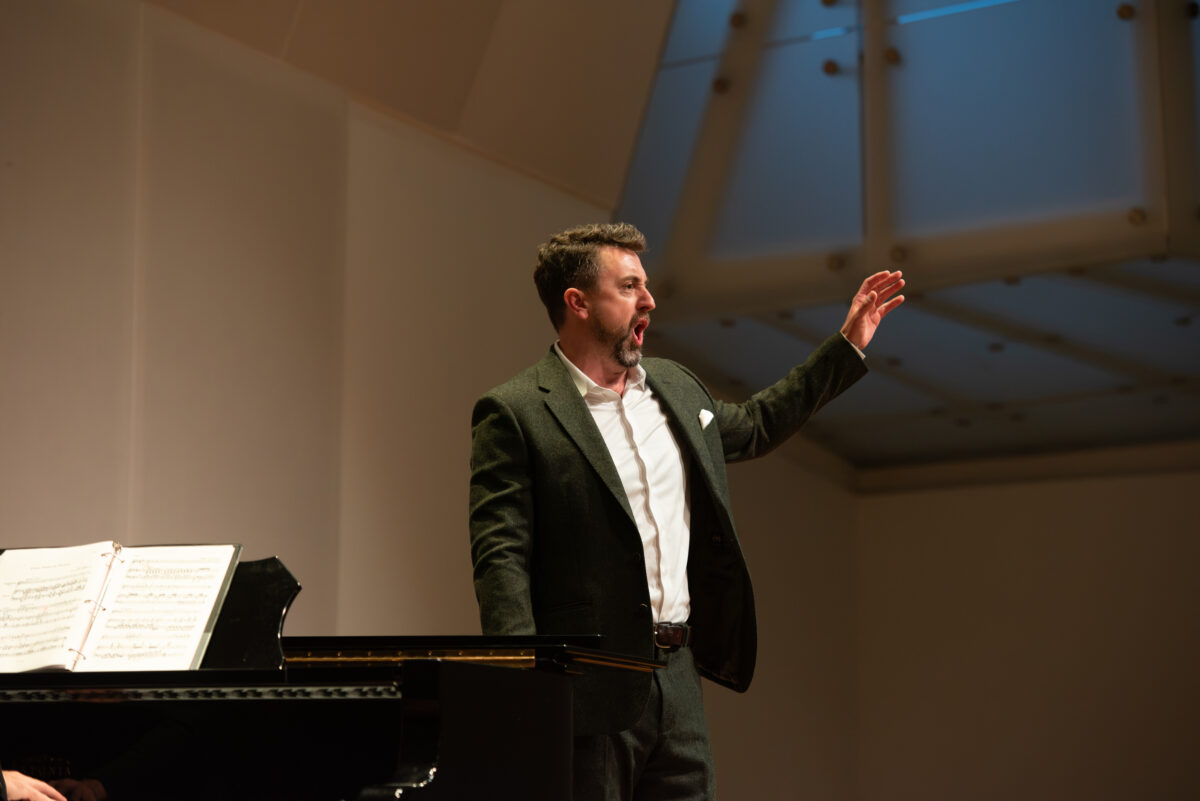
Photo: Caitlin Oldham Photography
The highlight of the recital was Bliss’s performance of two unpublished settings of e.e. cummings poems by the late composer John Gruen. Bliss said that Gruen’s daughter gave him access to the manuscripts for “Spring is like a perhaps hand” and “Lady will you come with me into.” The songs’ bounding rhythm, alternating tempi, and sudden endings honor cummings’s irreverent approach to the English language and beg for a professional recording. Bliss and Allen’s crisp and expressive rendition of Gruen’s music was a revelation.
Their performance of “The Things Our Fathers Loved,” Charles Ives’s reflection on patriotism, was an appropriate coda to a summer of America 250 celebrations in DC. Allen skillfully illustrated Ives’s musical references, including “Dixie,” the “Nettleton” hymn melody, and “In the Sweet Bye and Bye.” Bliss gave a heartfelt spin on Lowell Liebermann’s setting of Henry Wadsworth Longfellow’s poem “The Arrow and the Song,” which he said was his grandfather’s favorite poem.
Bliss’s more heterodox choices and song order made for some tonal whiplash. The Gruen songs were followed by a cover of the Simon and Garfunkel classic “Bridge over Troubled Water” that felt out of place for a classical recital. Next up was an awkwardly delivered version of Ray Charles’s arrangement of “America the Beautiful,” and then Sammy Frain’s “Are You Having any Fun?” (memorably recorded by Elaine Stritch), sung by Bliss with strong character-tenor energy. He wrapped up the first half with Walter Kent’s “I’m Gonna Live Till I Die,” his instrument taking on a midcentury chrome edge reminiscent of the Rat Pack. One got the sense that if Bliss had not pursued opera, he could have also enjoyed a successful career on Broadway or the cabaret stage.
The second half of the recital, which tracked the evolution of a love affair, was more thematically consistent. “Lonely House” from Kurt Weill’s Street Scene and Richard Rodgers’s “Where or When” revealed nice phrasing and delicate head voice from Bliss. Allen particularly shone in conjuring the lush, calm ambience of Samuel Barber’s Nocturne, set to a text by Frederic Proskosch, which also showcased Bliss’s rich sound despite his cold. Bliss was at the top of his game in Sondheim’s “Being Alive.” He deployed a velvety tenor with emotional vulnerability and brought the song to a showstopping conclusion. Bliss’s suave style in Harold Arlen and Johnny Mercer’s “One for My Baby (and One More for the Road)” was also a highlight. There were some misfires in this half of the program. The selection of Coward’s “Let’s Say Good-bye,” while fitting the narrative, disrupted the program’s American theme, and Bliss got lost in the text of Leonard Bernstein’s “Some Other Time” from On the Town.
Bliss and Allen concluded with Philip Glass’s “Wichita Vortex Sutra,” a musical composition paired with a spoken-word recitation of an Allen Ginsberg poem. According to Bliss, the collaboration resulted from a chance meeting of Glass and Ginsburg in a Greenwich Village record store. While this unusual selection didn’t give audiences the chance to hear Bliss sing, his delivery was passionate and sincere, with precise pronunciation. Ginsburg’s text was dense and ambiguous; its inclusion in the program gave the audience the opportunity to hear something new and different from a typical recital. The text’s frequent references to the Sunflower State created a personal connection for Bliss, who hails from Kansas City.
Dawn Fatale
Richard Lynn is a New York City based opera lover who writes at parterre box under the name Dawn Fatale. His love of opera started at a very young age when he used to listen to the Met broadcasts and obsessively read back issues of Opera News in lieu of socializing at family gatherings. In college, he majored in Chemistry while taking as many music and theater courses as possible. He worked at the Music Library to get access to the opera recordings that were off limits to undergraduates. Since the early 1990s he has been writing about opera at parterre box and other publications and is particularly interested the evolution of staging and performance practices.
-
People: Ben Bliss, Christopher Allen, Matthew Epstein
-
Places & Organizations: Park Avenue Armory, Vocal Arts DC