In my end is my beginning
In San Francisco, an autumnal Renée Fleming proves she can still work her magic with Strauss’s Four Last Songs.
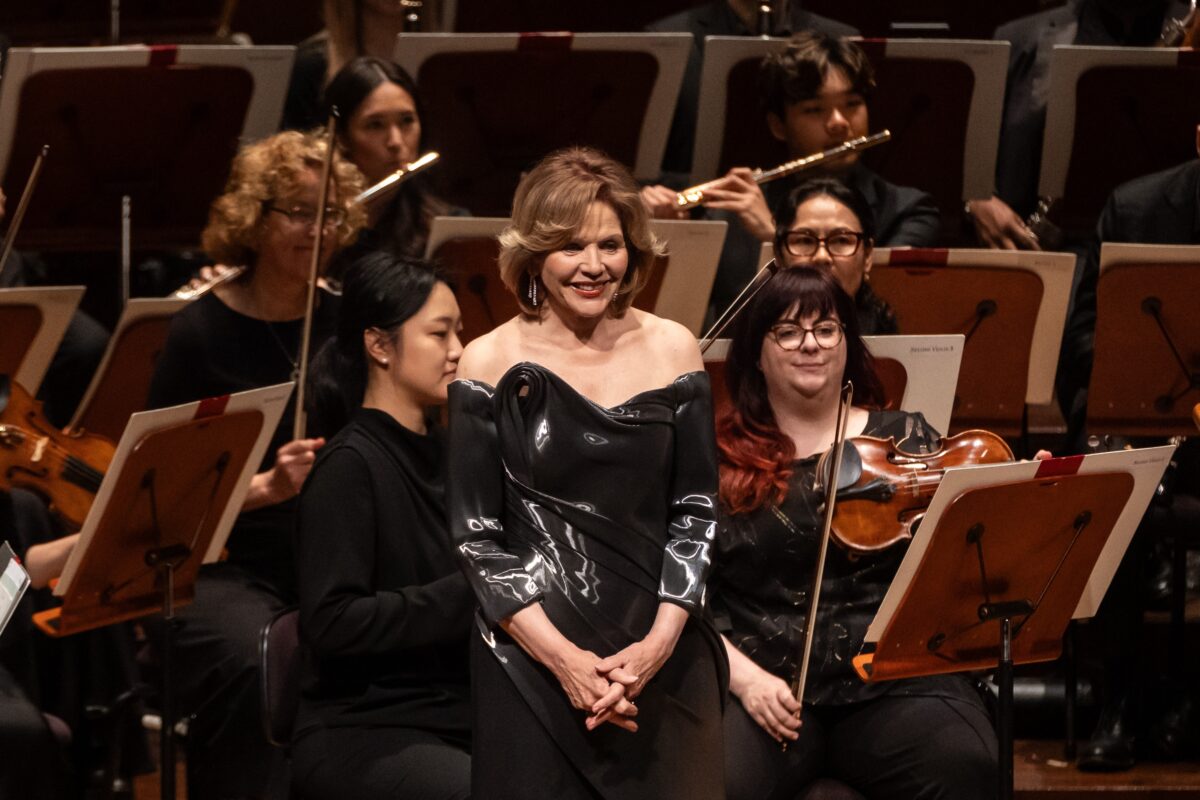
Photo: Brittany Hosea-Small/San Francisco Symphony
Aging and death are at the center of some of Richard Strauss’s most famous works. In his early shockers, Salome and Elektra, death is grotesquely life-affirming. The title character of each experiences a transcendent moment of ecstasy, as the death they call upon over and over finally arrives to enact their fantasies of revenge. In Der Rosenkavalier, the Marschallin has to accept that time has passed her by: a premature death as her young lover falls in love with a woman his own age. In his string work Metamorphosen, he wrote an elegy to remember those who died in Munich during World War II. His final word on the matter came in his Four Last Songs, completed in 1948, almost a year to the day before he died, leaving it his last completed work.
We say complete. Strauss did not consider the songs as a group. To be more precise, the song “September” was his last completed work (placed second in the final order of the Four Last Songs by publisher Ernst Roth).
The first three songs in The Four Last Songs each begin with a reference to endings:
In dusty vaults
(“Frühling”/”Spring”, text by Hermann Hesse)The garden in mourning
(“September”, text by Hermann Hesse)Now that the day has made me so tired
(“Beim Schlafengehen”/”While going to sleep”, text by Hermann Hesse)
The final song “Im Abendrot” (“In the twilight”, text by Joseph von Eichendorff) doesn’t hint at the end so much as it looks backward (“Through adversity and joy/We’ve gone hand in hand”). It’s not correct to say that the Four Last Songs are together nostalgic; Strauss would have rejected something so reductive and normalized. But they do look backward in a way.
As I listened to a performance of the Four Last Songs as part of the San Francisco Symphony’s most recent subscription concert at Davies Symphony Hall — a concert fully devoted to two works by Strauss inspired by his wife, Pauline — my mind traveled back a half-century to Gustav Mahler.
The previous spring I caught the San Francisco Symphony Youth Orchestra’s performance of Mahler’s Symphony No. 4 also at Davies. It’s one of those works I will go and hear whenever it’s playing. The final movement is also a song for soprano (“Das himmlische Leben”/”The heavenly life”), a child’s vision of the afterlife. Through spritely and energetic to begin, it finds a more wistful tone by the end, fading away into the ether. It’s as if Strauss picked up this wistfulness, this ambivalence from the child contemplating life after death and carried it forward to its conclusion in the person at the end of life. Mahler ends his symphony in E major and Strauss his final song in E-flat major, keys of the sublime, of a sort of rest.
Strauss and Mahler were deeply connected as friends; they were advocates for each other’s works, and yet were temperamentally ill-suited to working together (the former with his Bavarian pragmatism, the latter with his embrace of Sturm und Drang). Mahler famously said, “Strauss and I tunnel from opposite sides of the mountain. One day we shall meet.”
I think they meet in a song of beginning and a song of ending, both for soprano.
The soprano soloist for the Four Last Songs was Renée Fleming, a celebrated interpreter of the composer’s work on the concert stage and in the opera house. Fleming is in the autumn of her career, having stepped away from staged opera performances in favor of concerts, master classes, and even directing. In a sense, hers is the perfect voice for Strauss’ valedictory masterpiece.
It’s been a while since I heard Fleming sing live. In fact, it was exactly a decade ago in a recital at Zellerbach Hall in Berkeley. Before that, I caught several of her performances at San Francisco Opera (Louise, A Streetcar Named Desire, Der Rosenkavalier, Lucrezia Borgia) and her Thaïs at the Met (an odd choice of repertoire in so many ways).
Fleming’s voice has always been regal, in the way that Dame Felicity Lott’s or Lisa Della Casa’s voices were regal. It’s a voice she never pushed too hard. She never compromised the sound, always centering bel canto technique. Even in roles where a bit of hysteria was called for (Blanche DuBois, Lucrezia Borgia), she never really went there. She was bankable, dependable, consistent. Exciting? I think it depends on how we define the term. It’s exciting to hear a voice that pristine. But it has always left me feeling esteem more than adoration.
Frankly, I was glad to hear Fleming’s voice in its later, less perfectionist iteration. Because it fits the true character of the music. It tells the story better than she could have when she was in her prime, with that control and that gloss. No one would argue that she should record the Four Last Songs right now. But I would download it.
On Sunday, the sustained notes were a bit fuzzy, and the vibrato had widened. The German diction was soft and dispersed. And so what?
Her distinct timbre was there, all golden and warm, that roundedness as the soft palate is lifted, which, done in excess, can cause the “hooty” sound that sometimes crept in. And so what?
Fleming has always used her mouth, especially laterally, almost as the opening of a trumpet, the sound cascading out. (In my experience, I could always hear her, even from the balcony.) A brightness at her very top was clear in the arching lines of “Frühling”, indicating that the voice was at its upper limit. I loved hearing her ride the edge a bit, dare to be imperfect, and sound slightly stressed, even as her demeanor onstage never changed.
It was a performance in which we heard the mechanics of the voice, something Fleming in her prime would never have allowed. It humanized her. Here is a 67-year-old woman who is still a credible interpreter of orchestral songs. I wasn’t surprised at all. Singers are never really done.
Fleming didn’t need to warm up per se, but the voice did settle in a bit more with each song. Though Strauss didn’t order the songs, his publisher knew what he was doing. The most extroverted first, the least extroverted last. “Frühling” and “September” reminded me how Fleming can use her breath so strategically to sustain those long Straussian lines. A Strauss soprano has to have the lung capacity of a swimmer or at least the savvy to use what she has in the tank. Even as the intonation may not be what it once was (and any shortfalls were exceedingly minor), the phrasings were pristine.
The surging heights of the third song (“Beim Schlafengehen”) tested Fleming, but she found her way there. The final song (“Im Abentrot”) played to the strengths of her voice as it is now, since the song sits at the lower end of a soprano’s range and allows the singer to sit back a bit, with Fleming even swaying a bit to the music, just soaking it all in.
What did not help Fleming was the conducting. Santtu-Matias Rouvali, currently the principal conductor of the Philharmonia Orchestra in London, conducted Strauss’ emotionally complex orchestral songs as if he were conducting the final scene from Salome. The orchestra under his baton was just so, so loud. And the San Francisco Symphony is nothing if not an orchestra of great finesse. But an orchestra goes with the conductor and, to quote a line by the great Elaine May, Rouvali was riding a psychotic horse toward a burning stable.
Rouvali captured the swells of the score, and in those swells we can hear the complex harmonic language of Strauss’ great operas. But swells need to dissipate or else everything seems dire. His conducting made Fleming seem small, even frail at times. I would love to hear Rouvali conduct Die Frau Ohne Schatten or Elektra, where grandiosity (and delusions of grandeur) are central to the storytelling. But the Four Last Songs are painfully authentic. They need a lightness of touch that Rouvali just does not have yet.
Don’t misunderstand, it was thrilling to hear an orchestra of the caliber of the San Francisco Symphony give what they had to Strauss’ gorgeous score. Rouvali knows how to get a rich and theatrical sound out of an orchestra, and that is no small accomplishment. But it’s not a score that needs to be given everything one has. There is something to be said for Fleming’s trademark reserve and it would have benefited the reading of the score.
Which brings me back to Mahler. It was like Rouvali decided to bring Mahler’s maximalism to a work all about the small moments. His was a fundamental misreading of Strauss’ thesis. Through these songs, Strauss reminds us that endings are ambivalent, with things left undone, accounts left unsettled. As they drew to a close, I was grateful for Rouvali’s relative deference to Strauss as the final trills of the piccolos overlaid the composer’s beloved French horns. The piccolos are the heart flutter of young love, the horns the steady press of age toward rest, all fading to an awkward but fitting silence.
Where Rouvali’s approach was perhaps more appropriate was in the afternoon’s performance of Ein Heldenleben (“The Hero’s Life”), Strauss’ tone poem that he swore was not about him (but that is also very much about him). He quotes no less than eight of his own compositions, making Ein Heldenleben a backward glance at his own career still in formation—an ironic counterpoint to the backward glance of the Four Last Songs.
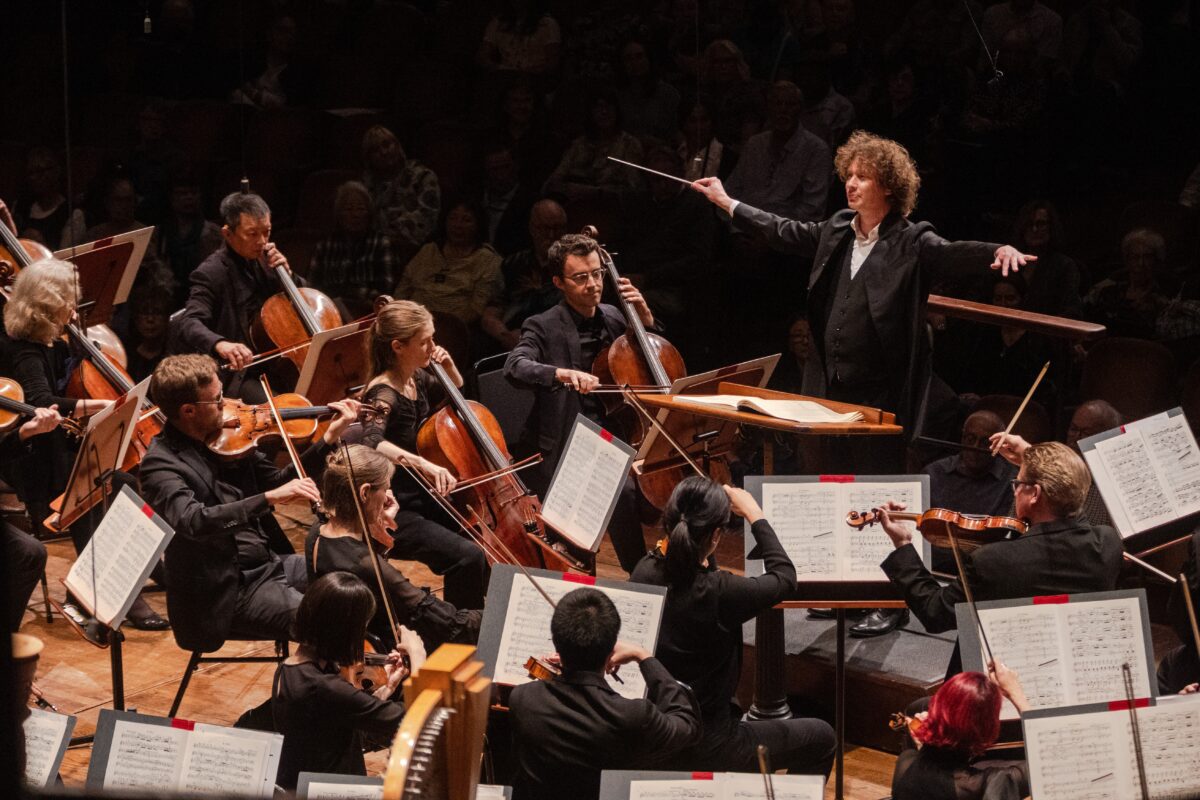
Photo: Brittany Hosea-Small/San Francisco Symphony
Not all of Strauss’ sometimes-swaggering paean to his own accomplishments swaggers. In the third section, practically a concerto for violin, longtime concertmaster Alexander Barantschik took on the soprano role vacated at intermission by Renee Fleming, a great artist in the autumn of her career, handing off the baton to another great artist in his.
It makes perfect sense that this section was Strauss’s love letter to his wife. In the violin, we hear her lush soprano voice along with a certain impishness. While the violin solos showed off Barantschik’s nimbleness, what was most rewarding were the swooning lines of melody made more magical when the rest of the strings joined him. In sections like these — what I hear as Strauss’ homage to Nikolai Rimsky-Korsakov’s Scheherezade — Rouvali’s maximalist approach worked. The bigness of his conducting contrasted thrillingly with the solo voice of the violin.
Equally enthralling playing came from the entire woodwind section, always a particular strength of the San Francisco Symphony, as it returned again and again to embody the hero’s enemies hectoring him. The brass (onstage and off) and the percussion again showed Rouvali’s approach at its best, thundering and marching toward the hero’s triumph.
In a smart bit of programming, the final song of the Four Last Songs and the final section of Ein Heldenleben are both in the key of E-flat major, again that key of rest, that key of an end but with the hint that there is still more to do. Strauss’s broad-shouldered ode to heroism ends in the same way as his ambivalent ode to carrying on. But carrying on toward what? It’s not clear. But Renée Fleming reminds us that how a singer carries on is to sing. And we carry on by listening to the singer as long as they still have a song to sing. And Strauss’s music? It will sing forever.
Matthew Travisano
Matthew is a San Francisco-based educator and actor. He has taught and lectured on the performing arts for more than two decades. He has trained a generation of actors in the greater Bay Area at both Oakland School for the Arts and Ruth Asawa School of the Arts, where he has also taught literature, composition, literary theory, and aesthetics. He holds a BA in English from UC Berkeley and a Master's in Teaching (MAT) from San Diego State University.
-
Topics: concert performances, Review, richard strauss
-
People: Alexander Barantschik, Renée Fleming, Santtu-Matias Rouvali
-
Works: Four Last Songs
-
Places & Organizations: San Francisco Symphony