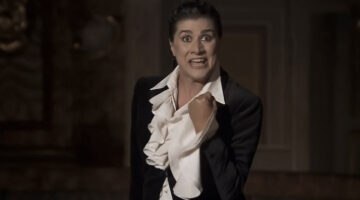
E avanti a lei tremava tutta Stoccarda
Two upcoming sopranos — Chelsea Lehnea and Marigona Qerkezi — make a splash across two nights in Stuttgart.
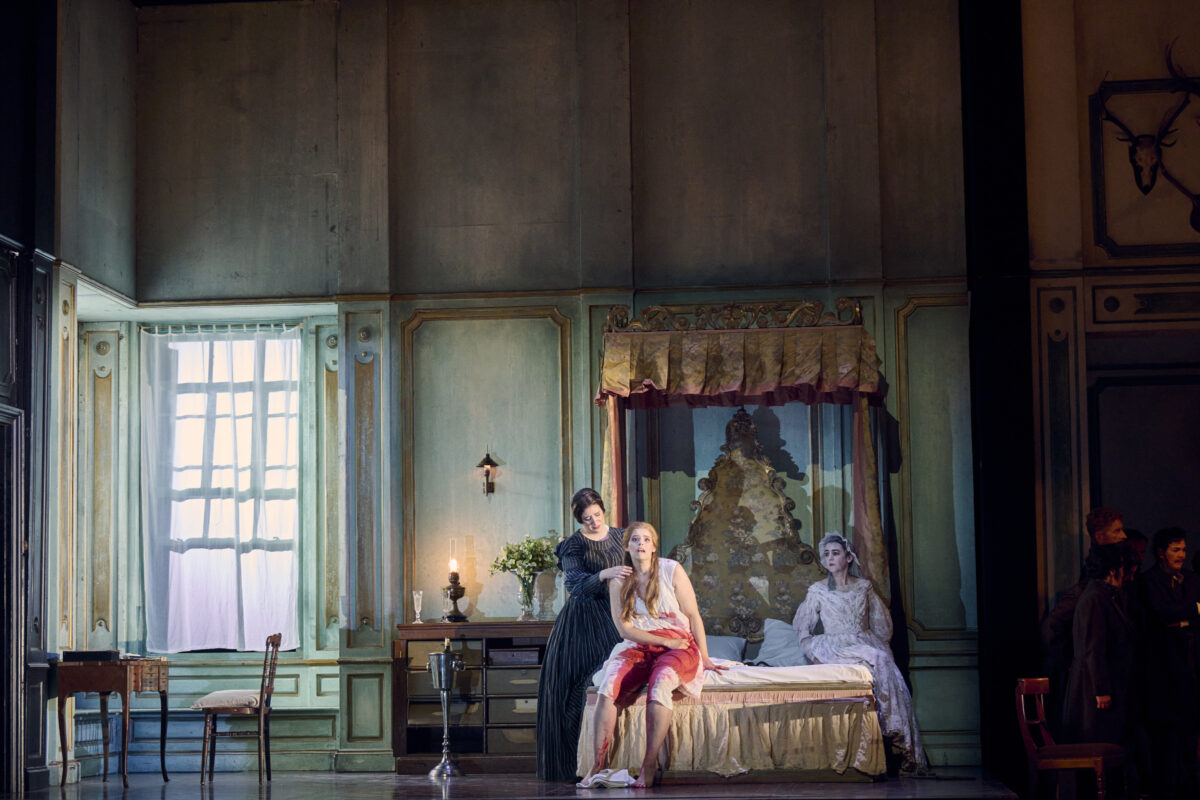
Photo: © Martin Sigmund
The Stuttgart Opera was last reviewed here in 2015 by James Jorden, who attended Stefan Herheim’s then-new production of Der Rosenkavalier. In his write-up of that evening, Jorden said nothing about the singing, focusing instead on a detailed, breathless description of Herheim’s inspired Regie. Eleven years later, what lifted the first two nights of the company’s 2026-2027 season out of the routine were remarkable, risky vocal performances by rising stars in title roles: two young sopranos who stood out for their total commitment and admirable, old-fashioned technique.
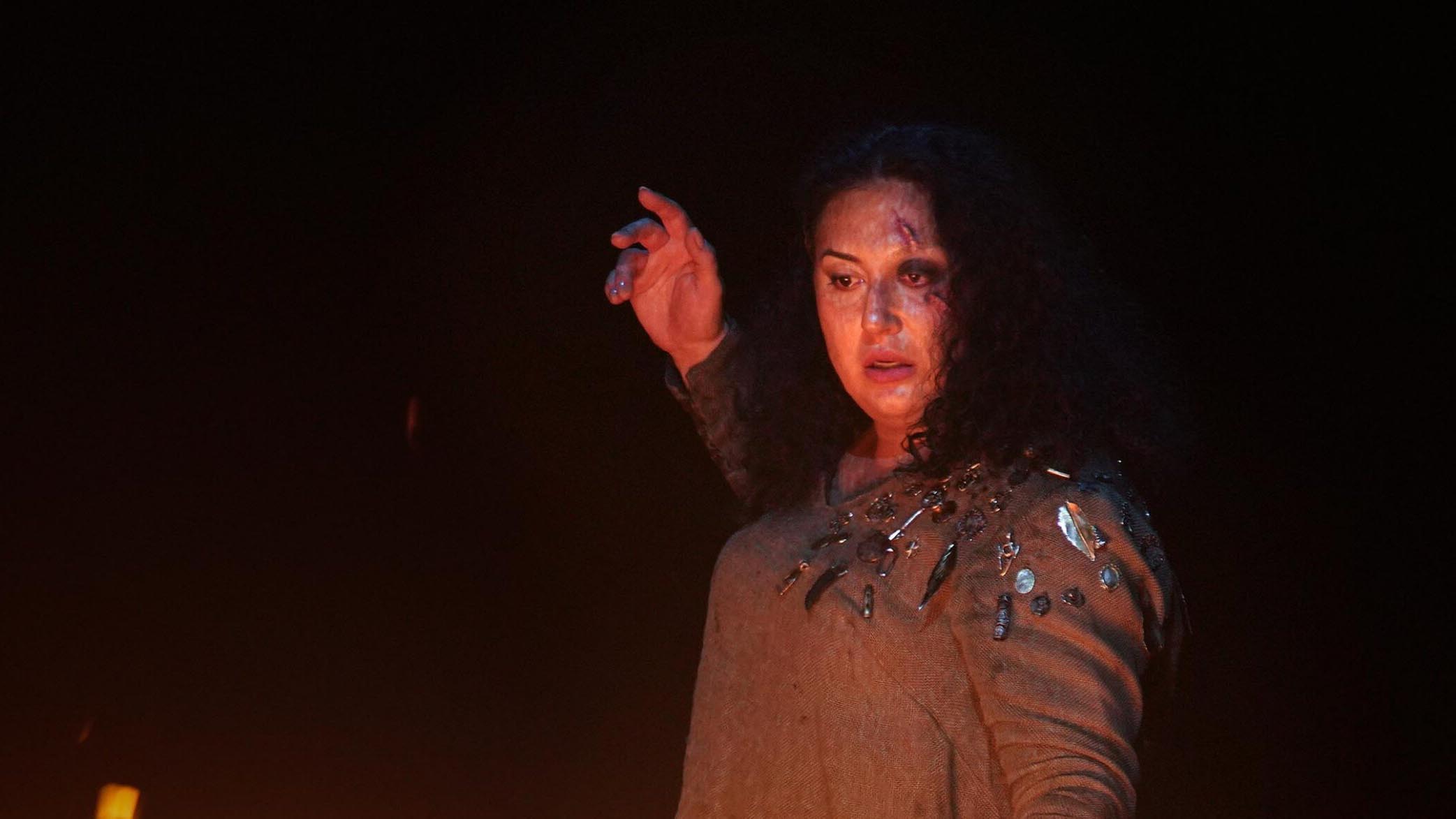
On October 3, the company opened its season with the premiere of a new-to-Stuttgart production of Lucia di Lammermoor directed by Katie Mitchell. Its star, the Tennessee-born Chelsea Lehnea, has, in concert with her friend and teacher James Smidt, cannily promoted herself as a keeper of the true vocal flame. She spits chest voice, holds high notes to infinity, and has the fuck-you flair to show up to her premiere party in a men’s three-piece suit with a blond pixie cut, eliciting some spectacular side-eye from the Swabian bourgeoisie. In clips she posts online and which circulate among voice-hungry queens like samizdat, her tone sounds enormous, if sometimes hard-edged, her phrasing somewhat blunt.
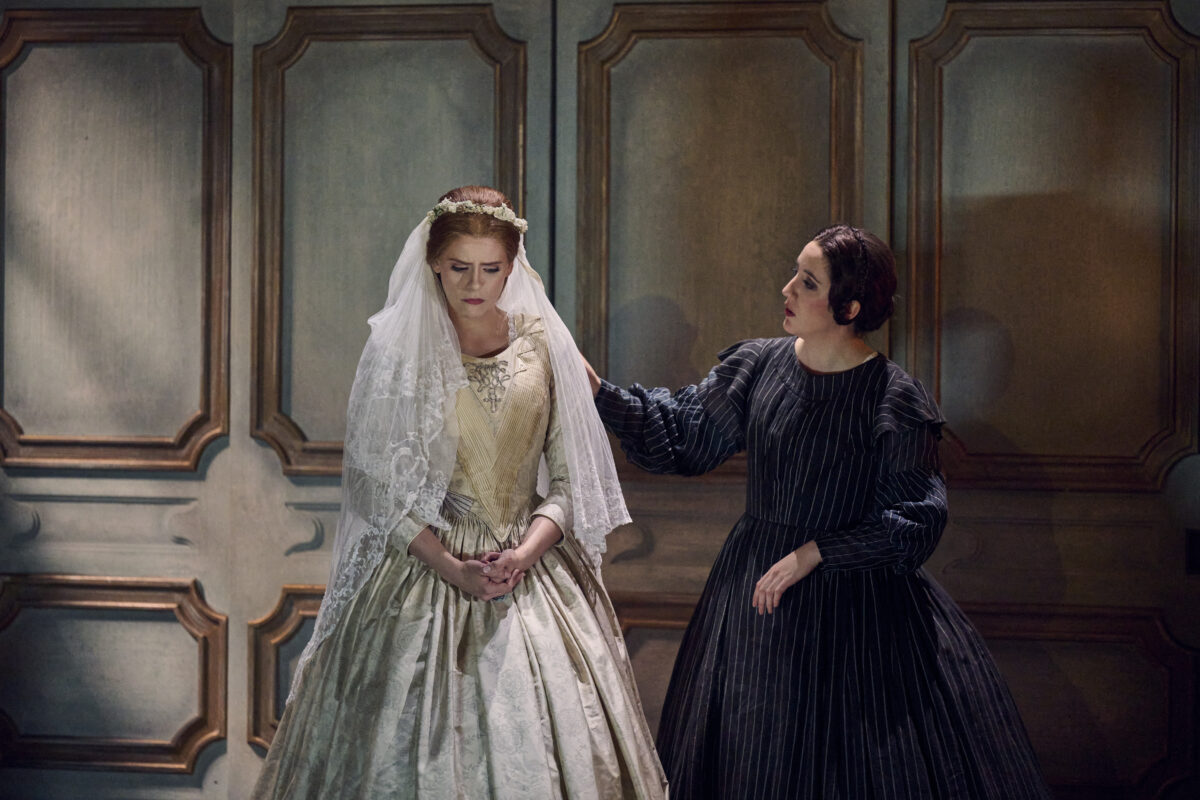
Photo: © Martin Sigmund
The evening turned into an object lesson in how different — not better or worse in this case, but different — voices can sound in person than on Instagram. Lehnea’s voice, as experienced in the fifth row of a 1400-seat theatre, is small, and she sings a Lucia informed by the high coloraturas who have come before her. Smartly refusing to push, she grades dynamics, saving volume in the middle for declamatory outbursts. Her Italian is a work in progress that’s progressing. She has a boffo E flat, one which she sustained thrillingly and to huge applause at the end of important scenes and duets. And her fast, functional, and stylistically appropriate vibrato doesn’t loosen or change phase as it goes up the staff.
The artistic meaning of her portrayal was deeper than these flashy high notes. One example: In the duet with Enrico in the second act, when she sings “io son tanto sventurata che la morte è un ben per me” — I am so cursed that death will be a blessing – her unusual registration (bringing the chest higher than normal) made the line both melt and throb. She cleverly uses glottal onsets to add declamatory weight to her middle voice, which is its smallest section, and portamenti to suggest a line that is not always entirely there.
In the mad scene, Lehnea delivered both a chested, appropriately violent and evocative “il fantasma” and a fluent, brilliant rendition of the stratospheric Melba-Marchesi cadenza, here offered with glass harmonica. If I wanted this to be taken with more rhythmic freedom — the “Spargi d’amor” that followed made it clear that Lehnea can sing high coloratura as quickly and accurately, with lovely connective legato, as she pleases — then the fault likely lay with conductor Andriy Yurkevych, whose square rhythms and lugubrious pacing made a long evening (no cuts were taken) seem longer. The orchestra was not inspired: Horn entrances sputtered and squawked, and the winds waxed in and out of tune. Paul Lungu stepped in as Edgardo with 24 hours notice to replace an indisposed Kai Kluge, who will sing the remainder of the run. Baritone Johannes Kammler, as Enrico, sang with force, if not refinement, and received deserved applause.
Katie Mitchell’s production, which first premiered more than a decade ago in London with Diana Damrau, departs from the objectively correct premise that this opera is the story of a woman subject to coercive control and abuse. Pregnant with Edgardo’s child, her desperation at what seems to her to be his lack of communication and callous rejection of her for another woman takes on additional meaning. Her brother needs to physically beat her to convince her to walk down the aisle with Arturo, whom she murders not out of abstract madness but in a premeditated attempt to escape being trapped in a bad marriage. It is only then, when she miscarries, that she actually goes “mad.”
Despite its good ideas, as often in my experience of Mitchell’s work, the stage pictures are obtuse and concepts executed in ways both overly complex and overly literal. (A case in point: must a ghost scatter rose petals as soon as they’re mentioned in the mad scene?) The stage is consistently split in two to allow us to witness what’s happening offstage, repeatedly forcing the chorus to crowd into half the stage while on the other side, a Lucia who could be having a sip of water and preparing for another scene is forced to mime unnecessary business. Frankly, making a soprano spend the first twenty minutes of Act I doing mime in a corner and then start “Regnava nel silenzio“ cold is sadistic — and the singing suffered, tending flat until the cabaletta, after which Lehnea sang scrupulously in tune.
Lehnea is not a “finished” singer, nor is she uncontroversial. After the first two acts, of three of us, one of us (me) loved it, one was appalled, and one was more sanguine. After the final act, all three of us were more positive, mostly due to the indisputable strength of her mad scene. I’m tremendously excited to see where she goes next and how her singing develops.
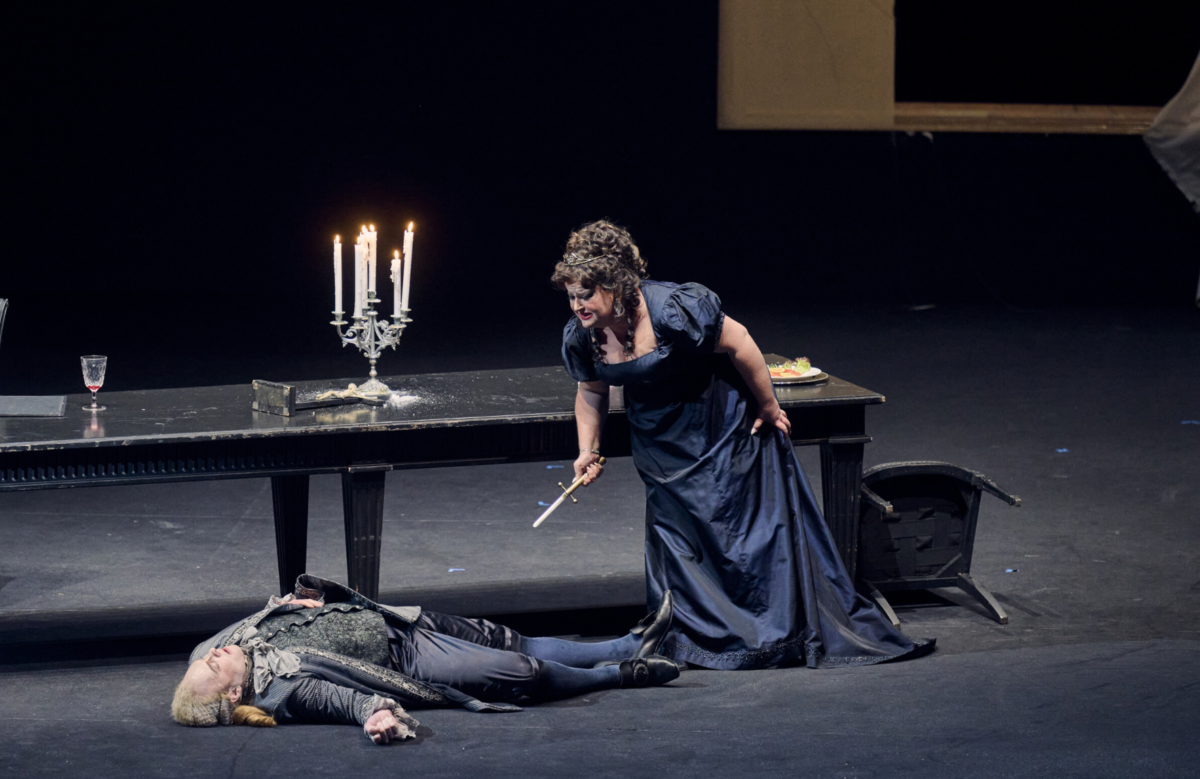
Photo: © Martin Sigmund
The next evening, conducting the first performance of this season’s revival of a Willy Decker Tosca that first premiered (with Catherine Nagelstad in the title role) in 1998, Francesco Cilluffo had the orchestra sounding like a different, and better, ensemble. He chose brisk tempi, taking the opening at something close to Puccini’s indicated marking of 69, wisely refusing to luxuriate in Scarpia’s theme at its first appearence and so making it rhyme when it returns at the end of the act. This was the better set of first chair players; only a (presumably) unintentionally Rhapsody In Blue-like clarinet solo at the beginning of “E lucevan le stelle“ served as a reminder of the condition of the orchestra the evening before.
Iain MacNeil, a Canadian baritone in the ensemble of Oper Frankfurt, made an impressive role debut as the Baron Scarpia. His voice is light in color, cold, and firm — and he made a chilling villain. The “Te Deum” rang out splendidly: only his second act aria seemed slightly too large for his instrument. Diego Godoy’s wan Cavaradossi was characterized by stock gestures, disinterest in what other characters were telling him, and lunged-at, screamed high notes, including a very strange vowel on what should have been the last syllable of the word “vita” in “Lucevan.” “Vi salverá,” in the first act, regrettably called to mind Carol Burnett’s Tarzan yell. Sections of Susan Sontag’s novel The Volcano Lover were provided in the program as intellectual justifications for what’s left of Decker’s staging: what was given likely owed little to his Personenregie, but was well-served by the stark, minimalist sets and costumes he conceived with Wolfgang Gussmann.
It was another Sontag essay, “Notes on Camp,” that Kosovar soprano Marigona Qerkezi brought to mind in her performance. In one particularly memorable fit of jealousy in the first act scene with Scarpia, she declaimed her rage in barked parlando before flinging the Attavanti’s fan at Cavaradossi’s painting hard enough to leave a visible dent. (Already, she’d flung her red velvet wrap to the ground before the same painting.) Hers was an instinctive and authentic, if not always an elegant or refined, diva. The business with the knife in the second act (complete with flashed chest to distract Scarpia while she grabbed for it) was everything one might have hoped for.
Vocally, Qerkezi delivered one of the most superbly sung Toscas I’ve ever heard, live or on recording. She has developed her voice across its registers, but it really takes off in the upper middle and top, where her high notes have a simultaneous size and softness that recall Karita Mattila (although Qerkezi sings in a more Italianate style). Her voice is large but superbly flexible and fluent: small ornaments and turns, even the details in the second act offstage cantata, were executed with a precision I’ve rarely heard. Her parlando has already come in for praise but it’s worth praising again: “e avanti lui tremava tutta Roma” did not disappoint, nor did the cackling that followed it. “Vissi d’arte” was delivered as a prayer, straightforward and refined, with floated high notes sung on the body, not faked.
Qerkezi, who has recently made a series of splashy step-ins as Aida and the Trovatore Leonora, has everything it takes to succeed in her repertoire. She would benefit from focused work with directors and from contracts generous enough to get her off the treadmill of endless performances of challenging repertoire in the provinces. The very worst thing she could do — and the same goes for Chelsea Lehnea — would be to sing like everyone else.
-
People: Andriy Yurkevych, Chelsea Lehnea, Diego Godoy, Francesco Cilluffo, Iain MacNeil, Johannes Kammler, Katie Mitchell, Marigona Qerkezi, Paul Lungu, Willy Decker
-
Works: Lucia di Lammermoor, Tosca
-
Places & Organizations: Staatsoper Stuttgart