Tell me something good
With ambition to spare, Boston Lyric Opera‘s William Tell shows that the state of American opera need not be depressing.
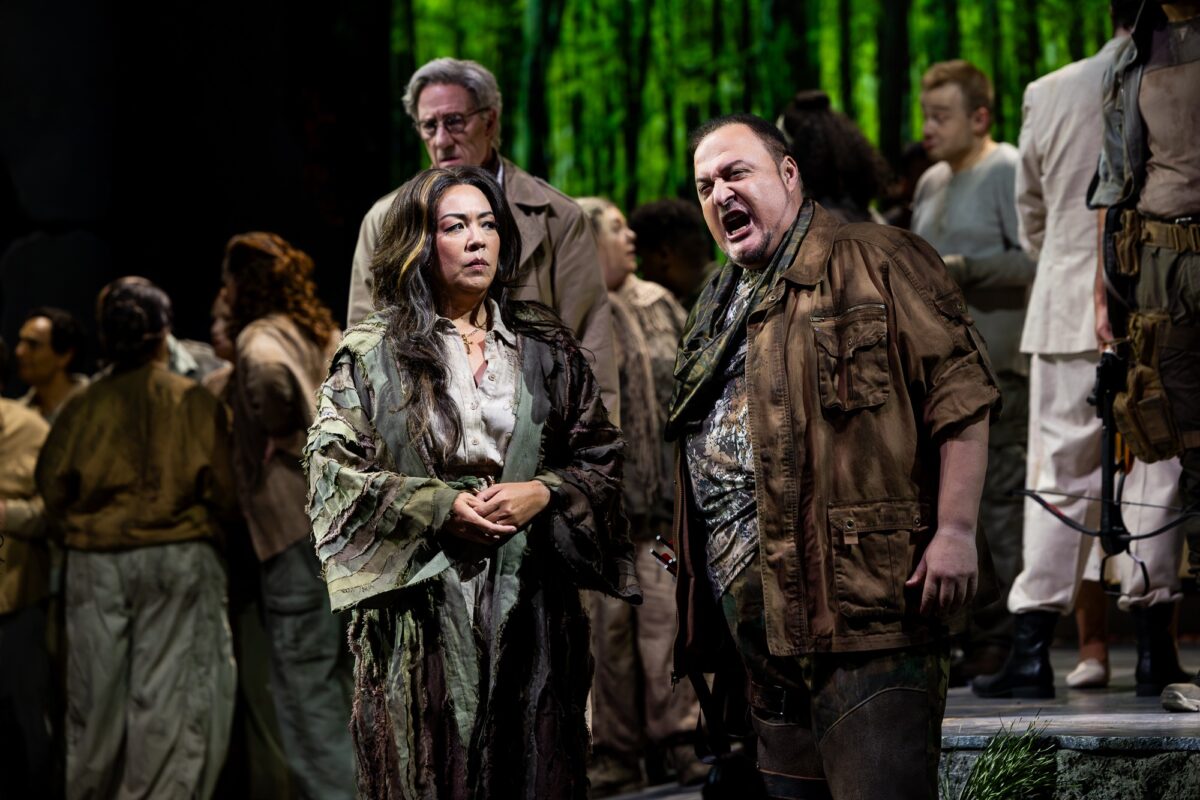
Photo: Nile Scott Studios
“William Tell, what’s that? Looks depressing”: a conversation between two Boston college students overheard outside Boston’s Emerson Colonial Theater. Rossini’s final opera, the grandiose William Tell, lurks in the shadow of his more iconic opere buffe. The overture is certainly catchy, though I don’t think Gen-Z even knows of The Lone Ranger. While this was the first staged William Tell in Boston in over 150 years, the Boston Lyric Opera made an admirable case for bringing it back.
With an uprising against tyranny and odes to freedom, the opera’s embellished story of the legendary 1307 Old Swiss Confederacy can also feel timely. Celebrating its 50th anniversary, the Boston Lyric Opera’s production also lined up with America 250, like last season’s patriotic Daughter of the Regiment. Instead of setting the Swiss story in America, co-directors Vita Tzykun and David Adam Moore reflected on recent political uncertainty indirectly but clearly: a dystopian former democracy taken over by oligarchs (a term used in Alexandra Dietrich’s detailed opera guide for the show), security cameras and biometric surveillance, and vacuous high society. Mar-al-Lago on Lake Lucerne?
Presented in its original French (Guillaume Tell), the BLO production streamlined Rossini’s score and Victor-Joseph Étienne de Jouy and L. F. Bis’s libretto — which already trimmed Schiller’s dense play — from 4 hours of music to 2.5. This performance practice is common. Indeed, the only complete uncut recording is from the 2013 Rossini in Wildbad festival with the late Antonino Fogliani. While the cuts did not reduce the story to incoherence, they came at the expense of the Act I and III ballets (some of my favorite parts in the score), the hunters’ chorus in Act II, and the Act III duet between Mathilde and Arnold. This was nowhere near as extreme as some productions. In my one previous experience hearing Guillaume Tell in 2014 (Michael Volle in the title role), director Antú Romero Nunes cut to black as Tell shoots the apple and placed the overture after the intermission (a decision met by a chorus of boos).
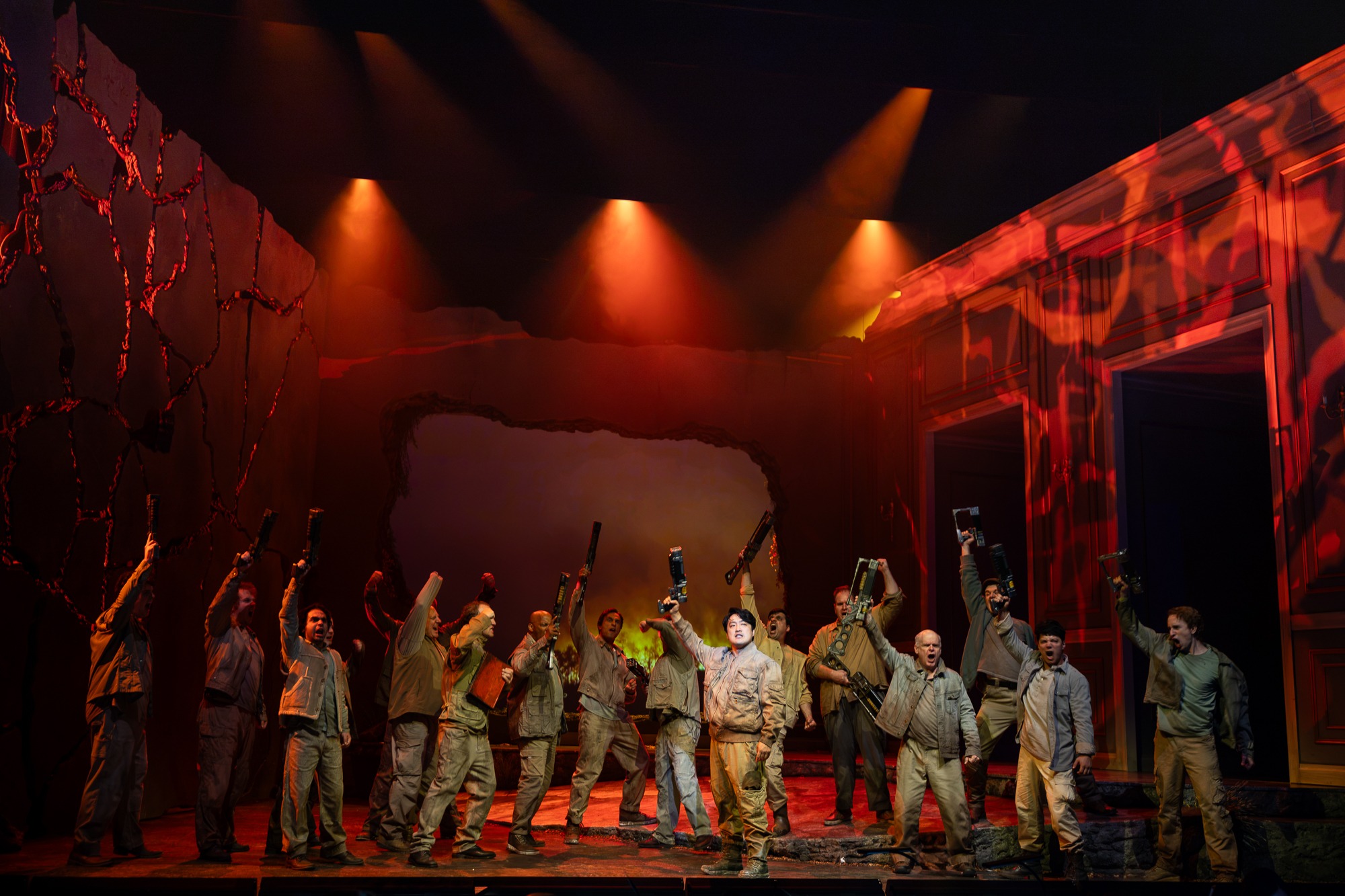
Photo: Nile Scott Studios
Tzykun and Moore took a relatively straightforward approach to adapting Tell in modern times. Costumes showed stark contrast between the two sides: Swiss villagers wore beige rags, dressing only in red folkloric costumes for their weddings, while Gessler and his henchmen had bright Star Wars-like uniforms. In a slightly befuddling move, the near-future dystopian setting insisted on archaic names for Switzerland and Austria, Helvetia and Allemania, confounding the Romantic nationalist subtleties of “l’Helvétie” and “la Suisse” found in the libretto and drawn from Schiller (the Latin names would no have been used in the 14th century anyways, growing popular in the early modern period with a revival of pre-Roman myth).
Simple but effective projections, with lighting by Eric Southern, conveyed a bucolic landscape ravaged by war. Yet unironic postcard-like projections of Alpine meadows in the finale and a computer-generated storm were perhaps too glib, succumbing to the same cliché as Gessler’s crew in the opening scene when they filmed a propaganda video of fake pastoralism.
Small acting details also gave the show depth. Melchtal is killed trying to save a villager from an assault (done more tactfully than Damiano Michieletto’s controversial 2015 Covent Garden production with its brutal reworking of the Act III ballet). In the closing moments, the calls for liberty are bittersweet as grieving relatives mourn the casualties of war. Other moments, however, were overworked, like cheesy off-beat clapping from the chorus or Arnold and Mathilde practically singing into each other’s mouths in their tryst.
Tell’s large cast was balanced, with particularly strong performances from the younger singers. The standout was tenor Konu Kim as Arnold. A bright, resonant timbre, Kim’s “Asile héréditaire” sounded almost effortless. With a future engagement at the Met, Kim is someone to watch out for. As his love interest, Mathilde, Anya Matanovič also provided a strong portrayal of the defiant Austrian princess. Her opening aria “Sombre forêt” started off too timid, her voice submerged in the orchestra, yet she gained confidence as the evening progressed. Matanovič will also make her Met debut soon, as Musetta in La Boheme.
While the Swiss patriot Walter Furst here was largely reduced to Tell’s sidekick, Sergio Martinez’s commanding bass was arguably more impressive than that of the production’s Tell, though Martinez’s timbre lost some shine as the evening wore on. Similarly, Leuthold was essentially a hatchet-wielding cameo, which Ilya Silchukou delivered with gusto. Morgan Mastrangelo as Ruodi the “tech worker” hit high notes with crystal-clear precision. Brianna J. Robinson’s Jemmy had a vocal warmth apt for Tell’s daughter.
Rossini’s opera however has a villain problem: the Austrian commander Gessler only appears by the middle of Act III and doesn’t do much. Hunter Enoch smartly amplified the militaristic autocratic role, but like Matanovič took some time for his voice to settle and cut through the orchestra. His henchman Rodolphe, played by Yeghishe Manucharyan, was appropriately sneering as he taunted the Swiss villagers.
James Demler as Melchtal made up for somewhat restrained projection his with sharp diction. As Tell’s wife, Hedwige, Nina Yoshida Nelsen (BLO Artistic Director) was unfortunately covered at times in the set pieces, her mellow mezzo lacking shine.
The protagonist George Gagnidze also had a mixed evening. His French diction was at times muffled, not helped by an overly nasal timbre and imprecise vibrato. Yet, importantly, Gagnidze’s “Sois immobile” conveyed a necessary pathos and conviction as he prepared to shoot the apple (the sliced shot was a nice bit of stagecraft).
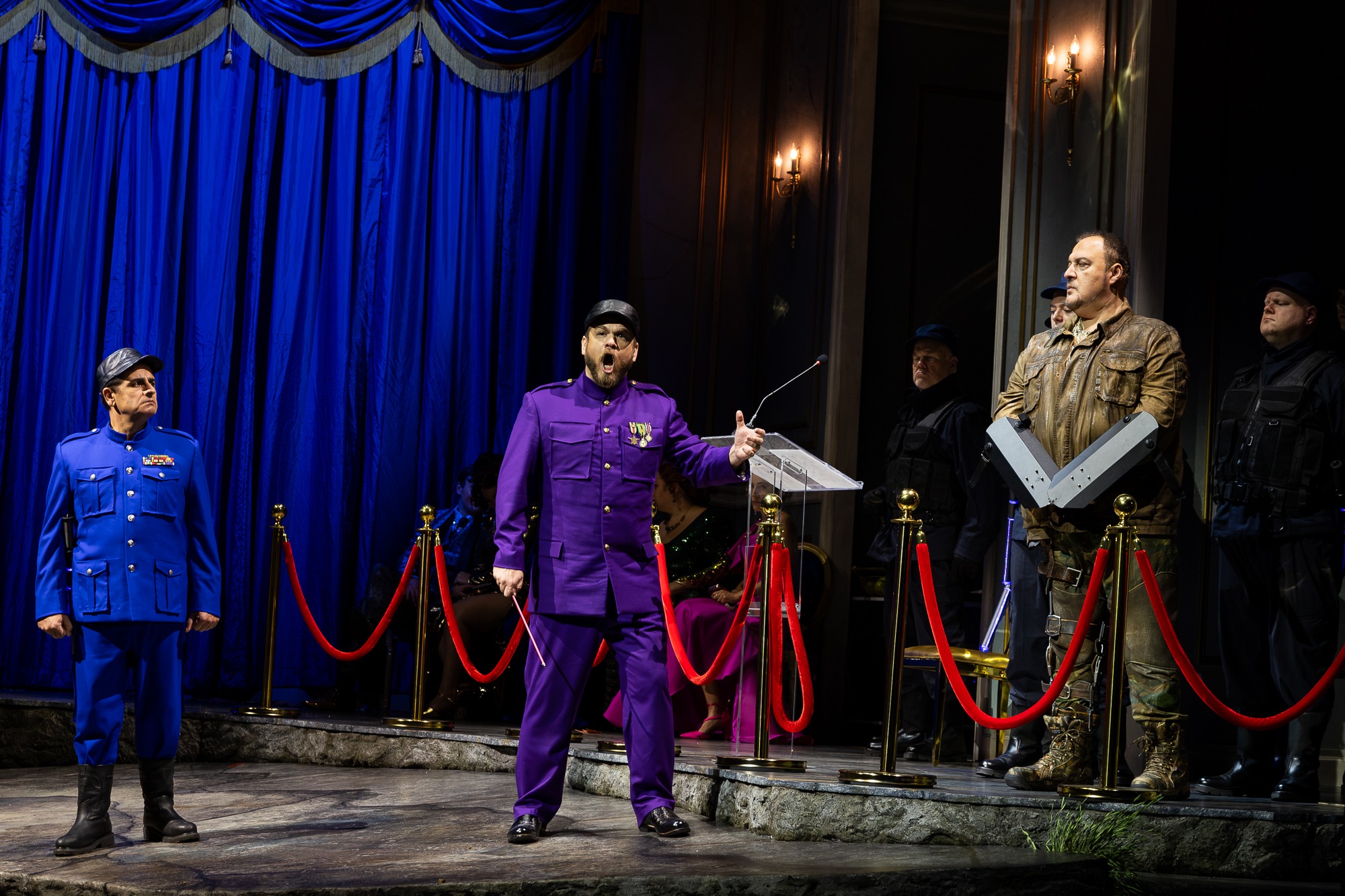
Photo: Nile Scott Studios
David Angus lead a measured performance from the pit. The overture’s “Ranz des Vaches” was appropriately melancholic, though the ending gallop could have had a bit more oomph. Slower moments sometimes plodded (Rossini’s brass-heavy score doesn’t do favors there) but the overall fine playing from the orchestra, particularly Brent Selby’s opening sorrowful cello solo, were commendable. The Boston Lyric Opera Chorus, directed by Brett Hodgdon, were in top form throughout Tell’s many choral numbers: from pointedly condemning traitors to finally celebrating their freedom.
The overall success of BLO’s Tell should provide a recipe for an opera-sparse city like Boston. Investing in a few relatively large-scale projects of under-appreciated works, rather than trotting out canonical warhorses, could be a path forward for institutions that prioritize educational and community initiatives and give opportunities to younger singers. The state of American opera does not need to be depressing.
Montagu James
Montagu James is a PhD student at Brown University studying modern European political and cultural history. He also enjoys composing and conducting.