Joy comes in the morning
Yannick Nézet-Séguin opens Philadelphia’s symphonic season in typically sunny style with programs feautring Beethoven, Brahms, and Bernstein.
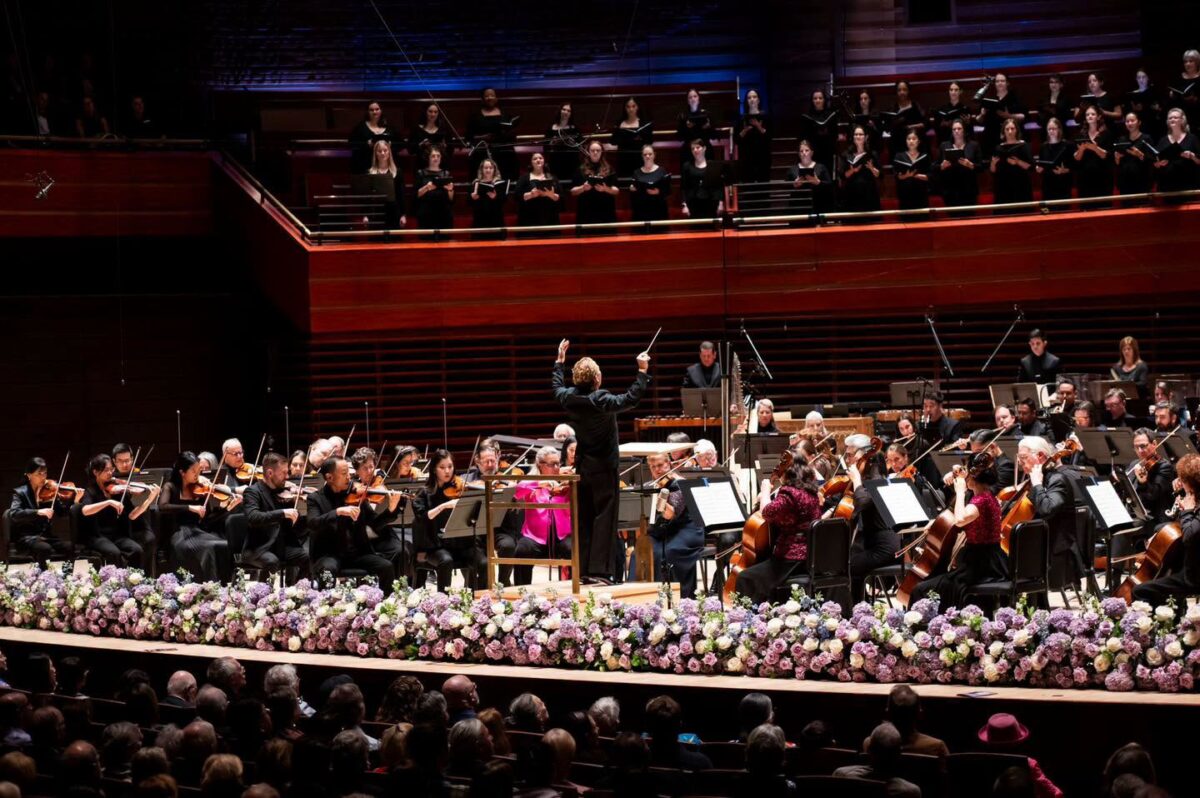
Photo: Pete Checchia
Joy. It’s a quality that Yannick Nézet-Séguin — Maestro of the Philadelphia Orchestra, among many other things —radiates. Universally known to Philadelphians by his first name (can you imagine previous Music Directors being called “Gene,” “Riccardo,” or “Wolfgang”?), Yannick seems eternally cheerful. Even when he wades into darker territory, as with a reference at the second concert to the dire Kennedy Center situation, there’s always a sense of light at the end of the tunnel.
And yes — talk about it he did. It’s a hallmark of Yannick performances that he regularly offers chatty commentary. His casual charm does have some detractors, but to judge from the audiences this week at the season opener (Beethoven’s Ninth Symphony and short piece by composer-in-residence Joe Hisaishi) or the following day’s concert (Brahms‘s Piano Concerto No. 1, and a new orchestral suite based on themes from Bernstein’s Mass) for the most part, he’s adored.
Choosing to open the season with Beethoven’s Ninth in many senses was a distillation of our Maestro’s world view. It’s a work full of passion and urgency, sometimes with a disquieting feeling that we’re not entirely sure where it’s going … but of course, the “Ode to Joy” / “An die Freude” in the end, with the beyond-iconic final movement for chorus (here the superb Philadelphia Symphonic Choir) and soloists: soprano Leah Hawkins, mezzo J’Nai Bridges, tenor Issachah Savage, and bass-baritone Ryan Speedo Green.
Beethoven’s Ninth is piece I’ve heard Yannick do multiple times over a decade or more, including this summer at Saratoga, and it’s notable how his interpretation has evolved over time. Always a conductor known for fast tempos, in recent performances his Ninth has sped up notably. This certainly lends a sense of momentum and excitement, and there are many passages where it pays off in a big way.
Another telling detail is that rests and short pauses within the musical line now seem to be even shorter. One instance that I noticed in Saratoga and again here is at the start of the tenor solo: Following a sustained chord for the choir and orchestra, there’s almost always a short rest separating the two. What Yannick does instead is to hold that chord for an unusually long time, and then have the solo emerge directly out of it.
This was an especially effective moment for me, particularly memorable because Issachah Savage sang the solo superbly.
Elsewhere though, the speeds really challenged the solo quartet, in some cases to the extent that the singers could barely keep up. Throughout the Symphony, some of the fast tempos struck me as too much — the second movement is marked “Molto vivace—Presto,” but still, we shouldn’t be on the edge of our seats wondering if the orchestra can keep up. Largely, they did … and played with the beautiful tone we’ve come to expect, though these first two concerts of the season weren’t quite the study in precision and coordination that often is a hallmark of the Philadelphia Orchestra.
The Hisaishi piece, called Orbis, was composed specifically as an overture to be paired with Beethoven’s Ninth. Though apart from making fine use of the chorus, I didn’t hear much obvious connection to the Symphony, I found the whole piece quite hypnotic and enjoyable — notably contemporary in style, but mixing many moods within that. Hisaishi is best known as a film composer in his native Japan, particularly of anime, and there is something sweepingly cinematic to Orbis.
The following day’s concert was for me an exceptional highlight among recent Philadelphia Orchestra performances. It was an intriguingly mixed program, bringing together Brahms’s Piano Concerto No. 1 with soloist Alexandre Kantorow, and the world premiere of “Symphonic Rituals from Mass,” a Philadelphia Orchestra commission that reworks Bernstein’s famous piece for the Kennedy Center opening as a purely orchestra piece. In his introductory remarks, Yannick connected the two works as revolutionary musical expressions in their time.
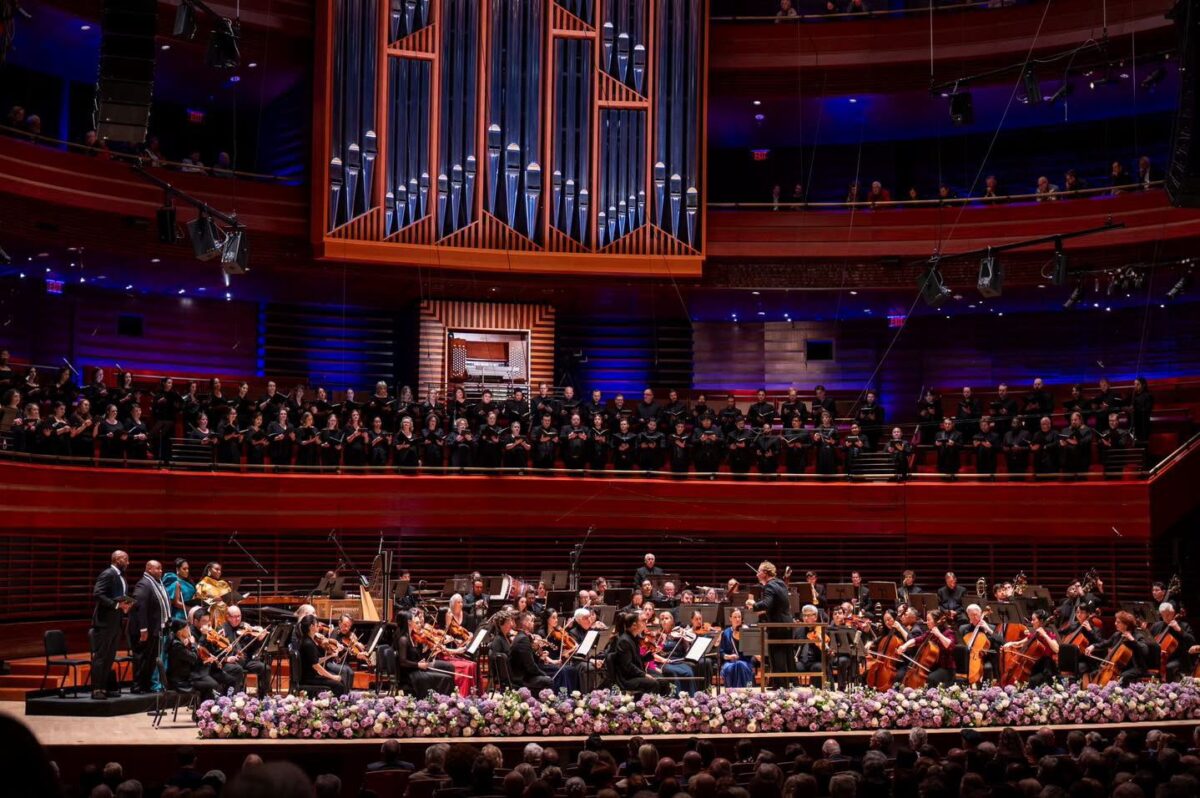
Photo: Pete Checchia
In his remarks about “Symphonic Rituals,” Yannick also made the point that Bernstein’s Mass is a monumental piece that from the very beginning has been controversial. It’s a generically wild mixed bag, employing that combination of jazz, classical, and everything in between that is instantly recognizable as Bernstein. The size and scale of the original — more a theater piece than a concert work — makes presenting it beyond the means of all but the largest and most solvent orchestras.
And frankly, the combination of dance, theatre, vocal music, and running themes of religion and political protest (in 1971 as the war in Vietnam was near its height) is overwhelming — and not always in a good way. To me, while there’s a lot of really splendid music, a lot of the piece now looks like dated kitsch. “Ungepatchka” is how I imagined my grandparents describing it.
Yannick, a major proponent of the work, made the point that an orchestral suite preserves Bernstein’s music — and makes it far more produceable. He likened this new work to the “Symphonic Dances from West Side Story.”
Indeed, that was my takeaway. Arranger Garth Edward Sunderland has cannily fused many of the best elements in Mass in a hugely enjoyable and very accessible way. It’s unmistakably Bernstein — those finger snaps! — and simultaneously evokes pleasant feelings of nostalgia with an invigorating sense of discovering “new” Bernstein.
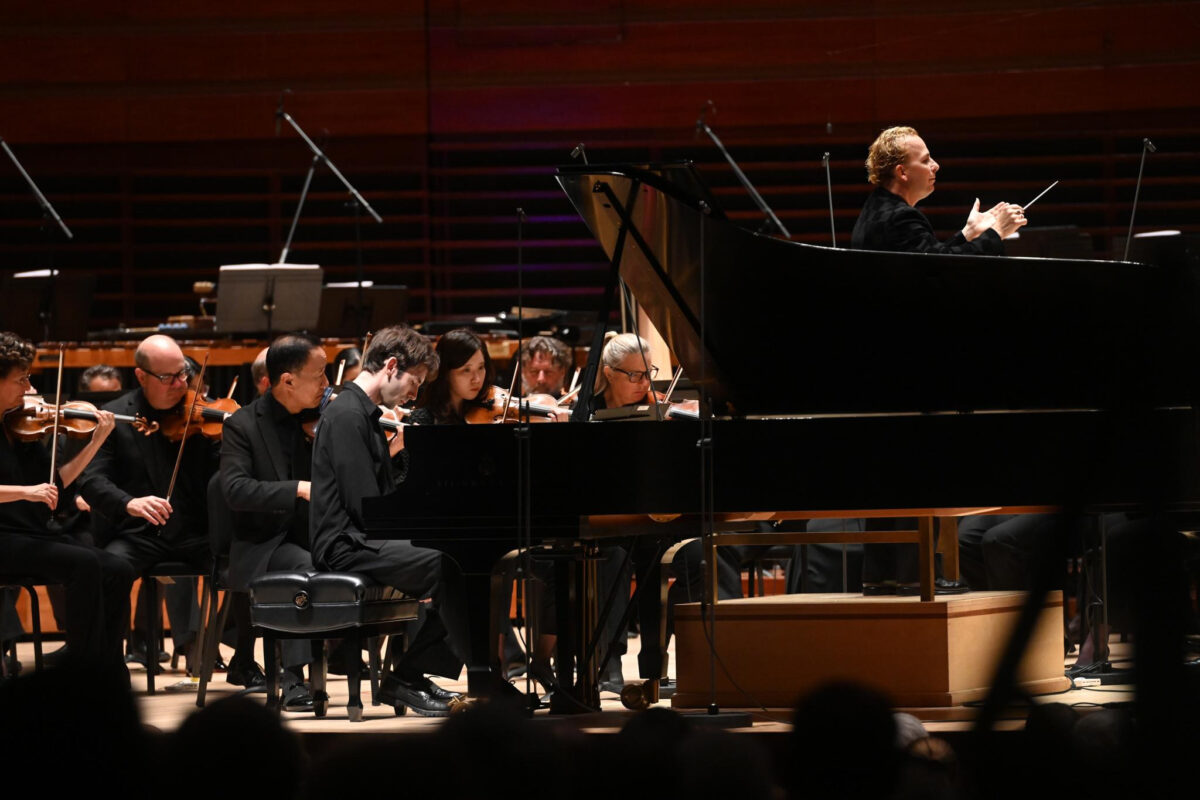
Photo: Pete Checchia
As for the Brahms, I’ll simply say that it was a magical experience. Yannick and Kantorow, clearly simpatico, brought a sense of playing-as-one throughout. Tempos were often fast—notably in the first movement—but there was also a sense of arching lyricism and stopped time. It struck me as everything Romanticism is meant to evoke.
As an encore, Kantorow played the Brahms op. 117, No. 1. The quietest audience I’ve been in in years collectively held their breath … and then, cheers.
-
Topics: concert performances, Review
-
People: Alexandre Kantorow, Garth Edward Sunderland, Issachah Savage, J'Nai Bridges, Leah Hawkins, Ryan Speedo Green, Yannick Nézet-Séguin
-
Works: Beethoven 9
-
Places & Organizations: Philadelphia Orchestra