A melody that begins a symphony
There may be frozen giant erections and psychedelic projections galore — but there’s also a surprising degree of emotion in Kirill Serebrennikov‘s latest theatrical experiment in Berlin.
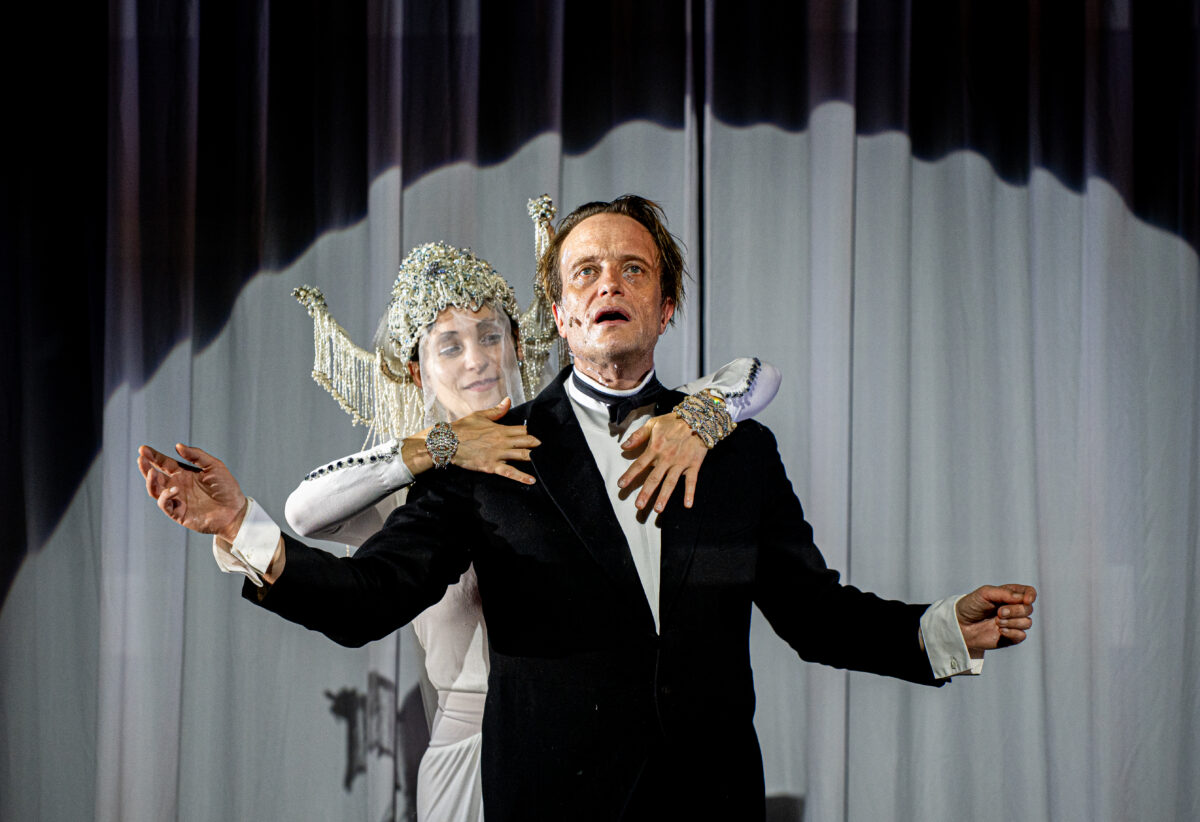
Photo: Vahid Amanpour
Two men are journeying across Russia. Stuck in a blizzard, there’s nothing they can do but drink vodka and debate god, oblivion, preordinance, and the banality of all humankind. It’s almost a cliché of Russian literature at this point — indeed, Tolstoy and Pushkin both wrote short stories using this exact conceit — but Vladimir Sorokin is a writer who elides cliché.
Born in 1955, Sorokin is perhaps Russia’s premier satirist. Born in Moscow, he found his artistic home in its underground art scene in the 1980’s, and his enormous oeuvre of novels, novellas, plays, screenplays, and libretti reveals a stylistic range that is at once dazzling, bewildering, and grotesque. He has picked up as many political condemnations as he has literary awards: his 2001 dystopian sci-fi novel Blue Lard, featuring a gay sex scene between Khrushchev and Stalin, was investigated for pornography, while his 2006 Gogol-esque satire Day of the Oprichnik was banned in Belarus. In 2022, he published a piece in The Guardian accusing Vladimir Putin of being a “monster crazed in its desires and ruthless in its decisions”, and has lived in exile in Berlin ever since.
Sorokin’s 2010 novella The Blizzard is, by his standards, gentle. Garin, a doctor, has a vaccine with the power to halt a zombie outbreak in a distant village, and recruits the stuttering, simple Perkhusha and his horses for his journey. Sorokin plays with his influences: there’s Tolstoy and Gogol, but there are also hints of Beckett’s Godot, Sartre’s Nausea, and Homer’s Odyssey, with hints of HBO’s The Last of Us thrown in for good measure. There are references to Schubert and Wagner, but there’s also a psychedelic drug trip gone wrong, a zombie wedding, and a frozen giant with an erection. This mishmash of 19th-century realism, Soviet surrealist satire, and dystopian sci-fi implies that journeys are less linear than we might like to think; rather, we are caught in a never-ending loop, a purgatory where each life lesson is erased by the coming snow.
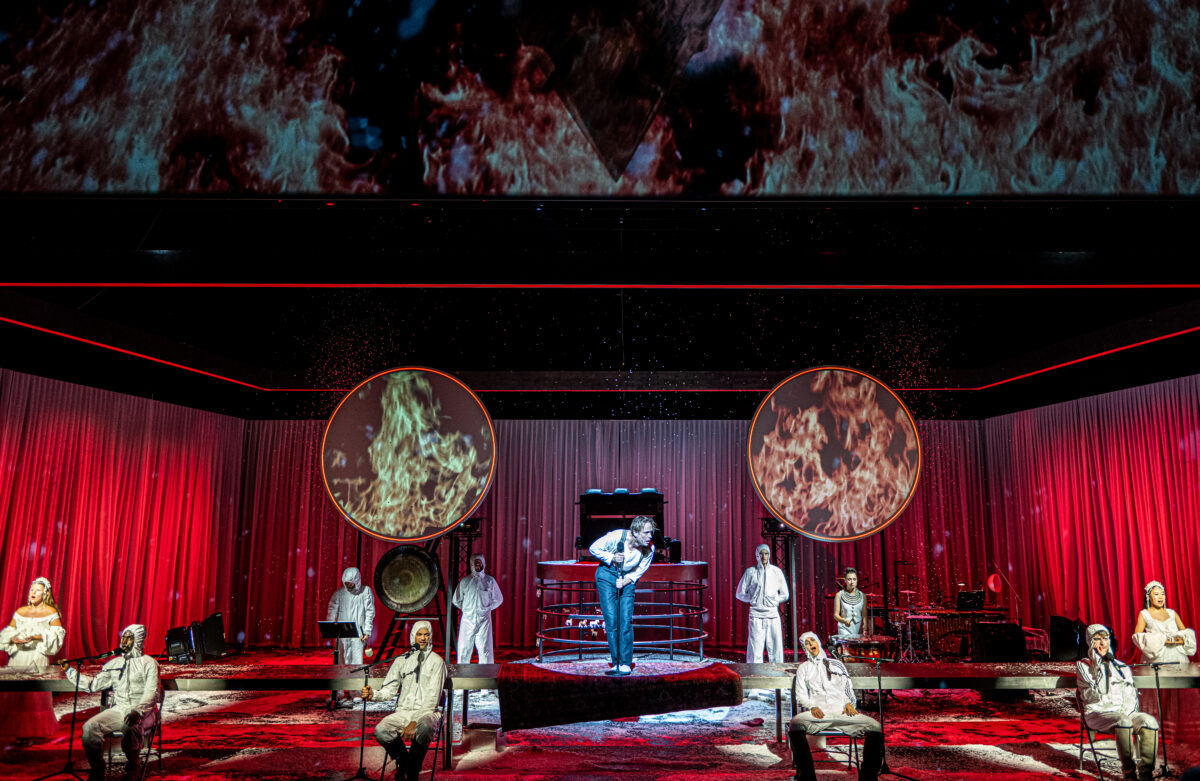
Photo: Vahid Amanpour
The sheer metaphysical weirdness of Sorokin’s text is an ideal fit for his fellow Russian-in-exile Kirill Serebrennikov, whose work encompasses film, theatre, ballet, and opera. Long critical of Putin’s annexation of Crimea and record on LGBTQ+ rights, he was arrested in 2017 on trumped-up charges of embezzlement; he directed Così fan tutte at the Komische Oper Berlin by video while under house arrest. He has since moved to Berlin to complete the Da Ponte trilogy for the Komische Oper, and has directed productions of Parsifal, Don Carlo, and Boris Godunov in Vienna and Amsterdam, and kicked off a new Ring Cycle at the Salzburg Festival earlier this year.
His opera work has been inconsistent: His Vienna Parsifal, a deconstructionist take set amongst the metaphorical ruins of free speech, was bleak and moving, while his Don Carlo for the same house, set in a costume institute, was so frigidly cerebral it left me entirely emotionless. One gets the sense that he is straining beyond the constraints of opera, and indeed it’s his other stage work such as his ballet Nureyev, originally conceived for the Bolshoi and cancelled on the grounds that it constituted “gay propaganda”, that has allowed him creative free rein.
Now, Serebrennikov has put together a festival in Berlin: titled “Kirill and Friends”, it comprises 10 days of theatre, film, dance, and photography together with the director’s friends and collaborators. The centerpiece is Serebrennikov’s theatrical adaptation of Sorokin’s The Blizzard following its 2025 premiere at the Salzburg Festival. Serebrennikov’s central directorial conceit is to embody the blizzard as an ensemble of actors. Actually, to call them actors sells them short: They play the accordion and timpani and marimba, they sing everything from Renaissance polyphony to Marlene Dietrich-esque cabaret songs to Russian folk songs to something out of Berg’s Lulu, and they contort, jump, and tap dance around the stage attired in everything from quarantine suits to Snegurochka costumes. The text, arranged by Serebrennikov himself, is a mix of German, Russian, and Mandarin.
It’s here that Serebrennikov’s opera experience shines. Sorokin’s texts are infamously difficult to translate, with their wordplay, allusions, and knotty imagery. It is nearly impossible to overlay any conventional narrative structure or Euclidean logic onto Sorokin, and Serebrennikov rightly treats the text as a constellation of sounds. The boundaries between text and music are blurred: An actor gargling his tea dissolves into the whir of a wind machine, and castanets punctuate the chattering teeth of the freezing characters. Situating the existentialist dread of Garin and Perkhusha within an exuberant whirlwind of a cabaret feels exactly right for the kind of virtuoso stylistic mimicry Sorokin loves.
Visually, Serebrennikov’s production plays with scale, taking his inspiration from Sorokin’s 50 bird-sized horses who transport our duo across the Russian countryside. The mysterious crystalline pyramids they encounter recall salt crystals, magnified to monstrous proportions; the aforementioned erect giant interrupts Garin and Kozma’s journey when their sled gets wedged up the giant’s nose. Even the oversexed miller’s wife is proportionally off: when she unrobes, she reveals a padded suit that exaggerates her hips and breasts to grotesque dimensions.
At the centre of it all is a spinning platform scaffolded with miniature horses, a sort of twisted carousel on top of which Garin and Perkhusha sit. Here, too, Serebrennikov plays with scale: Garin and Perkhusha wear plastic bubbles with mounted cameras, and their faces are projected onto two circular screens which stare out into the audience like disembodied eyes. A miniature sled and two figurines are filmed by an onstage cameraman and projected onto a frieze above the stage, allowing for images to be layered above, upon, and behind the scrim. Here, Serebrennikov’s love of projections detracts: The frosty glass, the psychedelic colors, and the rotating pyramids look like screensavers from the turn of the millennium. Tellingly, it’s Garin’s hallucination scene, played out in an all-white clinic, that is the most visually compelling, heightening the vivid terror of the drugged doctor.
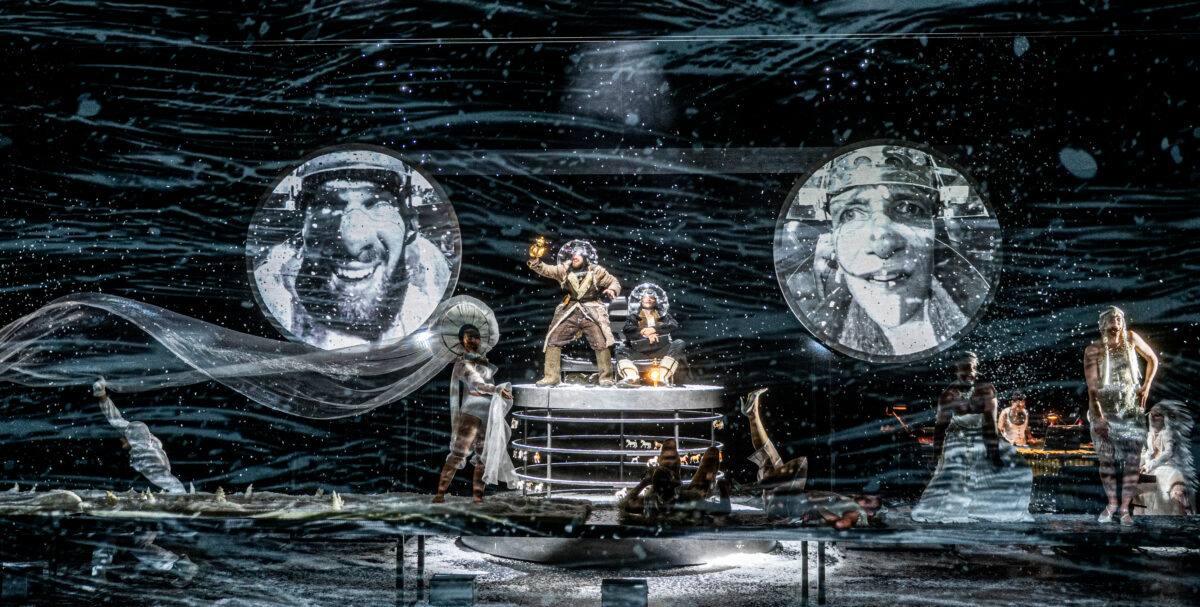
Photo: Vahid Amanpour
As Garin, the German actor August Diehl (best known to Anglophone audiences for his role in Tarantino’s Inglourious Basterds) is imperious and arrogant, effectively capturing the character’s impotent frustration and rage. But it’s Filipp Avdeev’s Perkhusha who is the beating heart of the piece: tender, ridiculous, and heartbreaking in equal measure. When you read a Sorokin text or watch a Serebrennikov production, you expect it to be smart and surprising — but rarely have I been as moved as in this production.
Is it a play? Is it an opera? Is it a cabaret? Whatever your categorization, Serebrennikov has demonstrated a compelling ability to transform sound, whether text or music, into theatre. And he could find no better partner for this than Sorokin, who describes his writing process as such: “The intonation of a first page is like a melody you catch — a melody that begins a symphony.”
-
People: August Diehl, Filipp Avdeev, Kirill Serebrennikov, Vladimir Sorokin
-
Works: Der Schneesturm/The Blizzard
-
Places & Organizations: Kirill and Friends