Don’t go in the basement
Malin Byström is a radiant water nymph in the Bayerische Staatsoper‘s house-of-horrors-set Rusalka.
 By
Lisa Hirsch
By
Lisa Hirsch
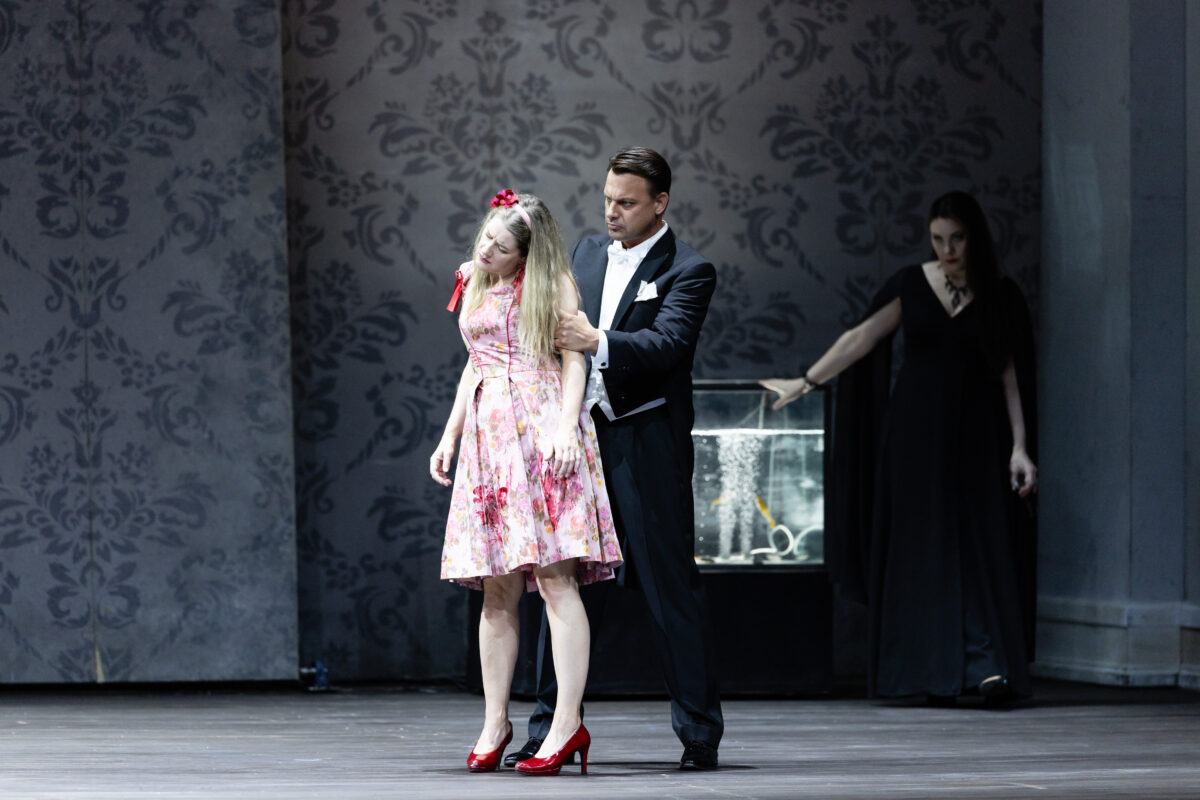
Photo: Geoffroy Schied
Antonín Dvořák‘s 1901 Rusalka, the only one of Antonín Dvořák‘s ten operas that is regularly performed outside Czechia, tells the story of an interspecies love affair that goes catastrophically wrong. The water nymph Rusalka, daughter of Vodník a water goblin who rules a lake, falls in love with a human Prince and wants him to fall in love with her. She turns to a witch, Ježibaba, who can grant her wish, but at a price: she will lose her voice and be unable to talk to the human.
What could possibly go wrong? Well, just about everything. The Prince does, indeed, fall in love with her, while hunting a white doe (Did Richard Strauss and Hugo von Hofmannsthal know this opera when they created Die Frau ohne Schatten, where the Emperor hunts and finds the Empress in the form of a white gazelle?), but their attempt at marriage is a disaster; she is mute before the wedding guests, who find her very strange. Meanwhile, the Prince has turned his attention to a Foreign Princess, a demonic figure who dominates the Prince but ultimately curses him and Rusalka.
Rusalka, miserable, returns to the lake. Ježibaba tells Rusalka that she can end the Prince’s suffering and her own by killing him with a magic knife, but the nymph refuses. In the end, the Prince asks for Rusalka’s kiss and dies.
A director can do a lot with this scenario, and Martin Kušej‘s production, seen at the Bayerische Staatsoper on July 25 with a superb cast, goes in some interesting directions. He places the action in the present — a somewhat decayed present, given the appearance of the Prince´s palace — and makes Vodník into a monster.
The production works extremely well and everyone in the cast is excellent, but the heart of the opera is Rusalka herself. This revival is lucky enough to have the Swedish soprano Malin Byström in the title role, Byström brings enormous stage presence and deep vocal expressivity to the part, managing to be both passionate and cool as a character described by the Prince as ¨always remaining cold” and ¨ice-cold and eerie.¨
Vodnik, here the expressive and resonant bass Christof Fischesser, oversees an Alpine lake, surrounded by greenery and high mountains. But during the seemingly idyllic opening scenes, the stage elevator lifts to reveal a horrific scene: beneath the lake is what appears to be a sewer or flooded basement full of half-naked people. Rusalka is curled up on a couch, sulky and depressed. Vodník withholds life-giving water and sexually abuses the wood nymphs and even his daughter. He is a monster; Could you wonder that his impressionable daughter might want to escape via romance?
Mezzo-soprano Jamie Barton‘s beautifully sung Ježibaba is conceived and played as nearly indifferent to Rusalka’s plight, both before and after the nymph’s disastrous encounters with the Prince, and yet she also abuses Rusalka. While stealing her voice, Ježibaba places her on a massage table and suggestively rubs her down with a towel. In Act 3, offering Rusalka a magic knife to kill the Prince, she runs the knife about the nymph’s body.
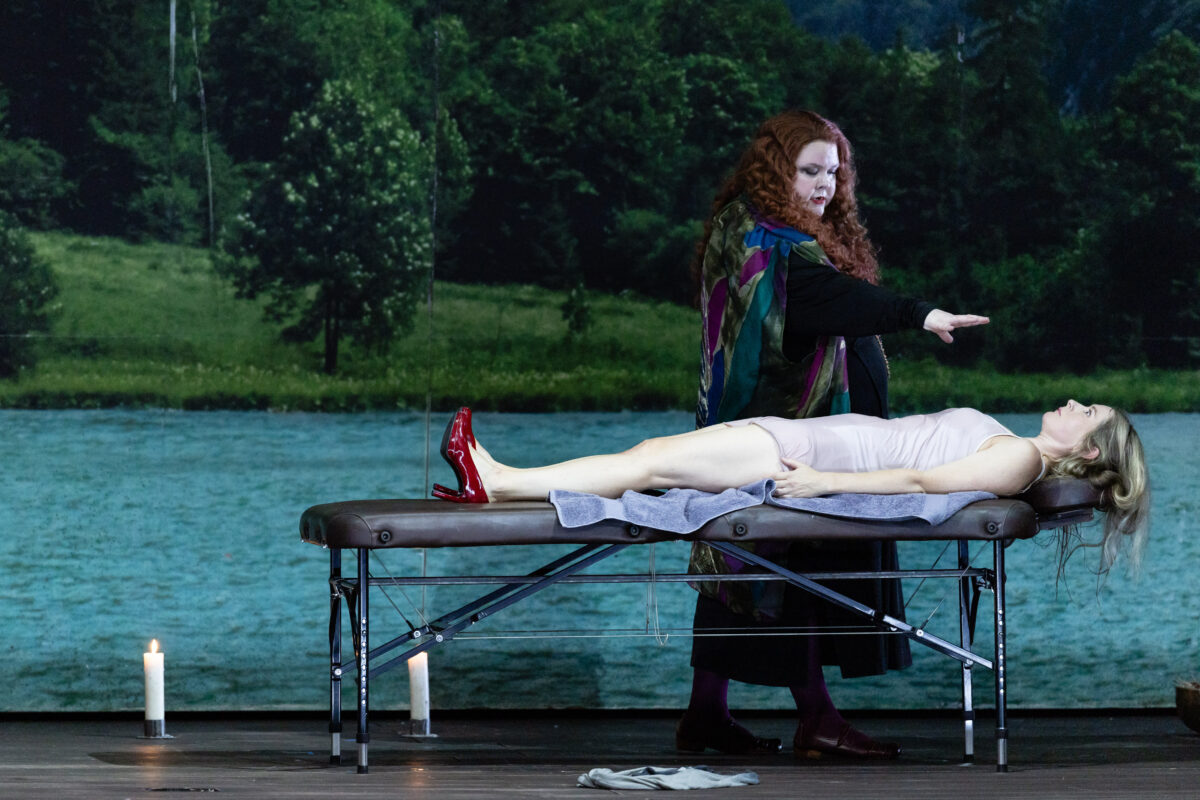
Photo: Geoffroy Schied
Transformed into a human, Rusalka retains signs of her previous life. She can’t manage shoes, staggering around the stage in heels, unable to keep her balance. When she and the prince, heldentenor Pavel Černoch in a strongly sung performance, finally meet, sh’s carried off, stunned, by hunters.
The black-clad Elena Guseva nearly steals the show as the Foreign Princess, her powerful soprano and charisma dominating the stage for much of Act II. While she and the Prince are occupied with each other, Rusalka, still in her wedding dress, climbs into a gigantic fish tank, unable to truly escape her watery origins. There’s yet more abuse in the act, with the gamekeeper (Tansel Akzeybek) trying to abuse the kitchen boy (Meg Brilleslyper), who is dressed as a woman as well as sung by one.
Act III brings some surprises. Much of it takes place in some kind of an institution, with white bunk beds scattered about the stage. The wood nymphs sing from the beds; Vodník is dragged in by thugs. The Prince’s final moments come off very much as a mad scene, and somehow Černoch managed to look both horrified and bewitched as Byström simultaneously kisses and stabs him.
Petr Popelka, who becomes music director of the Bayerische Staatsoper in the 2029-30 season, led a gorgeous performance, the lushly orchestrated score resounding through the house.
Lisa Hirsch
Lisa Hirsch studied music at Brandeis University and Stony Brook. She studied flute seriously for a number of years and has sung a wide variety of music in many choruses. She has written about opera and classical music for San Francisco Classical Voice, Opera News (RIP), Opera, and the San Francisco Chronicle. She blogs about these subjects at Iron Tongue of Midnight, which also includes many of her photos.
Though she has attended San Francisco Opera and other companies since the early 1980s, her opera obsession really started in the early 90s, when she started listening to historic singers.
-
People: Antonín Dvo?ák, Christof Fischesser, Elena Guseva, Hugo von Hoffmannsthal, Jamie Barton, Malin Byström, Martin Kusej, Martin Kušej, Meg Brilleslyper, Pavel ?ernoch, Petr Popelka, Richard Strauss, Tansel Akzeybek
-
Works: Die Frau ohne Schatten, Rusalka
-
Places & Organizations: Bayerische Staatsoper