The juice is on the loose
The bonkers, bewildering Die ägyptische Helena begets a suitably lush musical and creative treatment at Bard SummerScape.
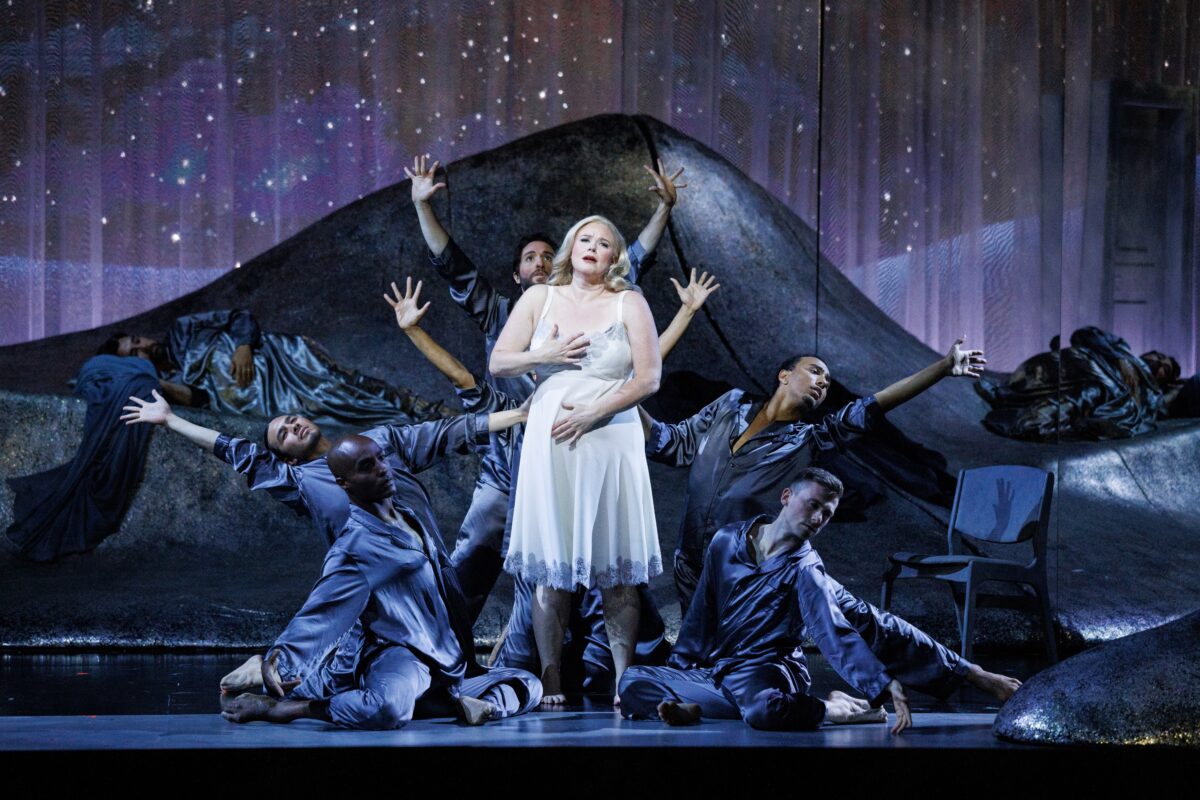
Photo: Maria Baranova
Richard Strauss’s Die ägyptische Helena (1928) is a strange, static, talky, and often abstruse work. Hugo von Hofmannsthal thought the libretto was his best, originally envisioning it as a mythological farce in the style of Offenbach. It turned, however, into something more serious, surreal, and personal; this is a story about the aftermath of war and betrayal and the healing that must take place.
Hofmannsthal and Strauss revisited this theme several times with stories involving difficult marriages and the need for forgiveness, with marriage and children being the ultimate goal. Die Frau ohne Schatten, Intermezzo (libretto by Strauss based on an autobiographical incident involving him and his temperamental wife Pauline de Ahna Strauss), and Die Liebe der Danae (libretto by Josef Gregor based on a Hofmannsthal sketch) all deal with couples dealing with betrayal and end in a hymn to conjugal love. In Arabella, we have an affianced couple dealing with an alleged infidelity who also come to forgiveness and reconciliation with the pledge of matrimony in a radiant final duet.
Die ägyptische Helena checks all these boxes exploring these themes in a tenuous plot, derived loosely from Euripides’s Helen, that the real Helen never went to Troy with Prince Paris but was spirited away to Egypt and languished while a phantom Helen launched a thousand ships. This story emerged in ancient mythology perhaps to restore the honor of Spartan women from the shame of an adulterous and traitorous queen.
But both Euripides’s play and Strauss and Hofmannsthal’s opera were created in the aftermath of huge wars – the Sicilian Expedition (a defeat for Athens) for Euripides and World War I (a defeat for Germany) for Strauss and von Hofmannsthal. The theme of forgiveness and rebuilding, forgetting the past is very much au courant with the spirit of those times, as societal issues are explored through the personal and romantic lens.
Another theme is choosing illusion and escape over remembrance and reality. The libretto symbolizes these opposing ideas with the lotus juice, which makes one forget the pain of reality, calms emotional distress, and heightens sensation and emotion with the opposing drink of remembrance, which brings one back to harsh reality but also truth. Menelaus and Helen, a married couple, drink the lotus juice to forget which leads to an ecstatic reunion. This leads to a repeat of jealousy and irrational obsession. In Act II, Helena chooses the draught of remembrance for both her and her husband to see each other as they really are and build from there. Any true relationship must be based on both self-knowledge and a real perception of your partner with all their faults and mistakes. It all ends with a reunion with their young daughter Hermione and a rapturous love duet with chorus while (in this production) snow gently falls from the sky.
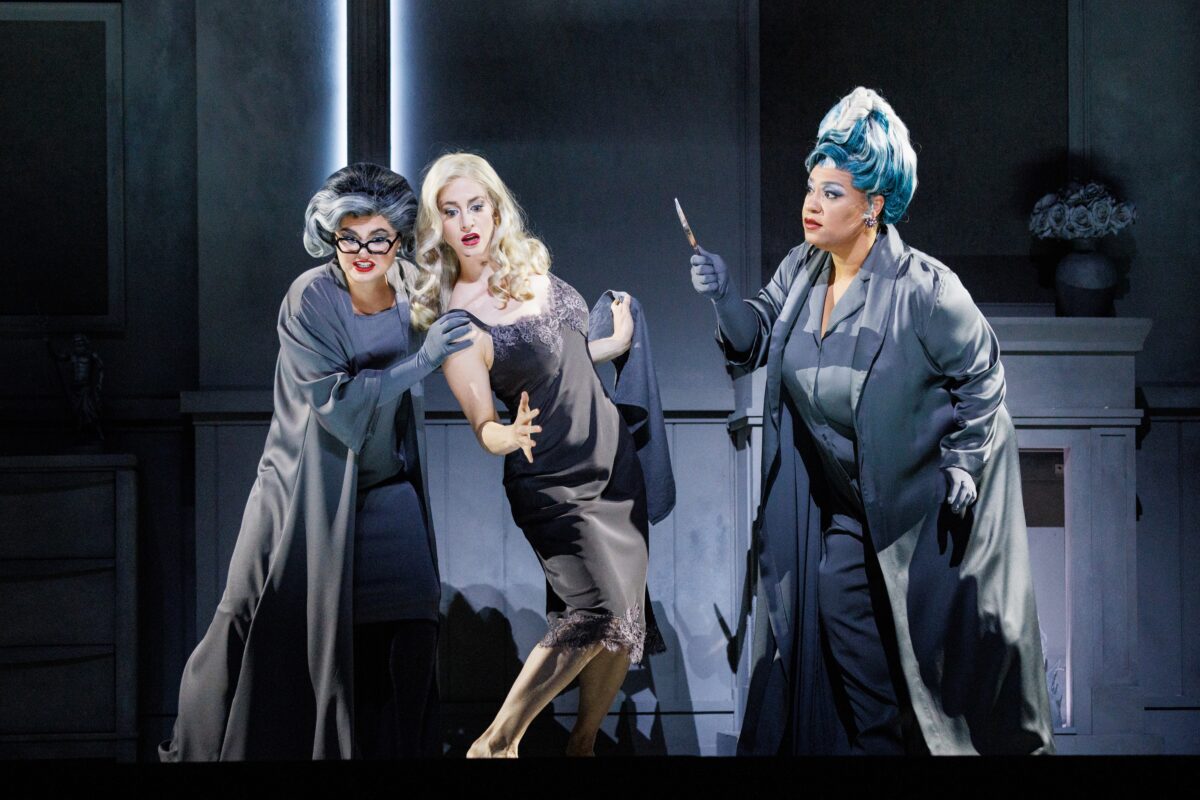
Photo: Maria Baranova
The ringmaster of this mythological circus is the sorceress Aithra. In Act I, Aithra lures the shipwrecked Helen and Menelaus to her secluded Egyptian island, gives Helen a youthful makeover and drugs them with lotus juice. She sells Menelaus a fake story about the phantom Helen who went to Troy. This confuses poor Menelaus, leading to a rapturous night of marital love with a wife who may or may not be real. Act II which starts well with “Zweite brautnacht” (the hit tune of the score) then turns into a bizarre farrago involving the amorous barbarian King Altair and his equally on-the-make son Da-Ud, who are more cardboard puppets than people. The score gets frantic (as does Menelaus) and musically empty, full of note-spinning and phony bombast. Da-Ud is killed in a hunt by a paranoid Menelaus who is having flashbacks of Paris’ abduction of Helen. Aithra waves away these marionettes and brings on the child Hermione and we get a sort of forced happy ending that is not earned. These characters talk about their emotional journeys more than live them.
The Bard SummerScape production (seen on August 2, the last of the run) accepts the weirdness of the opera on its own terms without apology or condescension. Many Parterre readers have professed to love this opera, but even they admit that one must ignore the story and plot and wallow in the decadent lushness of Strauss’ score to enjoy it. Bard stage director Christian Räth agrees that “(t)he key to making sense of this opera may actually be to stop trying to grasp it intellectually and instead allow it to unfold as an emotional and psychological journey.”
Räth envisions this work as maybe the first surrealistic opera which “unfolds like a Freudian dream in which the true meaning of the character’s intentions and actions lie hidden from themselves beneath an entertainingly absurd surface.” Essentially it all is a dream (possibly conjured up by the lovelorn Aithra who has been abandoned by Poseidon with the essential help of the lotus juice consumed by all the principal characters) that will heal her emotional wounds by reuniting Helen and Menelaus (who may be lotus juice-inspired fantasy figure alter-egos). Helen becomes Aithra’s alter ego and they even exchange wigs (light blonde for dark) as if taking on each other’s identity.
Räth and Daniel Unger’s scene design initially shows a totally gray apartment with a table set for dinner – the back wall becomes a screen for dreamlike projections of what is supposed to be happening offstage. The Omniscient Seashell (mezzo-soprano Deborah Nansteel) emerges from a picture frame turned tv screen. The solid gray walls fracture into turning flats with mobile mirrors that suggest reality dissolving into illusion. The stage pictures become increasingly surreal and dreamlike with vivid saturated colors and background vistas of fantasy landscapes. It all seems like an opium dream (and since the “lotus eater” flowers of Homer’s Odyssey were supposedly actually opium plants this makes perfect sense). This roots the story in a kind of reality while letting the fantasy run wild and free. It doesn’t have to make sense.
Into this sophisticated and elegant milieu, Bard provided a strong cast and excellent musical values. The most polished standout performance came from the excellent Jana McIntyre, a Bard and ASO regular, who blossomed in Aithra’s tricky high-lying vocal lines with colorful and brilliant tone. As Aithra is the one character who shows agency and propels what plot there is, she often steals the show (as Diana Damrau did in the 2007 Metropolitan Opera production).
Hailey Clark as Helena was a late replacement for Ambur Braid (who chose to do another Strauss role, the Färberin in Frau at Aix), learning the demanding role in only a few months. Her soprano has a gleaming tone underpinned with a feminine warmth that fills out when the line gets expansive and high. She balanced both the amoral fascinator and regretful wife aspects of the character while maintaining cool poise onstage.
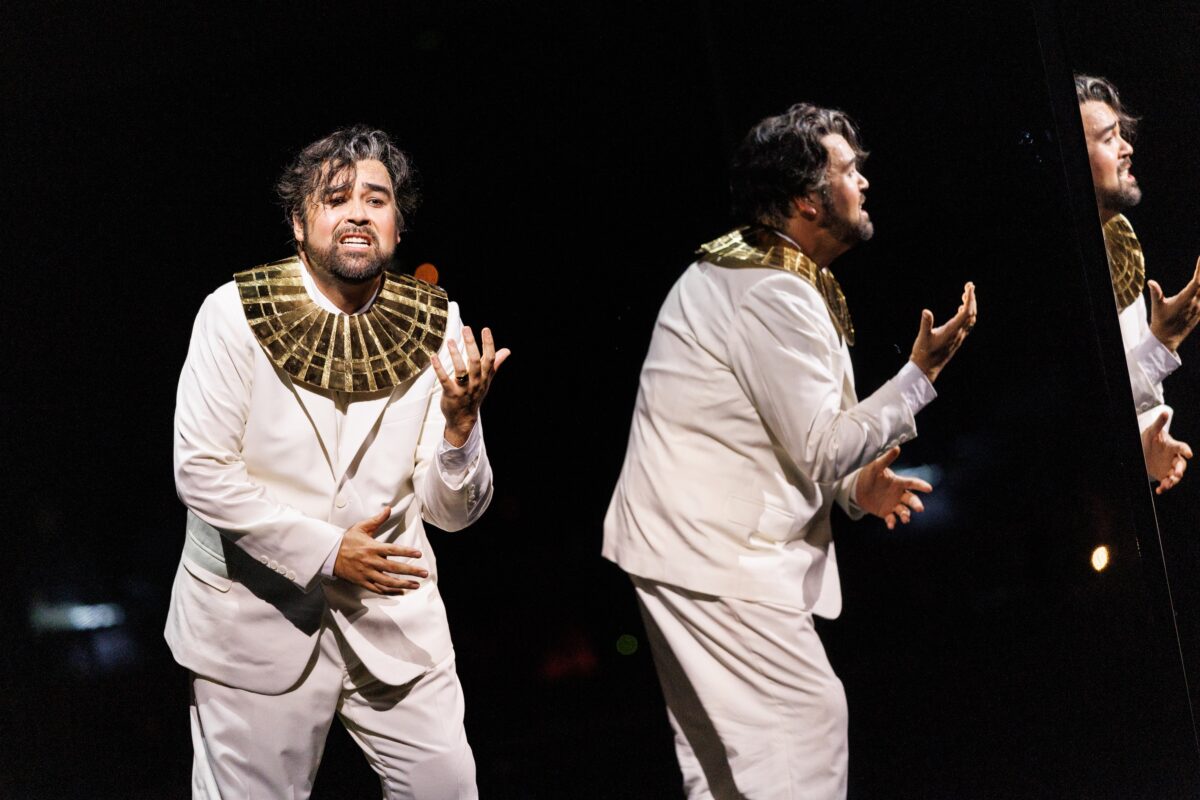
Photo: Maria Baranova
In the impossible, voice-breaking, high declamatory heldentenor vocal writing for Menelas (as he is called here), another Bard and ASO regular, John Matthew Myers again revealed a solid technique and musicality applied to punishing tenor music. He has a plangent almost Irish tenor-like timbre that can take pressure without breaking and makes music where other tenors make noise.
Other positive elements were bass-baritone Blake Denson as a vigorous, mahogany-toned Altair, Nansteel (doubling the Omniscient Seashell and the Second Servant Maid), and Catherine Creed (as the First Servant Maid). Tenor Shawn Roth as Da-Ud started out weakly with weedy, unsupported tone but came into focus in his brief love duet with Helen before he is summarily dispatched by her husband. James Bagwell’s large and versatile chorus scored in their brief interjections and choreographer Catherine Galasso’s handsome dancers embodied slain Trojan princes and barbarian henchmen with athletic flair.
Meanwhile, down in the pit, Bard president and SummerScape artistic director Leon Botstein presided over a sharp, clear, totally integrated musical performance. The playing was precise, and he contrasted the many fascinating colors in Strauss’ rich orchestration.
Botstein has conducted the work in New York before: I was introduced to the opera in a fascinating American Symphony Orchestra concert performance in January 1998 with a radiant, effulgent, golden-voiced Deborah Voigt as Helena (Paul Frey, Helen Field, Peter Coleman-Wright and Wendy Hoffman were the other soloists). Our fearless leader and site founder James Jorden/La Cieca was also there. He was taken with the opera (he always had a weak spot for the absurd and decadent) and had this to say:
An essay in the program book suggests that Helena loses little in concert performance. I have to disagree. To begin with, Helena’s personal appearance is a major plot point… Further, the “plot” of the opera is mostly internal and therefore conveyed through subtle gesture and eye contact, not so easy to do with scores and music stands. A staged production of Helena would have to be the last word in chic and sophistication, both in design and performance, so I don’t think we’ll see one soon.
Well James, we did see one at Bard and it was a revelation, one of the best all-around productions the festival has produced. I just wish you were around to see it.
Meanwhile, Dr. Botstein is continuing his exploration of Richard Strauss’ operas with an American Symphony Orchestra concert performance of Intermezzo at Carnegie Hall on April 1, 2027. Next summer at Bard SummerScape, though, has not yet been announced.
-
People: Ambur Braid, Christian Räth, Deborah Nansteel, Deborah Voigt, Diana Damrau, Hailey Clark, Halley Clark, Hugo von Hoffmannsthal, James Bagwell, Jana McIntyre, John Matthew Myers, Josef Gregor, Leon Bostein, Leon Botstein, Lotus Juice, Richard Strauss
-
Works: Arabella, Die Frau ohne Schatten, Die Liebe der Danae, Die ägyptische Helena, Intermezzo
-
Places & Organizations: American Symphony Orchestra, Bard SummerScape, Carnegie Hall, Metropolitan Opera