A barrel of laughs
Jake Heggie and Gene Scheer‘s bubbly The Judgement of Paris brings a distinctly Californian terroir to operatic comedy.
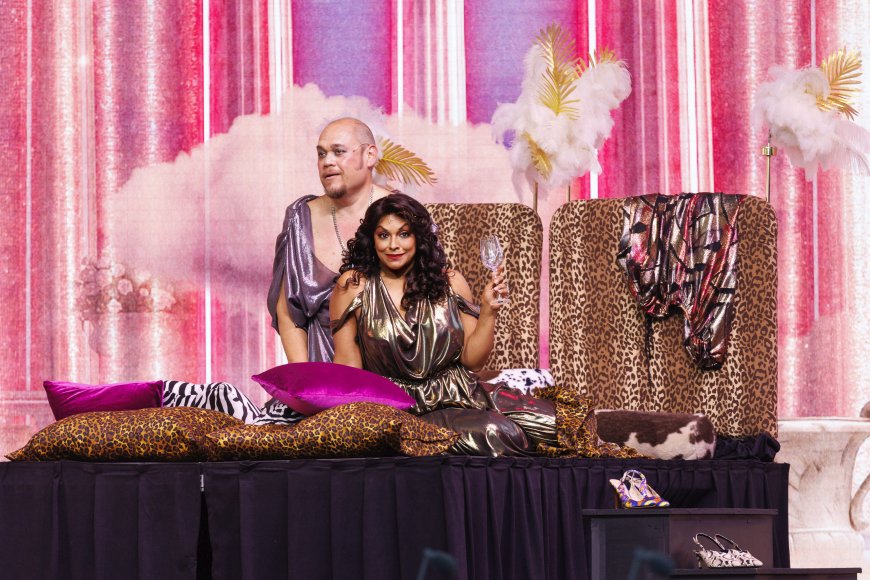
Photo: Drew Altizer Photography
How do you celebrate the fiftieth anniversary of a historic event that changed the course of history? You turn it into an opera, obviously!
That was exactly how Festival Napa Valley celebrated the fiftieth anniversary of The Paris Wine Tasting of 1976, a wine competition held in Paris to commemorate the United States Bicentennial. It subsequently placed California, specifically Napa Valley wines, and New World wines in general on the world map. The one-night event also served as a commission for Festival Napa Valley’s 20th Anniversary Season and as a celebration of the United States Semiquincentennial.
To understand the event’s significance, one needs to look at Napa Valley’s history. After settler George Yount planted the first grapes in Napa Valley in 1839 and Charles Krug opened the first commercial winery in 1861, the wine business boomed at the turn of the 20th century. The double whammy of the root louse phylloxera and the Prohibition era (1920–1933) almost completely decimated the industry, forcing the few remaining wineries to produce sacramental wine for churches. As the region recovered, seven wineries signed a collaborative agreement to form the Napa Valley Vintners Association in 1944, with the goal of producing the best possible wine. That fighting spirit eventually spearheaded the rehabilitation movement, and by the early 1970s, the quality of California wines was outstanding, though there was little recognition worldwide. Among those making great wines at that time were Croatian-American Miljenko “Mike” Grgich, winemaker at Chateau Montelena, and Warren Winiarski, founder and proprietor of Stag’s Leap Wine Cellars, both of whom became characters in the opera.
Around the same time, British wine expert Steven Spurrier, together with his American colleague Patricia Gallagher, established Académie du Vin in 1973, France’s first private wine school intended to teach wine appreciation to expatriate British and American residents in France. Spurrier and Gallagher organized the Judgment of Paris wine tasting in 1973, which compared top Chardonnays from California against top Burgundy whites and outstanding Californian Cabernet Sauvignons against red Bordeaux wines in two separate blind tastings, judged by nine French oenophiles, including Odette Kahn, the outspoken editor of La Revue du vin de France. The event itself received very little coverage at the time; the only reporter to attend was George M. Taber from Time magazine, who subsequently reported the story. Spurrier and Gallagher traveled to California to secure the wines for the tastings, and there they met the last character of the opera, Joanne DePuy, founder of Wine Travel International, who “saved the Judgment of Paris” when Spurrier ran into a problem clearing customs with the bottles of California wines and her wine tour group members brought the bottles along with them individually. In both tastings, California wines, emerged at the top, to the chagrin and outrage of the French wine industry. Kahn famously demanded her scorecard back unsuccessfully (which led to her 11 o’clock number in the opera). The rest is history.
For composer Jake Heggie and his frequent collaborator, librettist Gene Scheer, The Judgment of Paris was an opportunity to do something different, something “fun, silly, and delightful,” as Scheer said in an interview. As with their last collaboration, 2024’s one-act Before It All Goes Dark, the opera took a real situation involving real people, adapted it into operatic idioms, and ultimately gave its creators a new perspective. “The idea of having fun and just entertaining an audience, especially in a summer festival, seemed exactly like what we wanted to do at the time. That’s why it started, and I think what surprised us is how moving and touching the piece turned out to be.”
From the outset, Heggie and Scheer seemed to take a page from Monteverdi’s playbook, framing the opera with gods and goddesses, specifically Bacchus, the god of wine, and Venus, the goddess of love. In this version, Bacchus was a French wine snob who bored Venus with his nonstop imbibing. Venus’s search for something new and exciting to drink set the story in motion, and soon it was clear that the pair was the heart of the opera. Their constant jibes and nonstop bickering provided the audience with many comedic moments, while the real-life characters were treated with respect and dignity (well, maybe except Kahn).
The opera was clearly a labor of love, and both Scheer and Heggie excelled in the piece. It was quintessentially Californian, particularly in the libretto. Scheer’s words were marked by a strong sense of naturalness and were chock-full of wine references that could only come from a study of wine or extensive research on the topic (the opera was supposedly completed in only nine months!). The California scenes with the winemakers were exceptionally tender and hopeful, deeply resonating with the audience, some of whom were winemakers themselves. On the other hand, Heggie’s score was a marvel, as he made a clear delineation between Paris and California scenes. With jazz influences and heavy on percussion, he evoked the distinctly French sounds of Les Six in the Paris scenes, while the grand Americana feel of the California scenes brought to mind Aaron Copland’s works, perfectly coupled with the sunny California landscapes projected on the screen. The central tasting scene unfolded with delightful Rossinian panache that felt fresh and exciting. It was smart, funny, sleek and sparkling – definitely one of the best contemporary comic operas in recent years, made even more memorable by the lack of cross-dressing and mistaken-identity characters!
As with the previous six iterations of the Manetti Shrem Opera Program portion of the festival, including last year’s ebullient La fille du regiment, featuring the Versailles Royal Opera Orchestra, Parisian director Jean-Romain Vesperini returned to direct The Judgment of Paris. He translated the score’s energy and the libretto’s naturalness into a joyful staging that moved swiftly even within the constraints of Festival Napa Valley’s tiny stage. As before, Étienne Guiol’s outstanding videos and projections proved a great asset for denoting locations, whether they were Mount Olympus, Paris, or Napa Valley. Guiol smartly used postcards as transitions, giving a sense of travel in between. Natasha Adorlee’s judicious choreography made full use of the four dancers (on roller skates!) as Venus’s and Kahn’s entourages, while Amanda Gladu dressed everyone in chic costumes worthy of the occasion!
Vesperini’s greatest strength, however, lay in his direction of the singers and pretty much everyone on stage. Rumors had it that they had been practicing for weeks before the performance, and it showed on stage, as everyone moved without hesitation and there was no sense of tentativeness. Furthermore, they all looked like they were having so much fun! It was such a joy to witness the camaraderie on display that night, which elevated the performance.
Festival Napa Valley spared no expense in assembling the who’s who in the opera world to make sure the event was a success. Bay Area native Kent Nagano conducted the orchestra with clarity and vigor, bringing out all the nuances and colors from Heggie’s scores, juggling between the various stylistic depictions that Heggie employed. With a calm and measured demeanor, he moved the proceedings forward without losing track of the big picture. In his hands, the pacing felt just right, from Bacchus & Venus’s romp at Mount Olympus all the way to the choral finale.
As the catalyst of change, Venus, soprano Danielle De Niese fully embodied the goddess through both her voice and acting. Her voice was considerably darker now than during her Cleopatra heyday, but she employed her instrument with elegance to portray a woman (or a goddess) in full control of her desires and ambitions. She also moved gracefully, integrating the choreography into her movements, making her Venus truly formidable on stage. Her aria “I was there” — set against a starry universe – was remarkably warm yet touching in its praise of winemaking as an example of greatness.
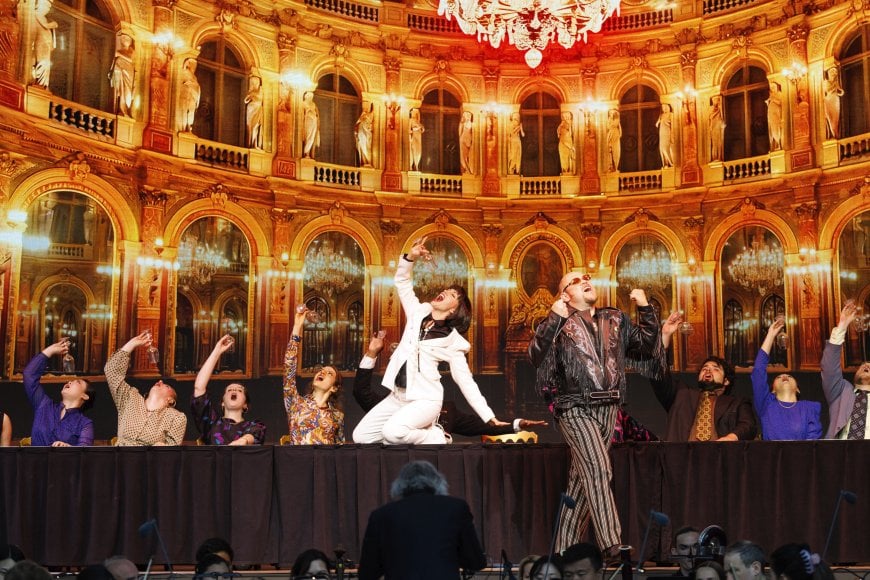
Photo: Drew Altizer Photography
Baritone Quinn Kelsey assumed the role of Bacchus with glee; his booming voice embodied a carefree god who acted with reckless abandon. It’s hard to imagine that many opera houses don’t hire him for more comedic roles, as Kelsey had perfect comic timing; every joke and jab landed squarely, drawing plenty of laughs from the audience. He, however, showed flashes of his “Verdi villain” side when Bacchus tried to influence Kahn to ensure French wines would win the contest!
Tenor Nicholas Phan and mezzo Simone McIntosh made a strong pairing as Spurrier and Gallagher. Their voices complemented each other, and their banter made them believable as the business partners at Académie du Vin. Soprano Brenda Rae, on the other hand, completely stole the scene whenever she appeared as Kahn. Dressed as a cross between Edna Mode and Miranda Priestly, Rae looked and sounded fierce, almost frightening. Her response aria to the tasting results was filled with jaw-dropping coloratura passages, reminiscent of bel canto’s mad scenes (or “Last Midnight” from Into the Woods), which she delivered with exaggerated body language to the audience’s delight. A chorus of 13 people served as the customers and judges, with four of them (Allison Fahey, Trey Fitzgerald, Theodore McAlindon, and Ross Macatangay) also doubling as DePuy, Grgich, Winiarski, and Taber. Fitzgerald and McAlindon’s brief duet as the winemakers was exceptionally touching.
In the interview above, Festival Napa Valley’s Vice President and Director of Artistic Planning, Charles Letourneau, admitted that commissioning this opera was a “massive undertaking.” I, for one, was glad the result exceeded expectations, judging by the overwhelming applause the opera received at the end. Nevertheless, if you have been following the news, you’ll notice that the region (and the wine world in general) is also facing a myriad of crises (from tariffs to dwindling consumer consumption). The piece, particularly the final chorus, serves as a timely reminder to stay hopeful and innovative while not forgetting the tradition in the great art of winemaking. Next April, The Judgment of Paris will be performed at the Royal Opera Versailles, and I am curious how the French audience will react to the work, since it’s so quintessentially Californian. I have a feeling they will enjoy it as much as I did!
-
People: Allison Fahey, Amanda Gladu, Brenda Rae, Danielle De Niese, Étienne Guiol, Gene Scheer, Jake Heggie, Jean-Romain Vesperini, Kent Nagano, Nicholas Phan, Quinn Kelsey, Ross Macatangay, Simone McIntosh, Theodore McAlindon, Trey Fitzgerald
-
Places & Organizations: Festival Napa Valley