Not in Kansas anymore
Christopher Corwin speaks to rising bass-baritone Le Bu about his journey from Yancheng, China to the Met (with a stop in Wichita) and what important roles await him.
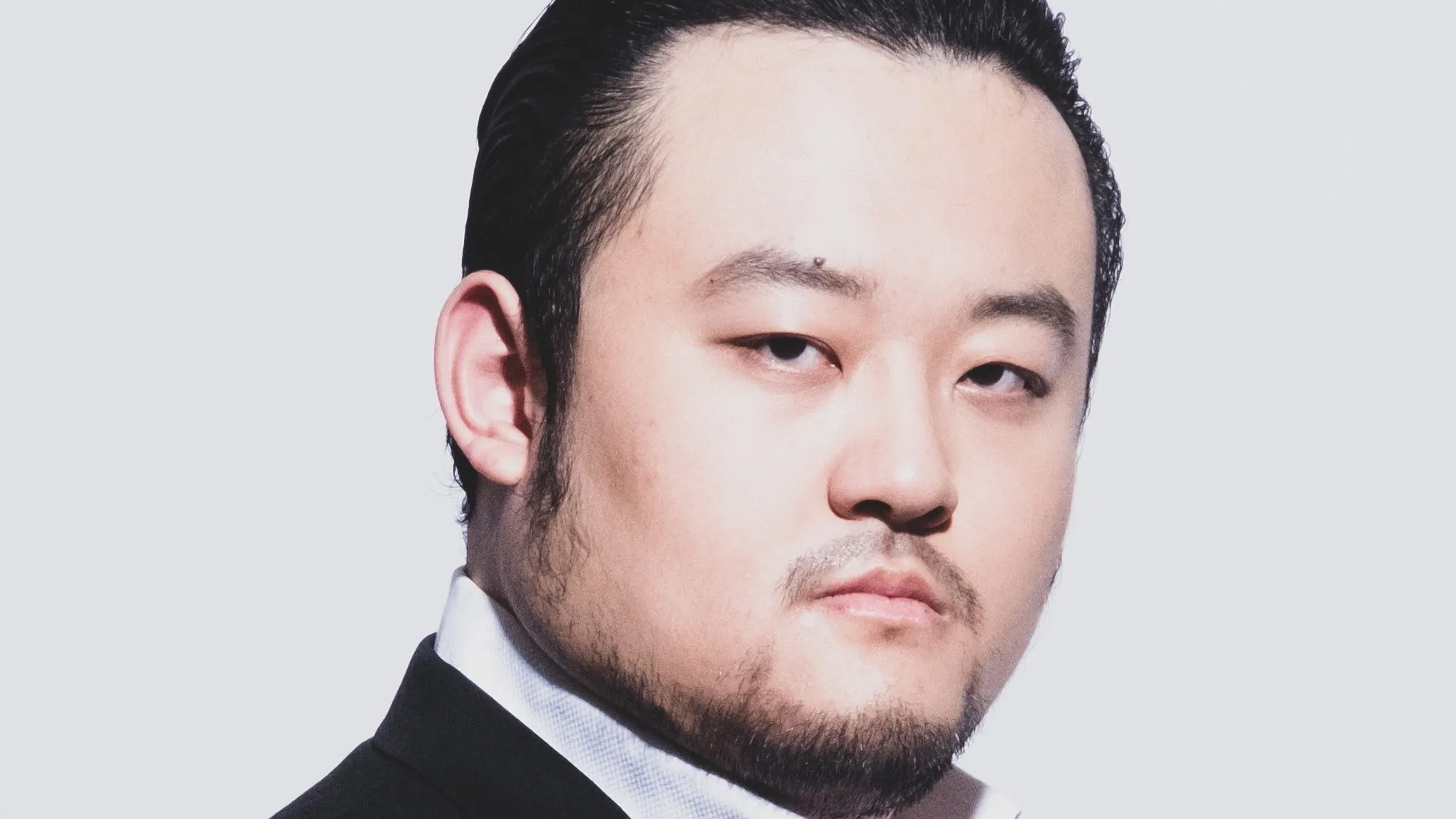
Photo: Dario Acosta
The Metropolitan Opera’s most recent revival of its legendary 1977 Otto Schenk Tannhäuser made headlines worldwide: shouting climate protesters twice halted the season premiere while unfurling banners from the balcony reading ‘No Opera on a Dead Planet!’ The performance eventually continued without further incident from where it was stopped in the midst of the Wartburg Song Contest. While opinions differed about Christian Gerhaher’s debut as Wolfram that evening, many post-performance conversations also involved questions about the virtually unknown young singer who had made such a striking impression as Biterolf. The Met’s program revealed he was Le Bu, a twenty-seven-year-old member of the company’s Lindemann Young Artist Development Program.
Since that November 2023 performance, the Chinese bass-baritone has continued his swift rise to becoming a one of opera’s most promising artists. First noticed in that Biterolf, his affinity for Wagner has dominated the first half of his 2026: following his acclaimed European opera debut as Fasolt in the Salzburg Easter Festival’s new Das Rheingold, he’s currently performing Gunther in the Atlanta Opera’s Gotterdämmerung which will be revived in June 2029 when the company presents the entire Ring.
In between performances as an eloquently noble Speaker in The Magic Flute at the Met last December, Le Bu discussed with me his unusual trajectory from Yancheng, a small (just two million!) town in China’s Jiangsu province to the Met via Wichita, Kansas. Despite his intention to ask the Guiness World Records about staking a claim to be the opera singer with the shortest name, Le Bu shared that he’s become exhausted with questions about his name’s pronunciation and by Starbucks’s repeated failure to get it right. His prescient grandmother named him Le Bu which means both “music” and “happiness” and which also evokes a famed ancient equestrian. Although ordinarily this piece would henceforth refer to him just as Bu, his last name, I’ll call him Le Bu throughout.
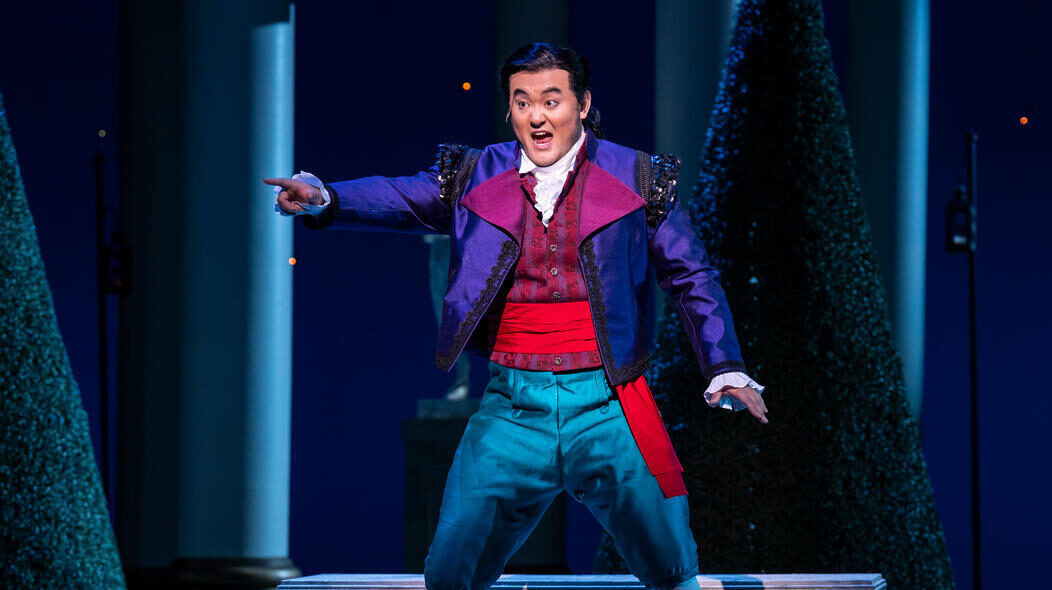
Le Bu as Figaro in The Marriage of Figaro at Washington National Opera /
Photo by Scott Suchman
Despite his name, music didn’t surface importantly in his life until it came time for Le Bu to apply to college. In order to get into the best schools in China, one must excel in at least one specialized subject. Although classical music wasn’t heard much in Yancheng, his mother thought that it would be a good idea if her son took up opera as a way to get into a fine college. After some lessons from a local voice teacher, a friend of his mother who was a soprano and taught at the noted Shanghai Conservatory of Music heard him and opined that he had a good instrument and his goal should be to aim for entrance into a music school rather than a conventional university.
Le Bu was then sent to study with Fugen Wei, a noted Chinese tenor who had spent much of his career in Italy and was “an amazing guy who took great care of me” during six to eight months of intensive study which resulted in his acceptance at the Shanghai Conservatory. However, the summer after high school, Le Bu participated in the iSing International Festival in Suzhou, China, a six-week-long program run by Met bass bass Hao Jiang Tian that brought together twenty of China’s finest young singers with twenty fine singers from the “West.” There he was taught by Met tenor Michael Sylvester who shared, “the first time I heard Le Bu sing, he was barely 19 years old and had been singing for less than a year. When I heard that voice, I remember thinking, ‘This voice is a major international talent.’ It was everything you could want – big, resonant, warm, dramatic, but at the time it was also lacking vocal technique.”
He made such a big impression that Sylvester, Tian and others advised Le Bu to consider coming to the U.S. to further his vocal education and improve his spoken English which is now charmingly fluent, although he admits he continues to rely on ChatGPT: “I just write whatever I want and it will fix my grammar. It’s not terrible anymore.” As he was still so young, Sylvester suggested that rather than try for a major conservatory straight off, he should come instead to Wichita State University where Sylvester continued to teach him: “We worked on his vocal technique. Voices of this caliber need training, but they learn quickly, and Le Bu was no exception. His voice matured, and his technique followed. It was a good situation for him.”
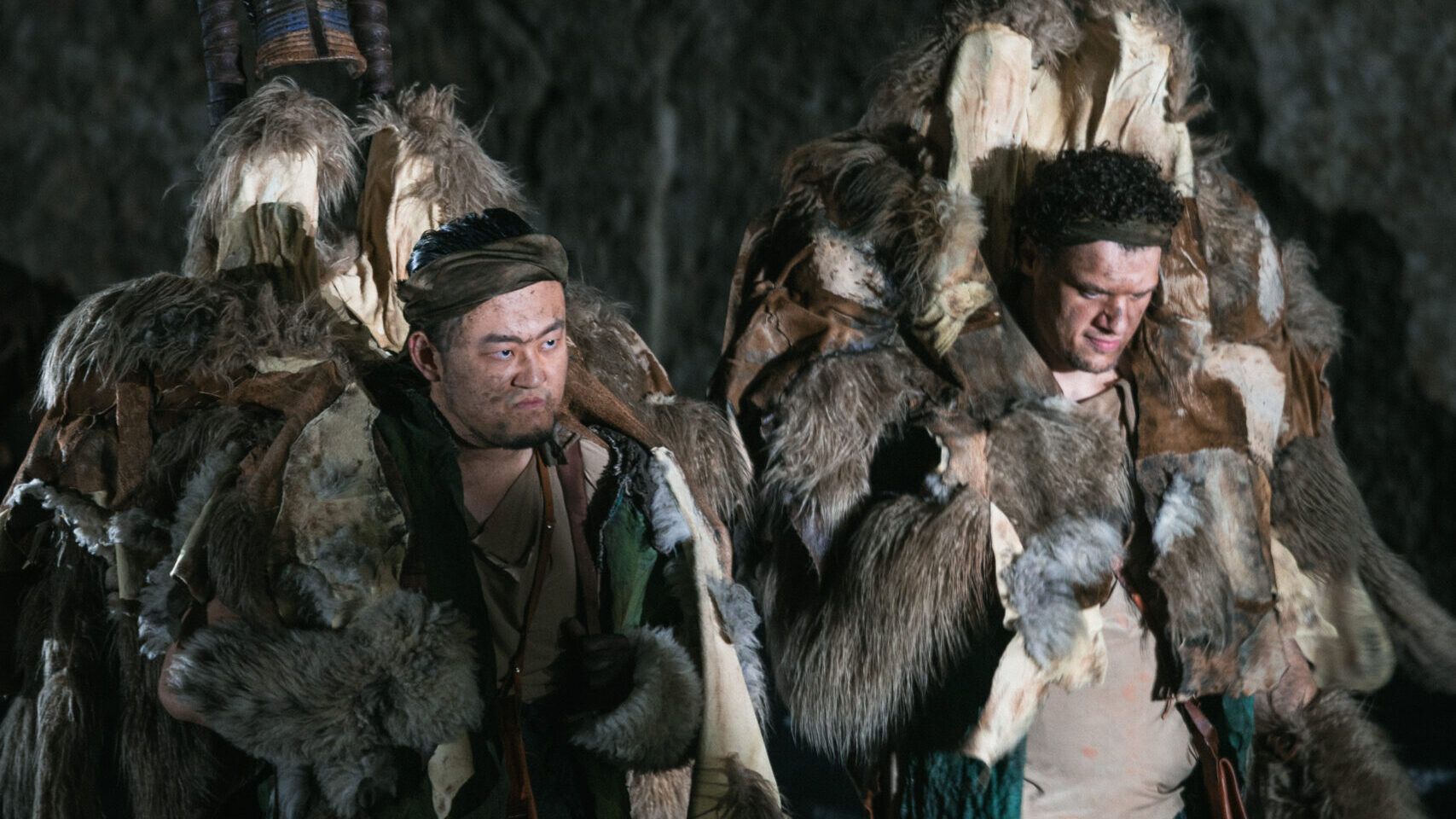
Le Bu and Patrick Guetti as Fasolt and Fafner at the Salzburg Easter Festival / Photo: Frol Podlesnyi
He advanced so quickly that it soon seemed inevitable that the next step should be to visit New York City, a place he still finds “a crazy town,” one he can’t wait to leave but also one he remains drawn to. Though L’elisir d’amore was the first opera he attended and he later bought a very expensive ticket for the Mariinsky’s Pikovaya Dama under Valery Gergiev in Shanghai, Roméo et Juliette at the Met proved his transformative event. The enormously impressive Lincoln Center theater persuaded Le Bu to audition for just one NYC school—the Manhattan School of Music (MSM)—in order to complete his undergraduate degree. He approached his audition with a surprisingly nonchalant attitude: “I’ll try but no big deal if I don’t get in.”
In March of 2019 Le Bu not only sang for MSM (and was accepted) but he also sent a “cold” email to James Morris (one of his idols) asking for a lesson! To his surprise Morris accepted and began a close relationship that continues today: “Le Bu was absolutely one of my very best students, always devouring information, always prepared, and constantly learning his music in record time. It was obvious from his very first lessons that he would have a great career! Beautiful instrument, extremely musical, intelligent, and energetic.”
Thanks to generous support from his family, Le Bu attended MSM (with no student debt!) from 2019 until 2022. However, he spent COVID in China which required him to be awake and prepared at challenging hours in order to abide by the school’s NYC time zone. As things gradually reopened, Le Bu began his journey in the Laffont National Council Auditions process by advancing quickly until he finished as one of the six winners at the 2022 finals where he sang—for the first time on the stage accompanied by the Met orchestra–Kaspar’s aria from Weber’s Der Freischütz and “Vyes’ tabor spit” from Rachmaninoff’s Aleko.
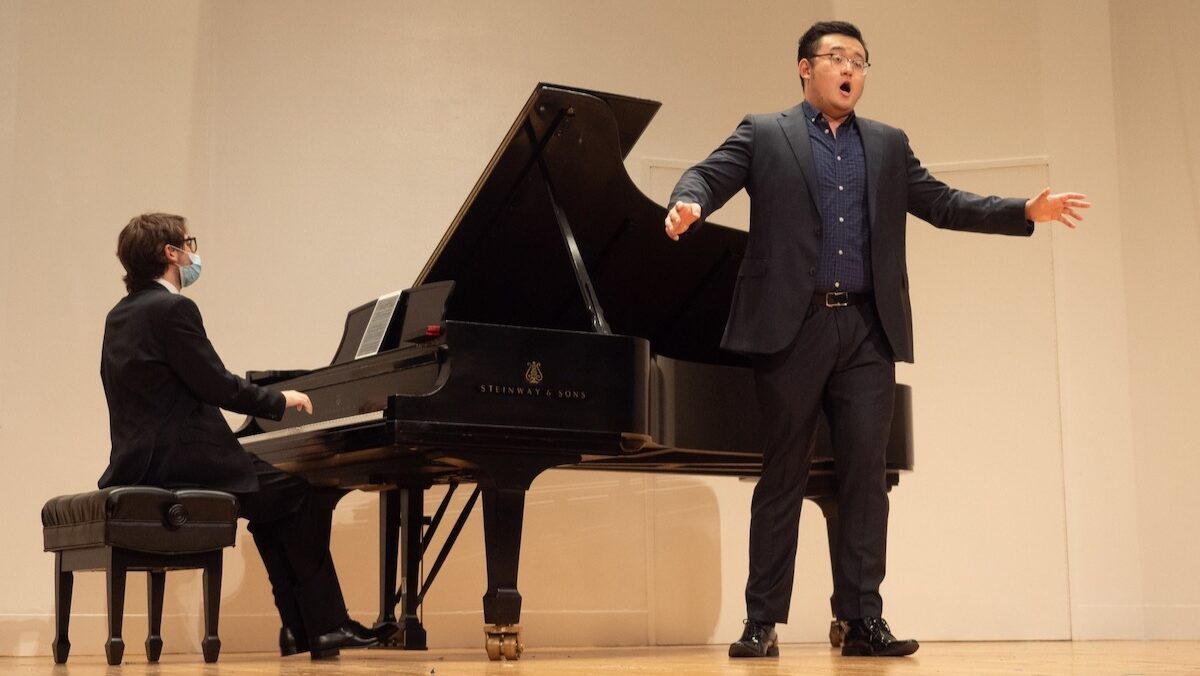
Le Bu in concert at Warren Jones Collaborative Pianist/Vocal Arts recital at MSM / Photo: MSM
Le Bu told me that he absent-mindedly clicked the tab on the Laffont site to signal an interest in auditioning for the Lindeman Young Artists Development Program. In the midst of the Laffont rounds he was offered a time to sing for the Lindeman staff in List Hall, “a terrible hall…so dry and dead there” which only increased his nervousness. A follow-up opportunity to sing was hastily arranged for the next day. When he received an email setting up a phone call for feedback, he felt discouraged only to be astonished when he was offered a slot in the program beginning the fall of the 2022-23 season.
By chance I attended Le Bu’s Met debut in November 2022, but he didn’t make much of an impression as one of eight Flemish deputies in the 4-act Italian revival of Verdi’s Don Carlo. I missed his Magic Flute Guard the following month. However, 2023-24 would prove much more consequential beginning with the High Priest in Nabucco followed by that significant first encounter with Wagner. Biterolf is usually cast with veteran bass-baritones so Le Bu’s casting, in just his second year as a Lindeman artist, was quite unusual. His authoritative portrayal that fraught opening night was so commanding that he instantly landed on my list of rising singers to follow. The following spring his ringing Mandarin opened the season’s run of Turandot and once again made me sit up and take notice.
Le Bu followed up his Laffont triumph with a win in the Giulio Gari Foundation 2023 competition, and he then accepted an invitation to compete in Operalia 2024 to be held in September in Mumbai, India. He submitted his visa application more than three months before the competition but border tensions between India and China meant that his acceptance was delayed and delayed. Though his passport was returned to him, the visa had still not arrived less than a week before the competition, so his manager sought assurances from Operalia that he would have a spot for the 2025 competition. While sitting hugely depressed about the situation at a Met rehearsal three days before the first round, he received word that his visa had been granted.
While he was advised that it would be foolhardy to rush to India and arrive exhausted and jet-lagged, Le Bu instead got “carried away” and hurriedly boarded a plane for Mumbai. Told by competition organizers that he could sing during the first round’s second day, he mulled his musical choices: everyone but Morris was against his including “Die Frist ist um” from Der fliegende Holländer, but he went ahead with it anyway. Though the jury knew of his late arrival, they asked for both the Wagner and “Ella giammai m’amò” from Don Carlo—a demanding twenty minutes of music! Le Bu often mentions how nervous he gets in stressful circumstances, but talent and adrenaline cooperated in Mumbai where he won $45,000 for the overall first prize, as well as the Birgit Nilsson Prize given to singers who exceled at either Wagner or Richard Strauss.
After his Operalia win, he returned to the Met where during his final Lindeman season he moved up to the Speaker in The Magic Flute as well as to another arresting German cameo–the First Nazarene in the company premiere of Claus Guth’s Salome.
The buzz surrounding the bass-baritone has exploded this season. After a “paid vacation” with the Santa Fe Opera performing Monterone in Rigoletto and covering Hunding in Die Walküre, he continued in small roles at the Met—repeating both the Mandarin and the Speaker. However, he then made an important leading role debut with a buoyant Figaro in an outstanding production of Mozart’s Le nozze di Figaro with the Washington National Opera.
He expressed appreciation for being “blessed with a great team” in that Figaro, especially Joélle Harvey, his “so supportive” Susanna. As soon as Magic Flute ended, he traveled to Europe for the very first time to take part in Mahler’s mighty Eighth Symphony with the Berlin Philharmonic under Kirill Petrenko. Prior to Berlin the singer had had just one short work session with Petrenko in New York where he found the conductor “so friendly, calm, quiet.” I watched the electrifying Mahler in mid-January via a Digital Concert Hall livestream and Le Bu stood out for his potent and secure singing as Pater Profundus.
After a trip to China with his fiancée, Le Bu returned to Europe for rehearsals for Das Rheingold, conducted by Petrenko and directed by Kirill Serebrennikov, the first installment of a new Ring which hadn’t been mounted in Salzburg since Herbert von Karajan began the Easter Festival with Walküre in 1967. Le Bu’s presence was definitely noted as just before the Rheingold opening, it was announced that he would share the 50,000-euro 2026 Herbert-von-Karajan-Preis with fellow cast member Jasmin White (Erda) and Konstantin Krimmel who performed Haydn’s Die Schöpfung during the Festival.
After Biterolf, which he described as “having everything a good role need to have,” Le Bu looked forward to Fasolt as his important next step in Wagner as “he’s the only good guy in the opera!” He anticipated encountering unconventional regie productions in Europe; however, he remains enthusiastic about the hyper-realistic Schenk and Zeffirelli stagings that he’s seen or performed in at the Met. If the Met ever retires its current La bohème, he told me that he’d top the highest bidder in order to own Colline’s iconic coat.
Upon returning to the U.S. Le Bu performed his first-ever solo recital for DC Vocal Arts which was appreciatively reviewed on this site. A highlight was the Songs and Dances of Death, which I heard him sing at a Lindemann performance at the Bruno Walter Auditorium. His riveting take on the Mussorgsky prompted me to ask him about any Russian operas that he might have his eye on: Boris Godunov (he’d previously sung bits of Varlaam) and Prince Igor were his swift answers.
He then headed to Atlanta for Gunther (“more of a baritone role than Fasolt”) conducted by Roberto Kalb and directed by Tomer Zvulun. It will be streamed on 5 June, followed on 13 June by a broadcast of the concert Rheingold performed in Berlin by the Salzburg forces directly following the festival.
On the books for an as-yet-undisclosed company in several years, Le Bu will follow up Fasolt and Gunther with his first Dutchman (having covered Daland in Santa Fe in 2023). He’s fascinated with earlier Wagnerians and cited George London as one favorite, but the bass-baritone he listens to most often is Ferdinand Frantz, a German artist whom Le Bu especially admires for his Wotan in the two Furtwängler-led Rings and who died at just 53 in 1959. His encore at the DC recital was, I’m told, a thrillingly expansive “Abendlich strahlt” from Rheingold. Might Le Bu be the Wotan of the 2030s?
He also praised Gerhaher, his Salzburg Wotan, as “such a nice guy” both as a singer and as an especially generous colleague during the Met Tannhaüser run. He was also thrilled to meet and learn from veteran Sir Willard White who portrayed Don Bartolo in the Kennedy Center Figaro production which was the first time his mother saw him on stage, the occasion of her first-ever trip to the U.S. Both Sylvester and Morris also traveled to DC to see Le Bu in his first American leading role.
For next season, he’ll move up to Colline at the Met during its premiere run in September, followed by a debut at the Paris Opéra as Ferrando in Il trovatore. 2027 finds the bass-baritone tackling French opera when he comes to Lyric Opera of Chicago for the first time for Phanuel in concert performances of Massenet’s Hérodiade followed by Sancho in the same composer’s Don Quichotte for Washington Concert Opera teamed with Elizabeth DeShong and Christian Van Horn. Though he’s yet to sung a French role on stage, I heard a private recording of a very impressive musically and linguistically “Elle n’aime pas” from Don Carlos performed with the Met Orchestra conducted by Yannick Nézet-Séguin.
In addition to that eagerly anticipated Dutchman, Le Bu also will be taking on Timur and Oroveso in future seasons. Michael Sylvester confided to me that “There was never any doubt in my mind from the moment I first heard his voice his career would be one that would put him firmly in the top hierarchy of opera singers. He is first and foremost a wonderful human being. Thoughtful, kind, intelligent, genuine, empathetic, and generous. In addition, he possesses an amazing voice and the heart and soul of a true singing artist.”

Christopher Corwin
Christopher Corwin began writing for parterre box in 2011 under the pen name “DeCaffarrelli.” His work has also appeared in , The New York Times, Musical America, The Observer, San Francisco Classical Voice and BAMNotes. Like many, he came to opera via the Saturday Met Opera broadcasts which he began listening to at age 11. His particular enthusiasm is 17th and 18th century opera. Since 2015 he has curated the weekly podcast Trove Thursday on parterre box presenting live recordings.
-
People: Christian Gerhaher, Christian Van Horn, Claus Guth, Elizabeth DeShong, Ferdinand Frantz, Franco Zeffirelli, George London, Hao Jiang Tian, Herbert von Karajan, James Morris, Jasmin White, Joélle Harvey, Kirill Petrenko, Kirill Serebrennikov, Konstantin Krimmel, Le Bu, Michael Sylvester, Otto Schenk, Roberto Kalb, Tomer Zvulun, Wilhelm Furtwängler, Willard white, Yannick Nézet-Séguin
-
Works: Aleko, Boris Godunov, Das Rheingold, Der fliegende Holländer, Der Freischütz, Die Schöpfung, Die Walküre, Die Zauberflöte, Don Carlo, Don Quichotte, Götterdämmerung, Hérodiade, Il trovatore, La bohème, Le nozze di Figaro, Nabucco, Rigoletto, Salome, Tannhäuser, Turandot
-
Places & Organizations: Atlanta Opera, Berlin Philharmonic, Lindemann Young Artist Development Program, Lyric Opera of Chicago, Manhattan School of Music, Metropolitan Opera, Operalia, Paris Opera, Salzburg Easter Festival, Santa Fe Opera, Washington Concert Opera, Washington National Opera