Rosina in bloom
Maria Kataeva makes a promising US debut in an otherwise uneven revival of Il Barbiere di Siviglia in San Francisco.
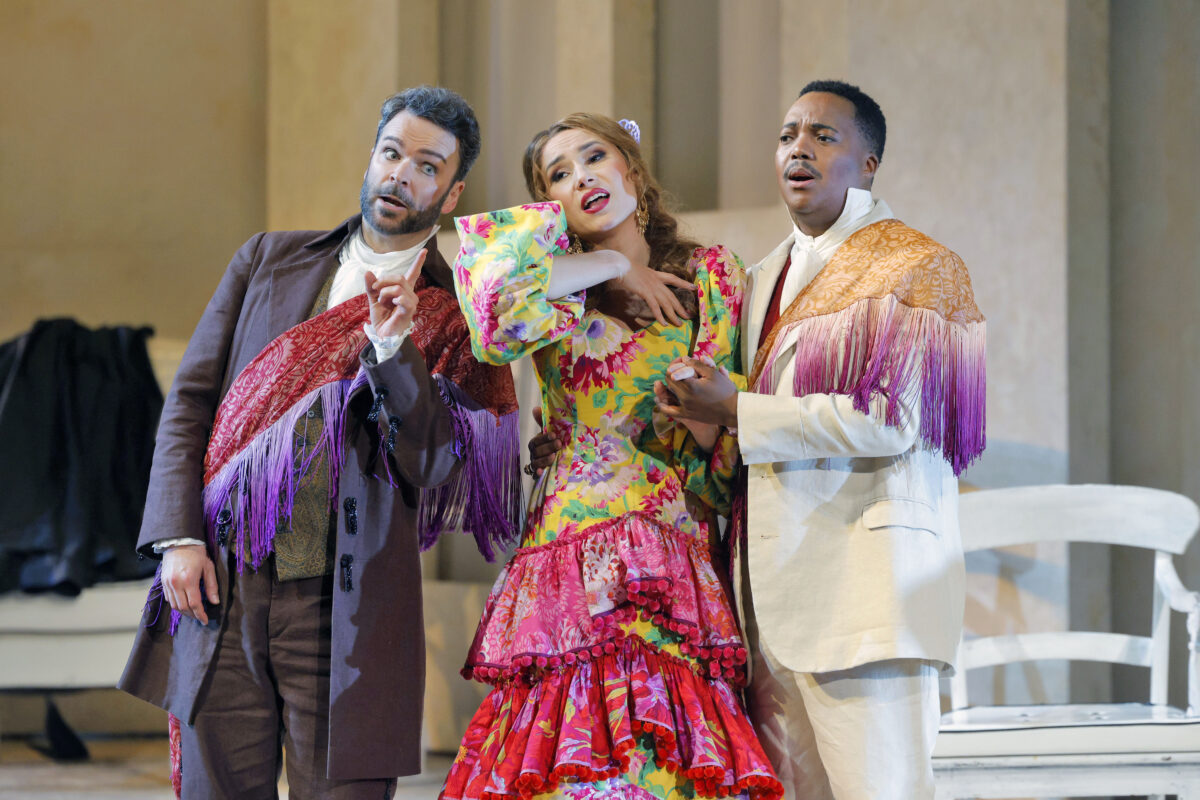
Joshua Hopkins as Figaro, Maria Kataeva as Rosina, and Levy Sekgapane as Count Almaviva in Rossini’s “The Barber of Seville.” Photo: Cory Weaver/San Francisco Opera
Everybody’s favorite barber returned to the War Memorial Opera House on Thursday, May 28, after eleven years (surprise, surprise!), as San Francisco Opera (SFO) dusted off Emilio Sagi’s colorful, flamenco-inspired production to open its 2026 Summer Season. (Those eleven years do not include the 2021 drive-in abridged version, which marked SFO’s return to live performances after the pandemic.)
Il barbiere di Siviglia, Gioachino Rossini’s adaptation of Pierre Beaumarchais‘s French social-criticism play of the same name, with Cesare Sterbini’s Italian libretto, has continued to dazzle operatic audiences around the world since its 1816 premiere. It is widely regarded as the greatest opera buffa and a mainstay of the operatic repertoire. The nonstop string of “hit” arias and ensemble pieces, often used in other media has ensured its continued popularity.
This production of Il barbiere di Siviglia, a co-production with Lithuanian National Opera, was first seen in 2013 and revived in 2015. It was a handsome production, sunny in its disposition and brightly lit (by Gary Marder), staying true to its Seville setting, with nearly all the action taking place outdoors. It was particularly striking for two reasons: the color progression throughout the show, from almost exclusively off-white to a kaleidoscopic range of rainbow colors in Pepa Ojanguren’s costumes for the finale (perfect timing for Pride season), and the incorporation of many flamenco dances during the crowd scenes, particularly in Act I (originally choreographed by Nuria Castejón, here revived by Colm Seery), almost as if suggesting that happiness comes when you embrace color and dance.
As in any other production of Il barbiere di Siviglia, Sagi focused on the physicality of everyone onstage to heighten the comedic quotient. Here, the largely youthful cast proved a great asset, making the evening lively and fun as they committedly performed one trick after another — like falling off the chair, flexing while flirting, even throwing spiderweb-like at the climax of Don Basilio’s “La calunnia” — to the delight of the audience. Llorenç Corbella placed Don Bartolo’s dwelling on a platform diagonally across the stage, and the area below became something of a playground for the commoners (the villagers, the soldiers, etc., including Figaro), a subtle nod to Beaumarchais’s social classes.
Musically speaking, Thursday’s performance got off to a rocky start. From the famous Overture, Benjamin Manis led the orchestra in a rather leisurely reading that failed to take off, particularly in Act I. There were a number of balance issues early on, before Rosina’s arrival. Fortunately, things improved in the second half, giving me hope that the latter performances would be better.
South African tenor Levy Sekgapane made an interesting house debut as Conte Almaviva, a role he had performed numerous times across Europe. His bright, lyrical voice was agile and clear, and his coloratura sounded effortless. Nevertheless, on Thursday, it took him a while to warm up, and he was often drowned out by the orchestra and chorus. Only in Act II did he fully blossom (to the point of almost sounding like a different person), and his delivery of Almaviva’s tour-de-force aria “Cessa di più Resistere” (complete with the cabaletta “Ah, il più lieto”) brought the house down.
Joshua Hopkins assumed the title role with cunning and playfulness, making it clear that he was in it only for the money (as he sang earlier in the first act). Curiously, his Figaro was less boastful than usual (even in the famous “Largo al factotum”) and almost as if he were content playing second fiddle to Conte Almaviva. Such a different take proved rather problematic for me, especially since the opera is, after all, about the barber!
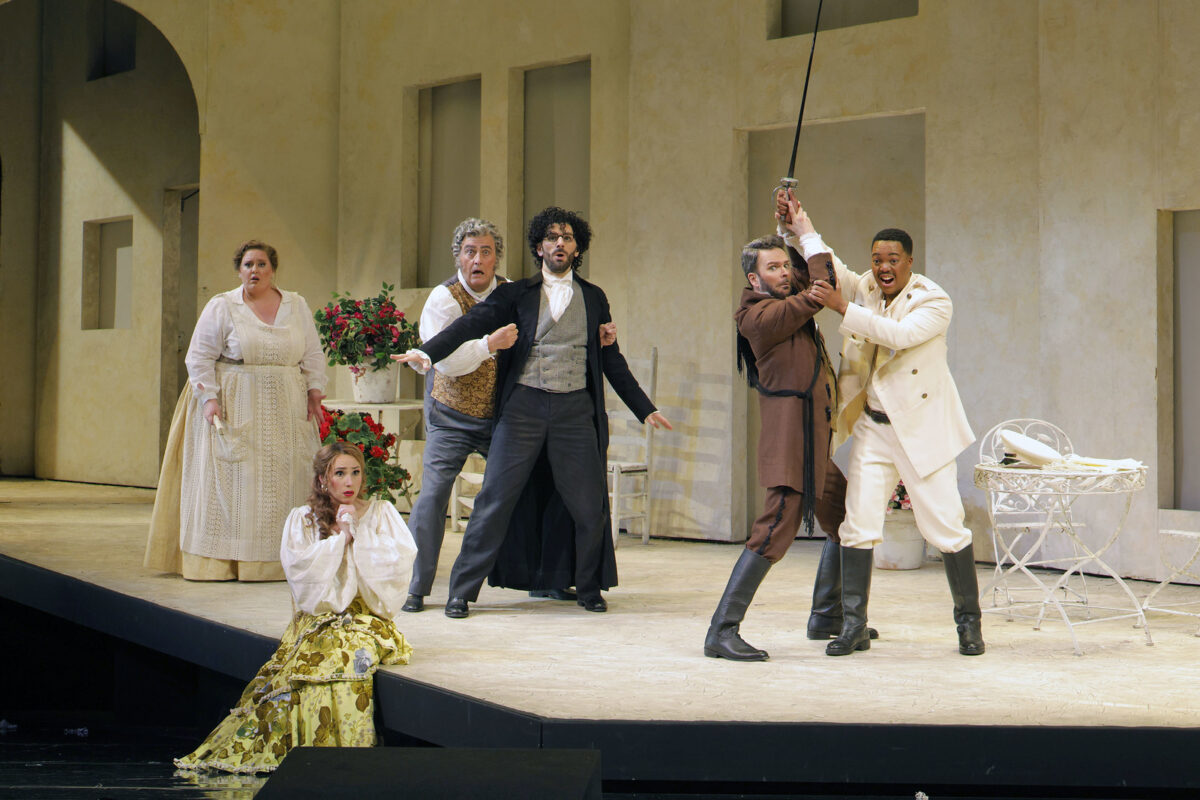
A scene from Rossini’s “The Barber of Seville” with Mary Hoskins as Berta, Maria Kataeva as Rosina, Renato Girolami as Doctor Bartolo, Riccardo Fassi as Don Basilio, Joshua Hopkins as Figaro, and Levy Sekgapane as Count Almaviva. Photo: Cory Weaver/San Francisco Opera
Renato Girolami worked hard as the token “villain” (and laughing stock) of the show, unreservedly throwing himself into various ridiculous situations throughout. Even in such a predicament, his familiarity with the role shone through in his intelligent delivery of “A un dottor della mia sorte,” marked by equal parts pride and delusion. Debuting bass Riccardo Fassi made an underwhelming Don Basilio, with problematic low notes in “La calunnia,” which curiously was performed one whole step lower (in C) here. The comprimario roles were admirably filled by current Adler Fellows, from Mary Hoskins (subbing for an indisposed Catherine Cook) as Berta to Olivier Zerouali, Thomas Kinch, and Gabriel Natal-Baéz as Fiorello, Officer, and Ambrogio, respectively.
To me, the star of the show was undoubtedly Maria Kataeva’s spellbinding Rosina. SFO once again demonstrated its Midas touch by introducing great singers to SF (and US) audiences. With a warm, velvety sound, a well-supported core, and an ease of delivery even in the most difficult coloratura passages, she was a force to be reckoned with, truly a scene-stealer every time she appeared. Even better, she moved with grace, performing little dances here and there to match the dancers onstage, while looking absolutely stunning in various Ojanguren’s flowery dresses. Little wonder she received the loudest applause from the audience!
SFO is presenting Il Barbiere di Siviglia with a double cast; the second cast begins on June 3. The third performance will also be livestreamed on Friday, June 5, at 7:30pm. Additionally, it will be presented as part of the Encounter series as a one-night-only event on June 17, where, after the first act, the audience can join the cast for an immersive opera experience. The Encounter series, now in its fourth season, has proven popular with audiences so far.
-
People: Benjamin Manis, Emilio Sagi, Gabriel Natal-Baéz, Gary Marder, Gioachino Rossini, Joshua Hopkins, Levy Sekgapane, Llorenç Corbella, Maria Kataeva, Mary Hoskins, Olivier Zerouali, Pierre Beaumarchais, Renato Girolami, Ricardo Fassi, Riccardo Massi, Thomas Kinch
-
Works: Idomeneo, Il barbiere di Siviglia
-
Places & Organizations: San Francisco Opera, War Memorial Opera House