Clipped wings
Madama Butterfly at Opera Colorado plays it safe — and never fully takes flight.
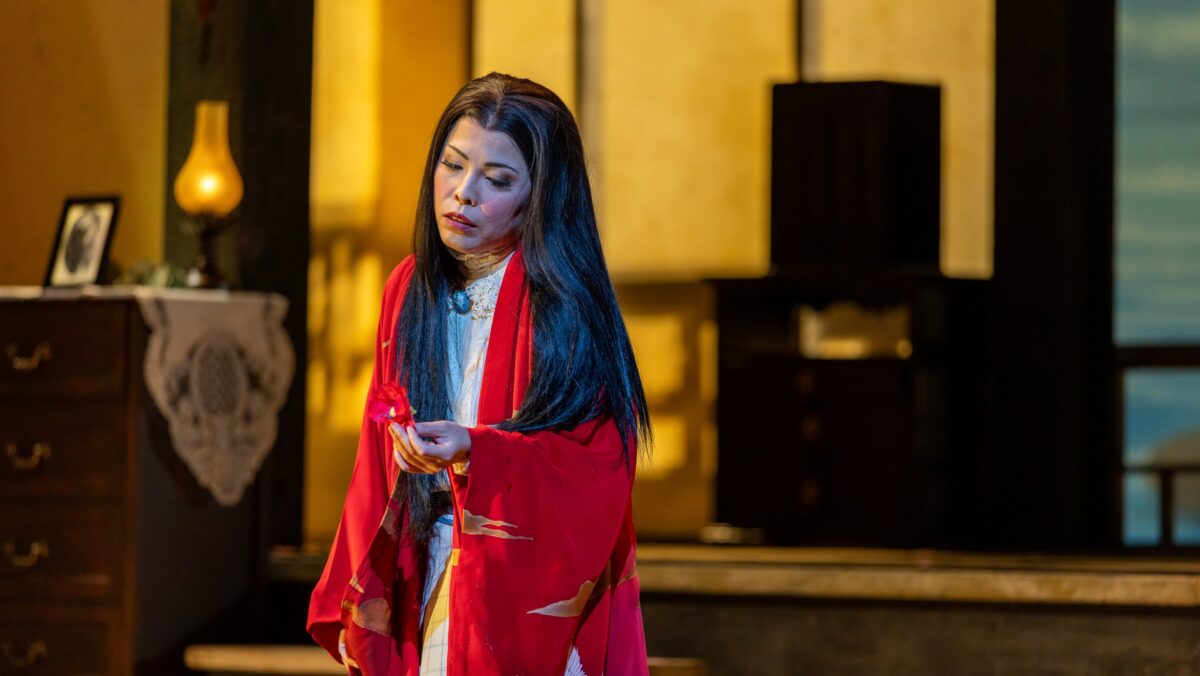
Photo by Matthew Staver
The latest mounting of Puccini’s Madama Butterfly at the Ellie Caulkins Opera House in Denver is less a revival and more an interrogation—a production that seems keenly aware of the weight of its own performance history. For an audience that can hum the scena of every legendary Cio-Cio-San from Destinn to Scotto, director Mo Zhou’s vision offers a refreshing, if intellectually demanding, recalibration of the work’s orientalist scaffolding.
Wait, no, that’s not correct! That’s not the opera I watched! Dammit, Janet!
The latest remounting of Puccini’s Madama Butterfly at the Ellie Caulkins Opera House is a perfectly respectable, middle-of-the-road production that makes no great demands on the audience. Since it is improbable that even 10% of the well-dressed, well-heeled, and well-mannered Coloradoans I met during the opening night would know whether Destinn was a legendary soprano or a local microbrewery specializing in artisanal marmalade beer, it is probably just as well that we’re NOT asked to interrogate colonialism, orientalism, or any -isms at all.
Mo Zhou, making a company debut, is known for a “war brides” regie version of this opera (a reimagined Madama Butterfly set in post-WWII Allied-occupied Japan, according to her bio): I am not quite sure if that is the production we watched. To me, the Opera Colorado version appears to be a traditional production at its most inoffensive. On stage is the flimsy set of interconnected rooms (“liminal spaces”, if you must) inside the little villa that Pinkerton has rented for 999 years, with a footbridge leading to the vast, uncompromising ocean in the backdrop. There are a few accessories – a dresser, cushions, tatamis, a few pictures, and flower petals for the last act. The costumes, too, would not offend even the most conservative opera-goer: a red kimono for Cio-cio-san with a white dress underneath, Pinkerton in his uniform, Suzuki in gun-metal drab apron/coveralls, little Trouble in a smart black and white kimono playing with a toy ship and a stuffed GI plushie. Cio-cio-san’s family would not look out of place in the town of Titipu. Pinkerton’s house-warming guests have quite a few women in Victorian garb, although they were likely his brother officers’ wives, and not his sisters, cousins, and aunts. I wasn’t sure why they joined the Mikado gang in condemning Cio-cio-san for converting to Christianity – surely, they would have rejoiced in it? The American flag is waved a lot, perhaps as an in-joke. There was some laughter from the audience at this, but it might have been a noisy grimace. Who knows, these days?
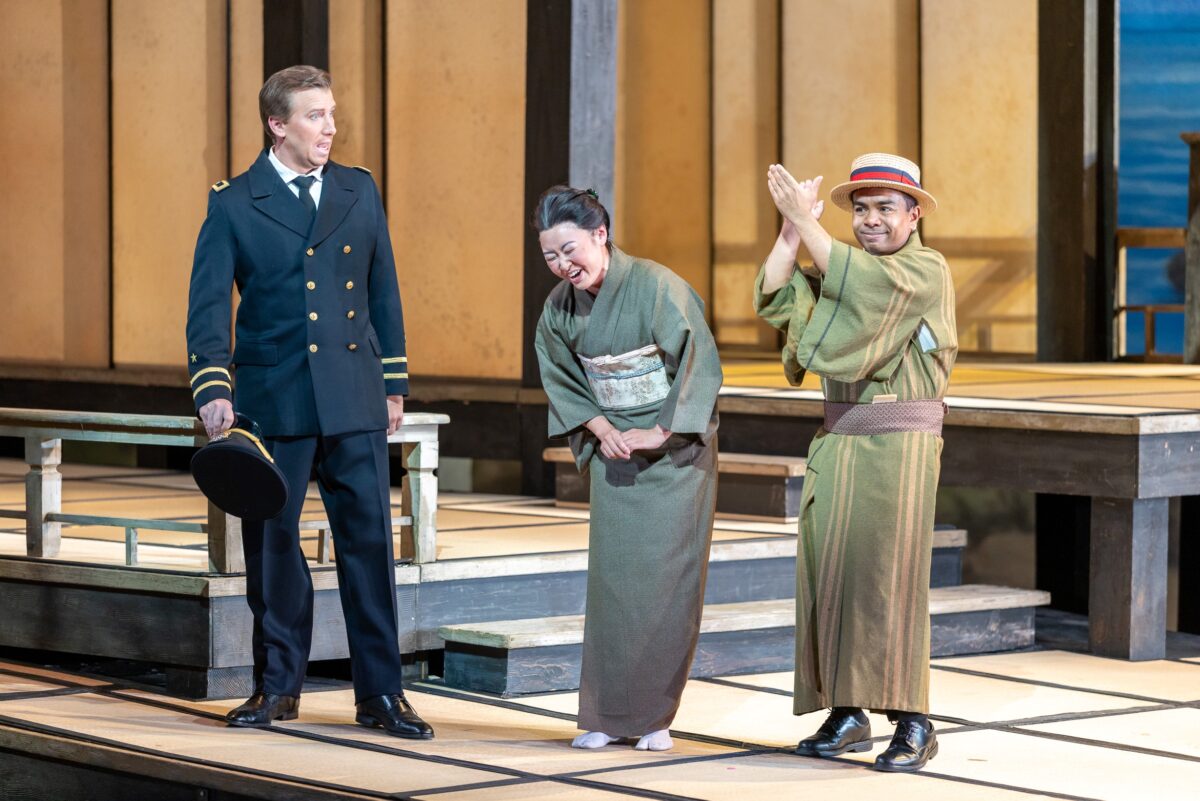
Photo by Matthew Staver
The Chorus and the conductor, Ari Pelto, acquitted themselves well. The tempi were brisk, but not Toscanini-lite. The Chorus sang well and in tune. The blockings were perfectly adequate, although Butterfly’s subservient little crab-walk – historically correct though it may have been – looked painful and unfunny from where I was sitting. I also couldn’t figure out the hair situation for Cio-cio-san: initially, she had an elaborate coiffure, suitable for a 999-year-contract-bride; then, in Act 2, she had a sort of mullet with pigtails, and in the final hara-kiri scene, her hair was long and straight, with a faint touch of J-horror: a pre-death Samara in “Ringu”, if you will. Did she straighten her hair while deciding to off herself? Inquiring minds want to know. (Side-note here: hair IS important in this opera. Just to give one example: in 2009, Ausrine Stundyte’s Butterfly took off her blonde wig before the death scene, reclaiming an identity in death which life and love had forced her to renounce. But that was another country – literally – and besides.)
The smaller roles, too, were sung well, or at the very least, adequately. Martin Bakari was a sly and broadly funny Goro, Young Bok Kim’s Bonze had a slightly more burnished bass than one expects these days, Mason O’Brien sang a dignified Yamadori whose overtures Butterfly should honestly have encouraged, and Jordan McCready was a young and winning Kate Pinkerton, who would likely have done justice to that character’s deleted aria.
I’m honestly a bit spoiled when it comes to Suzuki, because I’ve heard that role sung so well by so many stars in the making, or by excellent comprimarias. Kristen Choi sings it well without leaving her mark on the role. If there was a touch of the South Pacific Bloody Mary belligerence in some of her blocking, it served the role well. Levi Hernandez was a more blokey, bro-y Sharpless than usual – less a figure of authority and more a contemporary of Pinkerton, albeit one who comes to regret his role in the whole sorry affair. It is a nice voice, too.
That leaves us with Joseph Dennis’ Pinkerton and Eri Nakamura’s titular character. Dennis has some “rizz”, and is a good Pinkerton, simultaneously callow and ardent, but there is no suggestion that his Pinkerton comes to regret any of his decisions. This Pinkerton seemed quite okay with dumping the entire mess in someone else’s lap and starting afresh. Dennis also took his mock “booing” at the curtain call quite gamely. He has all the “Puccini tenor” qualities that are appealing in small doses. It would be interesting to see what he sings when he’s bored of playing (fuck)boi-ish lovers.
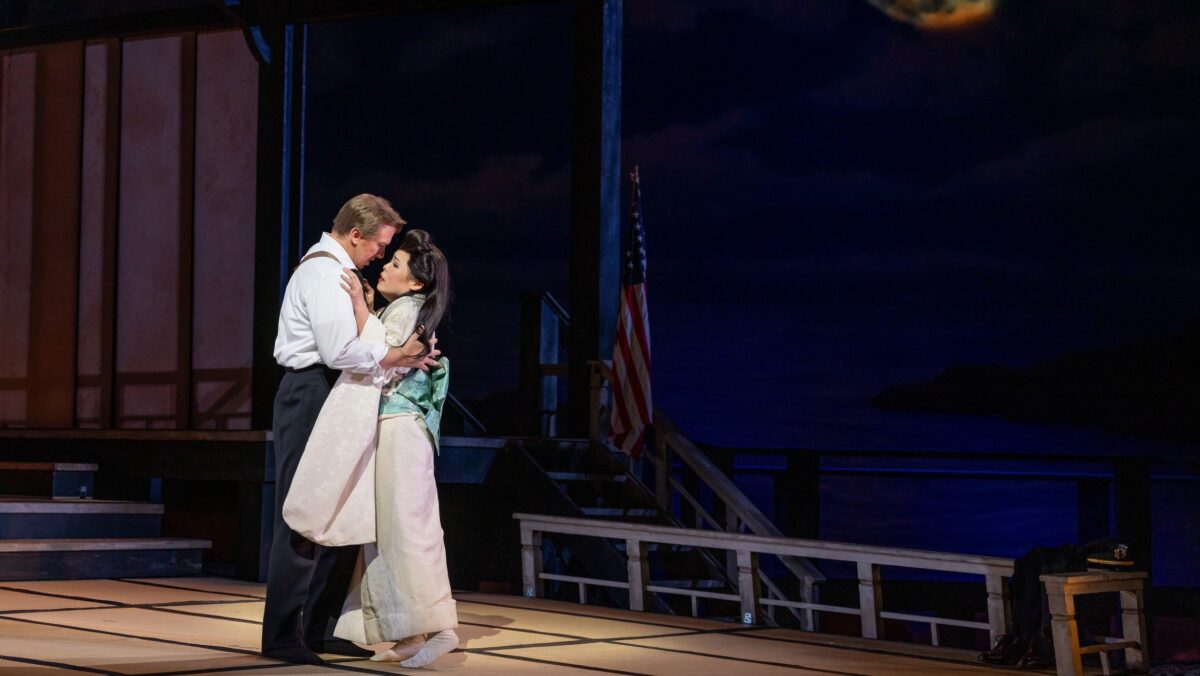
Photo by Matthew Staver
Eri Nakamura, who is already making a name for herself in the lirico-spinto rep, gives me some pause. Put very simply, her Butterfly seemed to be from a different production: she was vocally more assertive, with a wiry, somewhat tense timbre. She wasn’t a little girl in an abusive relationship (à la Toti dal Monte, Victoria de Los Angeles) or a tragic heroine trapped by circumstances (both Renatas). She didn’t have the plushiness or the feathery softness that a traditional Butterfly is often expected to show in her singing. It is a moderately sized instrument with a definite edge, and going through her discography, it isn’t surprising to me that she’s sung Amelia (in Ballo and Simon Boccanegra) as well as the more worldly-wise Puccini heroines (Magda in Rondine, Musetta in Boheme). Don’t get me wrong: she has a nice voice and would, perhaps, be a good (if not great) Butterfly in a production focusing on the limitations of the “little geisha” role that Butterfly internalizes just to survive, even as that façade begins to crack at the end. Unfortunately, that wasn’t the production she found herself in. Her acting, nevertheless, was adequate.
Finally, as an Asian person myself – albeit not Japanese, nor a student of the culture – let me point out the most egregious mistake that this (and many other) productions make in the final scene: the manner of Butterfly’s death. Without going into gory details, men and women are expected to use the knife differently during the ritual suicide, and neither can use it in the way this production demonstrates.
Mo Zhou has said in the past that Madama Butterfly isn’t a love story; it is a survival story, and maybe that is what Opera Colorado is trying to do during these troubled times: to survive by putting on a respectably sung, conventional production of the opera. In that, it succeeds.

Ronnie Banerjee
Ronnie Banerjee is an opera-lover and a scientist. Their very first opera was a Salome at the Leipzig Staatsoper. They are a Canadian researcher with a PhD in nanobiomaterials from Saskatoon, where they worked at the Canadian Light Source (a synchrotron), and occasionally scared personnel there with bad renditions of the confrontation scene from Maria Stuarda. They are presently based in Colorado, and look forward to visiting the Met one day.
-
Topics: Review
-
People: Ari Pelto, Ausrine Stundyte, Eri Nakamura, Eri Nakamura (Cio-Cio-San), Giacomo Puccini, Joseph Dennis, Joseph Dennis (Pinkerton), Kristen Choi, Kristen Choi (Suzuki), Levi Hernandez, Levi Hernandez (Sharpless), Martin Bakari, Mo Zhou
-
Works: La bohème, La rondine, Madama Butterfly, Simon Boccanegra, Un ballo in maschera
-
Places & Organizations: Opera Colorado