‘Tis almost fairy time
Curtis Opera and a charming cast of young singers cast a spell with their beguiling production of Britten‘s A Midsummer Night’s Dream.
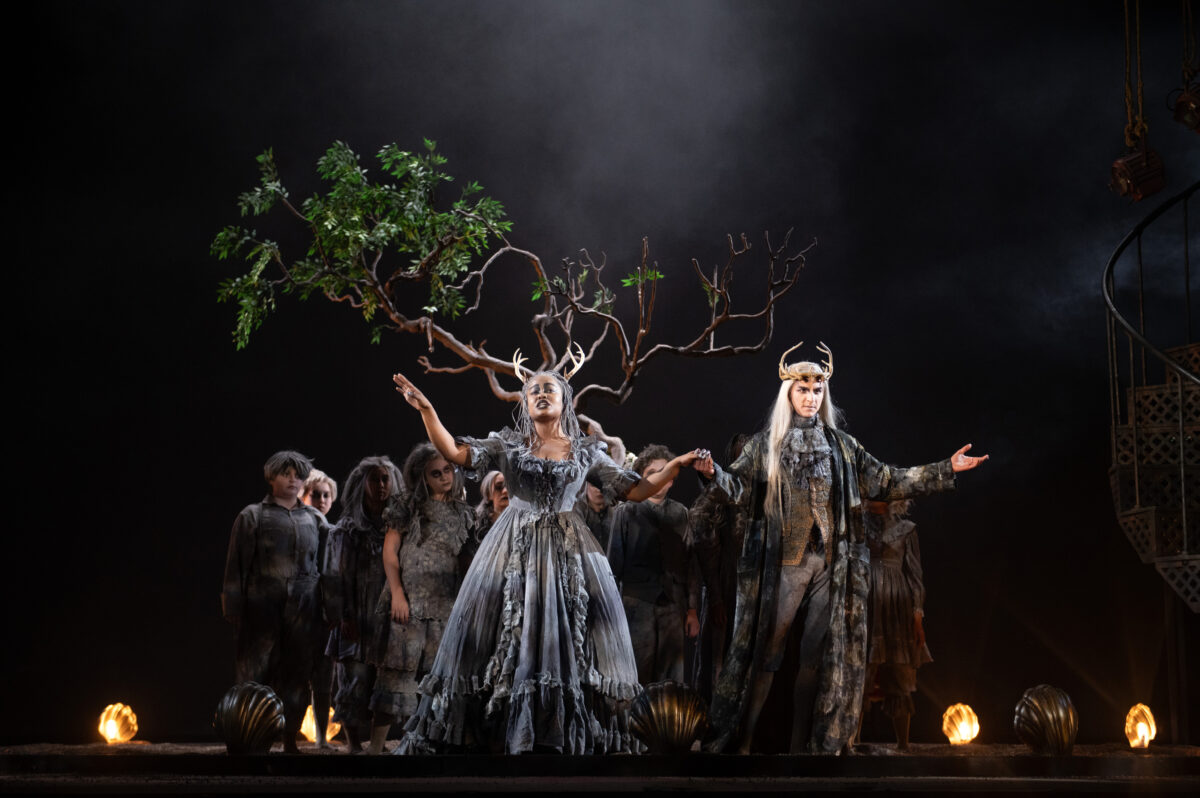
Tytania (Jeysla Rosario Santos), Oberon (Sam Higgins), and the fairies (Philadelphia Youth Choral Ensemble members). Photo by Tracie Van Auken
It begins with a bed. But if you’re thinking, “Well, sure: A Midsummer Night’s Dream is at least in part a sex comedy” — think again.
The bed, seen here at the side of the stage in eerie half-light, is rumpled and uninviting. Set on a severe iron frame, it suggests a grim Victorian boarding house more than anything romantic.
Or perhaps even a period psychological thriller. For in minutes, as a crying baby is heard, from under and around that bed come small, crawling figures. It takes a moment to register, but soon we realize they are children. Looking forlornly Dickensian, they will appear again and again, watching the central action of fighting fairies, bickering mortal couples, and likable but silly townspeople.
In Curtis Opera’s production of Britten’s opera — an absolute knockout both musically and theatrically — the presence of the children sets a tone that, while retaining Shakespeare’s infusions of comedy, leans into a sense of emotionality and poignance over enchantment. There is, of course, a child at the heart of Shakespeare’s play: the changeling baby that fuels tension between Titania and Oberon. But here, in director Sarah Ina Meyer’s beautiful in every way production, we sense that childhood more broadly is at play. Childlike vulnerability is present in everyone.
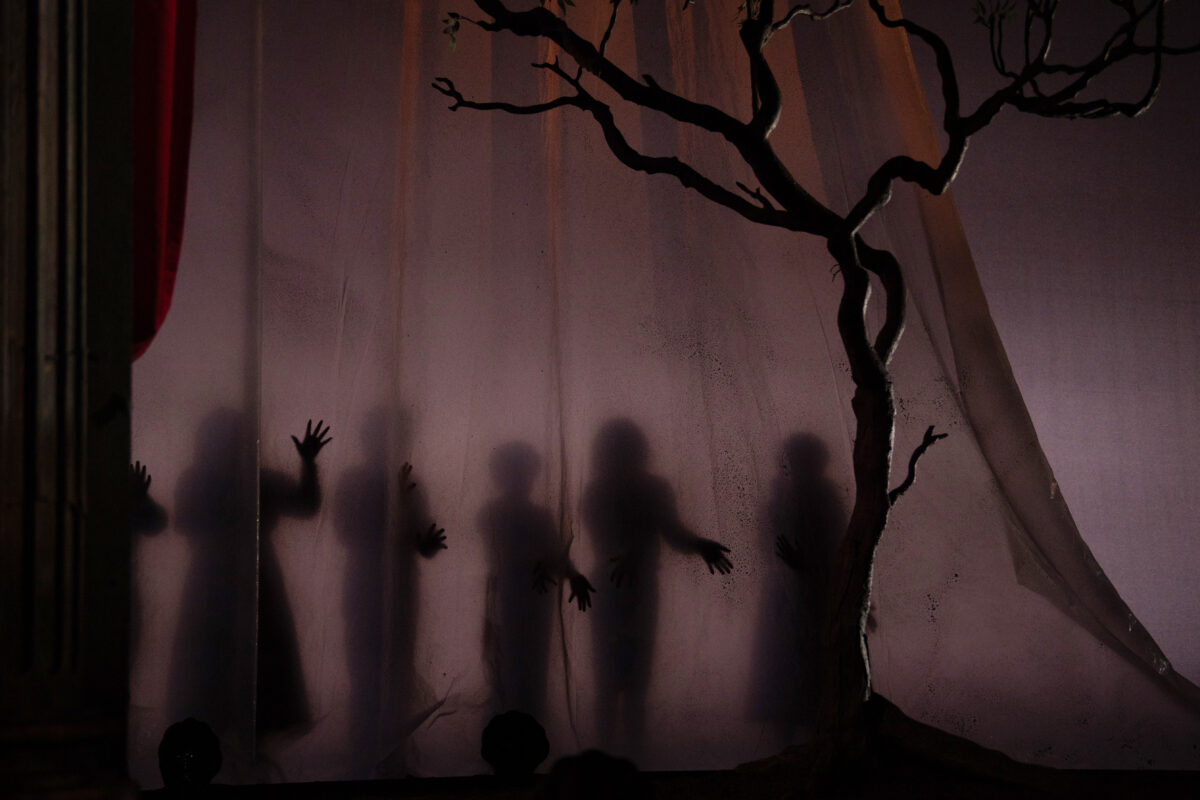
Silhouettes of the fairies (Philadelphia Youth Choral Ensemble members). Photo by Tracie Van Auken
It’s a transformational idea very much right for Britten’s own take on the Shakespeare, which we know from the first notes — lots of slides and glissandos, instantly identifiable as his unique style — will be quirky.
But there’s magic here, to be sure—not least in a sense of cohesiveness that we rarely get to see in opera productions. The visual world deftly mixes periods and styles (scenery is by Cameron Anderson, costumes by Whitney Locher, lighting by Tláloc López-Waterman), but it ultimately has a wonderful unity.
More importantly, every performance here feels fully inhabited and part of this collective world. Curtis Opera may be a training program (albeit one at the highest level), but I doubt any professional opera company could deliver a more committed and compelling performance.
Every Midsummer begins, literally and figuratively, with its Titania and Oberon. As the former, soprano Jeysla Rosario Santos spins the exceptionally difficult musical lines, from arching lyricism to fearsome coloratura, with silvery tone and real artistry, and is a glamorously regal presence. As the latter, Sam Higgins cuts a balletically elegant figure. His beautifully ethereal tone was heard at its loveliest in “I know a bank,” probably the opera’s best-known melody. Occasionally, Higgins’ was swamped by the orchestra, but the general effect was superb—and his countertenor has an unusually strong lower range anchoring his singing.
The young lovers too gave finely polished, ardent performances. Particularly notable were tenor Landy Allen as Lysander, and mezzo Carlyle Quinn as Hermia. Allen has just the kind of lyric tenor with some oomph and purity of tone that is ideally suited to Britten; Quinn’s darkly voluminous mezzo is a star sound in the making. Baritone Emilio Vásquez and soprano Jennifer Robinson both impressed as Demetrius and Helena—good actors, good singers. In the smallish role of Hippolyta, Maisy Parker impressed both for her lovely, soaring mezzo, and her fine comic timing.
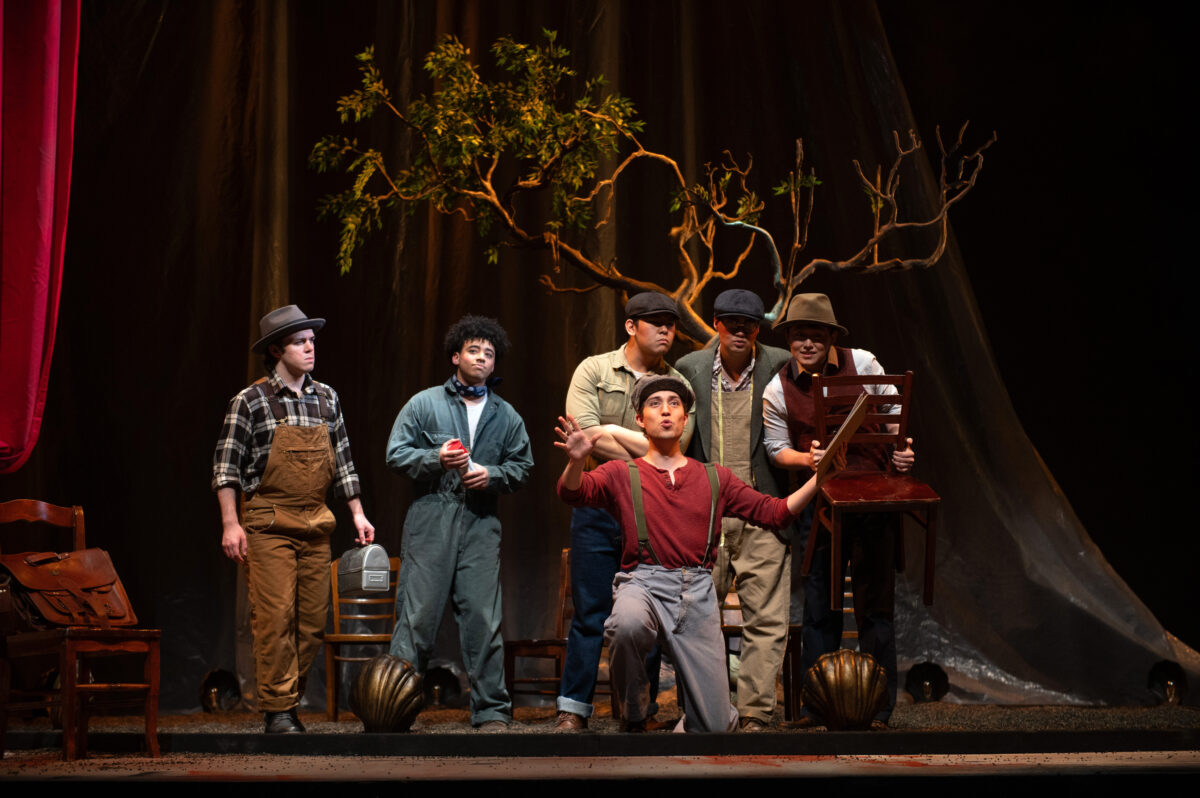
The Rustics: Quince (Sebastian Wittmoser Herrera, kneeling), with (L–R) Snug (Ryan Jester), Snout (Henry Drangel), Bottom (Yulin Yan), Starveling (Ross Macatangay), and Flute (Hongrui Ren). Photo by Tracie Van Auken
Speaking of comedy, there is, of course, the world of the “rude mechanicals” whose presence leavens the action. With one major exception, these are parts notable more for their acting demands than their vocal ones, but the group here delivered on both grounds. They were Sebastian Wittmoser Herrera (Quince), Hongrui Ren (Flute), Ryan Jester (Snug), Henry Drangel (Snout), and Ross Macatangy (Starveling)—charmers all.
Bottom is the exception, of course: it’s a challenging part in every sense. Yulin Yan, with his volcanic, theater-filling bass-baritone and comedic élan, won the day. He should have a big future.
Notable here too were four exceptional soloists from the Philadelphia Youth Choral Ensemble: Cole Nemer, Cody Prail, Mercy Scudder, and Nimi Oguntunde. Children they may be, but they delivered polished performances at a very adult level.
The Curtis Orchestra, under the direction of conductor and alumnus Vinay Parameswaran, led a heroic performance of this exceptionally difficult, virtuosic score. The first night, the brass were occasionally a little off-the-mark — the writing is both complicated and very exposed. By the second performance, it was smoothed out. (Yes, this Midsummer was so good that I went to both.)
Finally, a special shout-out to soprano Maya Mor-Mitrani as Puck. It’s a non-singing role (a few phrases are given a kind of “Sprechstimme” treatment here), usually played by an actor or even a dancer, since athletic prowess is expected. What Mor-Mitrani delivered here is by some margin the best performance of this role I’ve seen in any staging of Shakespeare’s play. Her Puck, with astonishing deft physicality, is both child and adult, elfin and sinister: an absolute tour de force. (Mor-Mitrani gets the final bow here, and it’s fitting.)
Bravi tutti!
-
Topics: benjamin britten, Review
-
People: Cameron Anderson, Carlyle Quinn, Cody Prall, Cole Nemer, Edward Smith, Emilio Vásquez, Henry Drangel, Hongrui Ren, Jennifer Robinson, Jeysla Rosario Santos, Landry Allen, Maisy Parker, Maya Mor-Mitrani, Mercy Scudder, Nimi Oguntunde, Ross Macatangay, Ryan Jester, Sam Higgins, Sebastian Wittmoser Herrera, Tláloc López-Watermann, Yulin Yan
-
Works: A Midsummer Night’s Dream
-
Places & Organizations: Curtis Institute of Music, Curtis Opera