Hustle your bustle
Opera San José‘s La Traviata has all the buzz and energy of a world premiere.
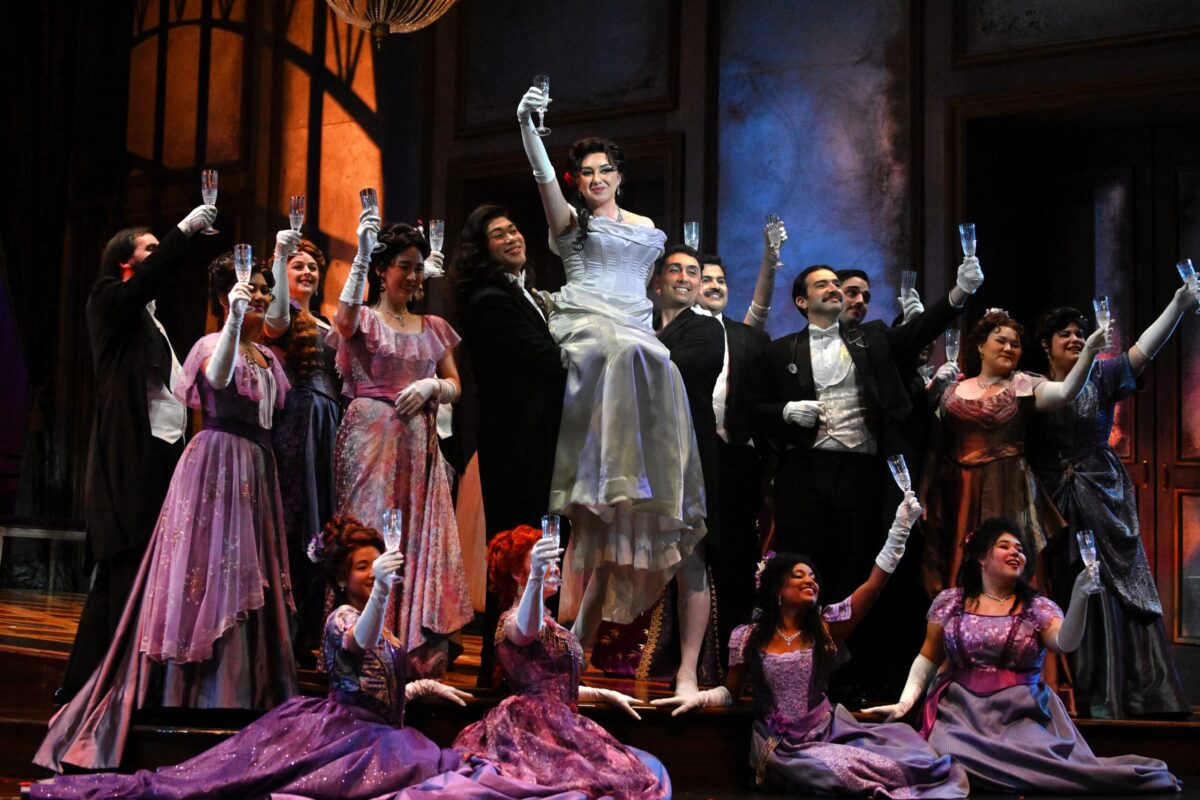
Photo by Dave Lepori
Giuseppe Verdi’s beloved La traviata is generally considered to be the single most-performed opera in the history of this planet. Attending a performance is like going to that restaurant you know is always there when you’re hungry, reliably meeting a need after a long day. Verdi’s score is earnest and tuneful, his characters impetuous and lovable. In the hands of Opera San José last Sunday, it had all the buzz and energy of a world premiere.
The company tends toward the classics, with the occasional foray into less-familiar or riskier works. I’m very intrigued by their season announcement for next year, which includes the first local (and new) production of John Adams’ Doctor Atomic since its world premiere at San Francisco Opera in 2005. That is an A-list arts event of 2027. Last Sunday, it was a largely traditional production of a much-loved work with some reimaginings.
The level of music-making in this Traviata was generally A-list. On the podium was Johannes Löhner, a former resident artist making his main stage debut. Starting with Verdi’s haunting prelude, it was clear that Löhner would give Verdi his due but wouldn’t belabor a score that can easily turn maudlin. I admit to finding the last vestiges of the bel canto style of Vincenzo Bellini and Gaetano Donizetti to be a bit tiresome in Verdi’s middle-period operas like La traviata and Rigoletto. There are many places in the score in which he tries to break free of it (even the opening party scene is much more breathless and fleet than anything Bellini or Donizetti wrote).
Löhner kept things moving enough that Verdi’s clutching onto bel canto clichés didn’t weigh things down. A few brass flubs early on and some coordination issues with the singers (who, to my eyes, did not appear to check in with the conductor too often) are rather standard fare for an opening performance. Löhner did have a tendency to downshift in the softer moments (the Violeta/Alfredo Act 1 duet “Un di felice” became leaden in places). It was a stylistic choice that didn’t cause any particular harm, but slowing things down that much always risks singers jumping a cue. That said, Löhner’s was a confident and capable reading of the score.
The singers clearly came to their assignments with a coltish energy that gave the performance the feel of a new work. Leading the cast was Canadian soprano Mikayla Sager as Violetta. What I can say about her happily is: she’s got the pipes. She’s also about as fearless a Violetta as you’ll see just about anywhere. Hers is a solid lyric soprano with some welcome heft. I was trying to figure out who her voice reminded me of, with its focused (near-flawless) intonation and silvery top. I settled on a young Ghena Dimitrova mixed with a Barbara Frittoli, more lyrical in approach than the former, more flexible than the latter.
Not much seemed to worry her, and it was fun to sit back and not be worried for the singer. Her crowning B-flat in “Libiamo ne’lieti calici” was so confident, I wondered whether she would take the interpolated E-flat later in “Sempre libera” (she didn’t). I was even surprised to hear her shorten some of the higher notes—they sounded so easy. She dispatched “E strano…Sempre libera” like an All-Star basketball player shooting hoops during warm-ups. I could be picky and ask for a bit more definition between notes in the coloratura passages in Act I. And I would have liked acting choices that strayed from the usual grab-bag of Violetta-isms (because Sager is clearly a smart and aware actor). But that’s indeed being picky. All afternoon, she sang the role without any sign of strain. Yet that was also a bit of a problem. While I don’t want a Violetta who coughs through the whole thing and sounds like a simpering windbag, there were moments when some pianissimi were called for that were largely sung mezzo forte or even forte. In the Act III heartbreaker “Addio del passato”, as Violetta is expiring in front of us from tuberculosis, Sager’s fallen courtesan sounds healthier than at the top of the show.
Her Alfredo was the ardent young South Korean tenor WooYoung Yoon, a company artist in residence, clearly put on the path of verismo Italian repertoire. With all the abandon of a flying squirrel, he hurled himself at the role and, like Sager, was afraid of nothing. It works for Alfredo, whose heart leads him. Yoon lists Tamino in The Magic Flute on his resume, and I’d be curious how he approached a role so lyrical and sweet. His Alfredo wore his heart on his sleeve, then put another heart on top of it. With this energy comes a certain tightness, like a coiled spring just waiting to burst forth. I wanted him to loosen up a bit. With that tightness, the voice’s top—a top which has room to spare—gets bright and a bit nasal. What made the opening of Act II (“Lunge da lei”) such a delight was that by sitting on a sofa with his arms spread, in post-coital splendor, his chest expanded up, he was relaxed, and his voice just opened up. He, too, has the pipes.
His father, Germont, was played by South Korean baritone Kidon Choi, yet another singer in the cast with more voice than he ever needed to actually use. Verdi wrote his most gorgeous music in La traviata for Germont. Much has been written about Verdi fathers (and their daughters), and I’m not original for noting that Verdi’s fathers are perhaps his most interesting characters. His Act II aria “Di provenza il mar” is written as a sort of serenade to his son, urging him to recall life before the scurrilous Violetta bewitched him. Returning to Mozart, I wrote in my notes (“Germont should be singing Sarastro”), so big and stentorian was Choi’s sound, the timbre more bass than baritone. Like the others, I wish Choi had embraced a bit more softness and lyricism. Even the relative rigidity of his body only heightened the bigness of the sound. Angry fathers still need the moments of softness, vocally and physically. At the same time, Choi, too, has the pipes, and never once was there a moment of vocal hesitancy or sloppiness.
The supporting roles were handled with uniform solidity. Joanne Evans as Flora offered a lyric mezzo-soprano sound that she didn’t try to darken or age. She played Flora her age, and it worked beautifully. Robert Balonek’s Baron Douphol was a brute without the voice being compromised. A particular standout in the cast was Benjamin Ruiz as Gastone (he sings Alfredo later in the run, and I wish I could hear it). Joseph Calzada was the most endearing and sweet-voiced Doctor Grenvil anywhere.
The production itself was as earnest as the singers. But sometimes with the earnest (and laudable) desire to try things, there are missteps. I would argue the missteps are worth the risk and the possible revelations that risk can offer. Though some are smarter risks than others.
It was a mostly traditional approach to La traviata in Tara Branham’s period production. Erik Flatmo’s design was straightforward, a pan-European drawing room of the 19th century. The forced perspective of the raked set cleverly provided some extra playing space on a shallow stage and added levels that any director would love. The scenic painting of the walls to resemble the corroded mirrors of older French interiors was truly well done. Violetta’s drawing room came complete with a picture window and view of a partially-completed Eiffel Tower (which read more like a silhouette than a realistic view). This gave the set a somewhat jazzy Victor/Victoria vibe that was at odds with the prevailing 19th-century feel.
The half-finished Eiffel Tower dates the setting of Barnham’s production specifically to 1888.
Branham’s choice to move the opera forward is not unusual. Most recently, Opera San José general director Shawna Lucey staged a new production for San Francisco Opera set also in the 1880s. The choice to set it in that period didn’t add or detract from the work.
As the Prelude to Act I begins, we see Violetta sitting pensively by herself, moodily top-lit as a cascade of white then red petals drops onto her as Alfredo looks on, enamored. This choice was an indication of what was to come. It was a moment. It didn’t reveal anything about Violetta or the dynamics of the drama. But it was a clear choice and was certainly a handsome one.
What was more awkward was a ballet pas de deux happening behind the two lovers, which made sense once the party guests slowly and quietly entered as the orchestral prelude concluded. Why the male dancer was shirtless and in a tuxedo jacket with tails, I’m not exactly sure.
When a director sets an opera in a specific year, then they are beholden to that choice. The shirtless ballerino was one of several moments in Act I where anachronisms made for moments that pulled me out of the drama. Branham’s comic approach placed La traviata more in the Rossini canon. When Violetta and Alfredo sing their famous love duet, the party guests scamper to peek in from the doorways, the women on the floor, the men straddling each other. I’m not a fussy purist, but no woman who had spent hours getting ready for a ball at the home of Paris’ most loved and respected courtesan would be crawling around on the floor. On the crowning note of the drinking anthem “Libiamo!” we find Violetta hoisted up precariously on the shoulders of party-goers as if she were Musetta in La bohème (also set in Paris, coincidentally). To take a singer off the floor for a high note is a needless challenge to the singer.
Most unaccountable was Branham’s staging of Violetta’s Act I aria “E strano…Sempre libera”. As the soliloquy opens, Violetta is being undressed by her maid. I say undressed, but this only involved the maid releasing Violetta’s skirt to collapse onto the ground around her feet, leaving her to sing the entire scene in her party dress bodice and stockings with garter belts. That Sager sailed through the aria without flaw was upstaged by this choice that left the singer unnecessarily exposed, literally and figuratively.
Act II was straightforward (though Branham’s staging of Violetta’s maid Annina was again Rossini energy the opera doesn’t need). In a running theme, Barnham’s staging of the more intimate moments was much more effective, so Violetta’s scene with Germont was effective for its simplicity. In the second scene of Act II, the raucous party at Flora Bervoix’s featured a shift from the usual Roma entertainment troupe to a group of Kathak dancers, a form of classical Indian dance. I appreciated this nod to a robust South Asian community in San Jose and a way to connect two classical art forms. Yet it also added an element of orientalism into the opera where none exists. I salute the risk, but the result was an unintentional celebration of cultural voyeurism.
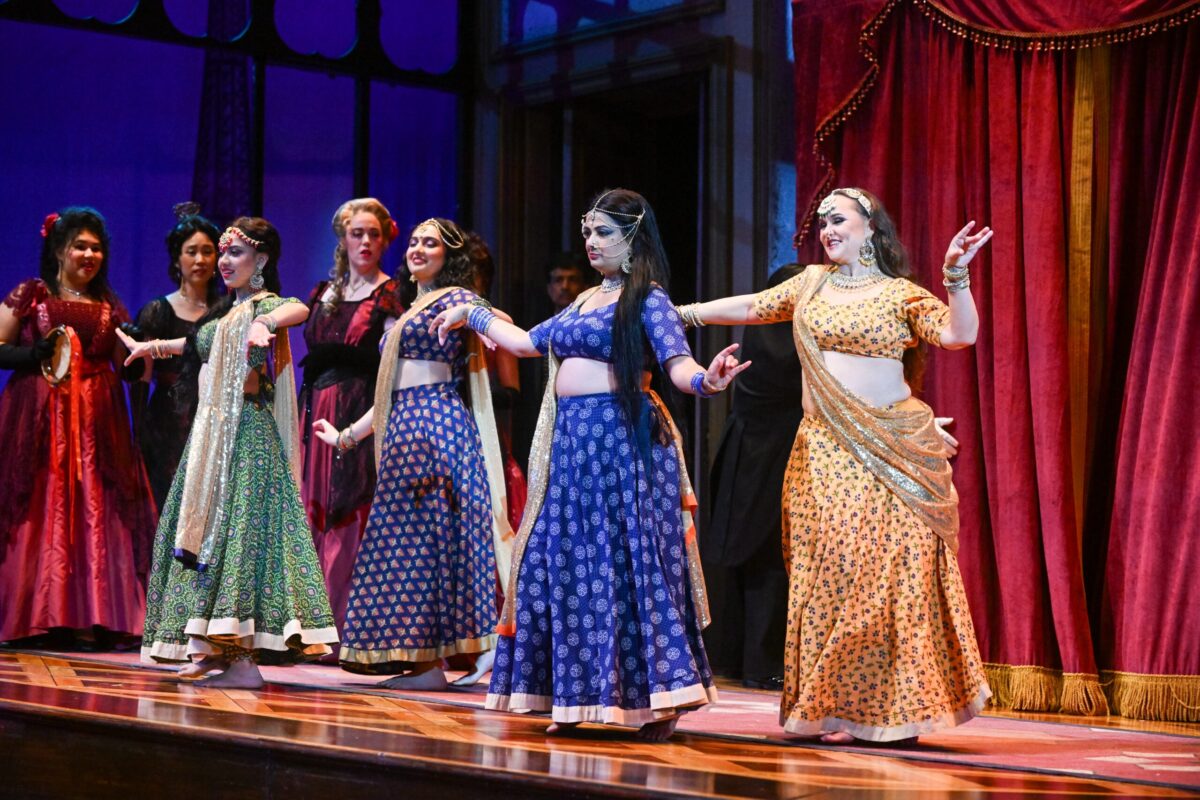
Photo by Dave Lepori
I will always applaud a director who makes choices. It’s just as easy to stage singers and tell them to park-and-bark. Barnham clearly thought about this work. Lazy she was not. Act III saw her strongest work. She created an affecting end for Violetta because she trusted the score and the text to do the storytelling that Verdi did so well. She didn’t get out of the way of the work; she made choices that worked in concert with it. Particularly affecting was her staging of Violetta’s desperate desire to be suddenly cured of tuberculosis by sheer force of will. Because the moment wasn’t trying for something. It was a singer and a director working together. I wanted more of that. In that scene, Mitchell Ost’s lighting was effective (as it was throughout), creating Violetta’s final dawn with eerie accuracy that also complemented the set, creating one of the more beautiful stage pictures I’ve ever seen.
Elizabeth Poindexter’s costume designs nodded at the fashions of 1888, but there were struggles. The women’s dresses had the trademark bustles of the period, all except Violetta for some reason. Violetta’s stark white satin dress (before the skirt was ditched) had the fabric gathered at the waist, ready for the bustle, but without the bustle. The stark white was giving the impression of a wedding dress, and the extra fabric at the waist made for an awkward silhouette. The garter belts and stockings made visible at the end of Act I should never have happened.
In Act II, when Violeta attended another party, Sager was dressed in a deep purple skirt with an off-the-shoulder sequined black bodice with visible straps, sheer gloves, no wrap or covering—a saloon girl better suited to Puccini’s La fanciulla del West. A trend was that the supporting cast looked more luxe than Violetta did. Their dresses were smartly color-blocked. They complemented the set in Act I and provided a burst of color for Flora’s party in Act II. Overall, the menswear fared much better (ironically, much more difficult to get right in just about any production).
I left the California Theatre, glad to hear so confidently sung and conducted an account of La traviata, in a production that earnestly wanted to make some new choices and reinvent some longstanding ones. Here was a cast and director clearly excited to share this work with us, irrespective of the work being an old warhorse trotted out more often than any opera in history. I noted earlier that next year the company will present Doctor Atomic. I was at the world premiere of that opera. A Verdi warhorse, in the hands of Opera San José, had the same buzz and urgency of a world premiere. I guess everything old can truly be new again.
Matthew Travisano
Matthew is a San Francisco-based educator and actor. He has taught and lectured on the performing arts for more than two decades. He has trained a generation of actors in the greater Bay Area at both Oakland School for the Arts and Ruth Asawa School of the Arts, where he has also taught literature, composition, literary theory, and aesthetics. He holds a BA in English from UC Berkeley and a Master's in Teaching (MAT) from San Diego State University.
-
People: Barbara Frittoli, Gaetano Donizetti, Ghena Dimitrova, Giuseppe Verdi, Johannes Löhner, John Adams, Joseph Calzada, Kidon Choi, Mikayla Sager, Robert Balonek, Shawna Lucey, Tara Branham, Vincenzo Bellini, WooYoung Yoon
-
Works: Die Zauberflöte, Doctor Atomic, La bohème, La fanciulla del West, La traviata, Rigoletto
-
Places & Organizations: California Theatre, Opera San Jose, San Francisco Opera