Now sleeps the crimson petal
Gregory Spears’s Sleepers Awake mystifies and delights at Opera Philadelphia.
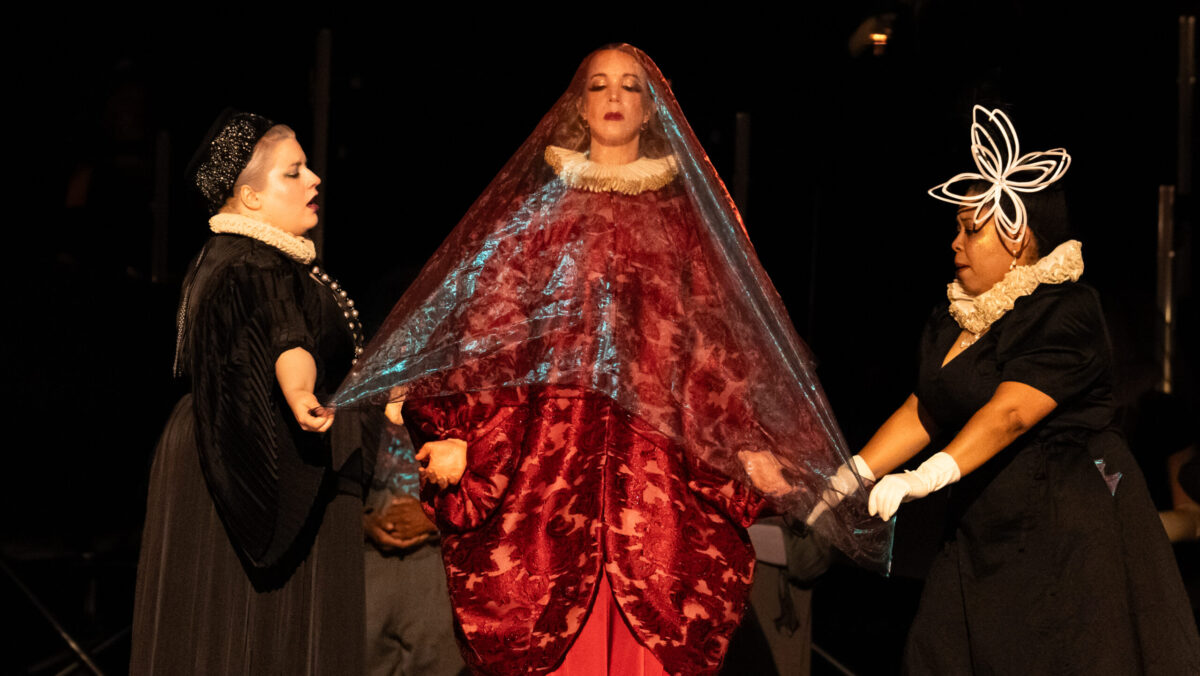
Photo by Jason Ardizzone-West
Once upon a time—not even so long ago—royal weddings were the stuff of modern fairy tales. The nuptials of Elizabeth and Philip, and Rainier and Grace, offered ordinary folks a window into almost unimaginable glamour and luxury… and what seemed at the time the promise of idealized bliss.
And then came Charles and Diana, Andrew and Fergie, Harry and Megan.
So, which is it? Happily ever after? Misery and mess? Something in-between?
That is the question—or at least a question—posed by Gregory Spears’s elliptical, quirky, and often ravishingly beautiful Sleepers Awake.
Lovers of Bach will instantly recognize the title as the English translation of Wachet auf, Cantata BWV 140. That work, too, evokes a marriage—but it is spiritual rather than carnal. Based on the Parable of Virgins, the “groom” is understood to be Christ, the bride an embodiment of faith and devotion. The instruction to “wake” is to open oneself to a life of awareness and devotion.
That Spears’ work is in part an homage to Wachet auf is notable in the musical structure itself. Sleepers Awake may be an opera, but it often sounds as much or more like a cantata. The heavy lifting is done by a chorus (here the excellent Opera Philadelphia Chorus, beautifully blended under the direction of Elizabeth Braden) with individuals often registering less as characters than as fragmented solo voices emerging from the darkness. There is little in the way of conventional action.
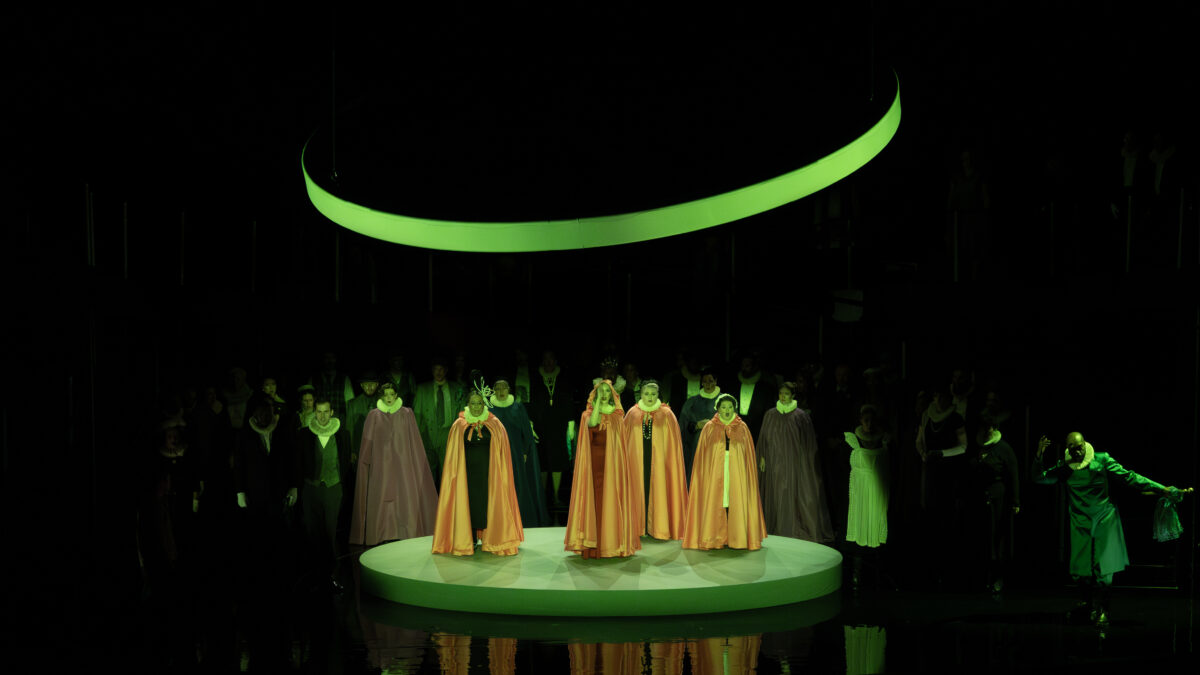
Photo by Jason Ardizzone-West
It’s not till the last section of this uninterrupted, 90 minute work that we have extended solo passages—a kind of aria or arioso for the character of The Stranger (lyric tenor Jonghyun Park, ardent and tonally very beautiful, especially on high) and Thorn Rose (soprano Susanne Burgess, effective vocally and a vivid theatrical presence).
As the character names suggest, there is another thematic overlay here, perhaps more important. Sleepers Awake invokes and riffs on the traditional Sleeping Beauty story, including references to the evil fairy Carabosse, who condemns the Princess to be awakened only through love.
While that theme is central here, Spears (the librettist here as well as the composer) has a trick up his sleeve. Without saying too much, at a point this story becomes less Sleeping Beauty than Turandot. It is the Stranger’s love that seems to be the one clear and positive emotional arc: All the rest is left in more open. The periodic insertions of “Alleluia”—another device slyly borrowed from Bach—feel ironically ambivalent here. Much is cloaked in ambiguity.
What is unambiguous is the wondrous, diaphanous beauty of the orchestral writing. Largely a chamber work, the play of colors is dazzling. (Conductor and company Music Director Corrado Rovaris and the orchestra deliver on all cylinders here. How lucky we are to have them!)
Two specific touches that enchanted me especially. Two harps are positioned at the Philadelphia Academy of Music in stage boxes on opposite sides; on one side, there is also a theorbo. Together, these set up a haunting musical dialogue between old and new.
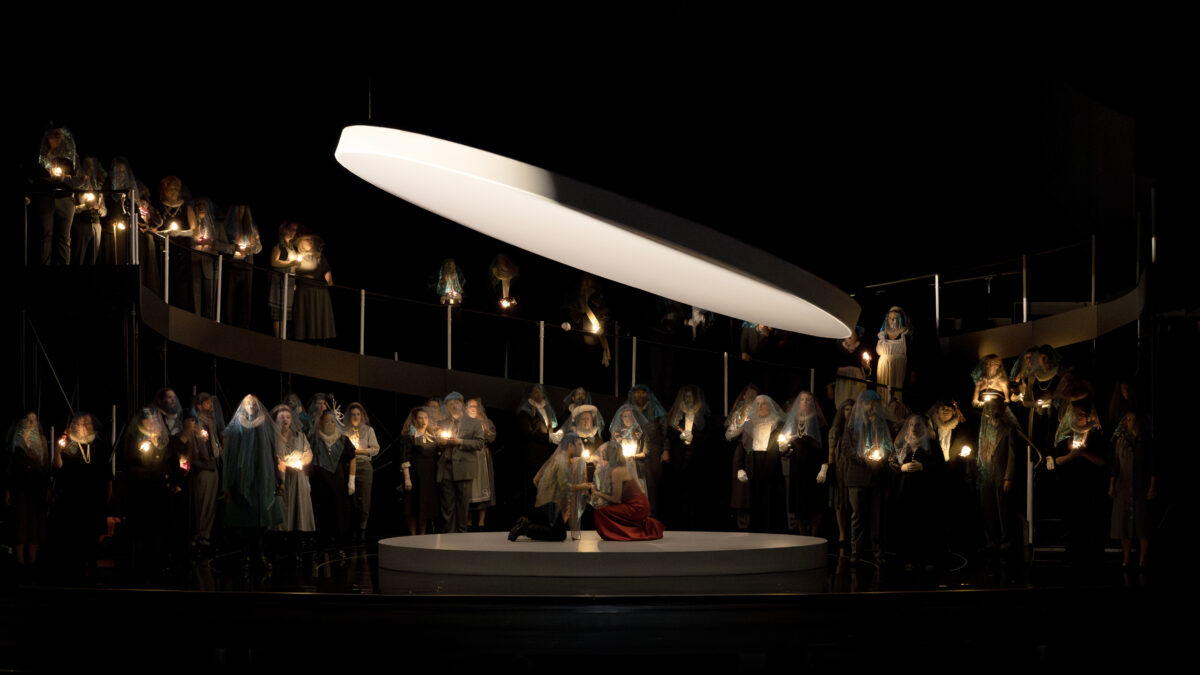
Photo by Jason Ardizzone-West
Another fantastic effect is the insertion of some odd percussion instruments. A slapstick provides a harsh wooden clap—like a ruler banged on a desk—that at unpredictable intervals stops the musical flow for a few seconds. There are also triangles that provide something between a bell and an alarm. (Given what I’ve already written, I doubt I need to point out that these serve significant metaphoric purpose.)
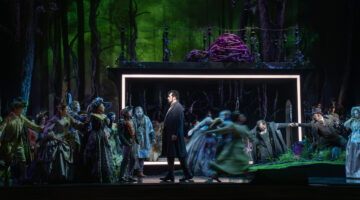
The production, too, reinforces ambiguity. Elegantly curved ramps serve as a kind of onstage choir loft, and both chorus and individual characters are costumed in a mélange of periods. Some Elizabethan ruffs suggest a link to the early origins of the story. A large disc is suspended above, moving to sometimes suggest a force that shapes the action (or what here passes for action). Lovely hand-held lanterns provide mood. Everything is ultra chic, in a way I now associate with Artistic Director Anthony Roth Costanzo, including gauzy veils that sometimes adorn the characters and at other times are removed. (The stage director is Jenny Koons; set, lighting, and costumes are by Jason Ardizzone West, Yuki Link, and Maiko Matsushima respectively.)
Ah, yes—those veils. They, too feel, like a metaphor, but frankly I’m still pondering what specific meaning it has. I guess I’ll sleep on it.
-
Topics: Review
-
People: Anthony Roth Costanzo, Corrado Rovaris, Elizabeth Braden, Gregory Spears, Jason Ardizzone-West, Jonghyun Park, Susanne Burgess, Yuki Link
-
Works: Sleepers Awake, Turandot
-
Places & Organizations: Opera Philadelphia