Heaven, here within my heart
The Chicago Symphony Orchestra explores love and death in an intense, intelligent program featuring soprano Corinne Winters.
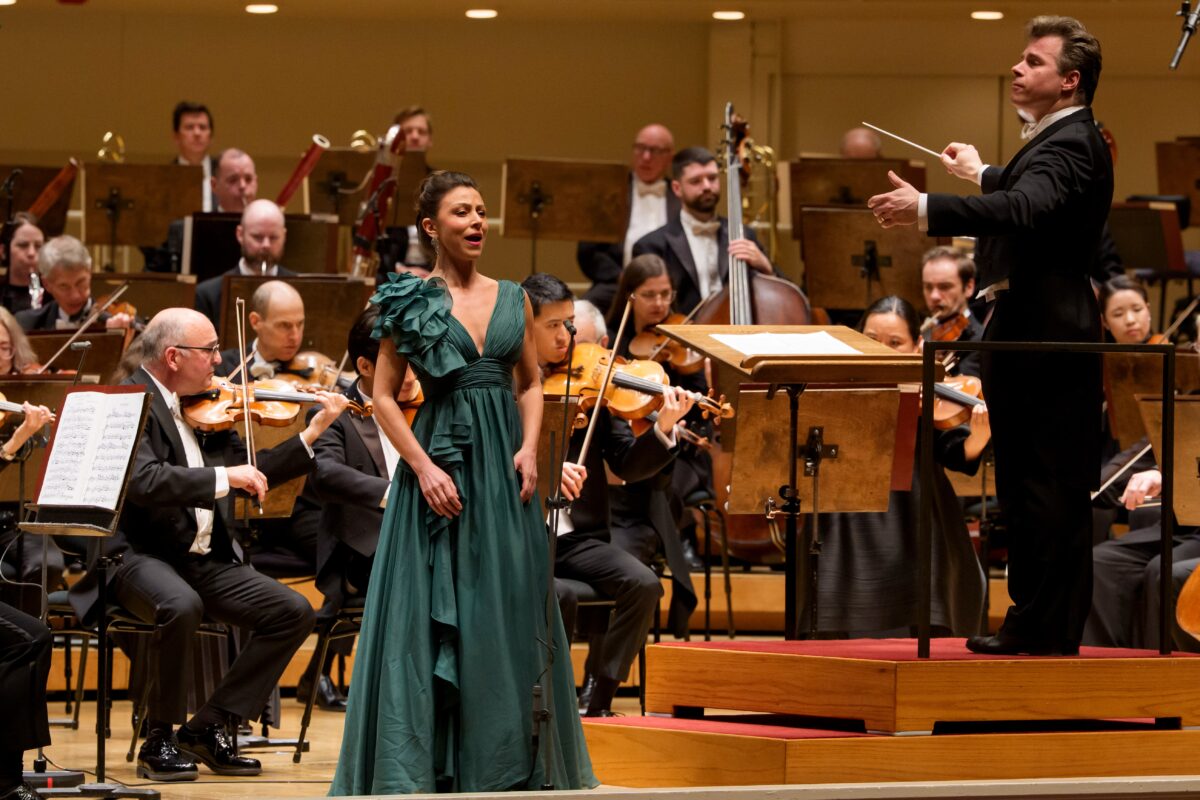
Photo by Todd Rosenberg
A few weeks after Music Director Emeritus Riccardo Muti led the Chicago Symphony Orchestra in a program of Italian opera selections, Royal Opera House Music Director Jakub Hrůša returned to the Windy City with operatic drama of contrasting Slavic and German halves. Billed as “Songs of Love and Farewell,” each piece dealt with the theme of death and reckoning with mortality.
Janáček’s final opera From the House of the Dead drew from Fyodor Dostoevsky’s harrowing tale of a group of inmates in Siberia, a fictionalized version of the Russian author’s own experience in prison. Hrůša is no stranger to the work, having conducted a brilliant double-bill with the contemporaneous Glagolitic Mass with the National Theater Brno in 2022. The concert opened with its brief overture, which Janáček drew from an unfinished Violin Concerto titled “The Pilgrimage of the Little Soul.” Concertmaster Robert Chen produced an unsentimental tone fit for an icy gulag, while Hrůša emphasized the staccato strings to depict the prisoners marching to the sound of the percussion’s rattling chains. As the opening “pilgrimage” theme returned with stratospheric strings and rolling trumpet akin to Janáček’s Sinfonietta, fanfare-like trumpets led by the fantastic Esteban Batallán ended on a note of hope: the score’s epigraph from Dostoevsky reads “In every creature a spark of God.”
Similarly bleak yet more overtly macabre, Rachmaninoff’s tone poem The Isle of the Dead has a special performance history with the CSO, as the composer made his house debut in December 1909 conducting its US premiere. Here Hrůša also opted for a rhythmically driven approach, emphasizing with pronounced dynamic contrast the uneven 2-3 motion like the ghostly boat’s oars as it approaches the titular island in Arnold Böcklin’s famous painting. Hrůša preferred a brisk tempo to build momentum, as the climax lacked somewhat in nuance with the deafening cymbal crash and low brass overpowering the frenzied strings. The mournful violin melody towards the conclusion eschewed a lush tone. Hrůša overall brought out a more rugged playing, as if the unsteady boat in the gothic musical canvas was in tension with an eerily calm water.
The second half of the program was equally somber, though more cathartic. Introspection tinged with nostalgia permeated Strauss’s Four Last Songs, composed in 1947-1948 in the twilight of his career. Corinne Winters, no stranger to these pages, delivered a confident performance of the poetic quartet, performing them in the traditional published sequence of Herman Hesse and Joseph Eichendorff’s texts. This weekend’s performance was the second time Winters has tackled the songs, first performing them with Hrůša and the Bamberg Symphony three years ago. In a CSO interview, Winters noted the songs’ optimism: “they lighten us, because they are so radiant. They are so truthful, and there’s hope in there.” Her performance effectively conveyed this sentiment, even if her soprano fach is generally more aligned with lyrical verismo than the austerity of late Strauss (Winters plans to sing Salome in 2029).
“Im Frühling” demanded much of Winters, navigating Strauss’s awkward vocal lines in the opening measures. While her lower register did not project over the strings, her well-rounded and energetic lyrical fach shone as the song concluded with the “selige Gegenwart” (“blessed presence”) of spring’s love. “September” started briskly, though minor intonation issues impacted the violins’ depiction of cool rain splashing on glistening autumn leaves. Winters portrayed the slowly “müdgewordnen Augen” (“wearied eyes”) with a smart rallentando, a subtle gesture not written explicitly in Strauss’s score but nevertheless apt word painting. In “Beim Schlafengehen,” Winters also drew out the longer phrases, splitting “sehliches” with an audible breath, for example. She conveyed a nice warmth, projecting confidently on “Seele” and “Flügen” — a “soaring soul.”
Balance was, however, a persistent issue in the first three songs. While Orchestra Hall provides a generous acoustic for the CSO’s phenomenal brass section, the stage does not always help singers overcome the orchestral forces. At times, Winters was barely audible over the orchestra, particularly in her lower register, though Hrůša managed to adjust the dynamics more successfully as the songs progressed.
The denouement “Im Abendrot” was justifiably the highlight. Hrůša favored a warm string sound that echoed the intimacy of Strauss’s Intermezzo “Träumerei,” and Chen’s violin solos had a delicate amount of vibrato. Winters’s diction was strongest here, bringing out the -z and -t of “Schlafenszeit” and “Einsamkeit” as the poem’s narrator reflects on the impending sleep and “boundless, silent peace.” The penultimate line “tief im Abendrot” (“deep in the red sunset”) showcased Winter’s impressive dynamic range more strongly than the earlier songs. Hrůša pulled back the orchestra effectively, closing with haunting flutes’ fluttering birdsong over the hushed orchestra — a resigned yet hopeful tranquility.
Without a five-hour buildup, the Prelude and “Liebestod” from Wagner’s Tristan und Isolde can risk failing to live up to its maximum intoxicating effect. While Wagner himself had conducted the two excerpts before the opera’s full 1865 staged premiere, concert performances can come across as somewhat mundane compared to the full epic drama. Yet Hrůša and the CSO delivered a performance of proper intensity. Here, the programmed Rachmaninoff-Wagner pairing also brought out connections between the two works, each of which depicted a seafaring journey towards death. The fortissimo death blows, followed by a sudden decrescendo towards the end of the Russian symphonic poem, echoed the escalation and rapid decline in Wagner’s prelude — perhaps Isolde leaving Ireland and Böcklin’s ghostly figure can be seen as parallel maritime tableaux. In the “Liebestod,” Hrůša gestured with assured undulating motions as the orchestra built up towards its final resolution (there was no need for the artificial sounds of waves which plagued Yuval Sharon’s Met production).
At around 70 minutes of music, one would have wished for the program to be slightly longer. For example, František Jílek’s 20-minute From the House of the Dead arrangement or Peter Breiner’s excellent 35-minute suite — featuring a rousing brass chorale for the prisoners’ cries of “freedom” — or the Tristan Act 3 Prelude or some of the Act 2 “Nachtgesang” would not have altered the program’s smart symmetry.
Nevertheless, the thoughtful program was a particular success. This type of pairing is an encouraging way to present canonical composers — Hrůša and the CSO showcased the potential for innovation without resorting to gimmicks.
Montagu James
Montagu James is a PhD student at Brown University studying modern European political and cultural history. He also enjoys composing and conducting.
-
People: Chicago Symphony Orchestra, Corinne Winters, Jakub Hr?ša, Leoš Janá?ek, Riccardo Muti, Richard Strauss, Richard Wagner, Sergei Rachmaninoff, Yuval Sharon
-
Works: Four Last Songs, From the House of the Dead, Glagolitic Mass, Salome, Sinfonietta, Tristan und Isolde
-
Places & Organizations: Chicago Symphony Orchestra, Metropolitan Opera, Royal Ballet and Opera