Photo: Karen Almond / Met Opera
I walked away from Kaija Saariaho’s final opera, and her second to be performed at the Metropolitan Opera, feeling two kinds of heartbreak: sorrow at the suffering of its characters, and sorrow that the composer of Innocence, who died in 2023, will never get the chance to write another.
Her L’Amour de loin was staged at the Met a few years ago, in a technologically inventive but unattractively designed production by Robert LePage. It dared to ask the question: what if Tristan und Isolde were an even less eventful, and even more musically atmospheric, tale of unrequited love? A sonically intoxicating piece, L’Amour takes place in a remote past, with characters from a realm of pure mythic archetype, and is written in a style blending a palette of rich, lovely musical colors with compelling vocal lyricism.
And color, above all, is central to Saariaho’s musical language. She studied with the so-called “spectralist” school, who developed techniques for using spectral analysis as a tool for synthesizing new sounds from combinations of acoustic instruments, or from electroacoustic sources. Never a dogmatic spectralist, she nevertheless internalized both their acoustic discoveries and their use of color as a structural element, at least equal to—and also blending into—such elements as harmony and melody.
Innocence begins with a heavy sonic atmosphere with swirls of dark, low orchestral color, then giving way to mysterious melodic material passed around from instrument, all reminiscent of Saariaho’s earlier work. But occasionally startling elements bubble to the surface—wait, is that a pop beat?—that signal to the audience that Saariaho’s final opera inhabits a different universe from her first.
Innocence takes place in our moment, in our world, and as such its palette tentatively embraces sounds from outside the operatic tradition. You’ve probably heard that it’s an opera about a fictional school shooting, but the school isn’t an all-American Columbine or Sandy Hook. It’s an international school, a microcosm of the globe, and the first vocals we hear aren’t an operatic soprano or tenor but the voices of students from around the world, reflecting in their own languages on “the tragedy” (as they call it) that took place a decade ago. For the most part, the students aren’t singers at all, but actors and movement artists, haunting the set to reflect upon and then reenact the day that destroyed their lives.
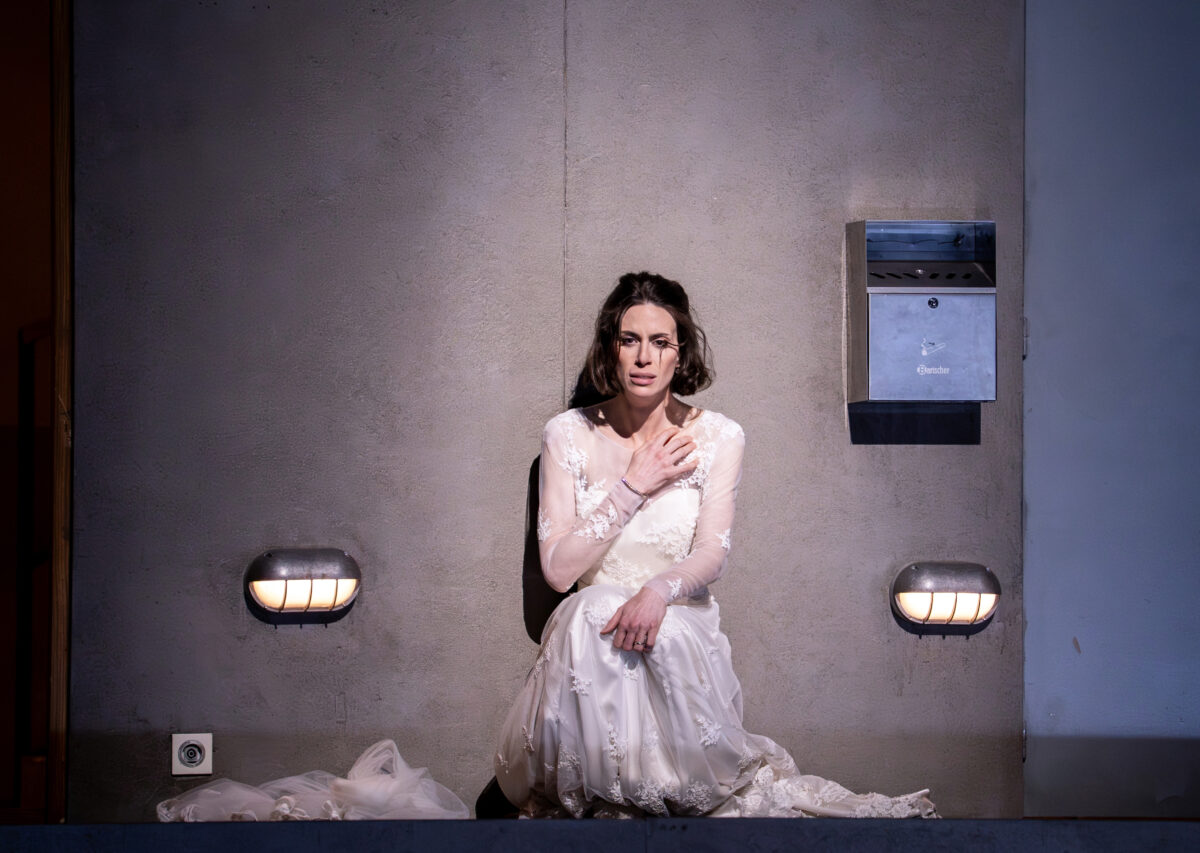
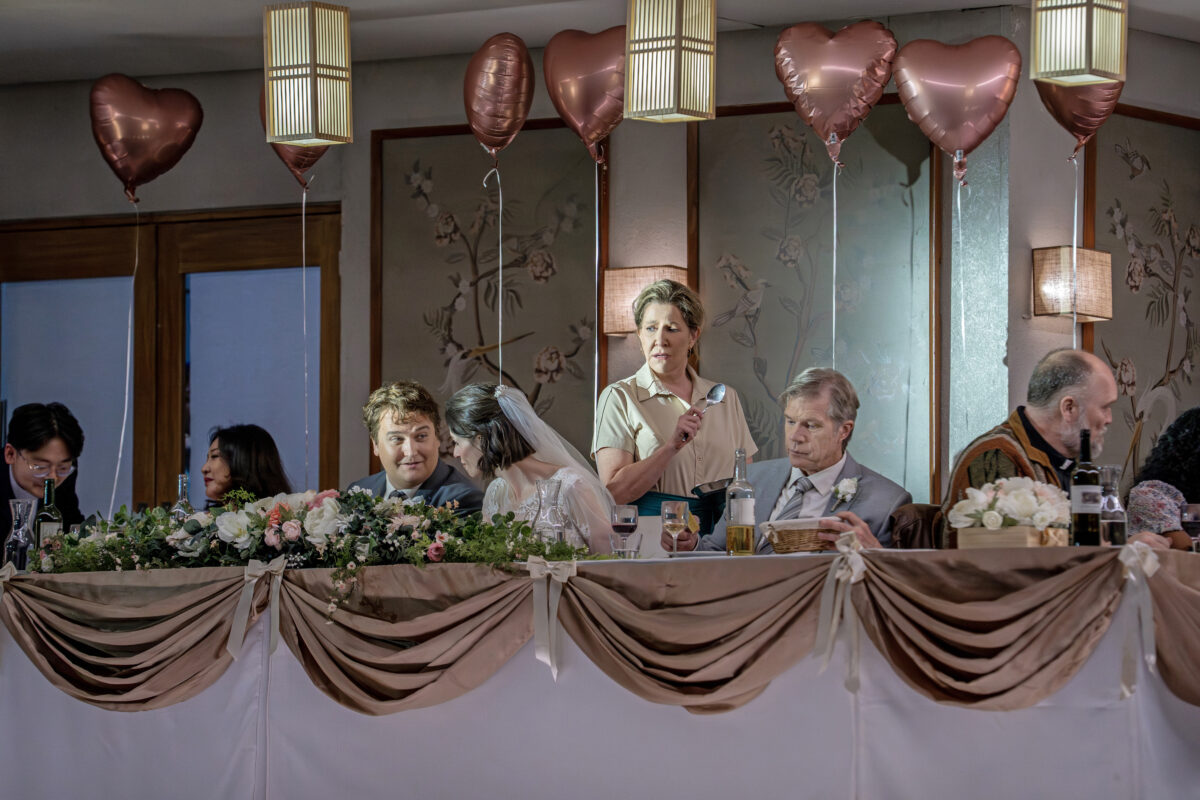
The actual plot of Innocence concerns a young couple, Stela (Jacquelyn Stucker) and Tuomas (Miles Mykkanen)—she the product of a miserable orphanage in Bucharest, he from a wholesome Nordic family—celebrating their wedding at a banquet hall in Finland. But what neither Tuomas nor his parents, Henrik and Patricia (Rod Gilfry and Kathleen Kim) have told Stela is that he has a brother, just released from prison a decade after he went on a killing spree at his high school. Tereza, a Czech waitress (Joyce DiDonato) called into work at the last minute, gradually realizes that this smiling family raised the monster that killed her daughter Markéta (Vilma Jää), and finally decides to pull the pin on the awful truth.
You’ll have recognized several of those boldfaced names, and the casting was strong all around. I loved Stucker as the Contessa in Figaro last season, and she brought the same brilliance of tone, emotional connection, and ingenuous charm to this role; Mykkanen, the wide-eyed Clay in The Amazing Adventures of Kavalier & Clay, was convincing in the utterly different role of Tuomas, and he was vocally Stucker’s match as the young lover of operatic archetype. Kim and Gilfry, meanwhile, sacrificed tone across their rangy, vocally challenging parts in favor of depth of characterization.
But the heart of the story are Tereza and Markéta, and the duets between the mother and the memory of her daughter are some of the most heartbreaking in the piece. DiDonato‘s performance was a study in contained fury and anguish, the diva disappearing into a working-class everywoman struggling with excruciating grief and a sense of cosmic injustice. But Jää, in a role written for her, adds another one of those strange new ingredients to Saariaho’s musical language: Not an opera singer, she belts and yodels pop vocals in the Finnish folk tradition, and the melding of her ghost’s piercing cries with the velvety mezzo of her bereaved mother is especially eerie and poignant.
But I have to digress here to point out what was, for me, the most compelling performance of the evening, and another fascinating contribution to the opera’s wide-open soundworld. The children’s teacher—new-music specialist Lucy Shelton, making her Met debut in her 80s—reflected on her career in sprechstimme monologues on a well-worn instrument, telling us that she was so dedicated to her students that she took her vacations in their home countries, a different one each year; after the killings, teaching seemed useless, and instead of grading papers out of a desire to nurture and educate, she found herself scouring her students’ manuscripts for clues that would help her catch the next murderer in time. The destruction of her joy and her sense of purpose throbbed with heartbreak in every note, every uncanny portamento.
Kudos—for moments like these, and for the taut dramatic structure of the piece—to librettists Sofi Oksanen, who created the story and original Finnish text, and Aleksi Barrière, the composer’s son, who adapted into its final, multilingual form. The genuine suspense and surprise that unfolded throughout the piece felt more like the plot twists of a Broadway play than the ceremonious inevitabilities of a conventional opera. Some of the elements in the plot are cliché, like the old trope of the alienated outsider going school-shooter to get back at his bullies (when in real life, mass murderers are much more likely to be abusers than abused), but there’s more than enough beauty and novelty to the drama that these could be overlooked.
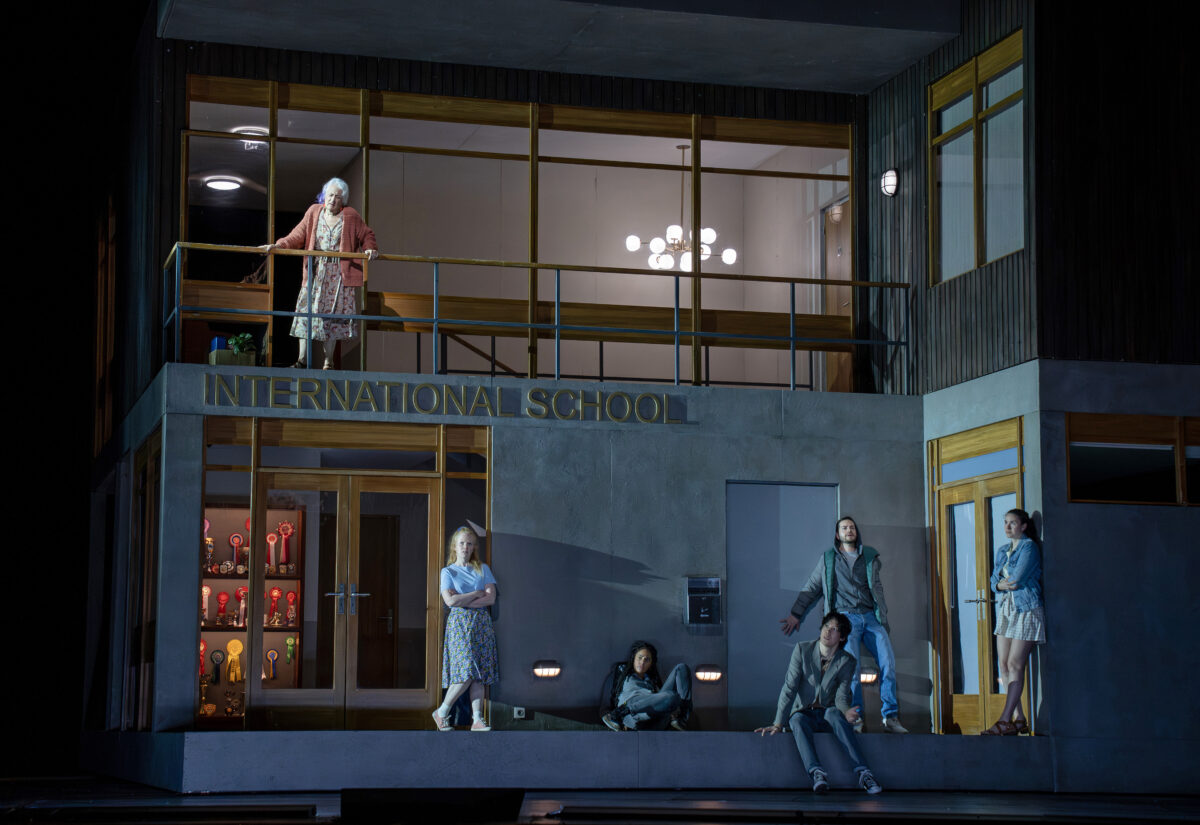
Photo: Karen Almond / Met Opera
Director Simon Stone’s production is dramatically direct and nightmarishly real, with a rotating, lifelike two-story unit set (designed by Chloe Lamford) that serves simultaneously as a high school for flashback sequences and as a banquet hall in the present. The actual shootings, the actual killer, are all kept offstage throughout the piece, and when the zero hour finally arrived in flashback—bloodstained students fleeing their unseen attacker—, I felt the grinding, visceral horror that comes from witnessing violence in real life instead of in a Hollywood movie. In a brilliant final gesture, as one horrible truth after another is revealed, the set is gradually stripped bare, so that the characters at the wedding eventually find themselves wandering into empty, institutional rooms, under the harsh fluorescent lighting of a high school hallway.
In its opening moments, the orchestra seemed a little disjunct, the melodic material not quite combining organically with the more atmospheric material, though overall, Susanna Mälkki made emotional and dramatic sense of the complex and varied score, deftly melding trademark Saariaho elements like the murmuring of an offstage chorus with the improvised ululations of the young pop singer. The score is itself a banquet, a feast of these brilliant little moments: long after the performance, I can’t stop thinking of how Saariaho matched a high, forced falsetto note in Henrik’s part with the note of a muted trumpet immediately thereafter.
Mälkki, and the rest of the opera’s creators and interpreters, received well-deserved avalanches of applause at the curtain call—but the bittersweetness of the evening’s achievement was underlined when Barrière took the stage, brandishing the score aloft, eliciting an ovation for the maestra who couldn’t be there to take her bow.