Photo by Corey Weaver
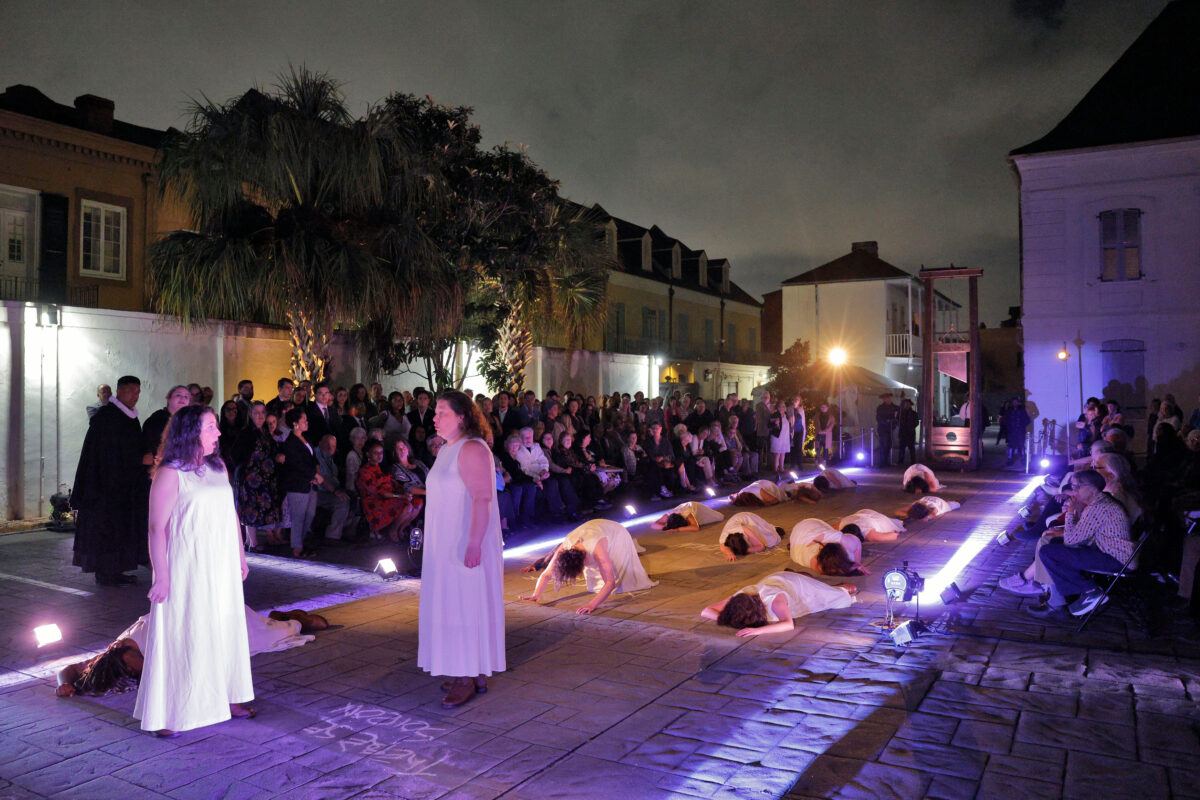
Not every venue needs to be Bayreuth. Not every opera must be performed with hushed reverence in the dark, with carefully-curated acoustics. Sometimes Poulenc’s nuns process to the guillotine in a French Quarter courtyard while bridesmaids cackle over the garden wall. (Cackling factored into the proceedings in the old Place de la Révolution itself, I presume.) Sometimes Kern’s Show Boat shows off well on a riverboat heading down the Mississippi River. Sometimes Wagner’s Pilgrims’ Chorus from Tannhäuser reverberates with resonance in a renovated train depot near where Homer Plessy took his own significant journey on a whites-only railcar.
Recently Brendan Latimer wrote for Parterre Box on the ways that “site-responsive stagings can break financial constraints imposed by the nature of production and let smaller companies flex artistic muscles.” The inaugural New Orleans Opera Festival, held between March 24 and March 29, ended up – despite initial plans – becoming an entirely site-specific affair. Der Rosenkavalier, the only production slated to be held at the New Orleans Opera Association’s standard venue, the Mahalia Jackson Theater, wound up rescheduled for November. Even Golda Schultz’s recital (review to come) moved, with only twenty-four hours’ notice, from its original location at The Civic Theater to the Opera Guild Home parlor, becoming, in its own way, a site-specific performance – lieder performed, fittingly, in a snug living room.
The Old Ursuline Convent in the French Quarter and the connected St. Mary’s Church served as the stages for the fest’s first offering, Francis Poulenc’s Dialogues des Carmélites, conducted by Joshua Anand Slater (the husband of NOOA’s general and artistic director, Lila Palmer), with production design by Valentina Ceschi and Kate Lane. As Blanche de la Force, Stephanie Doche captured the necessary patrician aura – elevated but not haughty, all the noblesse without a hint of affectation. Véronique Filloux as the lovely and lovable Sr. Constance brought a spirit of effervescent delight to her role as the youngest of the nuns, capturing both bubbly bonhomie as she described her dances at her brother’s wedding as well as the sudden intensity required by her veer into prophecy when she predicts she and Blanche will die together. Domestic charm and ominous menace intermingled as well in the stage business going on behind Blanche and Constance in the convent workroom. A group of nuns with baskets of lavender on their backs, actively-fuming smokepots, and thatched beekeeper masks brought an early Renaissance energy (a dash of the Decameron) to the scene, as well as a faceless foreboding. The award for best costuming of the festival goes to Ceschi + Lane for these Sisters of the Beehives.
The opera’s family ties did not stop at the connection between the conductor and general director. Phyllis Treigle, daughter of New Orleans-born bass-baritone Norman Treigle, and her daughter Emily Treigle sang, respectively, the old prioress Madame de Croissy and the assistant prioress Mother Marie of the Incarnation. Treigle, mère, used her lower register to great effect during the prioress’s death scene. She arched atop her deathbed like an inverse of Bernini’s Saint Teresa in Ecstasy, twisting her body in convincing death throes. Treigle, fille, standing by as an observer, did an admirable job with her vocal characterization; you could hear the assumption of authority in her voice the moment the old prioress passed.
In the courtyard of the convent during the intermission, a man approached my friend and me with that distinctive, regretful-pleased look of someone about to deliver bad news. “You know we’re losing the orchestra?” I didn’t process the question at first, assuming he meant Louisiana was losing the Louisiana Philharmonic, but he clarified he meant that when we’d be ushered into the courtyard again for the final scenes of Poulenc’s opera, the LPO would not be joining us. When I asked why, the man replied cryptically, “It’s too cold…too cold…” and vanished into the 80-degree March night like a hamfisted theatrical device himself. Above us, on a balcony of the convent, young women dressed as St. Lucy. St. Catherine, and St. Joan of Arc unobtrusively mimed their way through the break between acts.
Our prophet’s words came to pass. The final three scenes, performed in the courtyard, had been orchestrated for solo piano. Revolutionaries rolled out a full-sized guillotine. I sincerely hoped the directorial choice had not been, “Orchestra or big ol’ guillotine?” After hours of Poulenc’s forceful orchestration, the piano behind the bushes simply did not cut it. At times the French Quarter noise – the emptying of a seemingly bottomless trash can of glass bottles, the revving of motorcycles – covered the piano, even though I was standing with my back almost directly to it. Piano, pianissimo indeed. What also got lost in the courtyard scene was the dramatic intensity of Blanche and Constance’s final encounter. My attention, at least, could not “take them in” together. They were two small moving parts amid much commotion. All in all, a letdown after the first two-thirds of the evening. I would not have shed a tear had we stayed inside the church for the execution scene, handled in a way that preserved Poulenc’s orchestrations. Site-specific opera directors of the world, I implore you, given the choice between a big ol’ outdoor guillotine and your orchestra, keep your orchestra.
Cheekily, I’ll give the opposite advice next. Given the chance to perform Show Boat on a show boat, please perform Show Boat on a show boat. The musical-that-can-shade-into-operetta was performed on the riverboat The City of New Orleans and went off without a hitch. As any good impresario knows, it’s good to get your audience fed and liquored up before the show. We had our fill of seafood pasta, jambalaya, crab cakes, and old fashioneds well before leaving the dock. My partner nudged me and pointed to the tray labeled “Assorted Crackers” – “I guess that’s where they want the audience to line up.” Of all events of the opera festival, this felt the most festive in its pre-show banter between strangers and the sense of celebratory relief you could sense from the NOOA staff (who, I must say, did an incredibly impressive job throughout the weekend managing the thousand moving parts of this musical marathon).
New York theater veteran Shawn Churchman narrated the plot of the musical between the nine numbers and contextualized the work within the history of American theater. He charmed the crowd so much that at certain points – Ravenal’s abandonment of Magnolia, Steve’s abandonment of Julie – the audience hissed and booed between orders of more drinks. This naïve embrace of melodrama as a mode tracks with the ways the novel, musical, and film versions of Show Boat depict the rowdy audience watching the fare performed on Captain Andy’s Cotton Blossom. Darren Drone drew standing ovations for his “Old Man River” – and I’ll admit, as much as I tried to resist the too-on-the-nose energy of “Show Boat on a show boat,” I did get goosebumps when he delivered this song as we churned downriver past Chalmette. Brittany Olivia Logan as Julie stood out for her sensitive, sparkling rendition of “Bill” – with less the tired, sad, Brechtian delivery of Helen Morgan and instead a wry, knowing affection. As for Jonathan Bryan as Ravenal – well, let’s just say you can see why Cadie J. Bryan’s Magnolia would put up with his “love her and leave her” shenanigans. Their “You Are Love” duet soared as a bit of high operetta. It’s a number I usually yawn through, but it showed off well that night. We ended with the entire ensemble launching into “Life Upon the Wicked Stage” to close us off before the audience scattered onto the decks to view the skyline of New Orleans. We had “come around” at some point during Briana Hunter’s breathy “Misery’s Coming Around” and were now heading upriver.
The finale of opera fest had been billed as Carlisle Floyd’s Pilgrimage (a piece initially sung by Norman Treigle), a cantata that draws from Psalms, Job, and St. Paul’s Epistle to the Romans. Its site-specific angle: seven venues that had been kept secret leading up to that Sunday. Additional secrets included the selections – beyond the Floyd – that remained so under-wraps that even on the day of the event numerous attendees complained about the lack of a program book to indicate which pieces were even being played. In lieu of such a program, each of us carried a Pilgrimage Passport which was to be stamped at each of the seven locations ranging over two miles from St. Louis Cathedral to the New Orleans Center for Creative Arts at the border of the Marigny and Bywater.
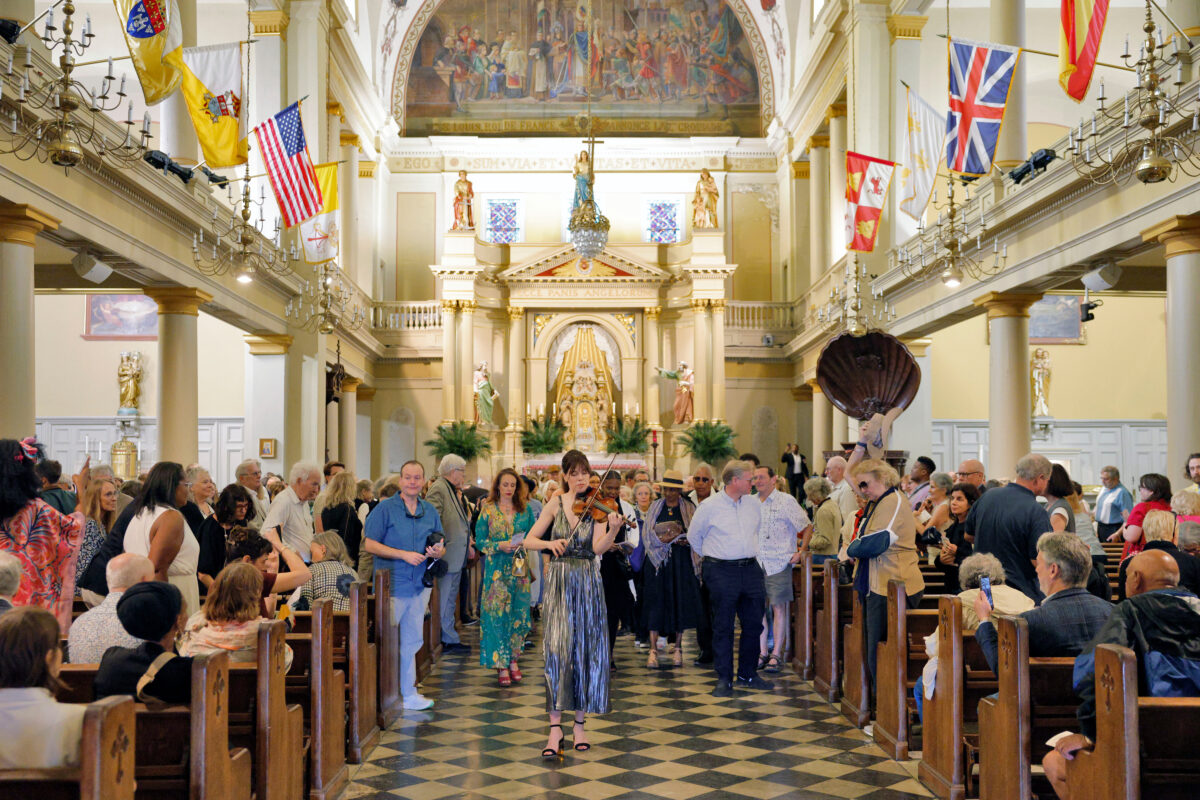
Photo by Corey Weaver
At the cathedral, baritone Norman Garrett took the shell-shaped pulpit and delivered the opening psalm from Floyd’s Pilgrimage. Violinist Tessa Lark processed up the main aisle with a liturgical air, eventually slipping into Wagner’s Pilgrims’ Chorus. From there, though, she pivoted into a hoedown-style fiddle number. We followed her out the church, down the aisle, in a sacred-secular recessional. Some attendees dipped their fingers in the holy water stoups and crossed themselves as we left. Others picked up leftover palms from the Palm Sunday Masses that had been left behind and carried them along our way, playing the ironic or sincere pilgrim.
While I can’t offer exhaustive breakdowns of each of the seven sites, I can say that all manner of genres blended with the classical pieces. We returned over and over to the Pilgrims’ Chorus in overt and subtle ways. Anna Laura Quinn in the Lanaux Mansion warbled the Wagner as she vocalized in the parlor to electronic accompaniment. In the Kingsway Mansion on Esplanade, Jorell Williams (accompanied by pianist Tessa Hartle) did the impossible for me, making Carlisle Floyd interesting with his rendering of the psalm “O Lord Thou Hast Searched Me and Known Me.” By the end, the “search me” came from Williams with searing anguish, overwhelming volume, and the devotional power of a man actually wrestling with demanding, petitionary prayer to God. Phyllis Treigle’s delivery of Madame de Croissy’s line from Carmélites floated back into my mind. When asked to concern herself in her final moments with God, the prioress howls, “Let Him concern Himself with me!” The same energy came barreling out of Williams here.
Another highlight came at the Venusian Art Gallery, where local Grammy-nominated musician Gladney took us through the Pilgrims’ Chorus on saxophone, slowly shading into “Just a Closer Walk With Thee” (a nod to the nearly two-mile pilgrimage the sweaty audience had taken at that point), then transitioning, with subtle, subtle delicacy, back into Wagner.
By the time we reached the last stop at NOCCA, Tessa Lark returned, processing up the auditorium aisle playing the Pilgrims’ Chorus but now in a mode that signaled exhaustion, brokenness. A plaintive dragging of the bow across the strings, slooped shoulders that showed less confidence than before. A pilgrim tired from the journey. When she joined the LPO, conducted by Matthew Kraemer, she regained power and force as the whole ensemble offered a resplendent rendition of the overture to Tannhäuser. Norman Garrett returned to deliver the final portion of Floyd’s Pilgrimage, St. Paul’s reminder that nothing separates us from the love of God. It came across, as the whole pilgrimage had, with sincerity, with an air of actual devotion.
The surprise encore came from Leah Crochetto (who had performed admirably as Madame Lidoine, the new prioress in Carmélites) who took the stage to deliver an outstanding “Dich, teure Halle.” It received enthusiastic, standing applause from the crowd – likely tired of much standing and much applauding but eager to offer it to her.
We ended, as most New Orleans festivals end, with beer in a gravel parking lot. I chatted with a Wagner fan. We shared our appreciation of Crochetto’s powerful delivery. We talked Tannhäuser and trashed the way the Met’s latest production ended Tristan und Isolde. She was setting out for Bayreuth for her birthday. Sometimes it’s enough to end an opera festival with beers in a Louisiana parking lot, watching the Wagnerian soprano chat with her friends as they head out for the evening, seeing the dog-tired staff members of a city opera association blow off steam, chatting with fellow attendees to figure out who’s related to whom. Not everything needs to be Bayreuth. In New Orleans, we enjoy our own kind of operatic festivity.