Photo by Iko Freese
Lucky for us Berliners, two operas by Shostakovich graced the Komische Oper stage this season. In January, we saw Barrie Kosky’s new production of Lady Macbeth of Mtsensk. Not only was Kosky’s production a sleek take on Shostakovich’s controversial work, but the singing was some of the best I heard all year. Between Sean Panikkar as Sergei and Ambur Braid as Katerina, the North American sound won over Berliners. Kevin Ng’s anecdote of the screaming woman seated next to him perfectly summarized my experience — I was perhaps that screaming woman!
Following his new production of Lady Macbeth, Kosky’s The Nose returned to the Komische Oper, having first been performed in June 2018. The Nose is Shostakovich’s surrealist opera, where the nose of a high-ranking major takes on a life of its own. While absurd to a modern audience, the symbol of the nose carried a deeper meaning back in the 1830s when Nikolai Vasil’evich Gogol originally wrote the tale. As dramaturg Ulrich Lenz reminds us, “in ancient times, soldiers in war would cut off the noses of statues of foreign deities, as well as those of prisoners or those killed on the battlefield, as a sign of dehumanization and humiliation.” Dehumanization and humiliation remained central tropes in Shostakovich’s refiguring of Gogol’s text and were undoubtedly legible in Kosky’s staging.
The curtain opens on the barber Ivan Yakovlevich (Dimitry Ivaschenko), shaving his client, Platon Kuzmich Kovalyov (Günther Papendell). The sound of Yakovlevich’s single blade being rhythmically sharpened on his strop provided sonic tension before the orchestra even played its first note. Perhaps it was also a sonic reminder for audiences to purchase their tickets for Kosky’s production of Sweeney Todd scheduled next season! After a short scene where Kovalyov teases Yakovlevich for his foul-smelling hands, the action skips to the next morning, where Yakovlevich’s wife finds a nose in the bread dough she is kneading. We then jump to Kovalyov in bed with his fool, Ivan (Ivan Turšić), where, after a quick comedic humping, Kovalyov realizes that his nose is missing. The rest of the opera follows Kovalyov’s hunt for his nose and his quest for assistance, first at a funeral, then turning to the police and the local news. The plot descends into chaos as a mob appears; more humping ensues. Although the nose is found, it cannot be reattached to Kovalyov’s face.
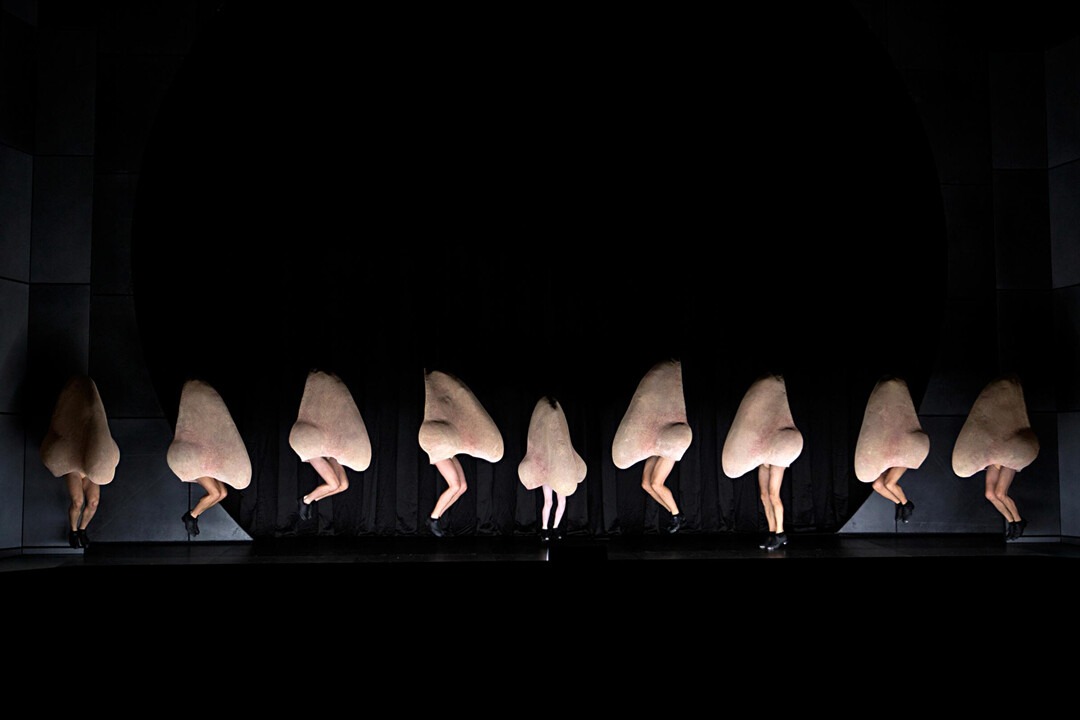
Kosky’s production is fittingly barren, the simple set and muted colors allowing space for the opera to stand on its own without unnecessary congestion. Kosky’s treatment of the orchestral interludes and choral writing specifically allows the music to take center stage with no extraneous distractions. The viral shock factor of the production is none other than the giant tap-dancing noses. Otto Pichler’s choreography features eleven noses in a kick line, alternating between the Charleston and timesteps.
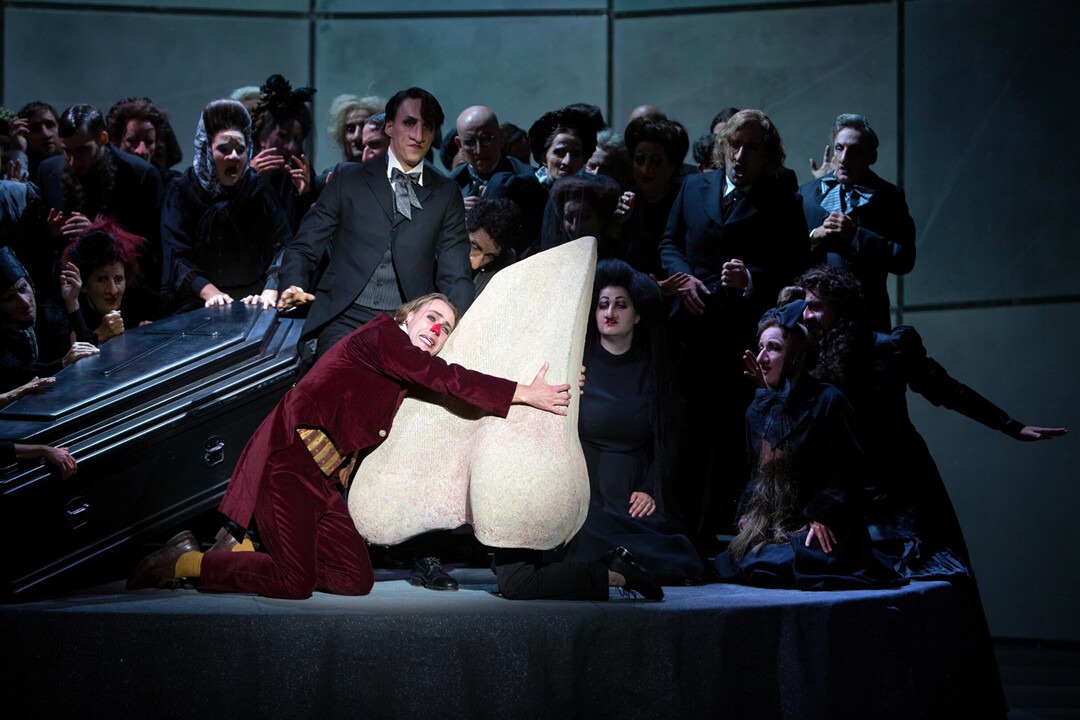
The only aspect of the production I was not fully sold on was the costuming. Foremost, the entire cast, sans Kovalyov, wore prosthetic noses. Perhaps I am a bit scarred from the Bradley Cooper controversy (when he was criticized for wearing a prosthetic nose when playing Leonard Bernstein in Maestro), but I found this choice unnerving. Of the inclusion of prosthetic noses, Kosky shares, “it’s extremely important that [Kovalyov] loses something that everyone else has. We simply reversed that: In our version, everyone else has a large nose, a combination of Barbara Streisand’s nose and an antisemitic Nazi cartoon – except for Kovalyov.” While the antisemitic caricature was at the forefront of my reading, I also wondered how the prosthetic noses might have affected the vocal performances. The costumes themselves were also distracting. Designer Buki Shiff was said to be inspired by the 1840s, 1880s, 1920s, and 1930s, which simultaneously provided a feeling of timelessness and confusion. While obscuring a set time and place is usually Kosky’s goal (as he maintains in his productions that the place isn’t important, the people are), the costumes were an unsuccessful attempt at this goal. A saving grace, Baritone Günther Papendell’s Kovalyov was perfectly comedic without sacrificing vocal quality. Even without a nose, his resonance prevailed!