Photo: Kristen Loken/San Francisco Opera
(Interviews have been lightly edited for clarity.)
On a snowy night in New York in 2011, Eric Einhorn gathered a few musician friends in his apartment to discuss a very impractical idea. Einhorn was feeling restless. Then an assistant director at the Met with a freelance directing business, he wanted to distinguish himself from the small, theater-based companies flourishing on the NYC-metro opera scene. The group discussed putting on a show in an unusual setting with all the trappings of a conventional opera: hanging lighting trusses, crafting an elaborate set, architecting an experience from on high. It was too expensive, they decided – too unwieldy. An idea conceived and stillborn in the same wintry evening.
Things could have ended there. Instead, handcuffed by the logistics of traditional staging, Einhorn began to think with a DIY ethos: why not guerilla, pop-up performances? The first piece he considered was producing the “Canary Cantata” by Georg Phillip Telemann at the Museum of Natural History. (The director of public programs loved the idea, but couldn’t commit due to administrative reasons.)
Einhorn then turned to Jessica Kiger, a friend and set designer who had worked with the Bronx Zoo on a previous project. Despite the fact the Zoo was focusing on family programming that summer, the “Canara Cantata” was once again a no-go. (Kiger’s contact there loved the idea, but they couldn’t do a piece about a dead bird in the zoo.)
Einhorn instead found a 13 minute piece by Shostakovich called The Tale of the Silly Baby Mouse and commissioned a re-orchestration for “loud, outdoor instruments.” To further raise the group’s profile amidst the hurley-burly of the zoo, he rented huge animal puppets, which he envisioned would pop out of trash cans as the opera unfolded. (He later nixed the idea – the trash cans couldn’t fit in his car.) When everything was set, Einhorn stood up and addressed the crowd, then simply lounging in a spot of shade. “Hi, I’m Eric,” he said, “I’m from a new company called On Site Opera, and we’re going to perform an opera here in the next 10 minutes.” Einhorn watched as everyone stood and walked away.
Then the little troupe began to play. A new crowd formed. People loved it. Hundreds of sweaty zoogoers stopped to take in the performance. Kiger had blasted a press release prior to the show, which, to Einhorn’s surprise, was picked up by the New York Times. “Now and then you witness a debut so happy and so rich with potential that you can’t wait to share the news,” Steve Smith, a critic for the Times, raved: “In the case of On Site Opera…it seems especially vital to spread the word, since few cognoscenti were on hand to witness its opening splash.”
Einhorn stepped down from On Site Opera (but remained on its board) in 2023; the outfit, citing financial concerns, closed shop last year. The impact left by the company, however, has been significant. On-Site Opera demonstrated that site-responsive stagings can break financial constraints imposed by the nature of production and let smaller companies flex artistic muscle on small budgets; they showed that thrifty, motivated entrepreneurs could draw sharp attention to contemporary issues; and, perhaps most importantly to the art form, they showed they could manufacture chance. These kinds of serendipitous encounters have become increasingly rare in a society shunted into aesthetic and ideological corners by ruthless algorithms. Perhaps this alone justifies the usefulness – and even necessity – of tactical, site-specific opera
Over the past decade or so, opera companies large and small have experimented with taking opera outside of the theater. But what exactly happens when opera goes beyond the “proscenium,” or theater? How do singers and musicians feel? Is it a gimmick, a travesty, operatic greenwashing? Or is it perhaps a new way of looking at the form – different, but no less valuable than its traditional milieu?
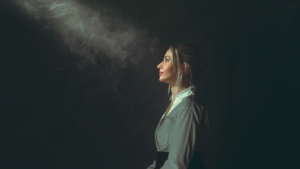
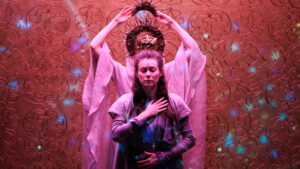
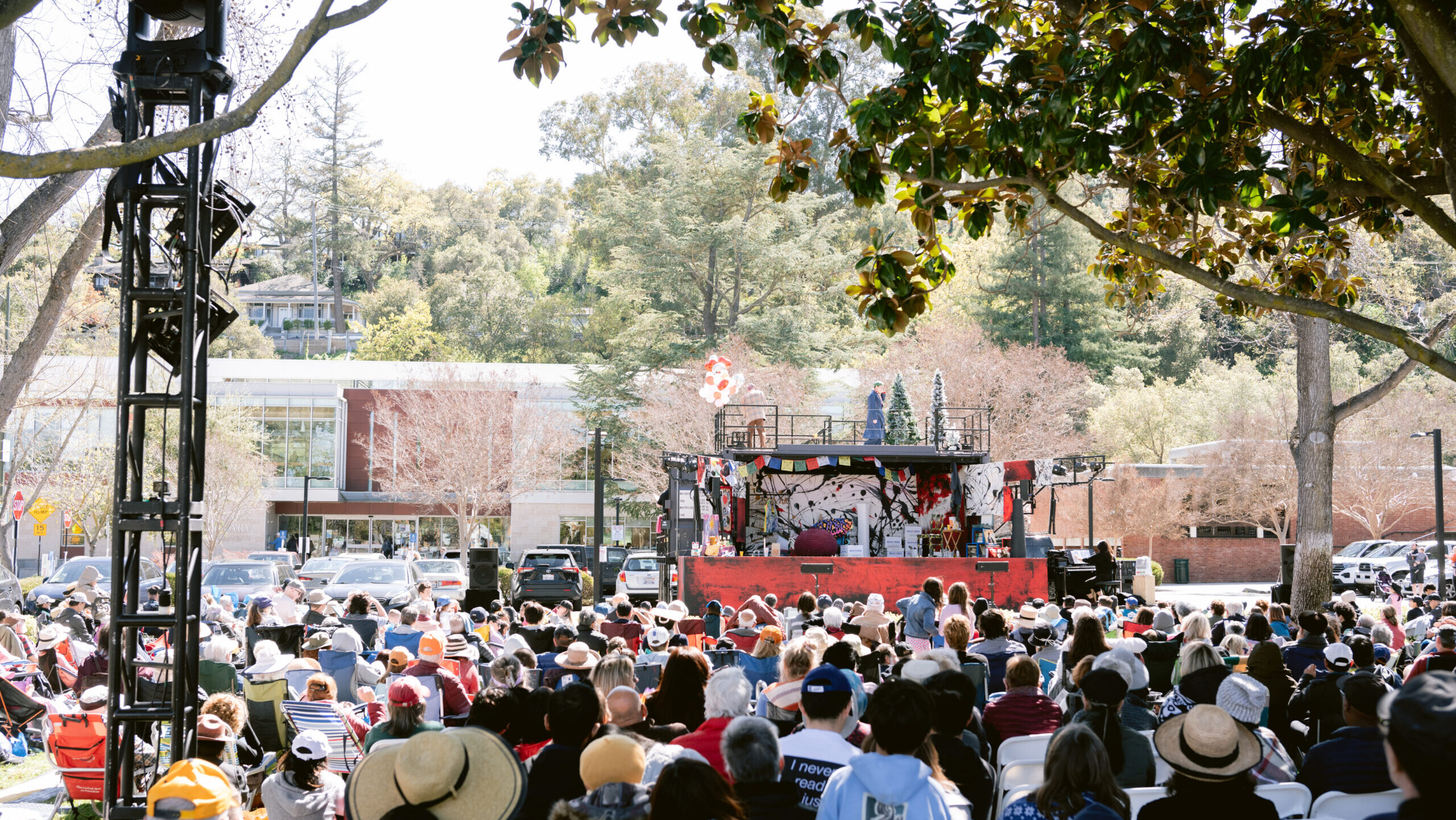
“Part of it is an attention thing.” Julian Grabarek and I are chatting over Google Meet. In the summer of 2025, Grabarek was the pianist for Bohème out of the Box, San Francisco Opera’s (SFO) free community opera initiative which brings a shortened version of Puccini’s opera to communities throughout the Bay Area. “My experience in the theater is that I have to fight with my attention often – even if I love the performance that’s going on. I’m constantly bombarded by other thoughts: what I had for dinner, what I have to do tomorrow, it’s late, I’m tired, my feet hurt from my shoes that I wore to see Don Carlo.”
Grabarek’s experience at SFO’s Opera at the Park series was different. “I think you are able to dissipate some of those distractions easier. You’re fighting with them less because there is the benefit of not feeling like you’re supposed to be paying attention. You’re not constrained by the theater and the expectations that come with it.”
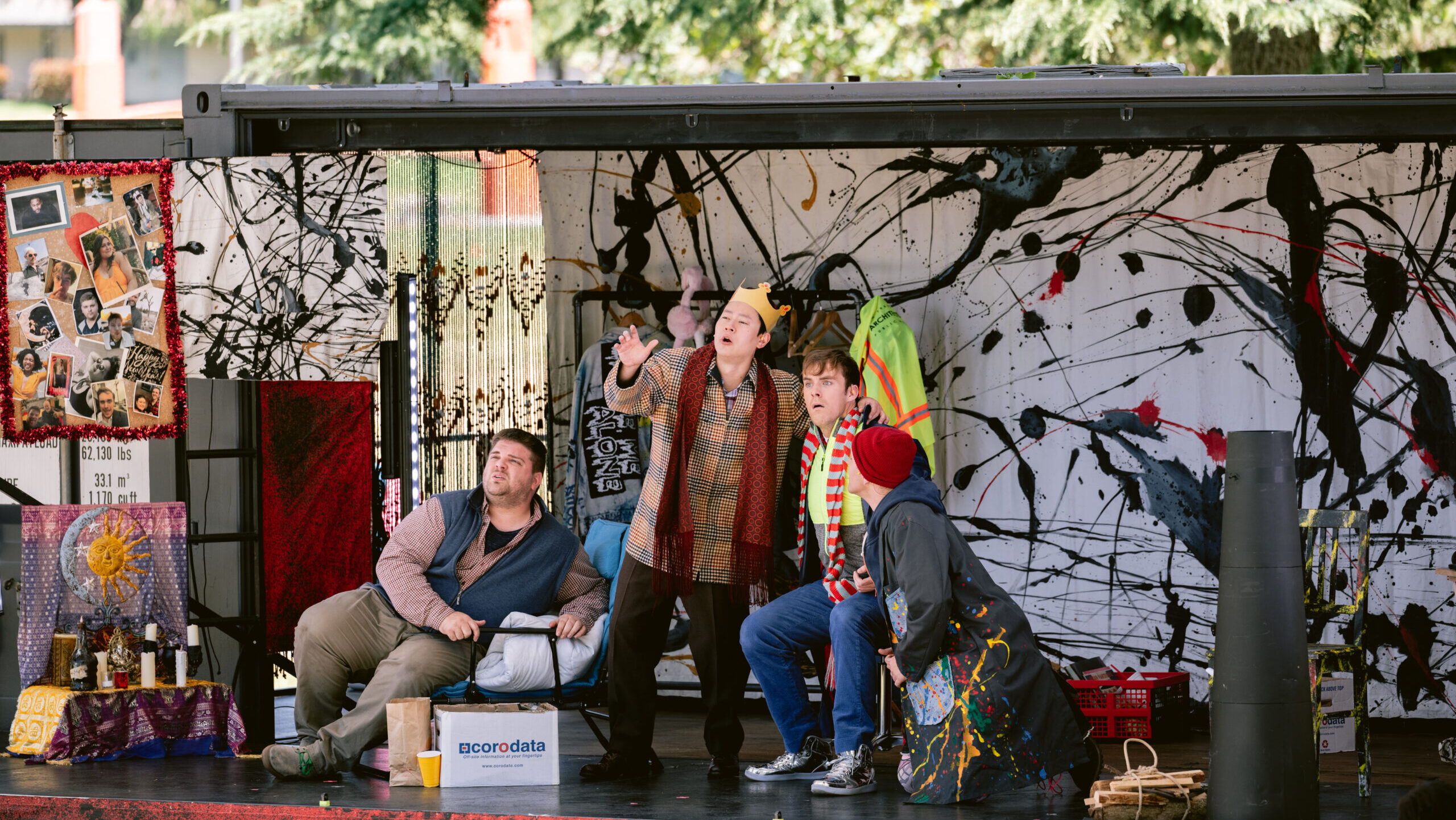
Photo: Kristen Loken/San Francisco Opera
The idea that freeing an audience member’s body can unlock latent emotional and intellectual capacity has been championed by the innovative director Yuval Sharon, who famously staged La bohème backwards. In his recent book, A New Philosophy of Opera, Sharon admits his wayward attention freely, even encouraging a directionless, lantern-like focus of attention: “I find it enormously freeing to let my mind drift and take in everything as I watch an opera or listen to a concert,” he writes. “When I stop trying to understand a piece rationally and let my mind wander like a river over new terrain, I am allowing the music to help me explore how I think and feel. Then it becomes about my experience, and therefore the development of my consciousness.”
Sharon cites forbearers in experimental performance such as Antonin Artaud, whose conception of theater was that of the plague: a totalizing, purifying force that could strip away illusion to reveal a living truth. Artaud wanted to reestablish a direct connection “between the spectator and spectacle, between the actor and spectator, from the fact that the spectator, placed in the middle of the action, is engulfed and physically affected by it.”
Audience members going into a site-specific performance need to be ready for ambient distractions, uneven sound, physical discomfort, and more. “What you’re getting is the total experience. What you get is immersion. And with immersion there are tradeoffs. Sometimes you’ll see a performer’s back. Sometimes you’re not going to be able to hear all that well – but [the performers are] going to come around again,” Einhorn says. But he and others are undeterred by these compromises.
Perhaps a more precise term for the idea of such brash commitment to storytelling over comfort is a virus – performers catch it by sheer proximity. Morris Robinson spoke fondly of his time in Yuval Sharon’s adaptation of Gotterdamerung in a parking garage at Detroit Opera, called Twilight:Gods. “I felt more in touch with the audience,” he told me in a phone interview. “Because of the close proximity, I could do small things to sell the character more than I could on the big stage…Any time you can do something different, but not put in jeopardy the music or the story, any chance to get more involved and intimate is great.”
Grabarek was enthusiastic about what he saw as the broader benefit of Bohème out of the Box. “You get people walking into the park, hearing it from afar, and they’re having an encounter with opera on their own terms, and they’re experiencing it in maybe its 80 percent form,” he says, referencing the fact Bohème out of the Box performances are in Italian and feature mobile supertitles that most people seem to disregard. “All of the audience members thought that it was absolutely the greatest thing they’d ever seen.”
The extent to which experimental opera administrators strive to infect an audience with a totalizing plague is debatable. At the very least, its proliferation points to some perceived change in appetites. Grabarek alluded to this in our interview. “My feeling of the zeitgeist is that people are craving in-person, deep experiences with something.”
And bigger houses are accordingly beginning to deploy performances in communities, like dinghies from a ship. SFO operates Bohème out of the Box throughout the Bay Area. Jeffery McMillan, Public Relations Director at SFO, confirms Grabarek’s suspicions, confirming that new audiences are arriving with an “incredible energy [..] we’ve never seen before. Patrons are energized by what they experience here.”
In a similar vein, Kristian Roberts, Director of Education at Dallas Opera, runs the Dallas OperaTruck, which stages the Three Little Pigs set to a medley of Mozart by John Davies. The truck has stopped primarily at libraries, community centers, and retirement homes to bring opera to populations with limited access to the arts. Roberts envisions the program as not only a vehicle for culture and entertainment, but also for education that creates ripple effects. “If we can inspire a child who likes to build forts to grow up to become a set designer one day, then we’ve done something.”
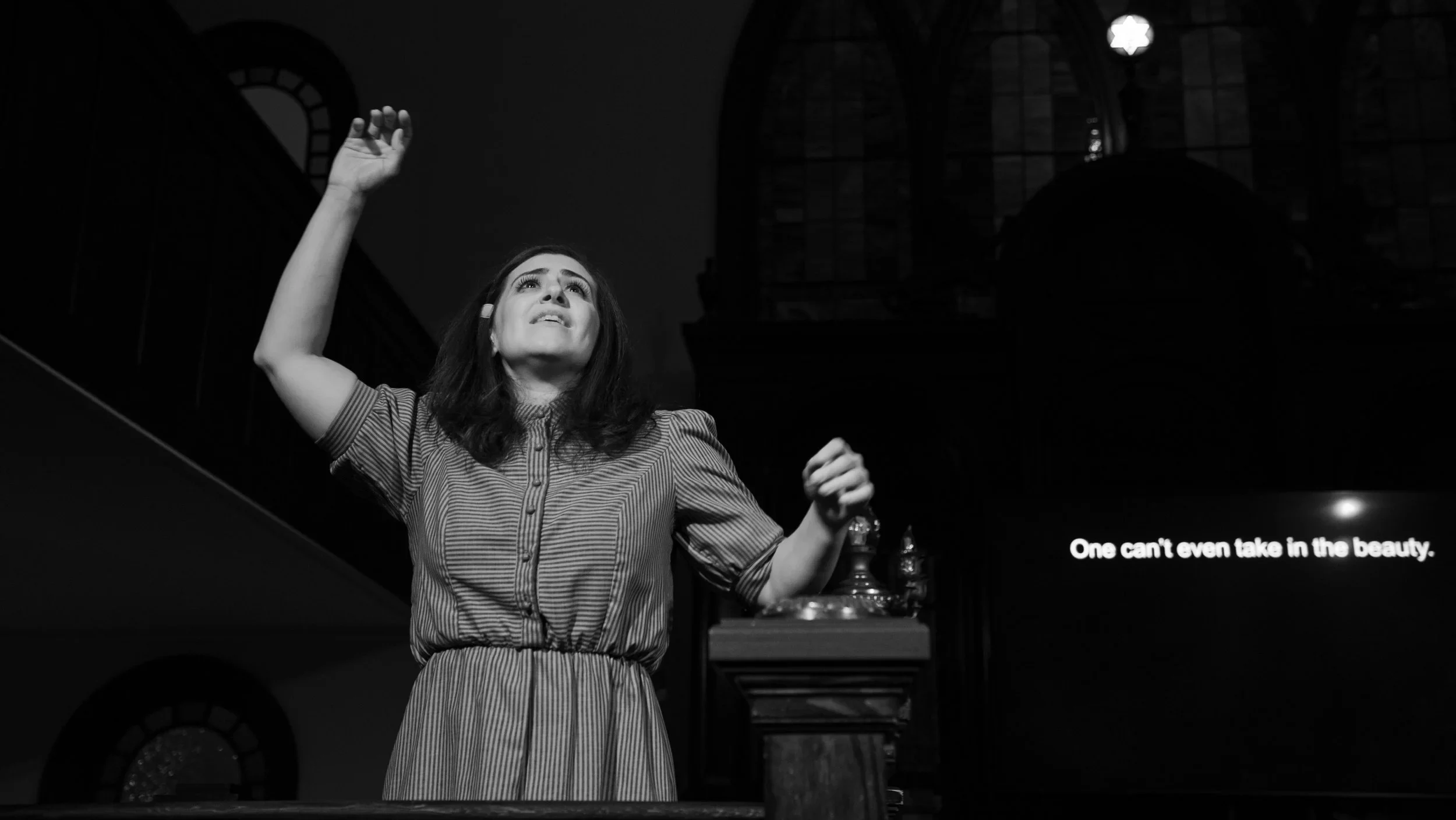
The Diary of Anne Frank at Opera in the Pines / Photo: Opera in the Pines/Molly Haley
Inspired by an On Site production of Amahl and the Night Visitors, Maine-based Opera in the Pines co-founders Lauren Yakobaskas and Sable Stroud turned a piano, a singer, and a contact at the local Holocaust Museum into a site-specific production of The Diary of Anne Frank. Happenstance seems to follow site-specific companies around – just as the NYT picked up Einhorn’s first production, the Portland Press Herald had an appointment to meet with the Jewish Museum’s new executive director, and that happened to coincide with the show.
“I remember initially people being like, ‘Oh, if you’re starting out, you have to do meat and potatoes staples of the repertoire or else people won’t show up,’” Lauren told me in a video interview. “And so betting on something like The Diary of Anne Frank completely went against that advice, but it just felt right, it was going with the energy, responding to the community, and going with the opportunities that were directly in front of us. We could have presented Tosca and made something work, but it just didn’t feel true to us.” Lauren and Sable laughed when I asked them how much that production cost. They got a $2500 springboard grant from the Maine Arts Commission and some private donations, and were able to prop up a roughly $12,000 production.
Sable calls the company’s productions love letters to the art form. “I’ve had people in venues who shuck lobsters for a living, brew beer, work in construction, come up to me and say, ‘I’ve never seen an opera before, and that was amazing, and I can’t wait to see what you guys are doing next,’ and I consider that the biggest compliment I could receive.” And it is a labor of love, even if Maine’s weather doesn’t want to cooperate. “Is it too cold still? Is it randomly going to snow? If it rains, is the ground still wet for a week after that because it’s raining for several days? There’s a lot that goes into an outdoor situation that is risky financially.”
Opera in the Pines shows are highly tailored to the community in which they are being presented; Cape Neddick, for example, is known for its lobster. Accordingly, the company staged a cheeky The Barber of the Cape in a lobster restaurant there. The character of Rosina was transformed into a head waitress – Bartolo was her boss. “Some people…want him to be the creepy old guy who’s keeping her as his ward, and that’s fine. I also want to see that production. But I also wanted to see my Barber of Seville.”
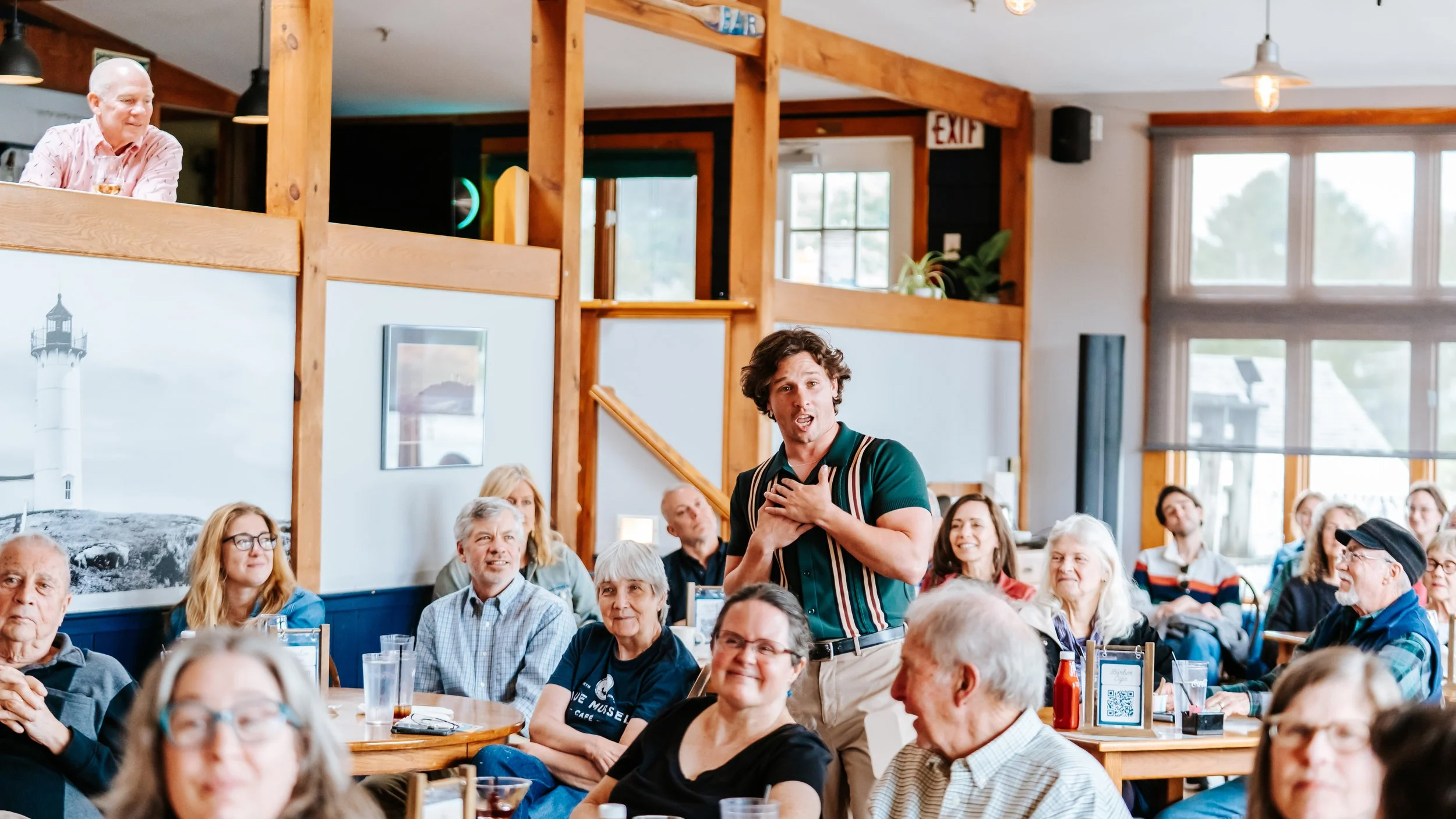
The Barber of the Cape at Opera in the Pines / Photo: Jordan Rowe / Opera in the Pines
A common theme in this corner of the opera world, it seems, is the exhilaration and exasperation of unexpected pivots, mishaps, and unusual situations. Even when Einhorn had expanded On Site’s production to a major staging on the New York City waterfront, singers still needed to use the bathroom of a local establishment as a dressing room. Once, he had to buy dehumidifiers to allow the pre-show habitation of a basement. Yokabaskas looks fondly back on decisions and situations that inevitably arise with such a DIY operation. “I cherish some of these stories from the past five years. Like making sure the entire set is loaded into my personal vehicle, or driving to get a prop in the middle of New Hampshire, or cleaning out the bar before we get started, or personally serving ice cream. It’s part of presenting this art form in a very salt-of-the-earth way.”
The pair, like Einhorn, are cavalier when asked about criticisms that on-site opera is gimmicky. “I don’t know if [traditionalists in the industry] love everything that we do, but that’s OK,” Stroud told me, “because we’re here for the middle ground, we’re here for new audiences and long-time audience lovers who want to see things in a different way…I think we need to continually reinvent the art form.” A big chunk of the company’s audience comes from total newcomers, a point of pride for the team. “Usually about a third of the audience has never been to an opera before,” Yokabaskas said. “Sometimes people are willing to take a chance on things because of the menu…someone will grab a beer for ‘Bar Crawl Bohème’ but won’t necessarily see a grand production in the theater.”
Site-specific opera can also give current singers and other professionals in the opera world opportunities to direct and found their own on site projects – if they had the right tools. “I wish that, as a singer, I had had training about the nonprofit structures and systems in the organizations that I was allegedly going to work in in the United States,” Yokabaskas said. “I had no idea. I’d go to donor events…and you would be talking to someone on the board, but you wouldn’t know the significance of that…I wish that there had been at least a conversation in my education about how those systems function and what the ideal scenario is for that. At least having an element of entrepreneurship as part of a musical education.”
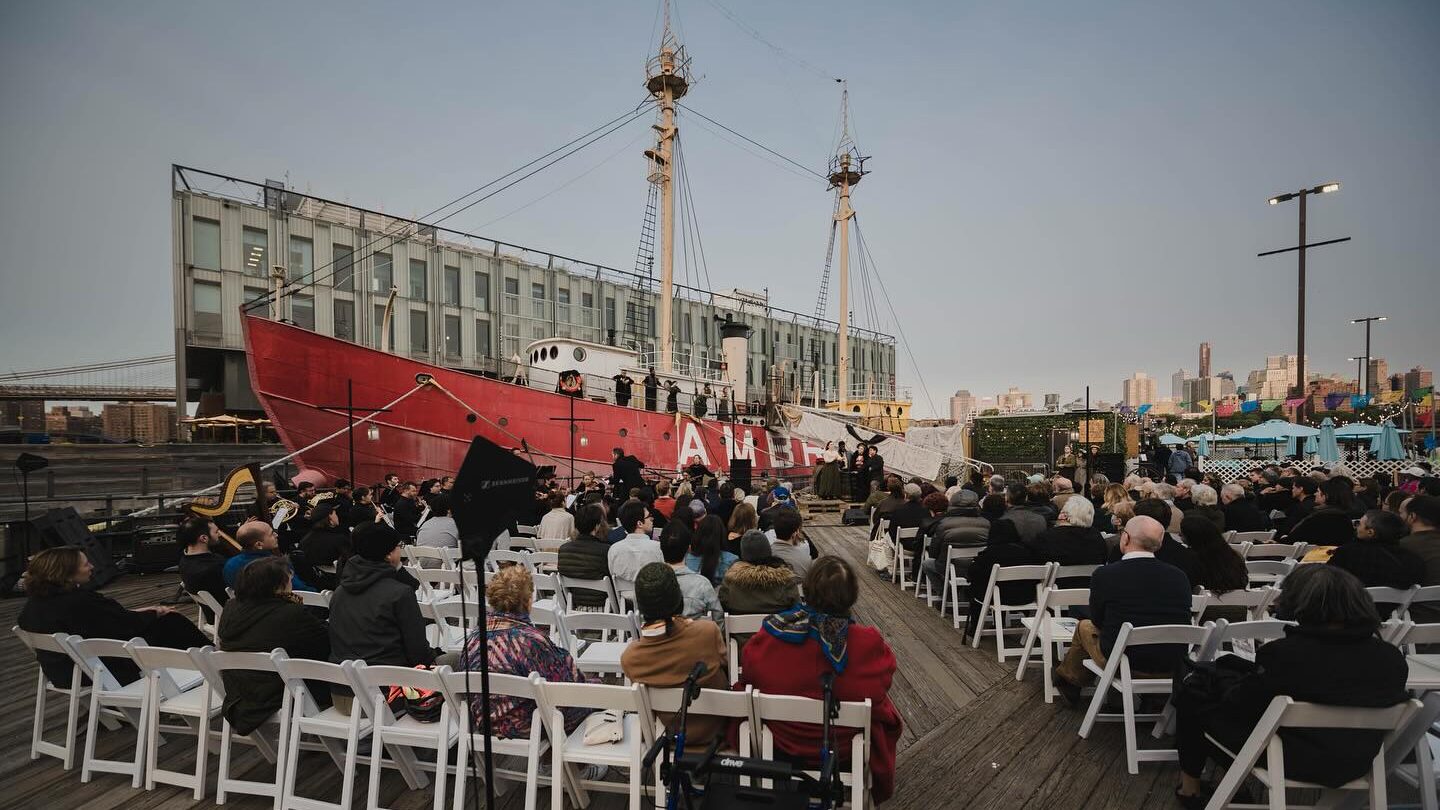
Il tabarro at On Site Opera / Photo: On Site Opera
But just like performers and impresarios, many audience members are not fully prepared for the unique demands of site-responsive opera performances, nor is everyone is in love with the idea of experimentation with a beloved art form. As Sharon points out in his book, a major obstacle in the way of experimentation is the industry’s hidebound obsession with unamplified human voice. Even proselytizers recognize the trade-offs between a proscenium-based and site-based performance. “You lose that perfect balance that an acoustically tuned theater gives you,” Einhorn said. And while he eventually overcame his own skepticism about amplifying On Site Opera productions, his objections were always less philosophical and more practical: he simply didn’t have the budget to properly amplify. But for those who might miss the pianissimo wafting up to the Family Circle or the Meistersinger overture’s wall of sound, he says, “go to the Met! There are great places in the city to have that kind of experience.”
But despite its appearance of low-cost, intimate productions, On Site Opera faced the same grave financial pressures present everywhere in arts funding and the compant never managed to shake the perception that they were a scrappy startup that didn’t need much to keep going. Even when its budget bloomed to support productions in the hundreds of thousands, loyal donors with the capacity to give more seemed skeptical. “Explaining scale in intimate opera is [dealing with] cognitive dissonance,” Einhorn said. “How do you scale this?”
For example, when Einhorn located a good venue with poor transit access for Britten’s Turn of the Screw, he wanted to charter buses and integrate logistics with performance. “The prologue to the opera [would happen] on the bus. We’d have a singer on the bus. We’d get off at the house and go to the house.” Chartering buses, however, would add $25,000 to the budget – an unacceptable amount. “My understanding of what Yuval [Sharon] did with the Industry [was that it was] funded in the millions. If I had a million dollars for a production – sure! I can have my buses.”
Towards the end of my conversation with Einhorn, I shared my vision for an on-site production of Verdi’s Otello by the Baltimore Harborfront, featuring tall-mast ships, a boat ride between acts, and a live cannon. Einhorn loved it. Almost immediately, however, he reeled off a list of caveats. “It sounds beautiful and absolutely within the realm of possibility. But the other half of my brain is like, ‘Well, Otello’s a three hour opera – now it’s four and a half. Do you have an intermission? Do people take bathroom breaks? Where are they breaking? What happens when people wander off? How are you getting on the boat? What are these boats going to cost you?’ This is where site-specific opera can scale. All of this stuff is super expensive.”
Rewatching the clip of On Site’s The Tale of the Silly Baby Mouse, I can’t help but be struck by the enraptured faces of children, the bewitched gaze of parents, the surprisingly potent forces of the players – the total collapse of life and art. The space is transformed, and everyone – including fidgety kids – along with it. As Smith wrote in the Times article: “Anyone who has ever seen very young children squirm in an opera house would have been amazed by the attentiveness and engagement on display during the first of two shows on Saturday afternoon.” And the work continues – but barely. Yuval Sharon’s startup, the Industry, has two shows in production. Opera on Tap hosts programs sporadically. The closure of On Site, it seems, dealt the site-responsive movement a serious blow.
Site-responsive and site-specific work isn’t a panacea for what ills the opera industry. But, for reaching new audiences while keeping a core of artistry, virtuosity, and creativity intact, it may be the best thing we’ve found yet.