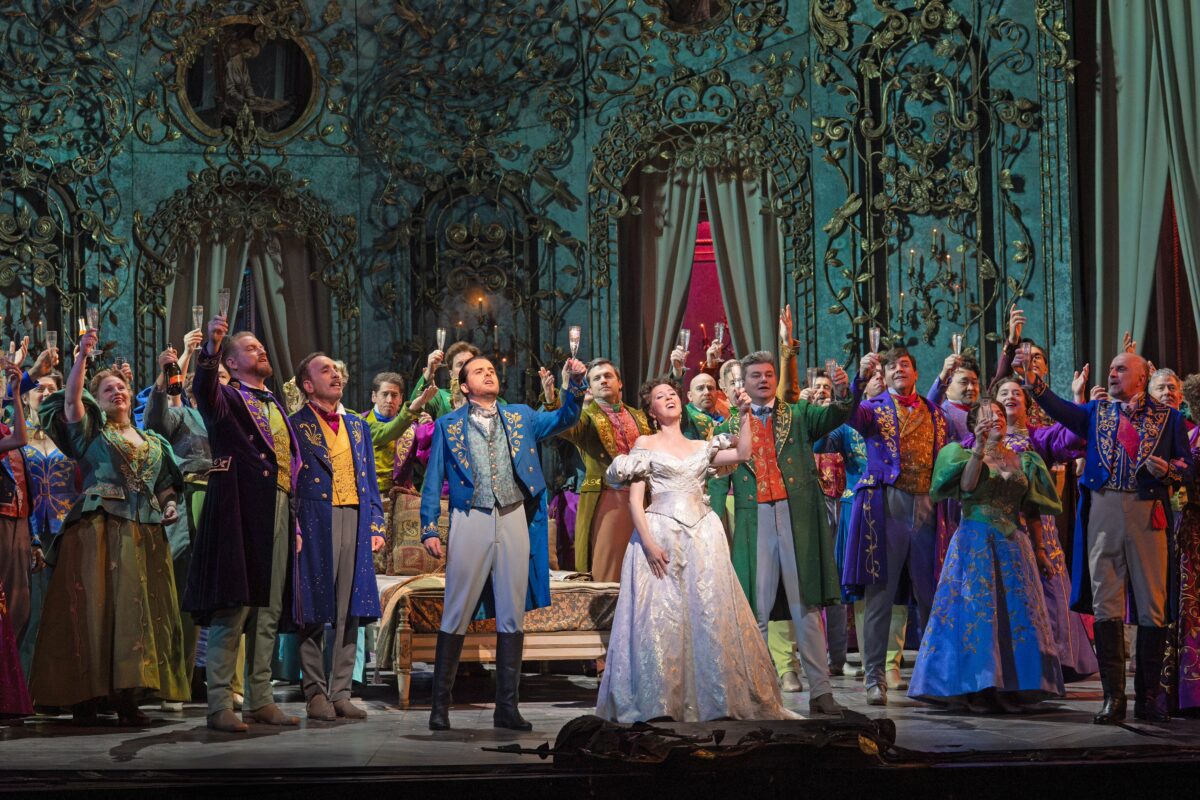
Photo by Ken Howard
Something about Michael Mayer’s production of La traviata—those lush, pastel sets, drizzled in rinceaux; that plump, white rose be-speckled in dewdrops, the hues and patterns of the costumes changing according to the season—brought out the cynic in me. It goes from witty and decadent to merely garish before Violetta even goes broke. After the initial dazzle, the lily just keeps getting gilded and re-gilded. By Act II, I felt like I was just looking at an Instagram wedding where hundreds of thousands have been spent on the orchids alone.
This production is certainly for someone. It just wasn’t for me. The audience was packed, and whole families were dressed to the nines, including, curiously, fathers and children in antique military uniforms. As usual, the Met reveals worlds within worlds, as six-year-olds dressed like Prussian cadets hobnobbed with sylph-like, half-naked Tik Tok influencers. I genuinely believe that opera would be more popular if people knew just how weird the interact scene is. Where else can you see the eccentricities of real opera fans side-by-side with the loony fashions of the wealthy and the desperate?
For certain, it was not the best week in politics to be watching La traviata, and this production in particular turns away from realism—emotional, political, or otherwise. Unsurprisingly, Lisette Oropesa reprised the role of Violetta with her usual technical panache. Her coloratura in “Sempre libera” was thrilling. Oropesa’s voice, a precise and finely tuned instrument, ideal for the death-defying trapeze acts of bel canto, slides easily into the role. Her Violetta was an anxious, pensive Millennial-type, in comparison to the more sensual and embodied Diana Damrau or Renée Fleming.
Alfredo, played by Piotr Buszewski, moved like clockwork through the production, doing the job of a groom at a wedding by ensuring he doesn’t draw attention from the bride. He avoided both the liberating highs of “Libiamo, ne’ lieti calici” and the brooding jealous darkness of “Questa donna conoscete.” While this was perhaps the fault of the stage direction, or of my writerly brain being too linear and straightforward, I found that Buszewski had a hard time conveying basic information. I lost the spirit of the romance and was confused by his motivations because I didn’t know when he knew what when.
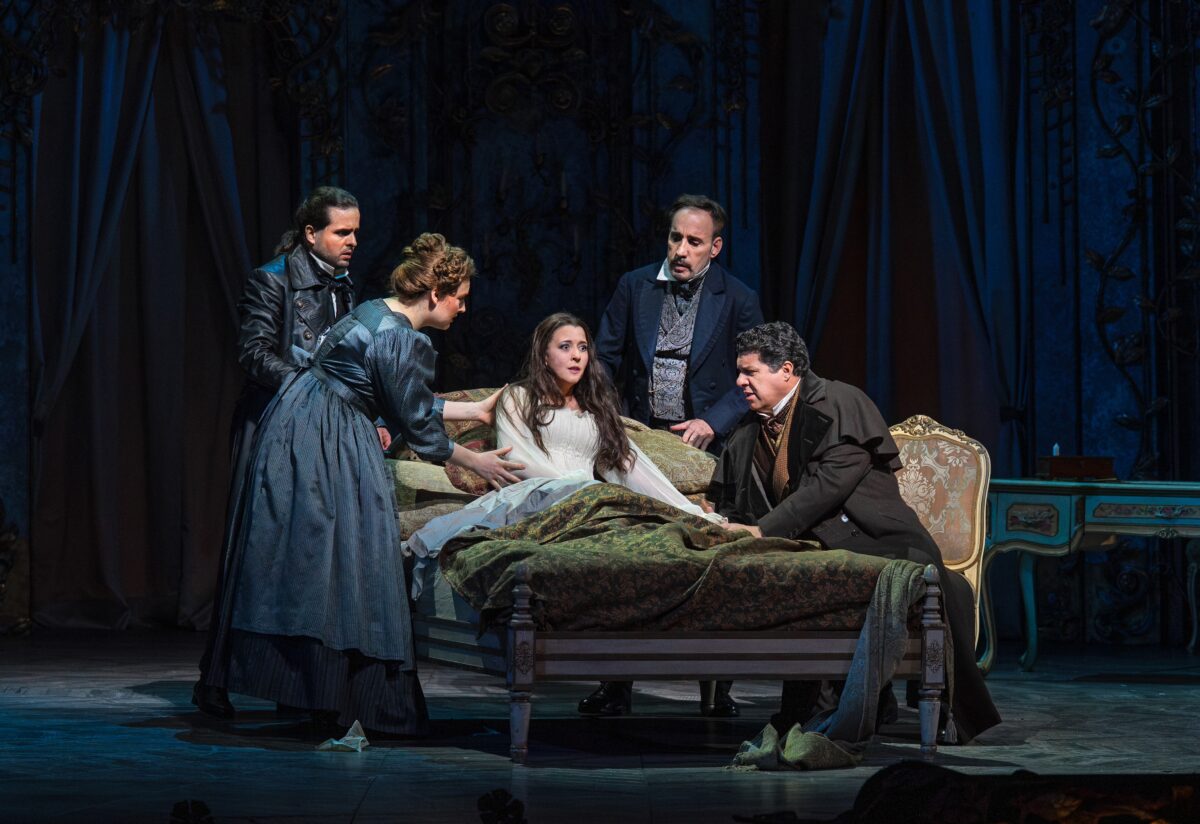
Photo by Ken Howard
Luca Salsi’s Giorgio had presence, sang with gravitas, and presented an old-fashioned, well-rounded role. But it was one of those reprised roles where the performer is like a ghost, doomed to repeat the old motions over and over for eternity. He performed too much to the audience, knowing too well when and for how long to pause for applause, and failed to spark against Violetta. Tessa McQueen’s Annina stood out to me for her powerful acting and skill at directing the eye and giving information in a somewhat sloppy production. Edyta Kulczak was a buxom and bouncy Flora. A strong counterpart to Oropesa’s Violetta, she is the more armored courtesan who won’t be waylaid in her career by a little thing like a doomed love affair. Dwayne Croft’s Baron Douphol was satisfyingly grim and covetous while Richard Bernstein’s Dr. Grenvil had a warm and solicitous bass voice and is a comforting presence for the dying Violetta.
The standout performance of the night was Antonello Manacorda’s sensitive and energetic conducting. He had his ear not just on the musicians but also on the audience and always seemed to know when and by precisely how much to manipulate the dynamics of the orchestra to drag our drifting attentions back to the stage. He conducted the chorus with wit and humor, and in a production that felt mired down in tradition, the party scenes made 19th century Paris burst into vibrant life.


