
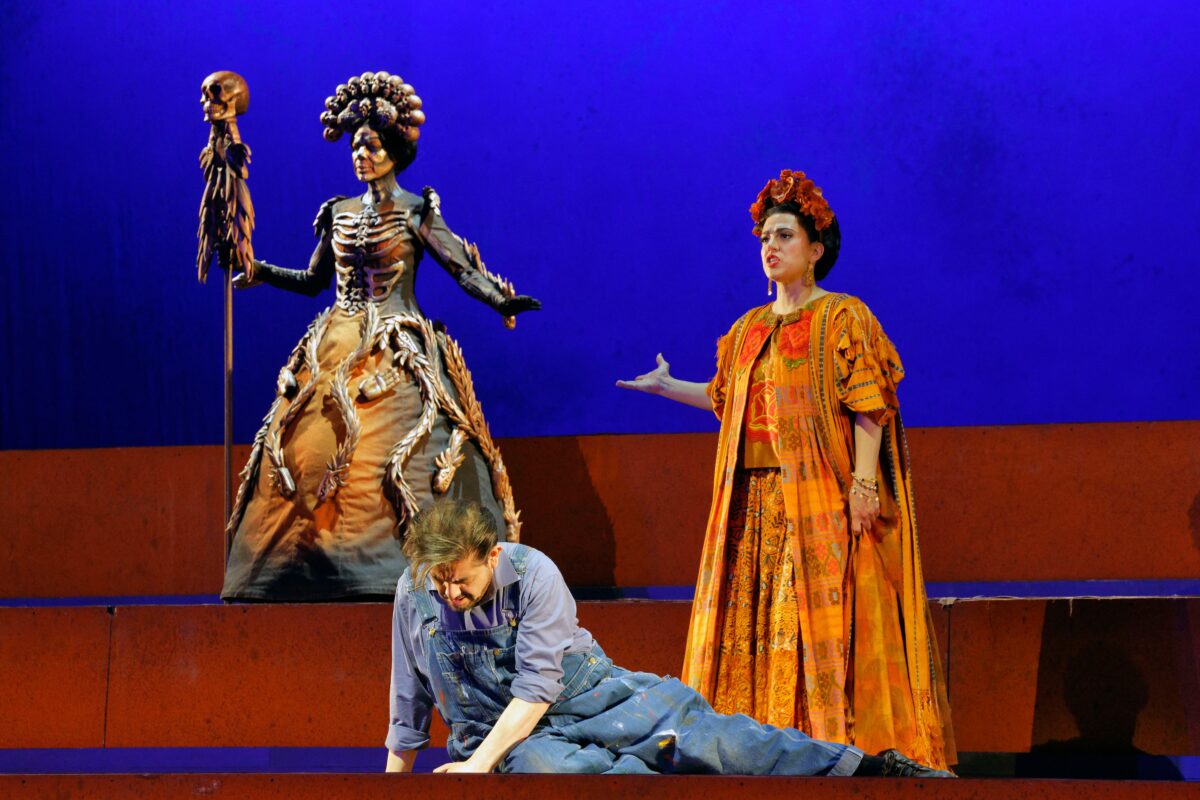
La Catrina, Keeper of the Dead (Ana María Martínez), orchestrates the Day of the Dead reunion of Diego Rivera (Alfredo Daza) and Frida Kahlo (Daniela Mack) in El último sueño de Frida y Diego at the Lyric Opera of Chicago. Courtesy of Cory Weaver/Lyric Opera of Chicago
There is an unending fascination with the legendary lives of the married Mexican artists Frida Kahlo and Diego Rivera . So, it’s easy to see why El último sueño de Frida y Diego (The Final Dream of Frida and Diego) has been embraced so quickly by major U.S. opera companies. But does it fully live up to the hype?
Now through April 4, the Lyric Opera of Chicago is presenting the Windy City premiere of El último sueño de Frida y Diego. This Spanish-language opera is the first by American composer Gabriela Lena Frank (Conquest Requiem, Picaflor: A Future Myth), though not for her Cuban American playwright collaborator, Nilo Cruz (Anna in the Tropics, Two Sisters and a Piano). Cruz previously made his Lyric Opera of Chicago debut as the librettist with Peruvian composer Jimmy López for their 2015 world-premiere opera Bel Canto, which was adapted from the 2001 novel by Ann Patchett.
The Lyric is presenting the much-traveled co-production of El último sueño de Frida y Diego by Mexican director Lorena Maza, which had its world premiere with San Diego Opera in 2022. Co-producer San Francisco Opera then featured it in their 2023 summer season, while LA Opera also staged Maza’s production in the fall of that same year. Opera Omaha then presented Maza’s staging for two performances in May 2024. And though Fort Worth Opera is listed as a co-commissioner, El último sueño de Frida y Diego has yet to receive a full Texas production.
El último sueño de Frida y Diego also has the rare distinction of receiving a new production less than five years after its debut. Director-choreographer Deborah Colker is taking the reins at The Metropolitan Opera this May with a different design team and a new cast led by Isabel Leonard and Carlos Álvarez. A Live in HD cinema simulcast is set for May 30, so El último sueño de Frida y Diego has already shown itself as a contemporary opera with legs.
I felt very primed to enjoy El último sueño de Frida y Diego, thanks to my exposure to a wealth of museum exhibits and Kahlo-inspired artworks in and around Chicago in the past few years. From March to July of 2025, the Art Institute of Chicago presented the compact and thoroughly researched exhibit Frida Kahlo’s Month in Paris: A Friendship with Mary Reynolds. And in the summer of 2021, I was also able to see works on loan from Mexico City’s Frida Kahlo Museum (the Casa Azul) as part of the exhibit Frida Kahlo: Timeless at College of DuPage’s Cleve Carney Museum of Art in the western Chicago suburb of Glen Ellyn. I also have strong memories of the 2002 film biopic Frida by director Julie Taymor alongside many PBS-TV Kahlo documentaries. And particularly striking was the Joffrey Ballet of Chicago’s passionate November 2025 revival of the 2016 Kahlo-inspired ballet Broken Wings by choreographer Annabelle Lopez Ochoa.
So already knowing many of the outlines of Kahlo and Rivera’s lives, I was very intrigued by Cruz and Frank’s fantastical storytelling premise. Rather than going with a biographical approach (which was apparently taken by composer Robert Xavier Rodríguez for his 1991 chamber opera Frida), Frank and Cruz riffed on a reverse Orpheus & Eurydice journey with echoes of Act III of Thornton Wilder’s Our Town.
El último sueño de Frida y Diego is set in 1957 around the Day of the Dead. An ailing Rivera (Mexican baritone Alfredo Daza) calls upon the spirit of his late wife to return to him.The skeletal Keeper of the Dead known as La Catrina (Puerto Rican soprano Ana María Martínez) then pressures the spirit of Kahlo (Argentine mezzo-soprano Daniela Mack) to visit earth for 24 hours to prepare Rivera for his impending death. But Kahlo is still embittered by her difficult marriage to Rivera, putting it on par with the horrific 1925 public transit crash that left her with agonizing physical pain for the remainder of her life. But Kahlo starts to come around to the idea of returning to the realm of the living when she encounters the drag artiste spirit Leonardo (American countertenor Key’Mon Murrah). Leonardo shares plans to game Day-of-the-Dead rules by appearing in the guise of Greta Garbo, since the spirit knows a living loved one who doesn’t realize that the film siren is only living in seclusion and isn’t actually dead yet.
Act I ends with the big chorus of spirits all changed out of their orange carnation-hued clothing and into more colorful festive wear as Catrina selectively grants permission to return for Day of the Dead celebrations. So, the audience is primed for plenty of dramatic sparks once Kahlo finally reunites with Rivera. The problem is that those expected conflicts and resolutions between Kahlo and Rivera don’t satisfactorily pan out with Cruz’s Act II libretto. Any lingering bitterness about past infidelities from both parties gets mostly brushed aside, while Catrina’s warnings about Kahlo giving into the temptations of earthly pleasures (like a physical embrace with Rivera) aren’t as consequential as expected. The build-up secondary character of Leonardo also seems to pull focus away from the main drama and dynamics of Rivera and Kahlo. The dream reunion of encountering a deceased loved one for just one day doesn’t seem to have the full dramatic weight that it could here.
Instead, Act II largely becomes a visual occasion for many of Kahlo’s surreal self-portraits and Rivera’s mural Sueño de una tarde dominical en la Alameda (Dream of a Sunday Afternoon in Alameda Central Park) to come to life onstage (think Sunday in the Park with George).Unfortunately, these amazing stage pictures dreamed up in tandem by set designer Jorge Ballina, costume designer Eloise Kaza and lighting designer Victor Zapatero are not matched to weighty descriptions in Cruz’s libretto, which reverts largely to generalized listings of colors as Frida tries in vain to paint once again.
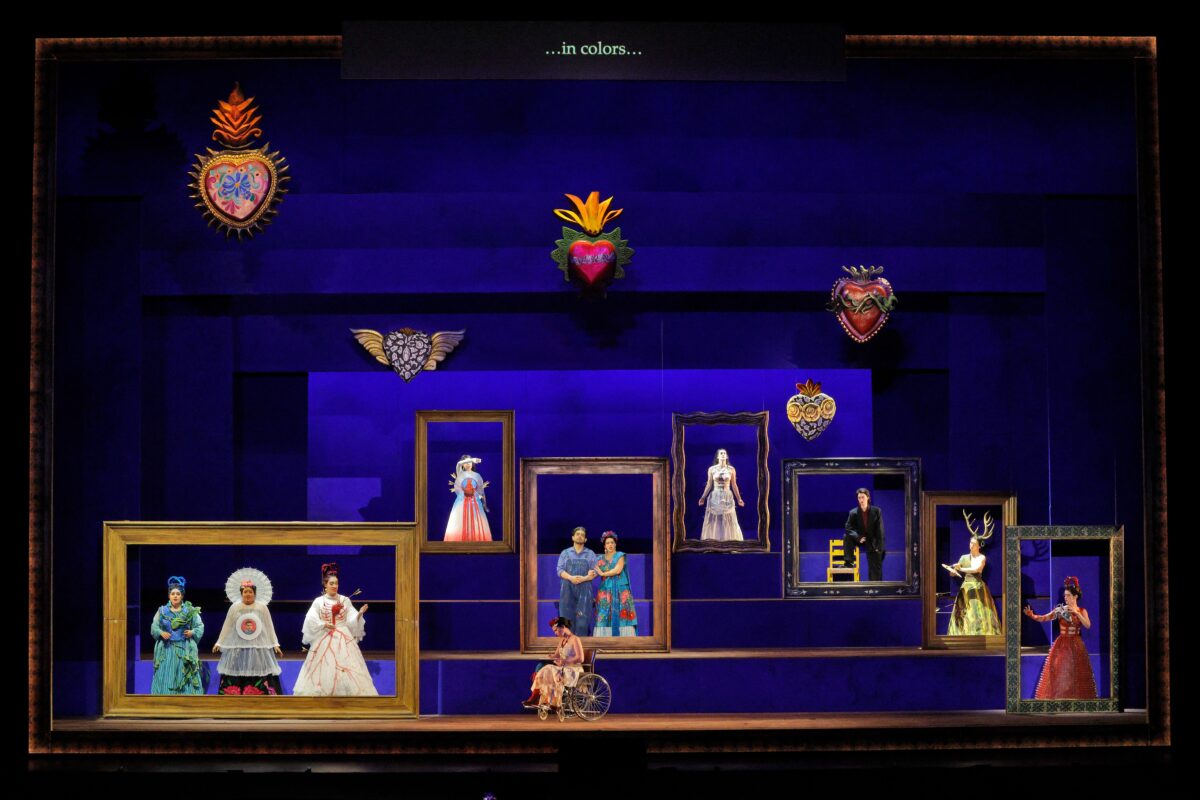
Diego (Alfredo Daza) and Frida (Daniela Mack), center, revel in their home filled with artwork in El último sueño de Frida y Diego at Lyric Opera of Chicago. Courtesy of Cory Weaver/Lyric Opera of Chicago
If Cruz’s Act II libretto doesn’t fully live up to the anticipation that is built up in Act I, at least Frank’s orchestral score is atmospherically affective and full of sonic color throughout. Frank’s orchestration includes many Latin percussion instruments, including an evocative use of the marimba to conjure up Mexico’s human and spiritual worlds. Mexican conductor Roberto Kalb does a fantastic job of leading the Lyric Opera Orchestra though Frank’s haunting score.
The aural splendor extends to the hard-working soloists and ensemble led by chorus director Michael Black. True, some of director Maza’s stage management of moving the chorus on, off and around the stage can feel a bit clunky, but the choral sound is heavenly.
Chicago audiences are also very lucky for the chance to see several veterans of West Coast productions of El último sueño de Frida y Diego. This is probably why so many of the main performances came off so strong and assuredly lived in at Lyric. Daniela Mack makes for a head-strong and commanding Frida with her weighty mezzo voice. (Mezzo-soprano Stephanie Sánchez, a veteran Kahlo with Opera Omaha, is scheduled to perform Frida on April 1.) Alfredo Daza is appropriately world weary and remorseful as the diminished Diego.
As Catrina, Ana María Martínez is a comical hoot as she brazenly wields her otherworldly powers. Martínez also gets to luxuriate in elaborate costumes while cackling out high notes through multiple character guises. As the turbaned Leonardo, Key’mon W. Murrah also gets plenty of time to shine with fierce poses and a knowing countertenor voice that rings out into the house.
The cast is rounded out by current young artists of the Patrick G. and Shirley W. Ryan Opera Center in smaller ensemble roles. As a trio of villagers, Finn Sagal, Daniel Luis Espinal and Benjamin R. Sokol do a fine job of delivering needed exposition at the top of Act I. And as singing embodiments of Kahlo self-portraits in Act II, Adia Evans, Alexis Peart and Camille Robles each harmonize beautifully together.
So much about the lives of Kahlo and Rivera have become mythologized and artistically reinterpreted over time and in so many different mediums. El último sueño de Frida y Diego certainly contributes with an intriguing premise and a visually compelling production.Too bad the opera doesn’t fully live up to its dramatic or emotional potential, even if it does do its job of celebrating the legacy of its titular artists and their enduring artworks.


