
Photo by Elman Studio
WNO announced in January that it was ending its 15-year-old affiliation agreement with the John F. Kennedy Center for the Performing Arts, citing “the Center’s new business model [which] requires productions to be fully funded in advance—a requirement incompatible with opera operations.” The move came several weeks after the Kennedy Center’s board, composed of members appointed by President Trump, who is also chair of the board, voted to add the president’s name to the institution. Last week, the board voted to close the Center for two years for renovations. (Rep. Joyce Beatty (D-OH) has challenged the renaming and upcoming closure in court and historic preservation groups have sued in an effort to block changes to the building.) WNO had performed at the nation’s cultural center since 1971.
Newly an independent organization, WNO relocated its three spring productions, all works by American composers reflecting the celebration of the nation’s semiquincentennial, to alternative venues in the region. For Treemonisha, WNO returned to George Washington University’s Lisner Auditorium, where the opera performed decades ago as the Opera Society of Washington. Lisner is also hosting WNO’s performance of Robert Ward’s The Crucible this month. WNO’s sold-out run of Treemonisha testified to enduring support for opera in the nation’s capital, regardless of what a certain Hollywood actor has to say.
Joplin may be known as the King of Ragtime, but Treemonisha is not exclusively a ragtime opera. The work follows the traditional structure of European opera but with American elements woven throughout, including African American folk music and spirituals, a barbershop-style quartet, and the ragtime genre pioneered by Joplin, which is present largely in the opera’s boisterous dance sequences. Composed in 1911, Treemonisha did not receive a complete performance until the 1970s, when it earned Joplin a posthumous Pulitzer Prize for music. Only a piano and vocal score have survived.
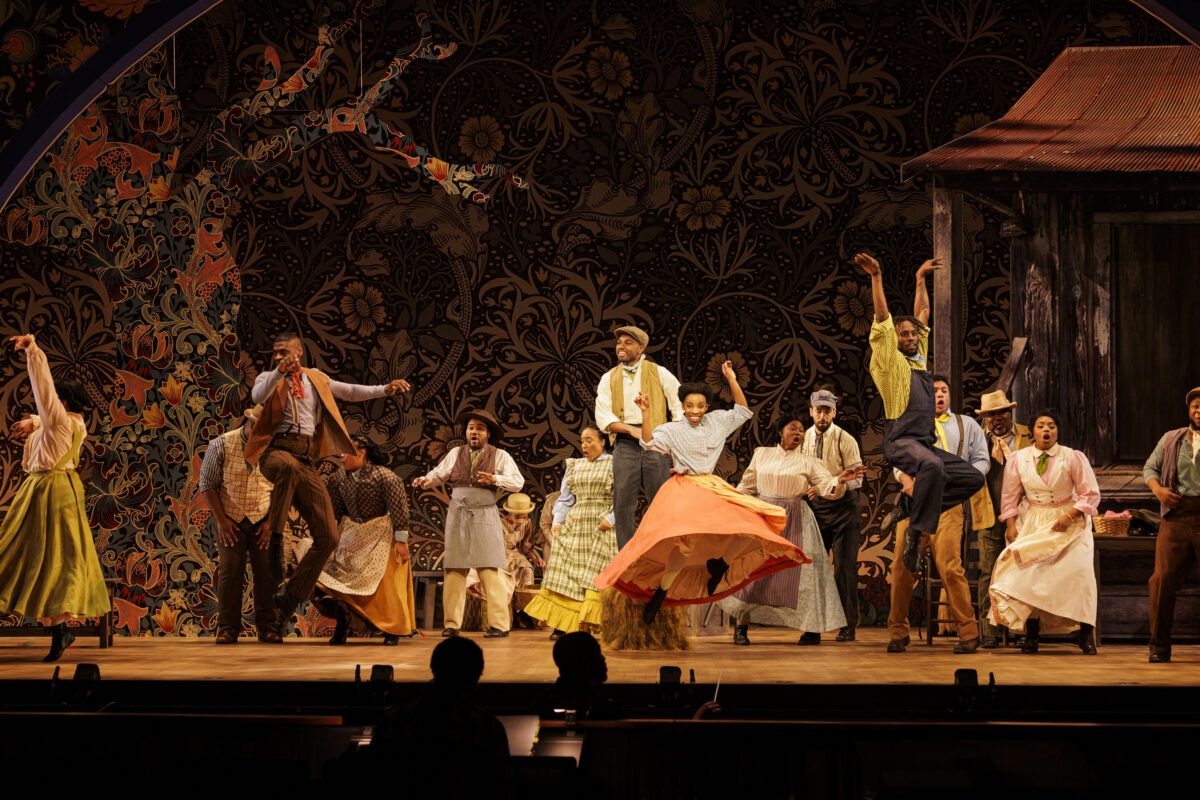
Photo by Elman Studio
Composer Damien Sneed created a new adaptation and orchestration of the opera for WNO. Sneed’s version honored Joplin’s original intent by focusing on his melodies and making modest instrumental additions without layering on excessive baggage. Sneed’s writing for the banjo (skillfully played by DeAnte Haggerty-Willis) was an effective choice that added a uniquely American spark. In his WNO debut, conductor Kedrick Armstrong, the music director of the Oakland Symphony, effectively led the WNO Orchestra in Sneed’s version of Joplin’s score with appropriate pacing.
The story of Treemonisha emphasizes empowerment for the Black community through education in the vein of Booker T. Washington, whom Joplin admired. Joplin wrote his own libretto (updated for the WNO production by playwright Kyle Bass), which is weaker than his score. There are some unresolved plot holes (why exactly the women decide to make garlands of leaves, the decision that sets the central story in motion, is unclear) and some unnecessary narration. Bass’s new lyrics, scenes, and dialogue built seamlessly on the century-old original text and helped advance the story.
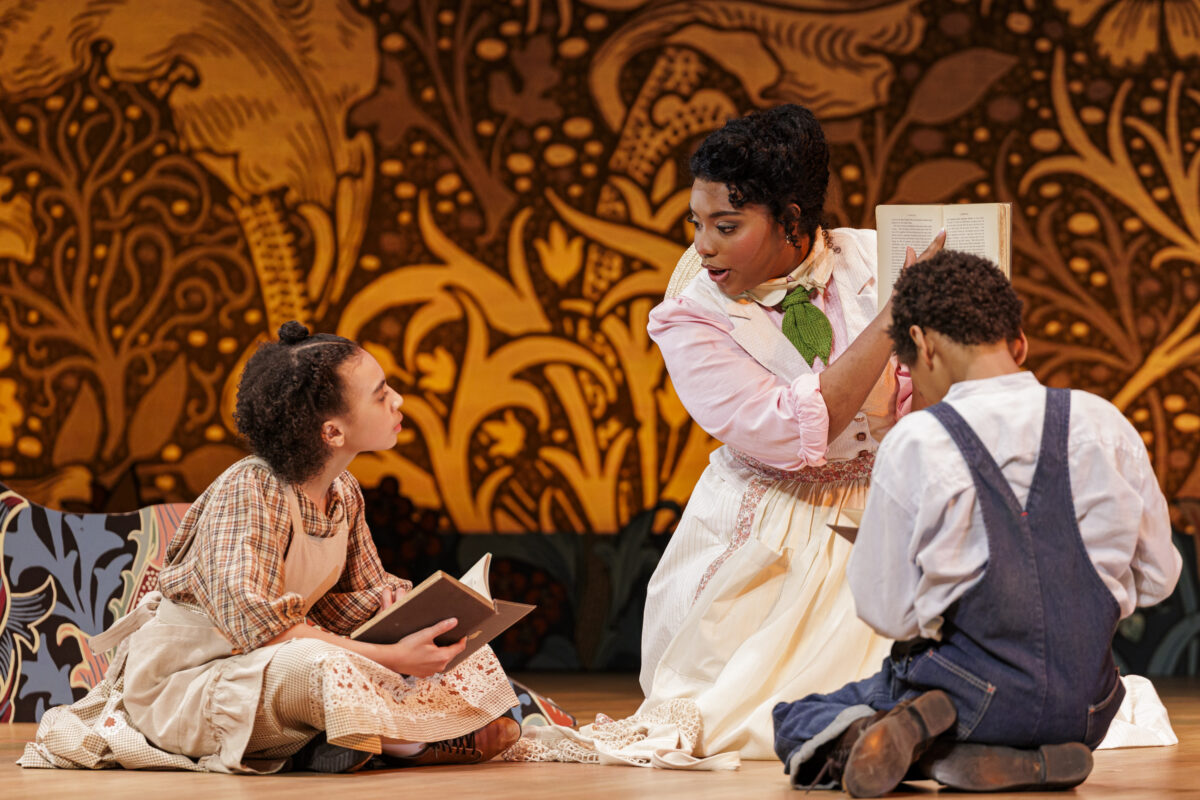
Soprano Viviana Goodwin, a member of WNO’s Cafritz Young Artists program, starred as Treemonisha. Goodwin possesses a big voice with a rich bottom register that soared over the orchestra. Singing with a distinctive warble, she sounded smoothly assertive in Treemonisha’s hymn-like arias. Sneed adapted the role of Remus, originally written by Joplin for a tenor, for baritone Justin Austin, who sang the part with a velvety touch and the gallant sincerity of a Boy Scout. Tenor Jonathan Pierce Rhodes excelled in the role of Zodzetrick, a conjurer hawking superstitions that Treemonisha dissuades her community from relying upon. Rhodes’s sinuously slick tenor made him an ideal snake-oil salesman and his expressive acting made him an effective antagonist to Treemonisha. Making her WNO debut, Tichina Vaughn lent her coppery mezzo with a strong top to the role of Treemonisha’s mother, Monisha, with a warm maternal affect. As Monisha’s father, Ned, bass-baritone Kevin Short, returning to WNO after singing the King in one of WNO’s alternating Aïda casts last fall, was protective with a good dose of humor, hitting impressively low notes.
Among the large cast of supporting roles, tenor Hakeem Henderson stood out as Andy for his effective role as a caller in one of the Act I dance sequences and his flinty delivery of the character’s call for vengeance against Treemonisha’s kidnappers in Act III. Nicholas LaGesse’s sonorous baritone made him a dignified presence as Parson Alltalk. The supporting cast sounded strong, particularly in a call-and-response worship service, the harmonies of the Act III number in which the community elects Treemonisha to lead them (“We Will Trust You as Our Leader”), and the ragtime dance that concludes the opera (“A Real Slow Drag”). Treemonisha is a dance-heavy opera and Eboni Adams’s elegant choreography, performed by Dwayne Brown, Amarachi Valentina Korie, Chivas Merchant-Buckman, and Jazmine Rutherford, lived up to the spirit of Joplin’s score, especially her rowdy Corn Huskers’ Dance and joyous “Real Slow Drag.” Robotic dancing for the wasps into whose nest the conjurers plan to toss Treemonisha stood out effectively against the flow of the other choreography.
Mezzo-soprano Denyce Graves, continuing her directing career after her recently announced retirement from the operatic stage, depicted Treemonisha as a humble yet courageous leader. Graves’s production powerfully evoked the Reconstruction-era South, capturing the joy and pride of Treemonisha’s community even as they faced danger from the troupe of conjurers on one hand and white supernumeraries, who inspected papers and oversaw the labor of Black farmworkers, on the other hand. Her blocking of the large cast made effective use of Lisner’s smaller stage, particularly in the charismatic worship scene, which featured characters having full-body religious experiences. Under Graves’s direction, the conjurers were reminiscent of African or Caribbean folk traditions. The creative team’s decision to add a new romance between Treemonisha and Remus, finishing with a wedding and jump over the broom in the final scene, added greater emotional resonance to the story. Other choices were not as successful: A pantomime of Treemonisha’s life story during the opera’s overture gave away the plot before Monisha revealed her adoptive daughter’s origins to her in one of the opera’s major arias, while sound effects of growls during Treemonisha and Remus’s flight from the forest proved to be more cheesy than threatening. Set design by Lawrence E. Moten III effectively suggested the era with a small ramshackle house and attractive patterned backgrounds resembling the 19th-century floral designs of William Morris and the Arts and Crafts Movement. Costumes by Lynly A. Saunders created a striking contrast between sober late 19th century period outfits and riotously colorful patched looks for the conjurers.


