
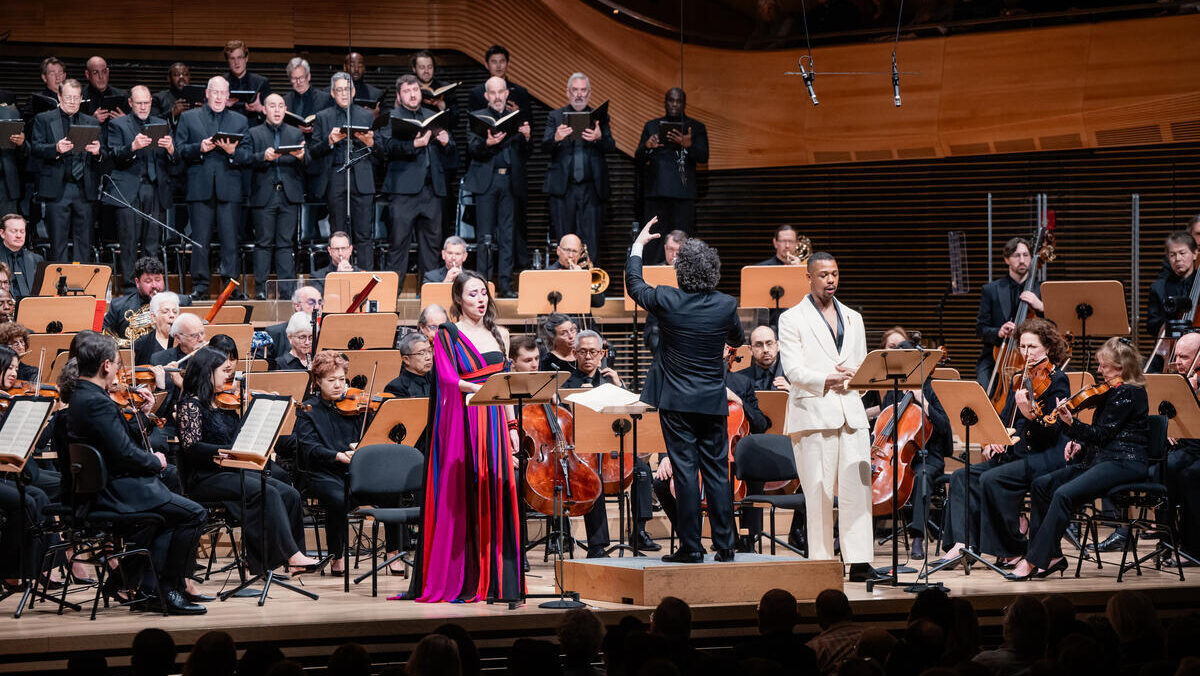
Photo by Brandon Patoc
David Lang’s music is so often deadly serious—dark, austere, haunting, even punishing—but always, perhaps hidden somewhere just below the surface, we can detect the operation of a dry, sharp wit, and his new, evening-length oratorio for the New York Philharmonic, premiered at Geffen Hall on Thursday night, is no exception.
Its premiere coinciding with the 250th anniversaries of both the United States and of the Adam Smith treatise that lends the piece its title, the wealth of nations draws its texts from a variety of sources, including Smith himself, and—are you imagining a paean to economic freedom and rugged American individualism?
Think again. The joke, if I can go so far as to call it that, of the wealth of nations, is that the work is animated not by the Spirit of Free Enterprise but by the ghost of Karl Marx. Lang sets passages in which Adam Smith describes labor as the original unit of value, the commodity as the sum of the labor that created it, and civil government as a mere tool for protecting private property. The last movement sets Smith’s warnings against the danger and injustice of extreme disparities of wealth, e.g.:
“No society can surely be flourishing and happy, of which the far greater part of the members are poor and miserable. It is but equity, besides, that they who feed, clothe, and lodge the whole body of the people, should have such a share of the produce of their own labour….”
Taken together, these quotations sound like the ravings of a radical socialist, by the standards of 21st-century America. One can only conclude that, just as none of the people calling America a Christian nation seem to have studied the teachings of their Christ, none of the laissez-faire fanatics running our world have read capitalism’s bible, either.
Other writers quoted in the piece include the great Frederick Douglass on the hoarding of wealth, Maria W. Stewart—a Black abolitionist and women’s rights activist totally unknown to me—on the exploitation of labor, and Ralph Waldo Emerson, also describing the labor theory of value in a poetic passage from “Wealth.”
The score itself is one of Lang’s most inviting, the culmination of decades of artistic growth. Always an exciting composer, he reached a new level in 2007 with The Little Match Girl Passion, in which process-driven text setting (think Arvo Pärt) met elastic polyrhythms and spare—maybe I should say bleak—textures and harmonies, to retell Hans Christian Andersen’s tale of a homeless child freezing to death at Christmas. Severe in its technique, darkly ironic in its appropriation of Christian forms and texts to tell this grim story of an anti-Nativity, Lang’s Passion remains one of his most moving works.
A few years later, he turned another corner with “Simple Song #3,” an orchestral song that dressed his musical processes in sumptuous post-Romantic drag to play the part of a beloved British composer’s magnum opus in the movie Youth by Paolo Sorrentino. (Anyone exhibiting residual symptoms of Oscar Fever may recall that soprano Sumi Jo, who lost the Oscar for Best Original Song to fucking Sam Smith’s 007 theme that year, wasn’t even invited to sing “Simple Song” on the telecast. Yes, I am still mad about this.)
Lang empties out his bag of tricks for the wealth of nations. His style, however defined, is ideally suited to a piece about economics: it ticks along busily but unpredictably, like a vast mechanical system with a persistent and unsettling malfunction. Using the huge resources of large orchestra, chorus, and dual vocal soloists to create a work of depth and variety unprecedented in his career to date, veering from rich and pleasant to icy and stark. The result is dramatically thrilling, like if Carmina Burana had been written as an arch American oratorio about socialism instead of a Nazi oratorio about nothing in particular.
An opening movement bustles with bright orchestral activity, as if to underscore a movie montage of American finance and industry, gives way to an ominous chorus about self-interest as the animating force of capitalism; later, Copland-esque syncopations and warm, spacious harmonies underscore a passage in which Smith seems to anticipate Marx’s theories of value and commodity fetishism—perhaps as a nod to Copland’s own socialist leanings?
The vocalists at Thursday’s premiere were well matched to each other—dark tones, low fach, big vibrato—and to the material. Bass-baritone Davóne Tines, with his booming instrument and covered delivery, sounded like an Old Testament prophet delivering the Word of God, and British mezzo Fleur Barron, in her Philharmonic debut, almost went over the top with her displays of emotion, bending the pitch like an opera singer performing an especially serious number from the Black spiritual rep.
And operatic they were. There is even a dramatic scene in the oratorio, a comic dialogue on the nature of privilege drawn from Edith Wharton’s House of Mirth. In a later movement, setting words apparently misattributed to FDR—“If ever there are, in this country, people who are rich enough to own this country, then they will own it”—she climbed up into her break in pure chest voice, poco vibrato, to create a deeply disturbing sound, like a mezzo in a Verdian character role. (The actual quote seems to be adapted from Woodrow Wilson’s The New Freedom.)
The New York Philharmonic Chorus, directed by Malcolm J. Merriweather also gave a spectacular performance in the often challenging choral part—the emotional climax of the piece, Lang’s setting of the Statement to the Court by Eugene Debs, had a soprano soloist banging out high Cs non vibrato. (This movement, originally dating back to Lang’s Match Girl Passion era and written in a similar style, has already been recorded, and I highly recommend giving it a listen.) The Philharmonic itself likewise sounded terrific, making it through the rhythmically unforgiving score without missing a click.
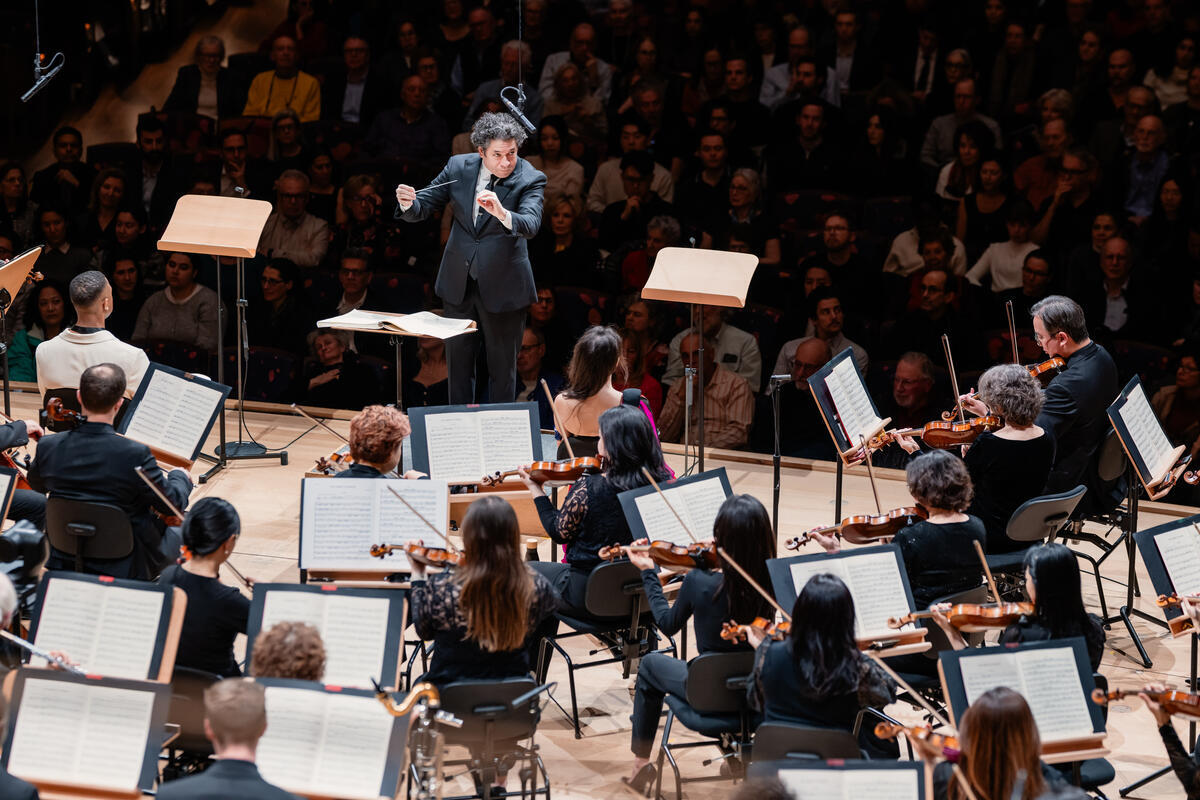
Photo by Brandon Patoc
The biggest star of the night, of course, was the orchestra’s next Artistic Director, Gustavo Dudamel. He deserves every bit of applause—he programmed this incredible work, he led the Phil as a cohesive unit through layers upon layers of syncopation—but wow, people just go nuts for that guy! This is the second Philharmonic concert of his I’ve reviewed in a row, both featured new works by interesting composers, and both absolutely brought the house down. Is this just what it’s going to be like in New York now?? Good, interesting new works filling the seats of Geffen and getting curtain call after curtain call? Honey, I could get used to this.
But mostly, I hope that this piece, a high point of Lang’s body of work, makes its way into the standard repertoire. The surprising beauty of the text, the compelling drama of the music, and the perennial relevance of the theme fairly beg for numerous revivals. Likewise, I hope that this spectacular showcase for Lang’s compositional voice leads to more commissions like this—I’m dying to hear what he could do next, with resources like these at his command.


