Photo by Courtney Ruckman
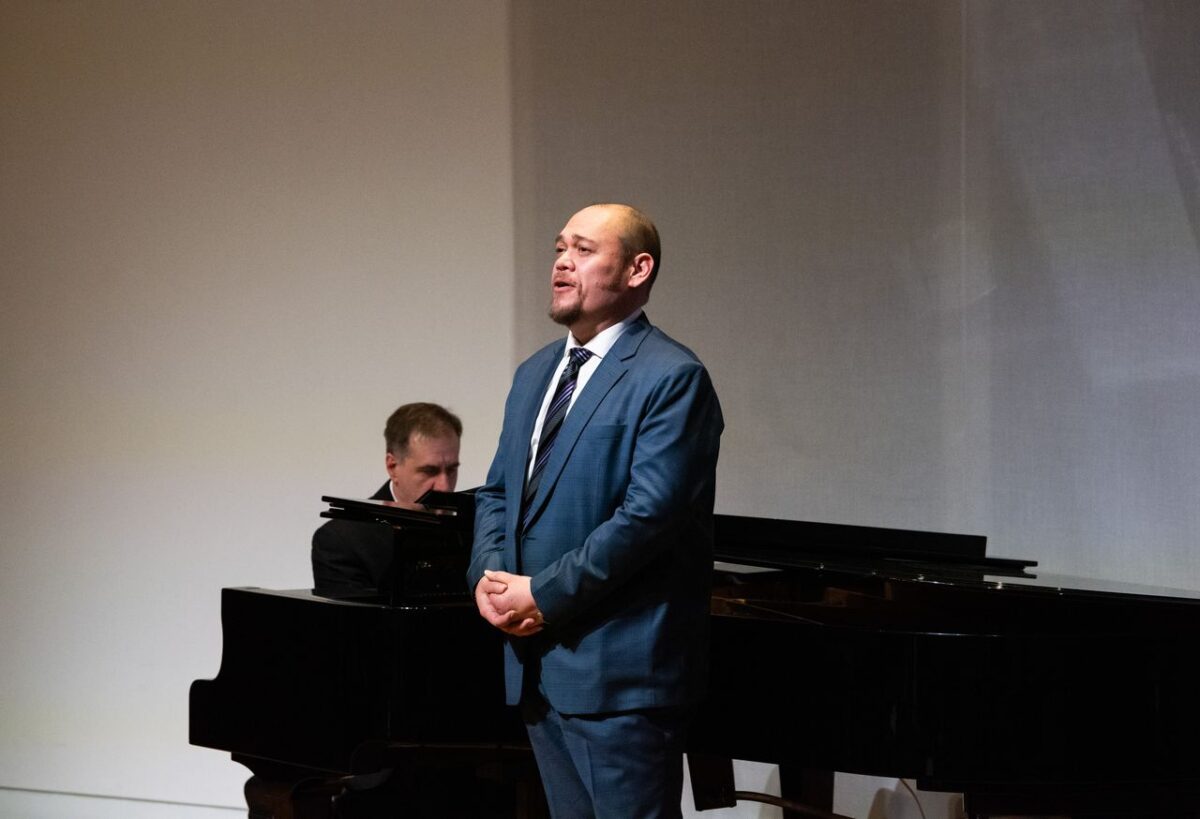
Known as a preeminent Verdi baritone, Kelsey took an alternative approach with this program, which featured exclusively American and British composers setting text in English. Kelsey has a powerful instrument, which this recital revealed at its best. Like the comfortably worn-in leather of a favorite chair, his pliable baritone deftly handled the emotional range of the selected art songs and capably handled transitions between fortissimo and pianissimo moments. Kelsey is a charismatic performer who fully inhabited the speakers of each of the songs.
Fittingly for the US semiquincentennial this year, the program opened with four selections from Aaron Copland’s first Old American Songs collection. Copland’s songs evoking scenes of American life provided a suitable template for Kelsey’s quicksilver baritone, which nimbly navigated the composer’s oscillations in tone and tempo, such as in “The Boatman’s Dance.” The push and pull of this song showcased the effective collaboration between Kelsey and Ketter. In “Simple Gifts,” one of Copland’s well-known melodies, Kelsey sounded stately and poised. The program’s inclusion of Copland’s “The Dodger,” which begins with questionable promises made by politicians (before moving onto hypocritical preachers and unfaithful lovers), was perhaps a sly nod to the recital’s location in Washington, DC. Kelsey’s seamless transition from bottom to top range was evident in these selections and his smooth legato nicely characterized Copland’s pastoral themes, particularly his solemn delivery of “Long Time Ago.”
The program continued with settings of Langston Hughes poems by three American composers: Florence Price, John Alden Carpenter, and Margaret Bonds. Written in the 1920s, the Hughes poems featured were influenced by jazz and speech; the musical settings helped them come alive off the page.
Kelsey gave an impassioned performance of Price’s “Song to The Dark Virgin,” enhanced by fiery resonant vibrato in his bottom range. His rendition of her setting of “My Dream” was a tour de force inflected with yearning and defiance. Ketter and Kelsey gamely conveyed the jazzy melodies of Carpenter’s art songs with quick-footed rhythm and limber pacing, and Ketter effectively set a brisk mood at the piano. Kelsey’s instrument lends itself to a variety of colors in conveying emotion and the tone shifts from joyous to solemn of “Shake Your Brown Feet, Honey” showed him at his best. Kelsey is also adept at taking lines or even individual words and wringing emotional impact out of them, as in the expressive exhaustion of his “Hey!…Hey!” in Carpenter’s “The Cryin’ Blues.” In “Jazz-Boys,” Kelsey brightened his baritone, adopting a magnanimous cabaret style that earned some of the biggest applause of the evening. The program rounded out the Hughes portion of the evening with three settings by Bonds, a student of Price, including her own variation on “My Dream.” Kelsey sang an excellent interpretation of Bonds’s “The Minstrel,” a selection that brought to mind his signature role of Rigoletto (Mid-Atlantic audiences will have the chance to see him in the role with the Baltimore Symphony Orchestra in June). He sang a fierce, defiant rendition of Bonds’s setting of “I, Too,” one of Hughes’s best-known poems.
Kelsey then transitioned to the British half of the evening, which began with Let Us Garlands Bring, Gerald Finzi’s five-song cycle of settings of songs from plays by William Shakespeare. Kelsey opened the cycle with a fresh, lovelorn take on “Come Away, Come Away Death” from Twelfth Night, finishing the song with a lovely melisma on “weep.” The cycle’s second song “O Mistress Mine,” concludes with “Youth’s a stuff will not endure,” an appropriate nod to Kelsey’s history with Vocal Arts DC. This recital marked his return to the Vocal Arts stage following his debut with the organization, under the auspices of the Marilyn Horne Foundation nearly 20 years ago—a period that encompassed his evolution from young artist to internationally known singer. The highlight of the Finzi song cycle was “Fear No More the Heat o’ the Sun,” a song taken from Cymbeline. (Sung by a lost son of the titular king, the song mourns his friend, who is actually his sister disguised as a man, and who is not actually dead but took a sleeping potion—it’s one of Shakespeare’s more convoluted plots). Kelsey’s stately chest voice made the song an affecting elegy. Kelsey sang two of the more light-hearted songs of the cycle with bounding exuberance, “Who is Sylvia?” from The Two Gentlemen of Verona, and “It Was a Lover and His Lass” from As You Like It, particularly excelling with the colorful onomatopoeia in the latter song.
The recital wrapped up with Ralph Vaughan Williams’s Songs of Travel, a nine-song cycle set to poems by Robert Louis Stevenson. In “The Vagabond,” Kelsey effectively expressed a sense of wanderlust, accentuated by Ketter’s ostinato rhythm on the piano reminiscent of a hiking pace. In “Let Beauty Awake,” “The Roadside Fire,” and “Youth and Love,” Kelsey’s plush baritone made for a tender delivery of meditations on beauty, love, and the fleeting nature of youth. Kelsey mined the riches of his voice for a luxurious and sophisticated take on “In Dreams,” a highlight of this section of the program. He continued the Vaughan Williams portion with a pensive performance of “The Infinite Shining Heavens” and a nourishing rendition of “Whither Must I Wander,” a paean to home, which probed the softened depths of his lower register. The program wrapped up with “Bright Is the Ring of Words,” which showcased Kelsey’s smooth transition from chest to head voice and more vibrato well-suited to the reflective tenor of Vaughan Williams’s music, and the gleaming pint-sized song “I Have Trod the Upward and the Downward Slope.”
Kelsey treated audiences to two encores. After sharing some moving remarks on vulnerability as a singer, Kelsey gave an emotionally raw and honest performance of William Arms Fisher’s song “Goin’ Home,” based on the English horn solo from the largo movement of Antonin Dvorak’s Symphony No. 9, famously recorded by Paul Robeson at a 1958 Carnegie Hall concert. He followed it with a golden rendition of “Warm as the Autumn Light” from Douglas Moore’s opera The Ballad of Baby Doe, continuing the program’s English-language focus with the only opera aria of the evening.