
Photo by Barbara Mallon
Così fan tutte, the last of Mozart and Da Ponte’s three operatic collaborations, is a tricky work to stage. The plot, in which two young soldiers set out, under the guidance of an older, more experienced friend, to test the fidelity of their fiancées, is misogynistic and borderline abusive, starting with the title: “Women are like that.”
In brief, Ferrando (the tenor) loves Dorabella (the mezzo, usually); Guglielmo (the baritone) loves Fiordiligi (Dorabella’s soprano sister). The soldiers’ friend Don Alfonso urges the soldiers to disguise themselves as Albanians and seduce the other’s fiancée, while he connives with the sisters’ maid Despina to further the plot. Also, some money rides on the outcome.
Yes, it’s awful, and the soldiers just don’t deserve their fiancées. Nonetheless, Così is extremely funny and full of great music, and offers a director a range of approaches. You can stage it as pure farce, stretching what’s built into the plot to extremes. You can take it seriously, allowing real love to develop between the switched couples, with any number of consequences – although, of course, the opera takes place over a ridiculously short time period.
The sisters can figure out the plotting early on and respond accordingly or they can be innocent (foolish?) enough to be taken in by the soldiers. (The soldiers aren’t too bright themselves, considering how easily Alfonso manipulates them into testing their lovers.)
In other words, the director has to have a point of view. At Livermore Valley Opera’s production of Così, seen at its opening performance on Saturday, Feb. 28, director Robert Herriot’s point of view didn’t snap into focus until much too late in the opera, when he injected an excellent twist ending into the plot. But along the way, it was hard to see a through line in the relationships among the two pairs of lovers, and the plot wasn’t taken to any of the possible extremes. Maybe he was aiming for the farcical side, because there were plenty of laughs and sight gags.
In general, the performance felt as though perhaps another rehearsal or two was needed. Conductor Alexander Katsman’s tempos had less snap than usual for him and the orchestra occasionally scrambled to stay together. There were more pit-stage coordination problems than I’ve heard before at Livermore Valley. And somehow the performance didn’t quite lift off until the entrance of the Albanians, well into Act I, though the trio “Soave sia il vento” (Gentle be the breeze) was sweetly sung and moving. With more rehearsal time, Herriot, whose work in the company’s Don Giovanni I enjoyed, might have further strengthened the staging.
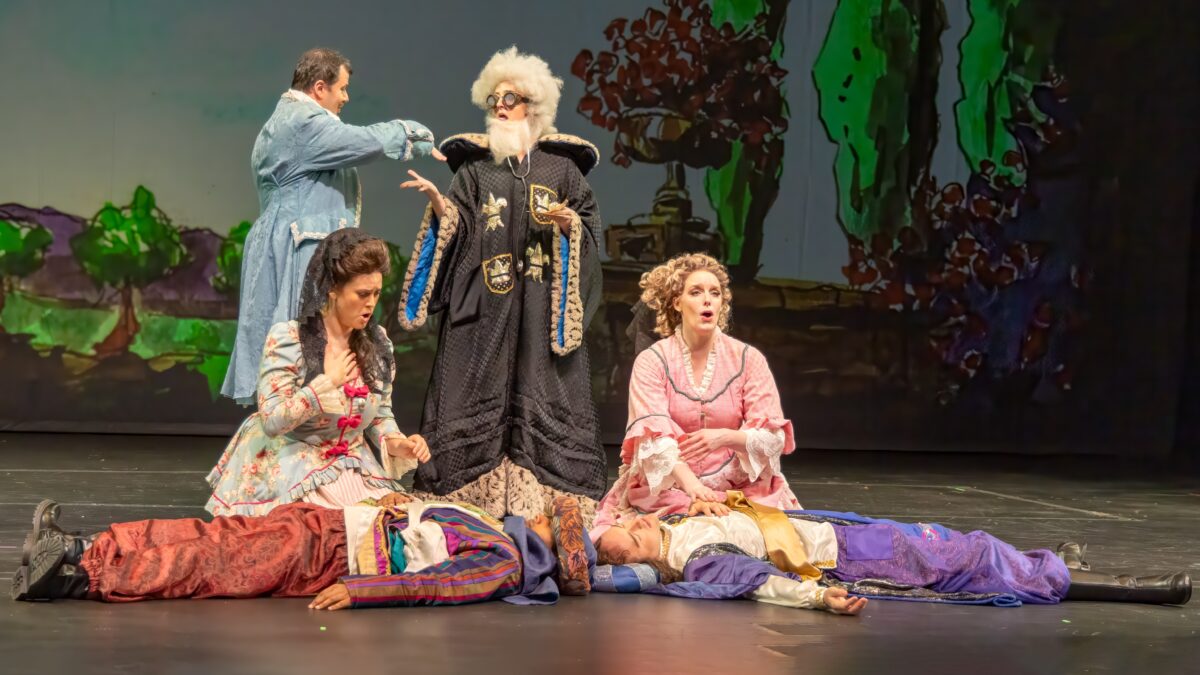
Still, there was much to enjoy in the performance. As Despina, mezzo-soprano Courtney Miller used every bit of vocal and physical wizardry to make the character’s two dress-up scenes, as the Doctor and the Notary, laugh-out-loud centerpieces of the opera. She was dramatically a delight throughout, though her top is short for a role usually sung by a light soprano, and the ensembles would have been better balanced with such casting.
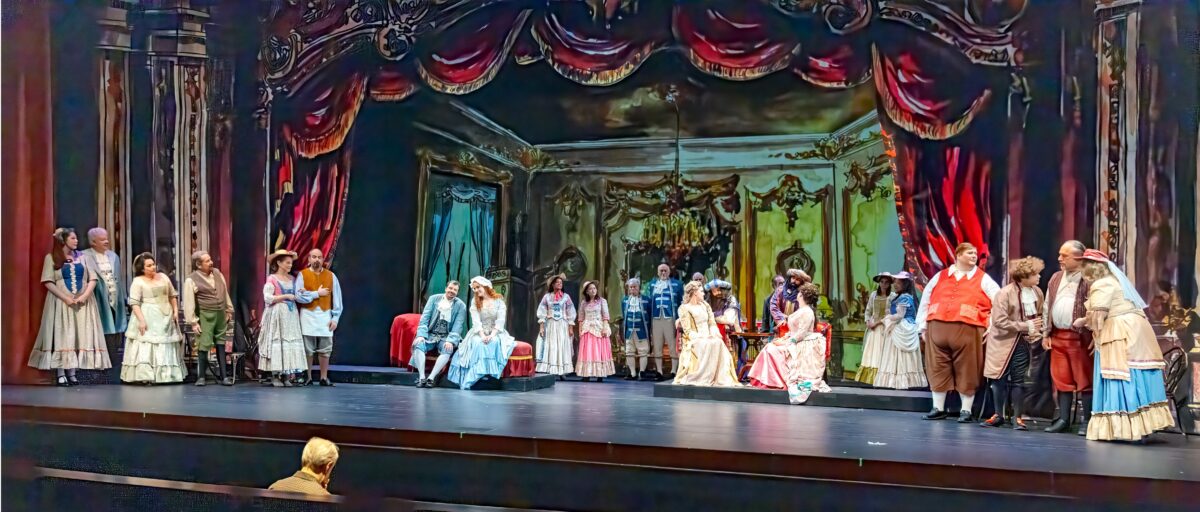
Photo by Barbara Mallon
Soprano Meryl Dominguez (Fiordiligi) and mezzo-soprano Megan Potter (Dorabella) worked together well as the sisters. Dominguez sailed through “Come scoglio” (Like a rock) with aplomb and sang a touching “Per pieta.” Potter’s a good actor, but vocally the role wasn’t a great fit. Her voice had an oddly squeezed quality from time to time and the role’s upper notes were a stretch.
On the male side, the situation was similar. Baritone Samuel Kidd, a delightful Schaunard in last year’s San Francisco Opera La bohème, was a hearty, though not very seductive, Guglielmo. Sid Chand’s voice is more that of a character tenor than a romantic lead; “Un aura amorosa” (A breath of love) would have benefitted from more float and warmth.
Eugene Brancoveanu deployed his bright, beautiful baritone effectively as Don Alfonso, and yet seemed under-directed in a role that provides great opportunities for such a skilled and experienced actor.
The chorus, under the direction of Bruce Olstad, sang well.
Two performances remain, at 2 p.m. on Saturday, March 7 and Sunday, March 8. The 500-seat Bankhead Theater, where the company performs, is a wonderfully intimate venue, and those performances may well go more smoothly than than the first.


