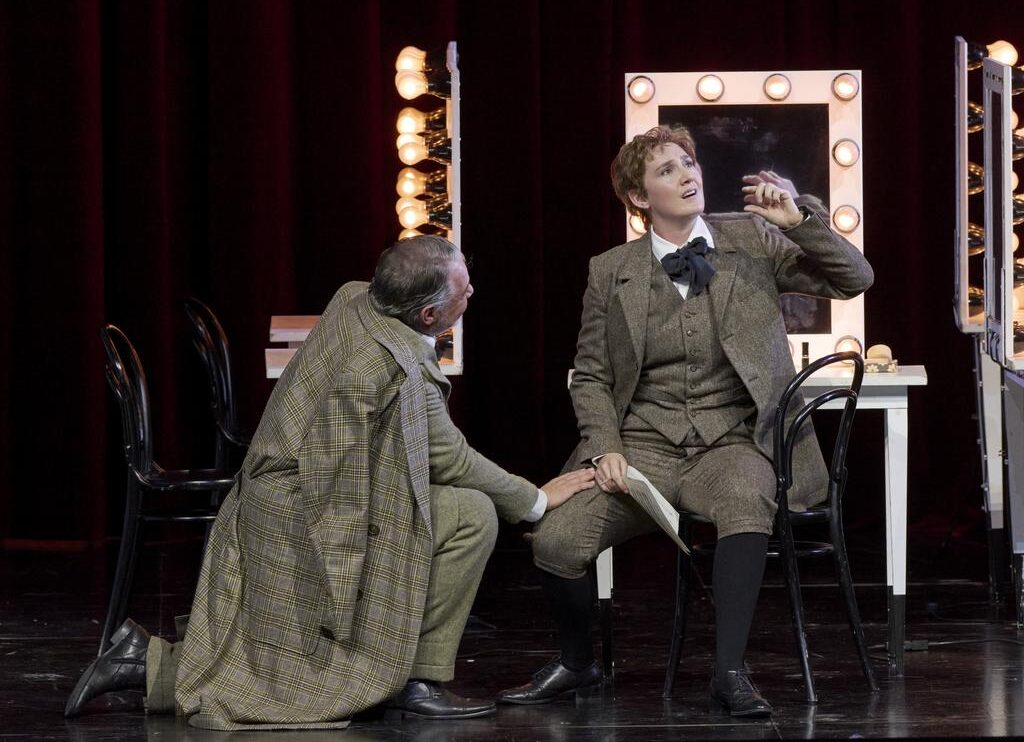
Photo by Michael Poehn
Sven-Eric Bechtolf’s production of Ariadne auf Naxos has been a reliable vehicle in Vienna, rolled out almost every season at the Staatsoper since its 2012 premiere. Even in its twelfth revival, it’s easy to see the draw: it’s a handsome staging that aspires to be nothing more than easy entertainment – and does it outstandingly well.
I do not mean to damn with faint praise. Bechtolf’s concept, inherited from its original Salzburg outing (where the 1912 version was staged), is as solid as it is straightforward, depicting the performance of the “opera proper” as it may have taken place. Fittingly, it’s chaotic and ridiculous, artistic integrity ceded to the funder’s whims and vanity: performers break character left and right, the Composer, his teacher, and the Dance Master intrude on the stage action with abandon, and “the richest man in Vienna” and his honorable guests watch happily on. Little remains, of course, of the themes Hofmannsthal once described to Strauss (unless one applies it to Ariadne, the Composer’s work, rather than Ariadne the character): “fidelity; whether to hold fast to that which is lost, to cling to it even unto death—or to live, to live on, to get over it, to transform oneself, to sacrifice the integrity of the soul and yet in this transmutation to preserve one’s essence, to remain a human being.”
But what there is, is done very well indeed, bubbling nicely along like a glass of champagne. Visually, the staging is undeniably appealing: Rolf Glittenberg’s sets move the action to an interwar mansion, airy, spacious, and perfectly chic, always evocatively lit by Jürgen Hoffmann’s light design (though in the opera proper, the design’s consistency is utterly undermined as the performers act with their backs to their supposed audience). Marianne Glittenberg’s costumes, from Zerbinetta’s polka dot dress and her troupe’s ragtag buffo getup to the Composer’s boyish, pointedly othering fin de siècle garb, colorfully depict personalities and class distinctions both.
The stage action, meanwhile, is vivid, mostly without being exhausting. Characters are emphatically drawn, stage movement is choreographed impeccably to the music, and the jokes land with certainty. And rather than just going all in on the clown show, the staging does offer a touching follow-up on the brief flirtation between Zerbinetta and the Composer, with the two circling each other with giddy flirtation through the opera, and reuniting with a kiss in the finale. A recent interview in Opera Now with Barrie Kosky has heralded a new Ariadne for Vienna: I will, admittedly, be a touch sad to see Bechtolf’s staging go.
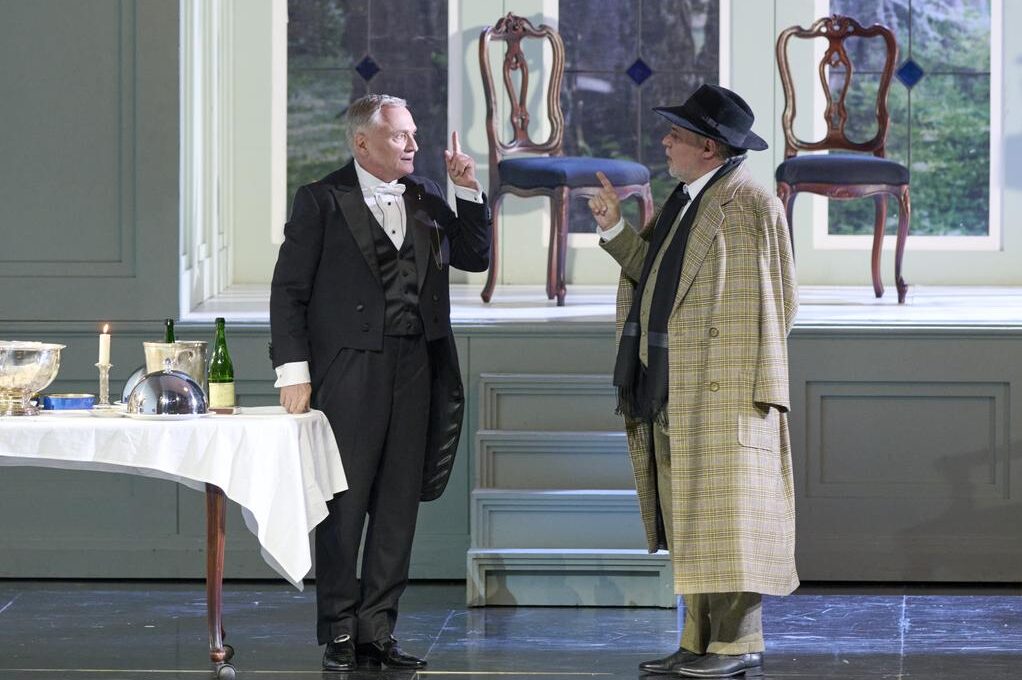
Musically, the evening offered considerable if not unsurpassable enjoyment. Last season’s revival headlined the Met’s current Wagnerian Traumpaar, Lise Davidsen and Michael Spyres, as the godly pair. This year, the production featured an almost all-American main quartet with Samantha Hankey, Erin Morley, Anja Kampe, and Clay Hilley: a more than respectable cast turning out to be more than the sum of its parts.
Above all stood Samantha Hankey’s impassioned, boyishly earnest Composer, in a performance that merits nothing but praise. Hankey’s smoky-hued mezzo, remarkably even and well-projected through her entire range, sailed through the role’s soprano heights with ease, offering sensitive phrasing and searing intensity: her “Seien wir wieder gut!” would allow no questions that music is the holiest of all arts.
There can be little doubt about Erin Morley’s abilities once she sails into the stratosphere: her “Großmächtige Prinzessin” was tossed off with ridiculous ease, spontaneity, charm and humor, and her Zerbinetta was altogether delightfully performed. (A rather underpowered middle register in the Prologue, however, definitely made me miss the even warmth of Sara Blanch from last season).
Impressions were more mixed on the ‘heroic’ couple. In my admittedly short time of opera-going, I’ve had the good fortune to hear Anja Kampe as Sieglinde sing the most effortless, radiant “O hehrstes Wunders” one can imagine. Since then, she’s graduated to Brünnhilde and the voice now unquestionably wears the Valkyrie’s battle scars. Her chest voice is powerful enough to make one tremble at the resounding darkness of “Totenreich,” but the top is beleaguered – and it doesn’t help that my ears still ring with the sheer vocal prowess and effortlessness exhibited by Lise Davidsen a year ago. To Kampe’s credit, though, she was nevertheless extremely touching in the final scene with Bacchus, perhaps because the staging finally allowed her to take Ariadne and her situation seriously and earnestly, resulting in some luminous-toned, sensitive and incredibly moving singing: an almost startling tipping over into the sublime.
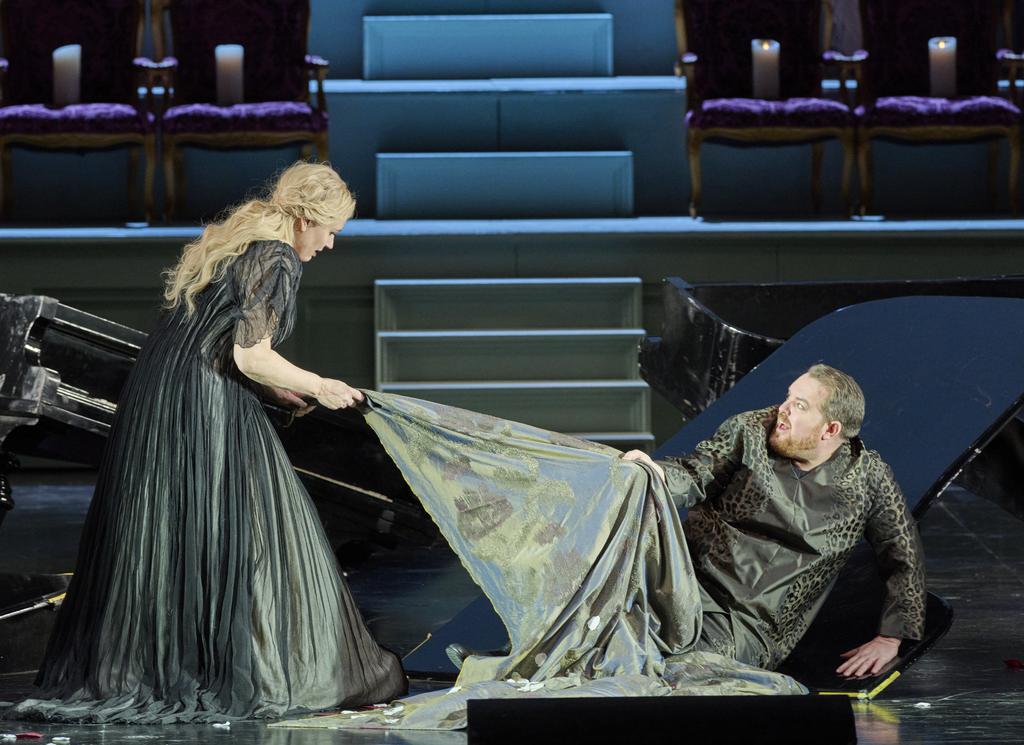
Photo by Michael-Poehn
As Bacchus, Clay Hilley showed off a decidedly more Helden-natured instrument than Spyres had, bronze-toned and trumpet-like, though its full force only became apparent as he blazed through his final lines, palpably pacing himself through the scene before. Not that I much missed a Siegfried-type screaming match: Hilley acquitted himself as commendably as possible in the role, and his attention to the text and his genuine chemistry with Kampe’s Ariadne definitely served to elevate the opera’s final scene.
In the supporting roles, Jochen Schmeckenbecher brought slightly world-weary gravitas to the Music Teacher, less velvety-toned than Adrian Eröd, but powerful and empathetic, while Jörg Schneider’s Dancing Master provided the comic touches without too much mugging. Zerbinetta’s gaggle of clowns was enthusiastically performed by reliable ensemble members Stefan Astakhov, Andrea Giovannini, Simonas Strazdas, and Hiroshi Amako. Bernhard Schir’s Major-domo tended towards a somewhat one-note tone of insipid arrogance.
In the pit, Cornelius Meister took up the reins again after last year’s outstanding performances, not quite delivering the same felicitous results. The Prologue was somewhat out of joint, the conversational passages oddly lagging, in stark contrast with the convincingly intoned sweeping passion of the Composer’s outbursts. Thankfully, things got rapidly back on track for the opera proper. Sensitively phrased and drawing an achingly sumptuous sound from the woodwinds and the strings, Meister led with a sure hand here, offering a startlingly explosive rendering of the moment of recognition between Ariadne and Bacchus, and a radiant, deeply affective reading of their duet. The old adage was proven true: all’s well that ends well.


