
Photo by Dave Pearson
The latest collaboration between Heggie and Scheer, whose previous works include Three Decembers and Moby-Dick, Intelligence centers on Elizabeth Van Lew and Mary Jane Bowser. Elizabeth, a socialite in the Confederate capital of Richmond, ran a spy ring in support of the Union during the Civil War of which Mary Jane, born into slavery in the Van Lew household, was an instrumental member. During her life, Mary Jane went by a variety of different names (the last name Bowser in the opera reflects her marriage to a man named Wilson Bowser, but no primary sources indicate that she used the Bowser name herself). Historical information on the pair is murky, leaving Heggie and Scheer to fill in the blanks.
The lengthy first act introduces the cast of characters and showcases the duo’s spying exploits. Intelligence begins with Mary Jane and Lucinda, a mysterious woman who appears to know a lot about our heroine yet is seen only by her. Travis Briggs, a member of a Confederate militia, and Elizabeth’s sister-in-law Callie Van Lew, a true believer in the secessionist cause, seek to stop them in vain (while also carrying on a Gone with the Wind-esque affair during Callie’s husband’s absence). Elizabeth and Mary Jane devise a plot: Mary Jane will infiltrate the Confederate White House to obtain secrets to help the Union win the war. Under an assumption of being illiterate, Mary Jane can evade suspicion. As Mary Jane reckons with a faltering marriage (Wilson is also a member of the spy ring), she also confronts confessions of love from Henry, Confederate President Jefferson Davis’s butler. The shorter second act addresses the women’s attempts to avoid being discovered and dives more deeply into Mary Jane’s personal history. Scheer’s libretto is dramaturgically effective, though you don’t have to be a Civil War buff to wish for more details on the spying, an intriguing subject that isn’t fully developed in the opera.
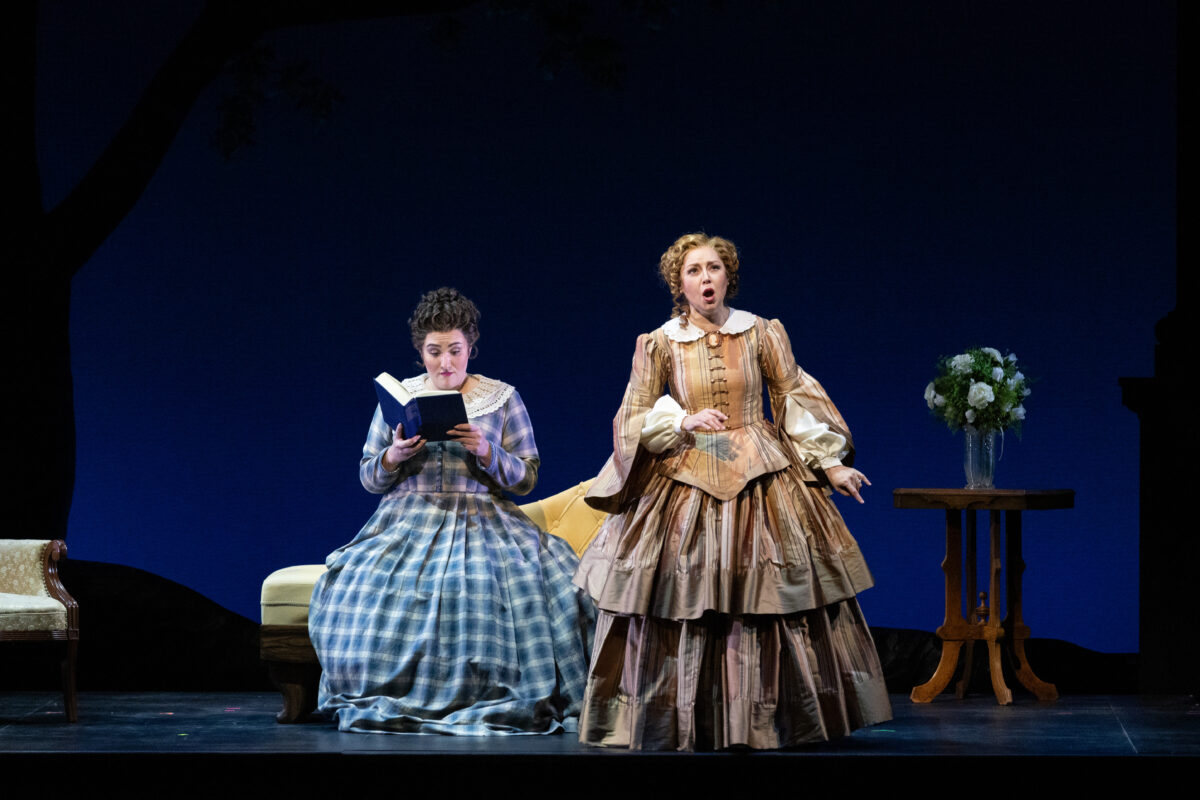
Photo by Dave Pearson
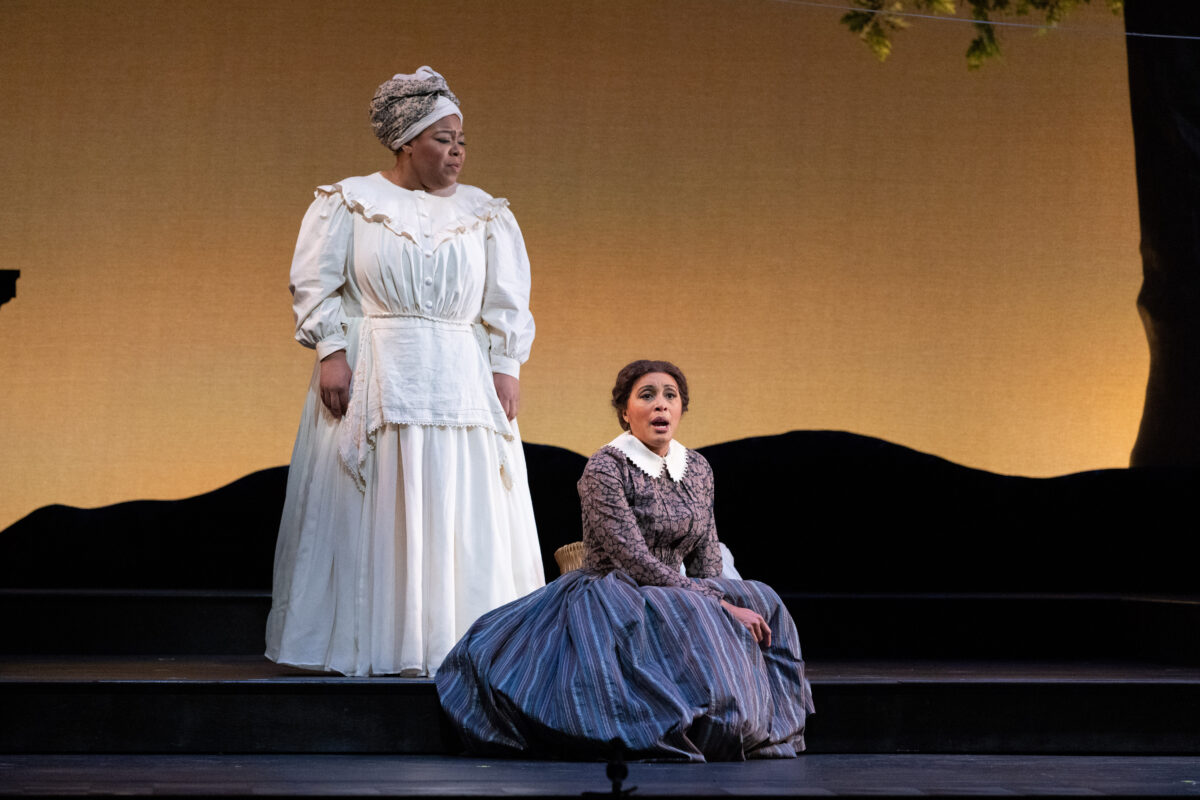
Heggie’s cinematic score builds tension appropriate to a spy story and his rich deployment of percussion immerses the audience in a soundscape reflecting the Civil War. Booming timpani and martial drum rolls suggest the front lines (the opera takes place in approximately late 1864), while gleaming scrapes of the cymbals and tam-tam suggest bayonets and swords. Intelligence opens with a soulful, bluesy melody as Mary Jane sings a lullaby while hanging laundry at the Van Lew mansion. This theme continues when Lucinda joins her and returns when the secrets of Mary Jane’s past are ultimately revealed, a haunting meditation on memory. After the opening, the orchestra rolls into an urgent pulse, a propulsive energy that the opera maintains, akin to a war film. An infectious earworm melody, launched in the pit with different instruments taking turns and taken up by the voice, accompanies Elizabeth and Mary Jane’s intelligence-gathering work and recurs throughout the opera. Heggie’s use of pizzicato as the women sing about sneaking around adds a thoughtful touch.
Heggie and Scheer’s powerful ensembles, often featuring characters singing the same words but with different connotations, elevate the vocal writing, which occasionally flags. The Civil War touched everyone in society and famously pit “brother against brother,” and the libretto’s double meanings hint at individuals’ complex experiences of the conflict. While I’ve found that contemporary opera libretti can sometimes tend to read like screenplays or scripts for straight theatre, Scheer’s frequently rhyming text for Intelligence snugly fits the vocal lines without superfluous elements.
Virginia Opera Associate Conductor Brandon Eldredge capably conducted the Virginia Symphony Orchestra in delivering the atmospheric qualities of Heggie’s music and executing the textured percussion. Voices higher on the staff were at times swallowed up by the heavier moments of Heggie’s orchestration in the hall at George Mason University’s Center for the Arts in Fairfax, where I saw the performance (Virginia Opera also regularly performs in Richmond and Norfolk).
Jacqueline Echols McCarley sang a resolutely determined Mary Jane Bowser with a polished soprano that shone during the numerous moments when Heggie left the character’s vocal line exposed. Ashley Dixon’s brassy mezzo effectively characterized the role of the assertive Elizabeth Van Lew. The duo’s highly engaging, naturalistic acting gave an illusion of reality to the historical drama. Cierra Byrd’s darker, smoky mezzo lent a sense of mystery and gravity to Lucinda. Soprano Maureen McKay was smoothly acidic as the backstabbing Callie Van Lew and Craig Irvin was a suitably malevolent Travis Briggs, his baritone roughened by war. Bass Kevin Thompson delivered a poignant performance as the lovelorn Henry, who yearns for freedom in the North. Edward Graves’ buttery tenor made him a deeply sympathetic Wilson Bowser.
Intelligence was commissioned by Houston Grand Opera (HGO), which gave the world premiere in October 2023. A recording from that run, featuring Janai Brugger as Mary Jane Bowser, Jamie Barton as Elizabeth Van Lew, and J’Nai Bridges as Lucinda, conducted by Kwamé Ryan, won the 2026 Grammy Award for Best Opera Recording. Virginia Opera deserves credit for presenting the opera’s second production, a task that lacks the glamor of a world premiere but is crucial for the longevity of a work. The company’s production of Intelligence featured a new staging directed by Kyle Lang, who faced the challenge of scaling down the opera to fit smaller venues in three cities. Simple but effective sets by Steven Kemp outlined the key locations of the story, with windows and a settee for the Van Lew mansion, Victorian wallpaper and furniture for the Confederate White House, and a Civil War-era map of Richmond as a backdrop for scenes in the street. Projections of the horizon conveyed the Van Lews’ hilltop from which Elizabeth keeps watch over the Confederate capital. Effective period-appropriate costumes by Pat Seyller wouldn’t look out of place at a Civil War reenactment.
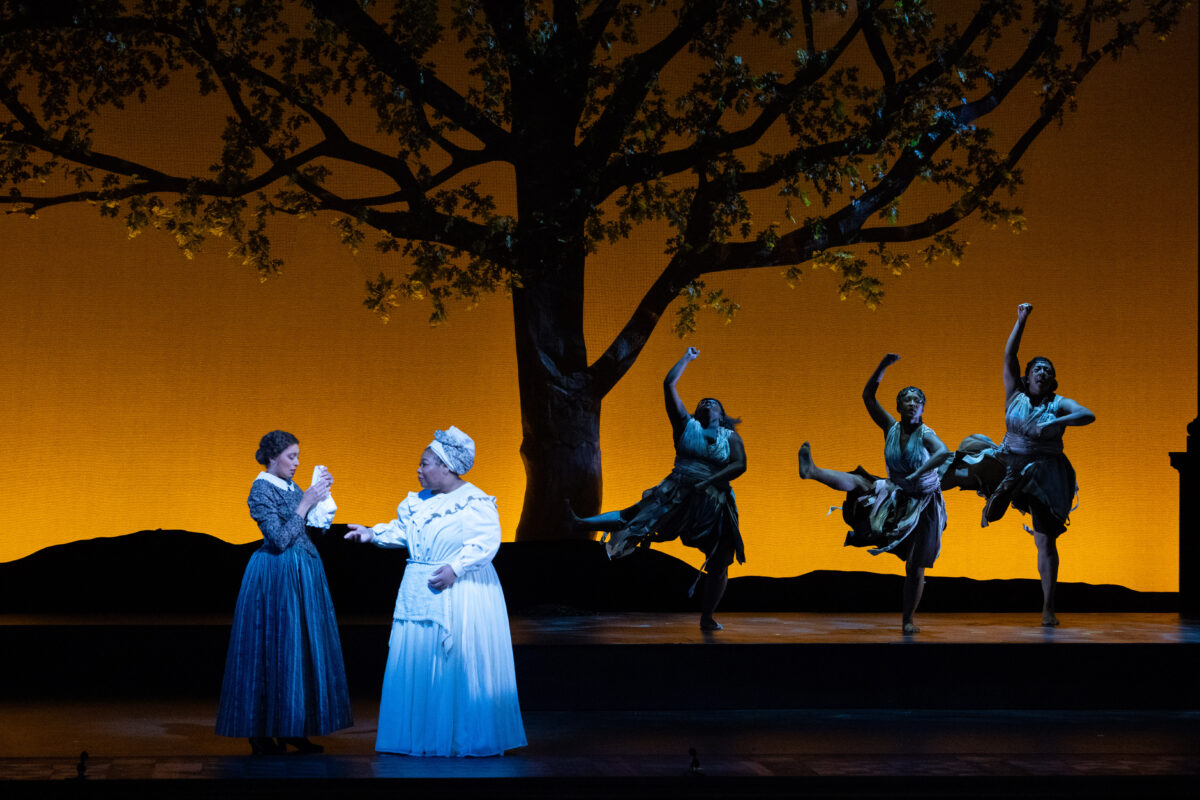
Photo by Dave Pearson
Intelligence was written with the intention for dance to play a pivotal role in the work, a vision that was not fully realized by this staging. In a recent interview with WETA Classical’s Evan Keely, Heggie said that dance is “incorporated into every corner of the storytelling” and that when given the choice by HGO between the inclusion of a chorus or dancers, he opted for the dancers. Heggie and Scheer collaborated with Jawole Zollar, founder of the Urban Bush Women dance company, in the conception of the opera. Zollar choreographed and directed HGO’s world premiere production, which included a corps of Urban Bush Women dancers. Virginia Opera’s production was choreographed by Christine C. Wyatt. The choreography didn’t leave a strong impression in the first act, in which a brief dance interlude between scenes felt disconnected from the narrative and dancers during a climactic fire at the Confederate White House were mostly blocked from view by a row of parked singers. Wyatt’s choreography (eloquently performed by Noelani Corey-Barr, Amaya Weston, and the choreographer herself) was more impactful in an Act II scene in which Mary Jane’s past comes to light, accompanied by African-inspired drums in the score, though lighting that was overly concentrated on the singers and monochromatic tan costumes diminished the effect.


